
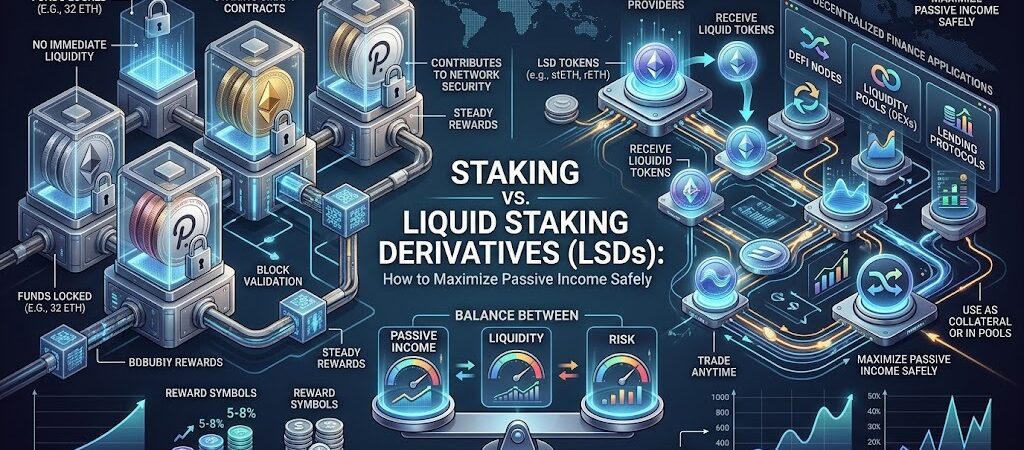
Introduction:
Staking Enters a More Flexible Era
Cryptocurrency staking has evolved from a relatively simple way to support Proof-of-Stake networks into a major component of the broader decentralized finance (DeFi) ecosystem. Instead of relying on energy-intensive mining, Proof-of-Stake blockchains allow users to commit their assets to network security and potentially earn rewards in return. Ethereum, for example, allows users to participate in staking through several approaches, including solo staking, staking as a service, and pooled staking.
For many crypto investors, staking offers an attractive combination: hold an asset for the long term while potentially generating additional returns from it. However, traditional staking can reduce liquidity because the underlying assets are committed to a staking mechanism and may not be immediately available for other opportunities, depending on the blockchain and staking method.
This is where Liquid Staking Derivatives (LSDs) enter the picture.
Liquid staking allows users to stake their crypto assets while receiving a transferable token representing their staked position. On Ethereum, for example, liquid staking protocols can issue tokens representing staked ETH and the rewards associated with that position. These tokens can potentially be held, transferred, traded, or used across DeFi applications while the underlying ETH remains staked.
The result is a fundamental difference between traditional staking and liquid staking:
Traditional staking prioritizes direct participation and simplicity, while liquid staking aims to combine staking rewards with greater capital flexibility.
However, greater flexibility does not automatically mean greater safety or higher returns. Liquid staking introduces additional layers of risk, including smart-contract vulnerabilities, liquidity risk, governance risk, validator or operator risk, and the possibility that a liquid staking token could trade below the value of the underlying asset.
Therefore, investors should look beyond headline yields when comparing the two strategies.
The real question is not simply:
“Which one pays more?”
It is:
“Which staking structure provides the best balance of rewards, liquidity, risk, and control for my strategy?”
Why Staking Matters in 2026
The growth of Proof-of-Stake networks has made staking an important part of crypto’s economic infrastructure. Stakers help secure blockchain networks by participating in validation, while the protocol distributes rewards according to its rules.
Ethereum’s official documentation describes staking as depositing ETH to activate validator software, with validators responsible for storing data, processing transactions, and adding blocks to the blockchain. Users can also participate through pooled staking when they do not want to operate their own validator.
This creates several different approaches for crypto holders.
A technically experienced investor with sufficient capital may prefer operating a validator directly. Another investor may prefer a staking service or pool. Someone who wants to keep their staked capital usable within DeFi may consider liquid staking.
Each option involves different trade-offs.
Traditional Staking vs. Liquid Staking at a Glance
At a basic level, traditional staking means committing crypto assets to help secure a Proof-of-Stake network and earning protocol-based rewards.
Liquid staking adds a second layer: the staking position is represented by a liquid token that can potentially be transferred or used elsewhere.
For example, an Ethereum liquid staking token may represent a claim on staked ETH and its accumulated rewards. Depending on the token design, rewards may appear through an increasing token balance or through an increasing redemption value against ETH.
This distinction is important because the investor is no longer dealing only with the underlying blockchain’s staking mechanism.
With liquid staking, the investor may also depend on:
- The liquid staking protocol
- Smart contracts
- Validator operators
- Governance mechanisms
- Token liquidity
- Secondary-market pricing
- Redemption mechanisms
- External DeFi protocols if the token is used elsewhere
That additional functionality can create more opportunities—but also more potential failure points.
The Passive Income Opportunity
Staking is often described as a form of passive income because users can potentially earn rewards without actively trading their assets every day.
But “passive” should not be confused with “risk-free.”
Staking rewards can vary, fees can reduce net returns, and validators can face penalties or slashing. Liquid staking adds further risks because the liquid token can potentially deviate from the value of the underlying asset, particularly during periods of market stress or reduced liquidity.
For this reason, a responsible staking strategy should evaluate net return rather than advertised yield alone.
A higher displayed yield may come with higher smart-contract risk, leverage, additional protocol exposure, or other conditions that can substantially change the investor’s risk profile.
The safest approach is therefore not to chase the highest percentage.
Instead, investors should understand where the yield comes from, what risks support it, how quickly capital can be exited, and what could happen under adverse market conditions.
What This Article Will Explore
This guide will provide a detailed comparison of staking vs. liquid staking derivatives (LSDs) and examine how investors can approach passive crypto income more carefully.
The following sections will explore:
- How traditional crypto staking works
- What Liquid Staking Derivatives are
- How liquid staking tokens generate and represent rewards
- Key differences between traditional staking and LSDs
- Liquidity advantages of liquid staking
- Smart-contract and validator risks
- Depeg and market-liquidity risks
- Fees and their effect on real returns
- DeFi opportunities for liquid staking tokens
- Why leverage can dramatically increase risk
- How to evaluate a staking protocol
- How to build a safer staking strategy
- Common mistakes investors should avoid
- A practical framework for choosing between traditional staking and liquid staking
The objective is not to claim that one approach is universally better.
Instead, the goal is to understand which model may be more appropriate for different investors, risk tolerances, and investment objectives.
That distinction becomes increasingly important as staking and DeFi become more interconnected.
Staking can generate rewards. Liquid staking can add flexibility. But responsible investors must understand the risks behind both before putting capital to work.
What Is Crypto Staking and How Does It Work?
Before comparing staking with Liquid Staking Derivatives (LSDs), it is important to understand how traditional Proof-of-Stake staking actually works.
Staking is one of the fundamental mechanisms used by Proof-of-Stake blockchain networks to maintain security and reach consensus. Instead of miners competing through computational power, validators commit cryptocurrency as economic collateral and participate in confirming transactions and maintaining the network.
In return for performing their responsibilities honestly, validators can receive staking rewards.
Ethereum is one of the best-known examples. According to Ethereum’s official documentation, a validator participates in the network by storing data, processing transactions, and helping add new blocks to the blockchain. Running an independent Ethereum validator requires 32 ETH, although users with smaller amounts can participate through pooled staking solutions.
How Traditional Staking Works
The basic staking process can be understood through several steps.
1. Acquire a Proof-of-Stake asset
The investor first holds a cryptocurrency belonging to a blockchain that uses Proof of Stake.
Examples include ETH, SOL, ADA, DOT, and other Proof-of-Stake assets. However, the exact staking mechanics, reward structures, lock-up periods, and risks differ from one network to another.
2. Commit the asset to staking
The user then commits the cryptocurrency to the network or to a staking provider.
In a direct validator model, the assets support a validator’s participation in network consensus. In a pooled model, multiple users’ assets can be combined to support validator infrastructure.
3. Validators perform network duties
Validators participate in activities such as proposing blocks, attesting to network state, and validating transactions, depending on the blockchain’s design.
The purpose is not simply to generate yield. The economic incentive is designed to encourage honest participation and strengthen the blockchain’s security.
4. Rewards are distributed
When validators perform their duties successfully, the protocol can distribute rewards.
The actual return depends on several factors, including network conditions, total amount staked, validator performance, protocol economics, commissions, and penalties.
5. Penalties can also occur
Staking is not a guaranteed-profit mechanism.
Validators can lose rewards or suffer penalties for downtime, and more serious forms of improper behavior can result in slashing. Ethereum’s staking documentation specifically identifies both offline penalties and slashing as risks for validators.
This is why investors should evaluate the complete staking structure rather than looking only at an advertised annual percentage yield.
Why Traditional Staking Can Be Attractive
Traditional staking has several advantages.
Network participation:
Staking allows investors to contribute to the security and operation of Proof-of-Stake networks.
Potential recurring rewards:
Instead of simply holding an asset, investors may earn protocol rewards while maintaining their long-term exposure.
Simple investment thesis:
For a long-term holder, staking can provide an additional source of return without requiring frequent trading.
Direct exposure to the underlying asset:
In a basic staking arrangement, the investor remains exposed to the original cryptocurrency rather than depending on the market price of a separate liquid staking token.
Potentially lower complexity:
Compared with more advanced DeFi strategies, straightforward staking can involve fewer moving parts.
However, these advantages come with an important trade-off: capital flexibility can be reduced depending on the staking method.
The Liquidity Problem
One of the biggest limitations of traditional staking has historically been liquidity.
When cryptocurrency is committed to a staking arrangement, the investor may not be able to immediately use that same capital elsewhere. The exact situation depends on the blockchain and staking mechanism.
Ethereum has improved this situation significantly. The Shanghai/Capella upgrade enabled validator withdrawals, allowing eligible validators to withdraw staking rewards and principal under Ethereum’s withdrawal rules.
Even so, investors may still want something more flexible.
Imagine an investor holding ETH who wants to earn staking rewards but also wants the ability to use the position in decentralized finance.
If the investor simply stakes ETH, the capital remains connected to the staking position. For a beginner-friendly explanation, see our complete guide to Ethereum Staking.
With liquid staking, the investor can receive a token representing the staked position. That token can potentially be transferred, traded, or integrated into DeFi applications while the underlying assets remain staked.
This is the central innovation behind liquid staking.
What Are Liquid Staking Derivatives?
Liquid Staking Derivatives, commonly called LSDs, are tokens or representations designed to reflect an underlying staked asset.
Today, the broader industry often uses the term Liquid Staking Tokens (LSTs) because these assets are generally transferable tokens representing staked positions rather than conventional derivatives in the traditional financial-market sense.
For example, a liquid staking protocol can accept ETH, arrange for it to be staked through validators, and issue a liquid staking token representing the user’s share of the staked position.
The investor therefore receives two economic components:
Underlying staking exposure + a liquid representation of that position.
Ethereum’s documentation explains that pooled staking solutions can issue tokens representing staked ETH, allowing users to trade the staking token while the underlying ETH remains staked.
Why Investors Use LSDs
The main attraction is capital efficiency.
Instead of choosing between:
- staking ETH for rewards, or
- keeping ETH liquid for DeFi,
an investor may be able to pursue both objectives through liquid staking.
The liquid token can potentially be used for:
- Decentralized exchanges
- Lending markets
- Liquidity pools
- Collateralized borrowing
- Portfolio management strategies
- Other DeFi applications
Ethereum’s institutional DeFi resources also describe liquid staking tokens such as stETH and rETH as assets that can continue earning staking rewards while being used across DeFi applications.
However, every additional use introduces another layer of risk.
Traditional Staking vs. LSDs: The Core Difference
The difference can be summarized simply:
| Feature | Traditional Staking | Liquid Staking |
|---|---|---|
| Earns staking rewards | Yes | Yes |
| Underlying asset remains staked | Yes | Yes |
| Receives liquid token | Usually no | Usually yes |
| Capital can potentially be used in DeFi | Limited | Greater flexibility |
| Smart-contract exposure | Depends on method | Often higher |
| Secondary-market price risk | Lower | Possible |
| Protocol dependency | Depends on method | Usually greater |
| Capital efficiency | Lower | Higher |
This table highlights an important principle:
Liquid staking does not remove the risks of staking. It adds additional functionality—and therefore additional risk considerations.
Ethereum’s documentation explicitly notes that pooled staking solutions are built by third parties and carry their own risks.
The Key Question for Investors
The choice between traditional staking and liquid staking ultimately depends on what the investor values most.
If the priority is simplicity and direct staking exposure, traditional staking may be more appropriate.
If the priority is maintaining liquidity and using the staking position within DeFi, liquid staking may offer greater flexibility.
But greater flexibility should never be mistaken for guaranteed higher returns.
The right decision depends on the investor’s:
- Risk tolerance
- Investment horizon
- Need for liquidity
- Technical knowledge
- DeFi experience
- Desired level of control
- Understanding of smart-contract risk
How Liquid Staking Derivatives Generate Value
Liquid Staking Derivatives (LSDs), more commonly referred to today as Liquid Staking Tokens (LSTs), are designed to solve one of the biggest limitations of traditional staking: the loss of liquidity while assets are committed to a Proof-of-Stake network.
The basic concept is straightforward.
An investor deposits a supported crypto asset into a liquid staking protocol. The protocol routes that asset into staking infrastructure and provides the investor with a liquid token representing the underlying staked position.
That token can potentially continue to earn staking-related value while remaining usable within the broader DeFi ecosystem.
The Basic Liquid Staking Process
Consider an investor who owns ETH and wants to earn staking rewards without giving up all flexibility.
The process can generally look like this:
Step 1: Deposit the underlying asset
The investor deposits ETH into a liquid staking protocol.
Step 2: Staking infrastructure is used
The protocol allocates the deposited assets to validators or other staking infrastructure according to its design.
Step 3: A liquid token is issued
The investor receives a liquid staking token representing their economic interest in the staked assets.
Step 4: Staking rewards accumulate
As the underlying validators earn rewards, the value represented by the liquid staking position can increase, depending on the token’s accounting model.
Step 5: The token remains usable
Instead of having an entirely illiquid staking position, the investor may be able to transfer the liquid token or use it in supported DeFi applications.
Ethereum describes liquid staking as a way to stake ETH while retaining a token that can be used elsewhere. (ethereum.org)
Two Common Ways LSTs Reflect Rewards
Not every liquid staking token works in exactly the same way.
There are two broad approaches investors may encounter.
1. Rebasing Model
With a rebasing token, the user’s token balance can increase as staking rewards accumulate.
For example, an investor might initially hold 10 units of a liquid staking token. As rewards are generated, the wallet balance could gradually increase.
The important point is that the token balance itself changes.
This can make the reward mechanism relatively intuitive for users, although the exact implementation depends on the protocol.
2. Exchange-Rate or Value-Appreciation Model
Another approach keeps the number of tokens relatively stable while increasing the value of each token relative to the underlying asset.
For example, an investor might hold 10 units of a liquid staking token when each token represents 1 ETH worth of underlying value.
Over time, accumulated staking rewards could cause the redemption value to rise.
In simplified terms:
More staking rewards → greater underlying value represented by the token
This distinction is important because investors should not judge performance simply by looking at the number of tokens in their wallet.
Where Does the Yield Come From?
One of the most important questions when evaluating staking products is:
Where does the return actually come from?
In a conventional staking arrangement, rewards primarily come from the blockchain’s protocol economics.
Validators receive rewards for participating correctly in network consensus and performing their assigned duties.
Liquid staking does not magically create a second independent source of staking yield.
Instead, the liquid staking protocol generally passes through the economic benefits of the underlying staking activity, after applicable fees and adjustments.
This means investors should distinguish between:
Native staking yield
and
Additional DeFi yield.
They are not the same thing.
Native Staking Yield vs. DeFi Yield
Suppose an investor receives a liquid staking token that represents staked ETH.
The underlying staking position may generate protocol rewards.
The investor could then potentially use the liquid token in a lending market or liquidity pool.
Any additional return from that activity is separate from the underlying staking reward.
For example:
Staking reward + DeFi lending return = potential combined return
But this does not mean the combined return is guaranteed.
The DeFi component introduces additional risks, including smart-contract vulnerabilities, liquidation risk, market volatility, and protocol-specific failure.
Therefore, a higher displayed yield may actually represent higher risk exposure rather than free additional income.
Why Capital Efficiency Matters
Capital efficiency is one of the strongest arguments for liquid staking.
Imagine an investor has a long-term bullish view on ETH and wants to continue holding it for several years.
Without liquid staking, the investor may need to choose between maintaining liquidity and committing ETH to staking.
Liquid staking can potentially allow the investor to:
- Maintain exposure to ETH.
- Earn staking-related rewards.
- Hold a liquid representation of the staked position.
- Potentially use that representation in DeFi.
This flexibility can be valuable for sophisticated investors.
However, capital efficiency works both ways.
More ways to use capital also create more ways to lose capital.
If an LST is deposited into another DeFi protocol, the investor is no longer exposed only to the staking system.
The investor now has exposure to the staking protocol and the additional DeFi application.
Understanding the Difference Between Yield and Total Return
Investors should also avoid confusing an advertised staking rate with total investment performance.
Suppose an investor earns a 4% staking return while the underlying cryptocurrency falls 30% against the investor’s preferred currency.
The staking reward does not automatically make the investment profitable.
The investor’s total result depends on both:
- The value of the underlying asset
- The rewards generated by the staking position
This is why staking should be viewed as an income component of a crypto investment, rather than a guarantee against market losses.
Fees Can Reduce Real Returns
Liquid staking protocols typically have operating costs and may charge fees from staking rewards.
These fees can vary considerably between providers and may change over time.
An investor should therefore calculate:
Gross staking rewards − protocol fees − transaction costs − other applicable costs = approximate net return
If the liquid token is subsequently used in DeFi, additional costs may include:
- Gas fees
- Lending fees
- Trading fees
- Liquidity-provider fees
- Borrowing interest
- Withdrawal or redemption costs
A strategy that looks highly profitable before fees may produce a much smaller net return afterward.
The Importance of Redemption
One of the most important characteristics of a liquid staking system is how users eventually convert the liquid token back into the underlying asset.
Depending on the protocol, redemption may occur through a native withdrawal mechanism, a protocol-specific process, or a secondary market.
This creates an important distinction between:
Liquidity
and
Immediate redemption.
A liquid staking token may be tradable on a decentralized exchange, but that does not guarantee that it will always trade exactly at the value of the underlying asset.
During periods of extreme market stress, liquidity can become thinner and price differences can become more significant.
The Depeg Risk
A liquid staking token can sometimes trade above or below its implied underlying value.
If an LST that represents approximately 1 ETH of economic value trades at a discount, an investor selling the token immediately could receive less than the expected underlying value.
This is commonly described as depeg or price divergence risk.
The risk becomes especially important when markets experience:
- Sudden volatility
- Large withdrawals
- Liquidity shortages
- Protocol concerns
- Smart-contract incidents
- Broader DeFi stress
A discount does not necessarily mean the protocol has permanently failed. But it can create significant losses for investors who are forced to sell during a period of market stress.
Why Liquid Staking Is Not Simply “Better Staking”
Liquid staking is better understood as a different risk-and-reward structure.
Traditional staking may offer greater simplicity and fewer intermediary layers.
Liquid staking may offer greater capital flexibility and DeFi composability.
Neither automatically wins in every situation.
A long-term investor who does not need liquidity may prefer a simpler staking arrangement.
An investor who actively uses DeFi may place a higher value on receiving a liquid token.
The appropriate choice depends on the investor’s objectives.
A Simple Decision Framework
Before selecting a staking method, investors can ask five basic questions:
1. Do I need access to this capital?
If the answer is yes, liquidity becomes more important.
2. Am I comfortable with smart-contract risk?
Liquid staking can introduce additional protocol exposure.
3. Will I actually use the liquid token?
If the investor does not intend to use the token, the additional complexity may not provide much practical benefit.
4. Have I calculated net returns after fees?
Headline yields do not necessarily equal realized returns.
5. Can I tolerate a temporary discount in the liquid token?
If the answer is no, traditional staking may be easier to understand from a risk-management perspective.
The central lesson is simple:
Liquid staking can make staked capital more flexible, but flexibility comes with additional layers of risk that investors must understand before pursuing higher capital efficiency.
Staking vs. Liquid Staking Derivatives: A Complete Comparison
The biggest difference between traditional staking and Liquid Staking Derivatives (LSDs) is not simply the amount of rewards an investor can earn.
The more important difference is what happens to the investor’s capital after it is staked.
Traditional staking focuses primarily on securing a Proof-of-Stake network and earning protocol rewards. Liquid staking attempts to preserve some of the capital’s usability by issuing a transferable representation of the staked position.
Both approaches can generate staking-related returns, but their risk profiles and practical uses can be very different.
1. Liquidity
Liquidity is arguably the most important advantage of liquid staking.
With traditional staking, the underlying asset is committed to the staking mechanism. The investor’s ability to access or move that capital depends on the blockchain’s rules and the specific staking method.
Ethereum now supports validator withdrawals, but users still need to understand the network’s withdrawal process and any applicable waiting or exit periods. (ethereum.org)
Liquid staking changes the structure.
Instead of receiving only a staking position, the investor receives a liquid token that can potentially be transferred or traded.
This means the investor may be able to maintain staking exposure while also accessing secondary liquidity.
However, this should not be interpreted as unlimited or guaranteed liquidity.
The liquid token depends on functioning markets, sufficient liquidity, protocol infrastructure, and user demand.
2. Staking Rewards
Both traditional staking and liquid staking ultimately depend on the economics of the underlying Proof-of-Stake network.
The key difference is how the rewards reach the investor.
With direct staking, rewards are connected directly to the validator or staking mechanism.
With liquid staking, rewards are reflected through the liquid staking token’s balance, exchange rate, or redemption value depending on its design.
The investor should therefore examine the net staking return, rather than simply comparing advertised percentages.
For example:
Gross staking rewards − protocol fees = approximate staking return before other costs
If an investor uses the liquid token in another DeFi strategy, the additional return should be calculated separately.
3. Smart-Contract Risk
Traditional staking can involve relatively direct interaction with the blockchain’s staking mechanism.
Liquid staking typically introduces another layer: the smart contracts responsible for depositing assets, managing staking positions, issuing tokens, and processing withdrawals or redemptions.
Smart contracts are software.
Like all software, they can contain vulnerabilities.
A security exploit could potentially result in the loss or impairment of funds held by the protocol.
This is one reason Ethereum’s documentation warns that staking through third-party pooled solutions involves additional risks compared with running an independent validator. (ethereum.org)
For investors, this creates an important principle:
Understanding smart-contract security is also important when evaluating on-chain lending security, particularly when assets interact with multiple DeFi protocols.
Higher functionality can mean higher technical risk.
4. Validator Risk
Validators are responsible for performing network duties correctly.
If validators experience downtime, they may lose potential rewards or incur penalties.
More serious behavior can lead to slashing depending on the network.
In a liquid staking arrangement, the investor may not personally operate the validator.
Instead, the protocol or staking provider may select and manage validator infrastructure.
This can make staking easier for the investor, but it also introduces dependence on the protocol’s validator-management process.
Therefore, investors should investigate:
- How validators are selected
- Whether validators are diversified
- How performance is monitored
- How penalties are handled
- Whether the protocol has safeguards against concentration
A diversified validator structure can potentially reduce dependence on a single operator.
5. Depeg Risk
Traditional staking generally does not involve a separate liquid token trading on a secondary market.
Liquid staking does.
That creates the possibility that the liquid staking token’s market price can diverge from the underlying asset.
For example, an LST designed to represent staked ETH could trade below the value of the ETH it represents.
This can happen because of temporary market imbalance, liquidity conditions, redemption constraints, or broader concerns about the protocol.
For a long-term holder who never sells the token during a discount, the impact may be different from that experienced by a trader who needs immediate liquidity.
This is why investors should understand the difference between:
Underlying value
and
Current market price.
6. DeFi Composability
This is where liquid staking becomes particularly powerful.
A traditional staked asset may have limited utility while it remains committed to the staking mechanism.
A liquid staking token can potentially become a building block for other DeFi strategies.
For example, investors may use an LST as:
- Collateral
- A lending asset
- A liquidity-pool asset
- A trading asset
- A portfolio-management asset
Ethereum’s institutional resources highlight the use of liquid staking tokens across DeFi applications, including lending and decentralized exchanges. (institutions.ethereum.org)
This creates what is often called composability.
One DeFi protocol can interact with assets created by another protocol.
But composability also creates composability risk.
If an investor uses an LST as collateral in a lending protocol, the investor is exposed not only to the staking protocol but also to the lending protocol.
7. Fees
Fees are another important difference.
Traditional staking can involve validator commissions, staking-service fees, or transaction costs.
Liquid staking can involve protocol fees deducted from staking rewards, along with potential costs associated with transferring, trading, or redeeming the liquid token.
If the investor uses the token in DeFi, additional costs can appear.
A useful calculation is:
Net return = staking rewards + additional DeFi income − all applicable fees and losses
This is much more useful than comparing two headline APYs.
8. Control
Direct staking can provide greater control for technically capable investors.
Running your own validator can reduce dependence on third-party staking providers, although it also requires technical knowledge, infrastructure, capital, and operational responsibility.
Liquid staking shifts much of that complexity to the protocol.
This can make participation easier, but investors are trusting the protocol’s:
- Smart contracts
- Validator infrastructure
- Governance
- Accounting mechanisms
- Withdrawal process
- Security practices
Therefore, convenience should always be evaluated against counterparty and technical exposure.
9. Capital Efficiency
Capital efficiency is where liquid staking has a major advantage.
A traditional staking position primarily performs one function: it participates in network security while generating staking rewards.
A liquid staking token can potentially perform several functions simultaneously.
For example:
Staked asset → Liquid staking token → DeFi collateral → Additional strategy
This can increase the potential utility of the original capital.
But investors should remember:
Capital efficiency does not mean capital safety.
Using the same asset across several protocols can increase the number of systems that must remain healthy for the overall strategy to work.
10. Complexity
Traditional staking is generally easier to understand.
The basic relationship is:
Stake → Secure network → Earn rewards
Liquid staking can become considerably more complicated:
Deposit → Stake → Receive LST → Trade or use LST → Potentially enter another DeFi protocol → Manage additional risks
For experienced DeFi users, this complexity may be worthwhile.
For beginners, unnecessary complexity can increase the probability of mistakes.
Side-by-Side Comparison
| Factor | Traditional Staking | Liquid Staking Derivatives (LSDs) |
|---|---|---|
| Primary purpose | Network staking | Staking + liquidity |
| Staking rewards | Yes | Yes |
| Liquid representation | Usually no | Yes |
| DeFi utility | Limited | Usually much greater |
| Smart-contract exposure | Depends on method | Often higher |
| Depeg risk | Generally lower | Present |
| Validator dependence | Yes | Yes, often through protocol |
| Capital efficiency | Lower | Higher |
| Complexity | Lower | Higher |
| Potential additional DeFi yield | Limited | Possible |
| Risk layers | Fewer | More |
| Best suited for | Long-term/simple staking | Investors seeking flexibility |
Which One Offers Higher Passive Income?
This is one of the most important questions—but there is no universal answer.
Traditional staking can provide a relatively straightforward source of protocol-based rewards.
Liquid staking can provide the same underlying staking exposure while allowing the liquid token to potentially generate additional returns through DeFi.
However, additional yield usually means additional risk.
For example, an investor could take a liquid staking token and deposit it into a lending protocol.
The investor might receive:
Staking yield + lending yield
But the investor is now exposed to the security and operational risks of both systems.
If leverage is added, the risk increases further.
Therefore, the best strategy is not necessarily the one with the highest advertised APY.
A more useful question is:
Which strategy provides the best risk-adjusted return for the investor’s objectives?
A Practical Example
Imagine two investors each hold the same amount of ETH.
Investor A chooses traditional staking.
The ETH is staked and the investor earns staking rewards. The strategy remains relatively simple.
Investor B chooses liquid staking.
The investor receives an LST and then uses it in a DeFi lending protocol to pursue additional income.
Investor B may potentially earn more.
But Investor B is also exposed to:
- Staking risk
- Liquid staking protocol risk
- LST market-price risk
- Lending protocol risk
- Smart-contract risk
- Liquidity risk
- Potential liquidation risk if borrowing is involved
Investor A has fewer moving parts.
Investor B has greater capital efficiency.
Neither strategy is automatically superior.
The difference is risk complexity versus capital flexibility.
The Core Lesson
The comparison between staking and liquid staking should never be reduced to:
“Which one has the higher APY?”
A better evaluation considers:
Return + liquidity + security + fees + complexity + exit flexibility + risk tolerance
For some investors, simplicity is the greatest advantage.
For others, liquidity and DeFi composability may justify additional complexity.
The best strategy is therefore the one that fits the investor’s goals rather than the one that produces the most impressive number on a yield dashboard.
Major Risks of Liquid Staking Derivatives
Liquid Staking Derivatives (LSDs) can provide greater flexibility than traditional staking, but that flexibility comes with additional risks.
Investors who focus only on staking rewards may overlook the fact that liquid staking creates several additional layers between the investor and the underlying asset.
The most important principle is:
Higher flexibility and potentially higher returns do not come without additional risk.
Understanding these risks is essential before using LSDs or LSTs as part of a passive-income strategy.
1. Smart-Contract Risk
Smart contracts are the foundation of most liquid staking protocols.
They control important functions such as deposits, token issuance, staking management, accounting, and withdrawals.
If a smart contract contains a vulnerability, attackers may potentially exploit it and cause financial losses.
This makes smart-contract security one of the most important considerations when selecting a liquid staking protocol.
Investors should investigate whether a protocol has:
- Independent security audits
- A long operating history
- Open-source code where appropriate
- Active security monitoring
- A transparent incident-response process
- Clearly documented contracts and permissions
However, even a heavily audited protocol cannot be considered completely risk-free.
An audit can identify potential vulnerabilities, but it does not guarantee that a smart contract will never experience an exploit.
2. Validator Risk
Liquid staking protocols depend on validators to perform the underlying network operations.
Validators must remain online and follow the blockchain’s consensus rules.
Poor performance can result in lost rewards or penalties.
More serious validator behavior can potentially result in slashing, depending on the network.
This means investors should examine how a liquid staking protocol manages its validator infrastructure.
A protocol that relies heavily on a small number of operators may create greater concentration risk.
A broader and more diversified validator set can reduce dependence on individual operators, although diversification does not eliminate all risks.
3. Depeg Risk
One of the most important differences between traditional staking and liquid staking is the existence of a liquid token that can trade in secondary markets.
The market price of an LST does not necessarily remain exactly equal to the value of the underlying asset at every moment.
It can trade:
- Above the underlying value
- Near the underlying value
- Below the underlying value
A temporary discount may occur because of market imbalance, limited liquidity, redemption constraints, or investor concerns.
This creates an important risk for investors who need to exit quickly.
For example, if an LST representing staked ETH trades at a significant discount to ETH, selling immediately could result in a loss even if the underlying staking position itself remains healthy.
4. Liquidity Risk
The word liquid in liquid staking should not be interpreted as a guarantee of unlimited liquidity.
An LST is only as liquid as the markets supporting it.
During normal market conditions, an investor may be able to exchange the token with relatively little price impact.
During severe market stress, however, available liquidity can decline.
This can lead to:
- Larger price spreads
- Higher slippage
- Greater discounts
- More difficult exits
Investors should therefore check the actual market depth of a liquid staking token rather than assuming that every LST has the same level of liquidity.
5. Redemption Risk
Investors should understand exactly how an LST can be converted back into the underlying asset.
Some protocols may provide direct redemption mechanisms subject to specific conditions.
Other investors may rely primarily on decentralized exchanges or secondary markets.
The difference is important.
A token may technically be transferable while still experiencing limited liquidity during stressed market conditions.
Before depositing funds, investors should understand:
How do I exit?
How long could it take?
What fees apply?
What happens if the secondary market becomes illiquid?
These questions are often more important than a small difference in advertised staking yield.
6. Governance Risk
Many DeFi protocols use governance systems to make decisions about protocol parameters, fees, validators, upgrades, or other important functions.
Governance can be useful, but it introduces another risk layer.
A protocol’s rules may change over time.
For example, governance could potentially affect:
- Protocol fees
- Validator selection
- Supported assets
- Risk parameters
- Upgrade procedures
- Treasury management
Investors should understand who has authority over critical protocol functions.
A highly centralized governance structure can create different risks from a broadly distributed governance system.
Neither model is automatically perfect.
The key is understanding who can change what and under which conditions.
7. Oracle Risk
Some DeFi applications depend on price oracles to determine the value of assets.
If an LST is used as collateral in a lending protocol, the lending system may rely on an oracle to determine its market value.
An inaccurate or manipulated price feed can create serious problems.
For example, an incorrectly low or high valuation could contribute to:
- Incorrect liquidations
- Under-collateralized borrowing
- Bad debt
- Market manipulation
This is another example of composability risk.
The more DeFi applications an investor connects together, the more external systems the strategy may depend on.
8. DeFi Composability Risk
Liquid staking tokens are attractive partly because they can interact with other DeFi protocols.
But every additional protocol creates another potential point of failure.
Consider this structure:
ETH → Liquid Staking Protocol → LST → Lending Protocol → Borrowed Asset → Another DeFi Protocol
The investor is no longer exposed to one system.
The strategy depends on multiple systems functioning correctly.
If one component fails, the impact can potentially spread to the rest of the strategy.
This is known as composability risk.
It is one of the most important risks advanced DeFi users need to understand.
9. Leverage and Liquidation Risk
Liquid staking can become particularly dangerous when investors use leverage.
An investor may deposit an LST as collateral, borrow another asset, and then deploy the borrowed funds into another strategy.
This can increase potential returns.
It can also increase potential losses.
If the collateral value falls sufficiently, the position may approach a liquidation threshold.
A simplified example:
LST collateral → Borrow stablecoin → Market falls → Collateral value declines → Liquidation risk increases
The staking rewards may continue accumulating, but they do not protect the investor from a leveraged liquidation event.
For this reason, investors seeking relatively passive income should be especially cautious about combining staking with excessive leverage.
10. Smart-Contract Upgrade Risk
Some protocols allow administrators or governance systems to upgrade smart contracts.
Upgrades can be necessary for improving security, functionality, or efficiency.
However, upgrade authority can also create additional trust assumptions.
Investors should determine:
- Who controls upgrade permissions
- Whether a multisignature system is used
- Whether upgrades have a timelock
- Whether users receive advance notice
- Whether emergency controls exist
A protocol with clearly documented administrative controls can be easier to evaluate than one where important permissions are difficult to understand.
11. Protocol Concentration Risk
The popularity of a particular liquid staking protocol can create another problem: concentration.
If a very large percentage of a blockchain’s staked assets is controlled through one protocol or group of validators, a failure could have broader consequences.
For individual investors, concentration can also create portfolio risk.
Instead of spreading exposure across multiple independent systems, an investor may unintentionally place a large portion of their capital behind one protocol.
Diversification can reduce concentration risk, although it can also increase management complexity and transaction costs.
12. Yield-Chasing Risk
One of the biggest mistakes investors make is choosing a staking strategy simply because it advertises the highest yield.
A very high APY can sometimes reflect:
- Temporary token incentives
- Promotional rewards
- High protocol risk
- Leverage
- Illiquid assets
- Unsustainable token emissions
- Additional DeFi exposure
A high number does not automatically represent a better investment.
Investors should always ask:
Where does this yield come from?
If the answer is unclear, the investor should investigate further before depositing capital.
13. Impermanent Loss Risk
If an LST is supplied to a liquidity pool alongside another asset, investors may become exposed to impermanent loss.
This risk is separate from the underlying staking reward.
A liquidity provider can earn trading fees and potentially other incentives while still experiencing a different portfolio outcome than simply holding the assets.
The result depends on how the relative prices of the assets change.
Therefore:
Staking yield + liquidity fees ≠ guaranteed profit
The entire position must be evaluated.
14. Market Volatility Risk
Neither traditional staking nor liquid staking protects investors from cryptocurrency price volatility.
An investor can earn staking rewards while the market value of the underlying asset declines substantially.
For example, earning several percentage points of staking income does not eliminate the possibility of a much larger decline in the underlying cryptocurrency.
This means investors should distinguish between:
Yield generation
and
capital preservation.
Staking primarily addresses the first.
It does not guarantee the second.
15. Regulatory and Tax Considerations
Crypto staking and liquid staking can also involve regulatory and tax considerations that differ by country.
The treatment of staking rewards, liquid staking tokens, token swaps, and DeFi transactions may vary significantly between jurisdictions.
Investors should therefore avoid assuming that tax treatment is identical across countries.
For significant investments, consulting a qualified local tax professional can be appropriate.
A Risk Hierarchy for Investors
Not every staking strategy carries the same level of complexity.
A simplified hierarchy might look like this:
Lower complexity:
Direct staking
↓
Moderate complexity:
Liquid staking
↓
Higher complexity:
Liquid staking + DeFi lending
↓
Very high complexity:
Liquid staking + leverage + multiple DeFi protocols
As additional layers are added, the potential return may increase—but so can the number of ways the strategy can fail.
The Safest Mindset
The goal should not be to eliminate every risk.
That is unrealistic in cryptocurrency.
Instead, investors should understand which risks they are accepting and whether the potential reward justifies them.
A responsible investor should know:
- What asset is being staked
- Which protocol is being used
- Who operates the validators
- How rewards are generated
- What fees are charged
- How withdrawals work
- How the liquid token is priced
- What smart contracts are involved
- Whether leverage is being used
- What happens during a market crisis
The strongest staking strategy is not necessarily the one with the highest APY.
It is the one where the investor understands the risks before accepting the return.
How to Choose the Right Staking Strategy
Understanding the differences between traditional staking and Liquid Staking Derivatives (LSDs) is only the first step.
The more important question for investors is:
Which strategy makes the most sense for my goals, risk tolerance, and need for liquidity?
There is no single answer that works for everyone.
A long-term investor who wants simplicity may prefer traditional staking, while an experienced DeFi user may value the additional flexibility offered by liquid staking.
The key is to choose the strategy deliberately rather than simply following the highest advertised yield.
1. Start With Your Investment Objective
Before selecting a staking method, define the purpose of the investment.
There are several possible objectives.
Long-term asset accumulation
An investor may simply want to hold a cryptocurrency for several years while earning staking rewards.
In this situation, a straightforward staking strategy may be sufficient.
Income generation
Another investor may be primarily interested in generating recurring rewards from an existing crypto portfolio.
In this case, both traditional staking and liquid staking can be considered, depending on the required liquidity.
DeFi participation
An investor who actively uses decentralized finance may place greater importance on having a liquid representation of the staked asset.
This is where liquid staking can become more attractive.
Capital efficiency
Some investors want their capital to perform multiple functions at the same time.
Liquid staking can potentially allow the investor to maintain staking exposure while using the liquid token elsewhere.
However, higher capital efficiency should always be evaluated against higher risk.
2. Determine How Much Liquidity You Actually Need
One of the simplest ways to choose between staking methods is to ask:
Will I need this money soon?
If the answer is yes, maintaining liquidity may be important.
If the answer is no and the investor has a long-term horizon, a simpler staking approach may be more suitable.
Investors should also maintain sufficient liquid reserves outside the staking position.
This can reduce the temptation to exit a staking strategy at an unfavorable time simply because unexpected expenses arise.
3. Compare Net Returns, Not Advertised APY
Yield percentages can be misleading when they are viewed without context.
A better approach is to calculate the approximate net return.
For example:
Net staking return = Gross rewards − protocol fees − validator fees − transaction costs
If the liquid token is used in DeFi:
Net strategy return = Staking rewards + DeFi income − all applicable costs − realized losses
This approach provides a much more realistic picture.
An advertised 8% yield may be less attractive than a 5% yield if the higher return requires substantially greater risk.
4. Understand the Source of the Yield
Before depositing assets, investors should identify exactly where the return originates.
Possible sources include:
- Native blockchain staking rewards
- Protocol incentives
- Liquidity-provider fees
- Lending interest
- Token emissions
- Trading activity
- Borrowing or leverage
These sources have very different risk profiles.
Native staking rewards are fundamentally different from temporary token incentives.
Likewise, lending income is different from liquidity-mining rewards.
The investor should never treat all yield as if it has the same economic foundation.
5. Research the Liquid Staking Protocol
If choosing liquid staking, the protocol itself deserves careful examination.
Important questions include:
How long has the protocol been operating?
A longer operating history does not guarantee safety, but it provides more information about how the system has behaved under different market conditions.
Has the protocol experienced security incidents?
Past incidents should be investigated carefully.
Are smart contracts audited?
Audits are useful but should not be treated as a guarantee.
How are validators selected?
Validator diversity can reduce concentration risk.
Who controls upgrades?
Administrative permissions should be transparent.
How does redemption work?
Investors should understand how they eventually recover the underlying asset.
6. Evaluate the Liquid Staking Token Itself
Not all LSTs should automatically be treated as equivalent.
Investors should examine:
- Market capitalization
- Trading volume
- Liquidity depth
- Historical price behavior
- Redemption mechanism
- Depeg history
- DeFi integrations
- Protocol fees
- Validator structure
The more widely integrated an LST is, the more opportunities it may have across DeFi.
But broader integration can also create additional systemic connections.
7. Check the LST-to-Underlying Exchange Rate
Investors should understand how much underlying value their liquid token represents.
This is particularly important when rewards accumulate through an exchange-rate mechanism.
Suppose an LST initially represents approximately 1 unit of the underlying asset.
Over time, staking rewards may cause that ratio to change.
The investor should understand whether the increase in value is coming from actual staking rewards or from another source.
This helps prevent confusion between genuine yield and temporary market price movements.
8. Monitor Depeg Risk
Investors using LSTs should monitor the relationship between the liquid token and the underlying asset.
A small temporary difference may not necessarily indicate a serious problem.
However, a large or persistent discount can be a warning sign.
Investors should investigate:
- Why the discount appeared
- Whether redemption remains available
- Whether market liquidity is sufficient
- Whether the protocol has announced an issue
- Whether broader market stress is involved
The goal is not to panic over every small price difference.
The goal is to recognize when market behavior may indicate a deeper problem.
9. Avoid Unnecessary Leverage
Leverage can make an otherwise understandable staking strategy much more complicated.
Suppose an investor holds a liquid staking token and uses it as collateral to borrow another asset.
The investor now has debt.
If the collateral falls in value, the position can approach liquidation.
The investor could lose a significant portion of the position even though the underlying staking protocol continues operating normally.
For investors whose primary objective is passive income, avoiding excessive leverage can substantially simplify risk management.
10. Consider a Layered Strategy
Some investors may prefer not to place all their capital into one staking structure.
A layered approach can divide capital according to different objectives.
For example:
Core allocation
A portion of the portfolio can be dedicated to relatively straightforward staking.
Liquidity allocation
Another portion can remain liquid for future opportunities or unexpected needs.
DeFi allocation
A smaller portion can be used for more advanced liquid staking strategies if the investor understands the associated risks.
This approach can reduce the temptation to expose the entire portfolio to higher-risk strategies simply to increase yield.
11. Do Not Automatically Reinvest Every Reward
Compounding can increase long-term returns, but investors should consider whether automatic reinvestment is appropriate.
Reinvesting rewards can increase exposure to the underlying asset.
If the asset later experiences a major price decline, the investor’s total portfolio can still lose value despite receiving additional staking rewards.
Investors should therefore distinguish between:
Compounding yield
and
portfolio diversification.
Sometimes taking a portion of rewards and maintaining liquidity may be more appropriate than automatically reinvesting everything.
12. Keep Emergency Liquidity Separate
One of the simplest risk-management principles is to avoid staking money that may be needed immediately.
Crypto markets can move rapidly.
If an investor needs cash during a market downturn, selling a liquid staking token at an unfavorable price can turn a temporary market fluctuation into a realized loss.
Maintaining separate liquid reserves can reduce this pressure.
13. Understand the Exit Strategy Before Entering
Every staking strategy should have an exit plan.
Before entering, investors should know:
- How to unstake
- How long withdrawals may take
- Whether an LST can be redeemed directly
- Which secondary markets support the token
- What fees apply
- What happens during network congestion
- What happens if liquidity disappears
A strategy is incomplete if the investor only knows how to enter but not how to exit.
14. Use Risk Limits
Investors can create simple limits before committing capital.
For example:
Protocol exposure limit:
Do not allow one liquid staking protocol to represent an excessive portion of the portfolio.
DeFi exposure limit:
Limit how much capital is exposed to secondary DeFi strategies.
Leverage limit:
Avoid leverage unless its mechanics and liquidation risks are fully understood.
Liquidity limit:
Maintain enough immediately accessible capital outside staking positions.
These limits can prevent one mistake from becoming a portfolio-wide problem.
15. Review the Strategy Regularly
Staking is often described as passive, but that does not mean it should be ignored indefinitely.
Protocol conditions can change.
Fees can change.
Validator structures can change.
DeFi incentives can disappear.
Smart contracts can be upgraded.
Market liquidity can change.
Investors should periodically review whether the original strategy still makes sense.
The goal is not to constantly trade.
It is to ensure that the risk profile remains consistent with the investor’s objectives.
A Simple Investor Decision Tree
A practical decision process can look like this:
Do you want maximum simplicity?
→ Consider traditional staking.
Do you need liquidity while earning staking rewards?
→ Consider liquid staking.
Do you actively use DeFi?
→ Liquid staking may provide additional flexibility.
Are you uncomfortable with smart-contract and protocol risk?
→ Keep the strategy simpler.
Are you considering leverage?
→ Understand liquidation mechanics before proceeding.
Are you choosing mainly because of a very high APY?
→ Stop and investigate the source of the yield first.
The 80/20 Principle of Staking
For many investors, the most important improvements do not come from finding an extra percentage point of yield.
They come from avoiding major mistakes.
Protecting capital from:
- Smart-contract exploits
- Excessive leverage
- Illiquid tokens
- Poorly understood protocols
- Concentrated exposure
- Unsustainable yield programs
can be far more important than maximizing headline APY.
This creates an important principle:
The best staking strategy is not the strategy that earns the most in perfect conditions. It is the strategy that remains understandable and manageable when market conditions become difficult.
Building a Safer Passive-Income Strategy
A balanced approach can therefore follow several principles:
Understand the asset.
Know what cryptocurrency is being staked and how its Proof-of-Stake mechanism works.
Understand the protocol.
Know who manages the staking infrastructure and smart contracts.
Understand the token.
If using an LST, understand how its value and rewards are represented.
Understand the exit.
Know how and when capital can be recovered.
Understand the downside.
Consider what happens during a major market decline, depeg, exploit, or liquidity crisis.
Understand the yield.
Know whether returns come from sustainable staking rewards or temporary incentives.
Once these questions are answered, the investor can make a much more informed decision.
How to Maximize Passive Income From Staking Safely
The goal of staking should not simply be to find the highest advertised APY.
A stronger approach is to maximize risk-adjusted passive income—the return an investor receives after considering fees, volatility, liquidity, smart-contract exposure, and the probability of significant losses.
This distinction is especially important when comparing traditional staking with Liquid Staking Derivatives (LSDs).
A strategy offering a slightly lower yield but significantly lower complexity may ultimately produce a better long-term outcome than a strategy offering a much higher yield with several additional risks.
1. Start With Sustainable Yield
The first step is identifying where the staking return actually comes from.
Native staking rewards are generated by the underlying blockchain’s incentive mechanism.
Other yield opportunities may depend on:
- Token emissions
- Liquidity incentives
- Lending demand
- Trading fees
- Promotional rewards
- Leverage
These sources should not be treated equally.
A temporary incentive may produce a very high APY today but decline rapidly once the incentive program changes.
For long-term passive income, investors should place greater emphasis on sustainable sources of return.
2. Compare Gross and Net APY
A displayed APY is not necessarily the amount an investor will ultimately receive.
Suppose a strategy advertises a 6% annual return.
The investor may still face:
- Protocol fees
- Validator commissions
- Gas costs
- Trading costs
- Slippage
- Withdrawal costs
The effective return could therefore be lower.
A better calculation is:
Net return = Gross rewards − fees − transaction costs − realized losses
This is particularly important when capital is relatively small.
For smaller positions, repeated transaction fees can consume a meaningful percentage of the generated rewards.
3. Use Compounding Carefully
Compounding can increase long-term returns because earned rewards are reinvested to generate additional rewards.
In simple terms:
Initial capital → staking rewards → reinvest rewards → larger staking position → potentially larger future rewards
However, compounding is not always automatic or cost-free.
If rewards need to be manually claimed and restaked, transaction costs can reduce the benefit.
Some liquid staking systems incorporate rewards directly into the token’s accounting mechanism, which can simplify the process.
Investors should understand how rewards are reflected before assuming that compounding is occurring.
4. Avoid Chasing Temporary APYs
One of the most common DeFi mistakes is moving capital from one protocol to another every time a higher APY appears.
This may look profitable on a dashboard.
In practice, it can introduce:
- Additional transaction costs
- Smart-contract exposure
- Slippage
- Tax complexity
- Operational mistakes
- Exposure to less-established protocols
A temporary 20% APY is not necessarily better than a more established 4% or 5% staking return.
The investor needs to understand why the yield is so high and how long it can realistically continue.
5. Use Liquid Staking for a Real Purpose
Liquid staking is most useful when the investor actually benefits from liquidity.
For example, an investor may want to maintain staking exposure while using an LST as collateral in a reputable DeFi lending market.
That can provide greater capital efficiency.
But if the investor simply plans to hold the LST without using its liquidity features, the additional protocol and smart-contract exposure may not provide a meaningful advantage.
The principle is simple:
Use liquid staking because you need its flexibility—not merely because it exists.
6. Consider Conservative DeFi Integration
For experienced users, an LST can potentially be integrated into carefully selected DeFi strategies.
However, investors should begin with the simplest use case they understand.
For example, using an LST in a well-established lending protocol may be easier to analyze than combining:
LST + liquidity pool + leverage + derivatives + automated strategy
Every additional component introduces another dependency.
A conservative strategy may therefore prioritize fewer protocols and transparent mechanics.
7. Understand Collateral Ratios
When LSTs are used as collateral, investors should pay close attention to collateralization and liquidation parameters.
Suppose an investor deposits an LST worth $10,000 and borrows $4,000.
If the LST falls significantly in value, the collateral ratio deteriorates.
If the position reaches the protocol’s liquidation threshold, part or all of the collateral may be sold.
This means the investor can suffer losses even while continuing to receive staking-related rewards.
A prudent investor should avoid borrowing close to the maximum permitted amount simply because the protocol allows it.
Maintaining a substantial safety margin can reduce liquidation risk.
8. Keep Leverage Moderate—or Avoid It
Leverage magnifies both gains and losses.
For investors whose primary goal is passive income, leverage may introduce more risk than necessary.
A staking strategy without leverage has a relatively straightforward structure:
Own asset → Stake → Earn rewards
A leveraged liquid staking strategy can look like:
Own asset → Liquid stake → Deposit as collateral → Borrow → Deploy borrowed funds → Monitor liquidation risk
The second strategy may generate greater returns under favorable conditions.
It can also experience much larger losses under unfavorable conditions.
Investors should therefore treat leveraged staking as a separate high-risk strategy rather than simply a better version of staking.
9. Diversify Protocol Exposure
Diversification can reduce concentration risk.
Instead of putting an entire staking portfolio into one protocol, investors may consider whether exposure should be distributed across different methods or providers.
However, diversification should be thoughtful.
Using five protocols does not automatically make a portfolio safer if all five depend on the same underlying infrastructure or liquidity venues.
Investors should consider correlation of risks, not just the number of protocols.
10. Diversify Validator Exposure
Validator concentration can also matter.
A liquid staking protocol may rely on multiple validator operators to reduce dependence on a single entity.
Investors should consider whether validator operations are sufficiently distributed.
A diversified validator structure can potentially reduce the impact of an individual operator’s technical failure or misconduct.
However, validator diversification cannot eliminate broader blockchain, protocol, or market risks.
11. Monitor Liquidity Depth
A liquid token’s market capitalization alone does not tell the full story.
An investor should also consider how much actual trading liquidity is available.
A token with a large market capitalization but relatively thin market depth may still experience significant slippage during a large transaction.
Before entering or exiting a position, investors should consider:
- Trading volume
- Available liquidity
- Bid-ask spreads
- Slippage
- Major trading venues
This becomes particularly important during volatile market conditions.
12. Keep a Portion of Capital Liquid
A passive-income strategy should not require every dollar of a crypto portfolio to be locked into a yield-generating position.
Maintaining a liquid allocation can provide flexibility.
It can help investors:
- Respond to emergencies
- Take advantage of market opportunities
- Pay transaction costs
- Avoid forced selling
- Handle temporary protocol disruptions
Liquidity itself has value.
An investor should not sacrifice all liquidity simply to earn a few additional percentage points.
13. Reinvest According to Risk Tolerance
Not every investor needs to compound 100% of their staking rewards.
One possible approach is to divide rewards into different purposes.
For example:
Reinvestment portion:
Used to increase the staking position.
Liquid portion:
Kept available for future opportunities.
Risk-management portion:
Used to reduce debt or strengthen portfolio reserves.
This approach can make the strategy more flexible than automatically reinvesting everything.
14. Track Performance Over Time
Investors should maintain records of:
- Initial capital
- Staking rewards
- Fees
- Additional DeFi income
- Token price changes
- Transaction costs
- Realized gains or losses
This helps distinguish between genuine income and market-driven portfolio appreciation.
For example, an LST may increase in value because staking rewards accumulate.
But if the underlying cryptocurrency itself rises sharply, the portfolio’s total value can increase for a different reason.
Separating these effects makes performance analysis more accurate.
15. Review Risk After Major Protocol Changes
A staking strategy should be reassessed whenever a major change occurs.
Important events can include:
- Smart-contract upgrades
- Governance changes
- Validator changes
- Fee changes
- New redemption rules
- Security incidents
- Major liquidity changes
- Changes in DeFi incentives
A protocol that was attractive six months ago may not have the same risk-return profile today.
16. Use a Risk-Adjusted Return Mindset
A simple yield comparison might look like:
Strategy A: 4% APY
Strategy B: 8% APY
At first glance, Strategy B appears superior.
But suppose Strategy B requires multiple smart contracts, has lower liquidity, uses leverage, and carries a greater chance of permanent loss.
The comparison is no longer simply 4% versus 8%.
The real question becomes:
Is the additional expected return sufficient to compensate for the additional risks?
That is the foundation of risk-adjusted investing.
17. The Safer Staking Pyramid
Investors can think about staking strategies in layers.
Foundation — Asset Quality
Understand the underlying cryptocurrency and its long-term role.
↓
Layer 2 — Native Staking
Earn protocol rewards through a straightforward staking method.
↓
Layer 3 — Liquid Staking
Add liquidity if there is a genuine need for it.
↓
Layer 4 — DeFi Integration
Use the liquid token in carefully selected applications.
↓
Layer 5 — Leverage
Only consider advanced strategies if the associated risks are fully understood.
The higher an investor moves up the pyramid, the more complex the risk management becomes.
For many investors, there is no reason to reach the highest level.
18. Don’t Confuse Passive With Automatic
Staking can be relatively passive compared with active trading.
But a responsible investor should still monitor the position periodically.
Passive income does not mean:
Deposit once and forget forever.
Instead, it means:
Reduce the amount of active management required while maintaining appropriate oversight.
This distinction can prevent investors from ignoring important changes in protocol conditions.
19. The Best Strategy May Be the Simplest One
Advanced DeFi strategies can be impressive.
But complexity itself does not create value.
If an investor does not understand how a strategy generates its return, how the collateral works, or how the position can fail, the strategy may not be appropriate.
A simpler strategy with transparent mechanics can sometimes be more effective over the long term.
This is especially true for investors whose primary objective is reliable participation in Proof-of-Stake networks rather than aggressive yield farming.
A Practical Passive-Income Formula
A responsible staking strategy can be summarized as:
Quality asset + reliable staking infrastructure + reasonable fees + sufficient liquidity + controlled DeFi exposure = stronger risk-adjusted passive income
The formula does not guarantee profits.
Instead, it provides a framework for reducing unnecessary risks.
Final Principle for Maximizing Passive Income
The objective should not be to maximize the highest possible yield.
The objective should be to maximize the sustainable return that an investor can reasonably understand, manage, and tolerate.
That means:
- Choosing transparent protocols
- Understanding where rewards come from
- Calculating net returns
- Avoiding unnecessary leverage
- Maintaining liquidity
- Monitoring protocol risks
- Diversifying where appropriate
- Reviewing strategies regularly
Staking can be a powerful long-term income tool.
Liquid staking can make that tool more flexible.
But the strongest results come from combining yield generation with disciplined risk management.
Common Staking and Liquid Staking Mistakes to Avoid
Staking can be a relatively straightforward way to participate in Proof-of-Stake networks, but investors can still make costly mistakes.
The biggest errors often happen when investors focus heavily on rewards while paying insufficient attention to liquidity, protocol security, fees, and exit conditions.
Liquid staking adds even more opportunities—and therefore more ways to make mistakes.
Understanding these common errors can help investors build a more disciplined passive-income strategy.
1. Chasing the Highest APY
One of the most common mistakes is choosing a protocol simply because it displays the highest annual percentage yield.
A high APY can be attractive, but investors should first determine where that yield comes from.
It may be supported by:
- Temporary token incentives
- New-token emissions
- High-risk DeFi activity
- Leverage
- Low-liquidity assets
- Promotional campaigns
A high APY that cannot be sustained may be much less valuable than a lower but more transparent return.
Better approach:
Investigate the economic source of the rewards before depositing capital.
2. Assuming Staking Is Risk-Free
Staking rewards can create the impression of predictable income.
However, staking does not eliminate market risk.
The underlying asset can decline substantially in value while the investor continues receiving staking rewards.
There can also be validator, protocol, smart-contract, liquidity, and operational risks depending on the staking method.
Better approach:
Treat staking rewards as one component of total investment performance—not as protection against losses.
3. Confusing APY With Profit
An investor might see an APY of 6% and assume the investment will automatically increase by 6%.
That assumption ignores asset-price movements.
If the underlying cryptocurrency declines significantly, staking rewards may not compensate for the market loss.
For example:
Asset price decline: −25%
Staking rewards: +5%
The investor’s total result would still be negative before considering fees and other costs.
Better approach:
Track both staking income and the market value of the underlying asset.
4. Ignoring Protocol Fees
Investors sometimes compare staking products based only on gross rewards.
But fees can materially affect the final result.
Possible costs include:
- Validator commissions
- Protocol fees
- Network transaction fees
- Withdrawal costs
- Trading fees
- Slippage
Better approach:
Calculate the expected net return after all relevant costs.
5. Using an LST Without Understanding It
A liquid staking token may look similar to the underlying asset, but it is not necessarily identical.
The investor should understand:
- What the token represents
- How rewards are reflected
- How it can be redeemed
- Where it trades
- What risks the protocol carries
- Whether its price can diverge from the underlying asset
Better approach:
Read the protocol’s documentation before using the token in another DeFi application.
6. Assuming “Liquid” Means Instantly Redeemable
This is a particularly important misconception.
A liquid staking token may be tradable on secondary markets, but that does not guarantee instant one-to-one redemption for the underlying asset.
Market liquidity and protocol redemption are different concepts.
During periods of stress, the token may trade at a discount.
Better approach:
Understand both the official redemption mechanism and the available secondary-market liquidity.
7. Ignoring Depeg Risk
Investors may assume that an LST will always trade exactly at the value of the underlying asset.
Markets do not always behave that way.
Temporary or persistent price divergence can occur.
A significant discount can become especially painful if the investor needs to sell during a market downturn.
Better approach:
Monitor the LST’s relationship with its underlying asset and understand what mechanisms exist to support redemption or price convergence.
8. Depositing LSTs Into Every Available DeFi Protocol
Just because an LST can be used in a DeFi application does not mean it should be.
Each additional protocol creates another risk layer.
Investors can also learn more about on-chain lending security and the risks that arise when assets interact with multiple DeFi protocols.
An investor might move from:
Staking
to:
Liquid staking
to:
Lending
to:
Liquidity provision
to:
Leverage
The potential return may increase, but so does the complexity.
Better approach:
Use only the DeFi applications whose mechanics and risks you understand.
9. Using Excessive Leverage
Leverage is one of the fastest ways to transform a relatively simple staking strategy into a high-risk position.
If an investor borrows against an LST and the collateral falls, liquidation can occur.
The investor may lose capital even though the staking protocol itself continues to operate.
Better approach:
Avoid leverage when the primary objective is conservative passive income. If leverage is used, maintain a substantial safety margin and understand the liquidation mechanism.
10. Ignoring Validator Concentration
A liquid staking protocol may depend on multiple validators or operators.
If too much exposure is concentrated in a small number of operators, a technical failure or operational problem could have a larger impact.
Better approach:
Examine how validator selection works and whether the protocol provides meaningful diversification.
11. Trusting Audits Blindly
Security audits are valuable, but they are not guarantees.
An audit represents an assessment of the code and system at a particular point in time.
Contracts can later be modified, new vulnerabilities can be discovered, or economic attacks can occur even when the code behaves exactly as programmed.
Better approach:
Treat audits as one part of due diligence rather than proof of complete safety.
12. Ignoring Upgrade and Admin Permissions
Some protocols include administrative controls that can change contracts or important parameters.
Investors should understand who has those permissions.
Questions worth asking include:
- Who can upgrade the contract?
- Is a multisignature wallet involved?
- Is there a timelock?
- Are emergency controls available?
- Are governance decisions transparent?
Better approach:
Understand the protocol’s control structure before committing capital.
13. Failing to Have an Exit Plan
Investors often spend significant time researching how to enter a staking strategy but little time considering how to exit.
That can become a serious problem during market stress.
Before entering, determine:
How will I exit?
How long could the exit take?
What fees apply?
What if the LST trades below its underlying value?
What if liquidity suddenly declines?
Having answers in advance can reduce emotional decision-making.
14. Staking Money That May Be Needed Soon
An investor should avoid committing funds that may be required for near-term expenses or emergencies.
Even liquid staking may involve market-price risk when exiting.
Better approach:
Maintain sufficient liquid reserves outside the staking position.
15. Failing to Track Tax and Accounting Records
Staking and liquid staking can create multiple transactions.
Depending on the jurisdiction, taxable events may potentially arise from:
- Receiving rewards
- Swapping tokens
- Selling LSTs
- Using LSTs in DeFi
- Borrowing or repaying assets
- Providing liquidity
Tax treatment varies by country and can change over time.
Better approach:
Maintain detailed transaction records and seek professional local tax advice when necessary.
16. Over-Diversifying
Diversification can reduce concentration risk, but too much diversification can make a portfolio difficult to manage.
An investor might hold many LSTs across numerous protocols and DeFi platforms without fully understanding any of them.
That is not necessarily safer.
Better approach:
Prioritize quality and understanding over simply increasing the number of protocols.
17. Ignoring Liquidity Depth
Market capitalization does not automatically mean deep liquidity.
An LST may have a large total value but limited liquidity at the price level where an investor wants to sell.
This can result in significant slippage.
Better approach:
Check actual trading liquidity before making large transactions.
18. Treating DeFi Incentives as Permanent Income
Many DeFi platforms distribute additional tokens to attract liquidity.
These rewards can make APYs appear extremely attractive.
But incentives may decline or disappear.
The reward token itself may also lose value.
Better approach:
Separate genuine staking income from temporary incentive income.
19. Automatically Reinvesting Everything
Compounding can be useful, but automatic reinvestment may increase portfolio exposure without considering changing market conditions.
An investor may prefer to periodically take some rewards as liquid assets instead.
Better approach:
Choose a reinvestment policy based on long-term objectives rather than automatically compounding every reward.
20. Failing to Monitor Major Changes
A staking strategy should not be completely ignored after the initial deposit.
Important changes may include:
- Protocol upgrades
- New governance decisions
- Security incidents
- Validator changes
- Fee changes
- Liquidity deterioration
- Regulatory developments
- Changes in DeFi incentives
Better approach:
Perform periodic reviews instead of constantly trading.
A Simple Staking Safety Checklist
Before committing capital, investors can ask:
- Do I understand the underlying blockchain?
- Do I understand how staking rewards are generated?
- Do I know exactly which protocol I am using?
- Have I reviewed its smart-contract risks?
- Do I understand validator selection?
- Do I know the fees?
- Do I understand the withdrawal process?
- Can the LST trade below the underlying asset?
- Is sufficient liquidity available?
- Am I using leverage?
- If so, do I fully understand liquidation risk?
- Do I have enough liquid capital outside the strategy?
- Have I considered applicable tax requirements?
If several answers are “no,” the investor may not yet be ready to commit capital.
The Most Important Rule
The most important rule in staking is simple:
Never risk capital in a strategy that you cannot explain clearly.
A sophisticated-looking DeFi strategy is not necessarily a good strategy.
The strongest passive-income approach is often one where the investor understands:
Where the rewards come from.
Where the risks come from.
How the capital can be recovered.
What happens if the market moves against the position.
This mindset helps investors avoid one of the most dangerous habits in crypto: pursuing yield first and researching risk afterward.
Traditional Staking or Liquid Staking?
After considering the risks and mistakes, the choice becomes clearer.
Traditional staking may be more appropriate when:
- Simplicity is the priority
- The investor has a long-term horizon
- DeFi liquidity is not required
- The investor wants fewer protocol dependencies
- The investor does not need to use the staked position elsewhere
Liquid staking may be more appropriate when:
- Liquidity is important
- The investor understands DeFi
- The investor wants to use the staked position elsewhere
- The additional protocol risks are acceptable
- Capital efficiency is an important objective
Neither approach is universally better.
The right choice depends on the investor’s goals and risk tolerance.
A Practical 2026 Framework for Choosing Between Staking and LSDs
By this point, the differences between traditional staking and Liquid Staking Derivatives (LSDs) should be clear.
Traditional staking generally emphasizes direct participation in a Proof-of-Stake network and straightforward reward generation.
Liquid staking adds another layer by providing a transferable representation of the staked position, potentially allowing investors to maintain staking exposure while using their capital elsewhere.
In 2026, the decision should therefore be based on more than headline yield.
Investors should evaluate return, liquidity, security, complexity, fees, and exit flexibility together.
The Four Main Staking Profiles
A useful way to approach the decision is to divide investors into four broad groups.
1. The Long-Term Holder
This investor plans to hold the underlying cryptocurrency for several years.
Liquidity is not a major concern, and the investor does not intend to use the position in DeFi.
For this type of investor, traditional staking can be attractive because it keeps the strategy relatively simple.
The basic structure is:
Hold → Stake → Earn rewards → Continue holding
There are fewer additional layers to manage compared with a strategy involving multiple DeFi protocols.
2. The Liquidity-Focused Investor
This investor wants staking rewards but also wants the ability to move or use the capital.
Liquid staking may be more attractive in this situation.
The investor receives an LST that can potentially be transferred or used within supported DeFi markets.
The structure becomes:
Hold → Liquid stake → Receive LST → Maintain potential DeFi flexibility
However, the investor must accept additional smart-contract, protocol, and market-price risks.
3. The DeFi User
This investor already participates actively in decentralized finance.
For them, an LST may serve as a useful building block.
The token could potentially be used as collateral, supplied to a lending protocol, traded, or incorporated into another strategy.
However, advanced users should be particularly careful about composability risk.
Every additional protocol adds another dependency.
4. The Yield Maximizer
This investor is primarily focused on maximizing returns.
This is also the category that requires the greatest caution.
The search for higher yield can lead investors toward:
- Leverage
- Less-established protocols
- Temporary incentives
- Low-liquidity assets
- Complex liquidity pools
- Multiple interconnected DeFi applications
The potential reward may be higher, but the downside can also become significantly larger.
For this type of investor, risk management is more important than simply finding the highest APY.
A Five-Factor Staking Scorecard
Investors can compare a staking opportunity using five major categories.
1. Return
Ask:
How much sustainable income does the strategy realistically generate?
Do not rely only on the advertised APY.
Consider:
- Native staking rewards
- Protocol fees
- Validator commissions
- DeFi incentives
- Transaction costs
- Expected slippage
The goal is to estimate net sustainable return.
2. Liquidity
Ask:
How easily can I exit the position?
Consider both the protocol’s official redemption mechanism and secondary-market liquidity.
A token can be transferable while still experiencing significant price impact during stressed conditions.
3. Security
Ask:
How many systems must work correctly for me to receive my expected return?
Traditional staking may involve the underlying blockchain and validator infrastructure.
Liquid staking can involve:
Blockchain + validators + smart contracts + liquid token + possible DeFi protocols
The more layers involved, the more carefully each one should be evaluated.
4. Complexity
Ask:
Can I explain exactly how this strategy works?
If the answer is no, the strategy may be too complicated for the investor’s current level of knowledge.
Complexity is not automatically bad.
But unnecessary complexity can create unnecessary risk.
5. Exit Flexibility
Ask:
What happens if I need my capital during a market crisis?
This question is often ignored.
A strategy that looks excellent during a bull market may behave very differently during a liquidity shock.
Understanding the exit mechanism before entering is therefore essential.
The Risk-Adjusted Return Equation
A useful mental model is:
Risk-adjusted staking value = Expected net return × confidence in the strategy’s resilience
This is not a formal financial formula.
It is a framework for thinking about risk.
For example, an investor might prefer a strategy generating a moderate return through a transparent and well-understood system rather than a strategy offering a much higher return with unclear risks.
The second strategy may have a higher theoretical return.
But the first may have a more attractive risk-adjusted profile.
Traditional Staking: When It May Make More Sense
Traditional staking can be particularly attractive when simplicity is the priority.
It may suit investors who:
- Have a long investment horizon
- Do not need immediate liquidity
- Want exposure to native staking rewards
- Prefer fewer intermediaries
- Do not actively use DeFi
- Want a strategy that is easier to monitor
For these investors, adding an LST may create complexity without providing a meaningful practical benefit.
The simplest strategy can sometimes be the strongest strategy.
Liquid Staking: When It May Make More Sense
Liquid staking may become more attractive when capital flexibility matters.
It can potentially suit investors who:
- Want to maintain staking exposure
- Need a transferable representation of their position
- Actively participate in DeFi
- Want to use an LST as collateral
- Understand smart-contract risks
- Are comfortable monitoring additional protocol dependencies
The key word is understand.
Liquid staking should not be selected simply because it offers a higher displayed yield.
Its primary advantage is flexibility.
The Role of DeFi in Passive Income
DeFi can potentially expand the income opportunities available to liquid staking investors.
An LST can sometimes be used in lending markets or liquidity pools, creating additional sources of return.
However, this changes the risk profile.
Consider three simplified strategies:
Strategy A — Native Staking
Asset → Staking → Rewards
This has relatively few components.
Strategy B — Liquid Staking
Asset → Liquid Staking → LST → Staking-related rewards
This introduces additional protocol and token risks.
Strategy C — Liquid Staking + DeFi
Asset → Liquid Staking → LST → DeFi protocol → Additional income
This can potentially increase capital efficiency but introduces another layer of smart-contract and market risk.
The important lesson is:
Each additional layer should have a clear purpose.
If a new layer does not provide enough benefit to justify its risk, it may not be worth adding.
Why 2026 Investors Should Focus on Quality
As the staking and DeFi ecosystem becomes more mature, investors have more choices.
More choices can be positive.
But they can also make it easier to become distracted by aggressive yield offers.
A mature staking strategy should prioritize:
- Transparent economics
- Strong security practices
- Clear governance
- Reliable validator infrastructure
- Meaningful liquidity
- Understandable redemption
- Sustainable reward sources
This is more important than chasing temporary promotional yields.
A Three-Level Risk Framework
Investors can categorize strategies into three broad levels.
Level 1 — Conservative Staking
Characteristics:
- Straightforward staking
- Limited protocol exposure
- No leverage
- Long-term horizon
- Simple exit plan
The main objective is participation and relatively straightforward reward generation.
Level 2 — Moderate Liquid Staking
Characteristics:
- Liquid staking token
- Additional protocol exposure
- Potential DeFi usage
- Active monitoring
- Greater liquidity flexibility
The investor accepts additional risks in exchange for capital efficiency.
Level 3 — Advanced DeFi Staking
Characteristics:
- Multiple protocols
- Lending
- Liquidity provision
- Leverage
- Complex strategies
- Active risk management
This can potentially produce greater returns, but it should not be confused with low-risk passive income.
The investor needs a much deeper understanding of DeFi mechanics.
How to Build a Balanced Staking Portfolio
Instead of choosing one strategy for the entire portfolio, investors may consider dividing capital according to its purpose.
For example:
Core staking allocation
Designed for long-term exposure and relatively simple reward generation.
Liquid allocation
Designed to maintain flexibility and respond to opportunities.
Higher-risk DeFi allocation
Only for capital the investor can afford to expose to more complex strategies.
This type of structure can prevent the entire portfolio from depending on one protocol or one risk model.
The exact allocation should depend on the individual’s financial situation, risk tolerance, investment horizon, and local regulatory and tax environment.
What Investors Should Monitor Monthly
Even a relatively passive strategy benefits from periodic review.
A monthly review can examine:
Rewards
Are staking returns behaving as expected?
Fees
Have protocol or validator fees changed?
Liquidity
Is the LST still trading with healthy liquidity?
Depeg
Has the token developed a persistent discount or premium?
Security
Have there been any incidents or important disclosures?
Governance
Have important protocol parameters changed?
Validators
Has validator concentration increased?
DeFi Exposure
Are connected lending or liquidity protocols still operating normally?
A monthly review does not require constant trading.
It simply keeps the investor informed.
Warning Signs That Deserve Attention
Investors should investigate further when they see:
- Extremely high APYs with unclear sources
- Sudden reward increases
- Sharp LST price discounts
- Rapid declines in liquidity
- Unexpected governance changes
- Unknown smart-contract upgrades
- Heavy validator concentration
- Unusual withdrawal restrictions
- Aggressive leverage incentives
- Poorly documented protocols
None of these signals automatically means a protocol is failing.
But they are reasons to slow down and perform additional research.
The 2026 Staking Decision Checklist
Before selecting traditional staking or liquid staking, investors can ask:
1. What is my investment horizon?
Short-term and long-term investors may have different liquidity needs.
2. Do I need access to the capital?
If yes, liquidity should receive greater weight.
3. Do I understand the protocol?
If not, more research is needed.
4. Where does the yield come from?
Native rewards and temporary incentives are not equivalent.
5. What are the total fees?
Calculate the expected net return.
6. What happens if the LST depegs?
Understand the downside before entering.
7. How do I exit?
Know the redemption and secondary-market options.
8. Am I using leverage?
If yes, understand liquidation risk completely.
9. How much protocol exposure am I comfortable with?
Avoid excessive concentration.
10. Can I tolerate a major crypto market decline?
Staking does not eliminate underlying asset volatility.
The Most Important Comparison
The decision between staking and liquid staking can ultimately be summarized like this:
| Factor | Traditional Staking | Liquid Staking |
|---|---|---|
| Simplicity | Higher | Lower |
| Liquidity flexibility | Lower | Higher |
| DeFi utility | Limited | Greater |
| Protocol dependencies | Fewer in some setups | More |
| Smart-contract exposure | Depends on method | Usually greater |
| Depeg risk | Generally limited | Present |
| Capital efficiency | Lower | Higher |
| Potential strategy complexity | Lower | Higher |
| Best for | Long-term simplicity | Flexibility and DeFi |
Neither column represents a guaranteed better investment.
The choice depends on what the investor needs from the capital.
Final Strategy Principle
The strongest staking strategy is not necessarily the one with the highest APY.
It is the strategy where:
The source of yield is understood.
The risks are understood.
The fees are understood.
The exit process is understood.
The investor can tolerate the downside.
That is the foundation of sustainable passive income in crypto.
Final Verdict: Staking or Liquid Staking Derivatives?
The debate between traditional staking and Liquid Staking Derivatives (LSDs) is ultimately not about finding one universal winner.
Both approaches serve different purposes.
Traditional staking focuses on participating directly in a Proof-of-Stake network while earning protocol-based rewards.
Liquid staking adds flexibility by providing a liquid representation of the staked position that can potentially be transferred, traded, or used throughout decentralized finance.
The right choice depends on the investor’s objectives, liquidity requirements, technical understanding, and tolerance for additional risk.
Traditional Staking: The Simpler Approach
Traditional staking can be attractive for investors who want a straightforward strategy.
The basic concept is easy to understand:
Hold the asset → Stake it → Support the network → Earn rewards
For a long-term investor who does not need to use the capital elsewhere, this simplicity can be valuable.
There may be fewer additional dependencies compared with a strategy involving liquid staking and multiple DeFi applications.
Traditional staking can therefore make sense when:
- Simplicity is important
- The investment horizon is long
- Liquidity is not urgently required
- DeFi participation is limited
- The investor prefers fewer moving parts
- The investor understands the underlying blockchain’s staking mechanism
However, traditional staking still carries risks.
The underlying cryptocurrency can lose value, validator performance can affect rewards, and blockchain-specific rules can influence how capital is staked and withdrawn.
Staking rewards should therefore never be interpreted as guaranteed protection against market losses.
Liquid Staking: The Flexible Approach
Liquid staking solves a different problem.
Instead of leaving the investor with only a staking position, the system provides a liquid representation of that position.
This can potentially allow the investor to maintain staking exposure while also using the liquid token within the DeFi ecosystem.
The structure can therefore look like:
Hold asset → Liquid stake → Receive LST → Maintain potential liquidity → Earn staking-related rewards
For experienced DeFi users, this flexibility can be extremely useful.
An LST may potentially be used for:
- Lending
- Collateral
- Liquidity provision
- Trading
- Portfolio strategies
- Other DeFi applications
However, every additional use can introduce additional risks.
Liquid staking therefore should not be described simply as “better staking.”
It is better understood as staking combined with additional flexibility and additional risk layers.
The Biggest Advantage of LSDs
The greatest advantage of liquid staking is capital efficiency.
A traditional staking position may primarily perform one function: securing the network while generating staking rewards.
A liquid staking token can potentially perform multiple functions.
The same economic position may be:
Staked
while also being:
Transferable
and potentially:
Usable in DeFi
This can make liquid staking attractive to investors who want their capital to remain productive across different parts of the crypto ecosystem.
But capital efficiency should never be confused with safety.
More functionality creates more dependencies.
The Biggest Risk of LSDs
The biggest disadvantage is the additional complexity.
A traditional staking strategy may primarily depend on:
Blockchain + validator
A liquid staking strategy may depend on:
Blockchain + validators + smart contracts + protocol governance + LST liquidity + redemption mechanisms
If the LST is then used in another DeFi protocol, the structure becomes even more complex.
That means the investor must evaluate more potential failure points.
This is why the additional yield or flexibility should always be compared with the additional risk.
Passive Income Does Not Mean Guaranteed Income
The phrase passive income can sometimes create unrealistic expectations in crypto.
Staking can generate rewards, but those rewards are not equivalent to a guaranteed salary or fixed-interest bank deposit.
Several factors can affect the final investment result:
- Underlying asset price
- Staking reward rate
- Network conditions
- Validator performance
- Protocol fees
- Market liquidity
- LST price
- Smart-contract security
- DeFi performance
An investor can therefore receive staking rewards and still experience an overall portfolio loss if the underlying cryptocurrency declines significantly.
The correct mindset is:
Staking can generate additional return, but it does not eliminate investment risk.
The Importance of Risk-Adjusted Returns
The most useful way to evaluate staking is through risk-adjusted returns.
Instead of asking:
“Which platform pays the most?”
Ask:
“Which strategy provides a reasonable return for the amount and type of risk I am accepting?”
This approach naturally encourages investors to examine:
- Protocol security
- Validator quality
- Liquidity
- Fees
- Governance
- Depeg risk
- Smart-contract exposure
- Leverage
- Exit conditions
A lower-risk strategy with a moderate return may be more suitable for a long-term investor than a high-yield strategy with multiple hidden dependencies.
A Practical Ranking of Priorities
For most investors, the order of priorities should be:
1. Capital protection
Understand what could cause a permanent loss.
2. Protocol security
Evaluate the systems responsible for holding and managing the assets.
3. Liquidity
Make sure the investment can be exited under realistic conditions.
4. Sustainable yield
Determine whether the rewards have a durable economic source.
5. Fees
Calculate the return after costs.
6. Capital efficiency
Only then consider whether additional DeFi strategies can improve the use of capital.
7. Maximum APY
The highest possible yield should come last—not first.
This order can help prevent investors from making decisions based purely on attractive numbers.
When Traditional Staking May Be the Better Choice
Traditional staking may be preferable for an investor who says:
“I want to hold my crypto for the long term, earn staking rewards, and avoid unnecessary complexity.”
For this investor, the simplicity of traditional staking may outweigh the additional flexibility offered by an LST.
The investor does not necessarily need to introduce another protocol simply because it offers more functionality.
When Liquid Staking May Be the Better Choice
Liquid staking may be preferable for an investor who says:
“I want staking rewards, but I also want my staked position to remain usable.”
This investor may benefit from the flexibility of an LST.
However, they should already understand the additional risks associated with liquid staking and any DeFi applications they intend to use.
What Investors Should Avoid
Regardless of which approach they choose, investors should avoid:
- Chasing unsustainable APYs
- Using excessive leverage
- Ignoring smart-contract risk
- Assuming audits guarantee safety
- Ignoring LST depeg risk
- Staking money needed for emergencies
- Concentrating too much capital in one protocol
- Using DeFi applications they do not understand
- Ignoring fees
- Assuming past yields will continue indefinitely
Avoiding major losses is often more important than squeezing out a few additional percentage points of yield.
A Balanced Approach to Passive Income
For investors who want a balanced approach, a simple framework may be:
Core holdings
Use a relatively straightforward staking strategy for the long-term portion of the portfolio.
Liquid allocation
Maintain some capital outside staking for flexibility and opportunities.
Liquid staking allocation
Use LSTs where liquidity provides a genuine benefit.
Advanced DeFi allocation
Only allocate a limited amount to complex strategies when the risks are fully understood.
This framework is not a universal portfolio recommendation.
It is simply a way of separating capital according to different objectives and risk levels.
Final Comparison
| Category | Traditional Staking | Liquid Staking Derivatives |
|---|---|---|
| Main objective | Network staking and rewards | Staking plus liquidity |
| Simplicity | Higher | Lower |
| Liquidity | More limited depending on network | Greater through liquid token |
| DeFi compatibility | Lower | Higher |
| Capital efficiency | Lower | Higher |
| Smart-contract exposure | Depends on staking method | Generally greater |
| Depeg risk | Generally limited | Present |
| Protocol dependency | Lower in direct staking | Higher |
| Potential additional DeFi income | Limited | Possible |
| Complexity | Lower | Higher |
| Best suited for | Long-term, simplicity-focused investors | Liquidity- and DeFi-focused investors |
Final Verdict
Staking and Liquid Staking Derivatives are not competing technologies where one must replace the other.
They are two different approaches to earning potential rewards from Proof-of-Stake assets.
Traditional staking is generally more straightforward.
Liquid staking is generally more flexible.
Traditional staking can reduce complexity.
Liquid staking can improve capital efficiency.
Traditional staking may be easier to monitor.
Liquid staking can provide greater opportunities within DeFi—but with additional risks.
The best choice depends on the investor.
For a long-term holder who values simplicity, traditional staking may be the more appropriate solution.
For an experienced DeFi user who values liquidity and understands smart-contract and protocol risks, liquid staking may provide greater flexibility.
The most important lesson is therefore:
Do not choose staking strategies based only on APY. Choose them based on the complete relationship between return, liquidity, security, fees, complexity, and risk.
Conclusion: Maximize Passive Income Without Maximizing Unnecessary Risk
Crypto staking can be a powerful way for long-term investors to potentially generate additional returns while participating in Proof-of-Stake networks.
Liquid Staking Derivatives take this concept further by making staked positions more flexible and potentially usable across decentralized finance.
But greater flexibility comes with greater responsibility.
The investor must understand where the rewards originate, how the liquid token works, what happens during a depeg, how validators are managed, how smart contracts are secured, and how the position can be exited.
The strongest passive-income strategy is therefore not the one promising the largest number.
It is the one that an investor can understand, monitor, and tolerate through both favorable and unfavorable market conditions.
In crypto, protecting capital is just as important as generating yield.
Earn responsibly. Understand the risks. Keep liquidity where you need it. And never sacrifice capital protection simply to chase a higher APY.
Key Takeaways
- Traditional staking provides a relatively straightforward way to participate in Proof-of-Stake networks.
- Liquid Staking Derivatives can provide a liquid representation of staked assets.
- Liquid staking can improve capital efficiency and DeFi flexibility.
- LSDs and LSTs introduce additional smart-contract, liquidity, governance, and depeg risks.
- Staking rewards do not protect investors from declines in the underlying asset.
- Net returns matter more than advertised APY.
- Excessive leverage can turn a passive-income strategy into a high-risk position.
- Investors should understand the protocol, validator structure, fees, redemption process, and exit strategy.
- Traditional staking may suit simplicity-focused long-term holders.
- Liquid staking may suit investors who genuinely need liquidity and DeFi composability.
- The best strategy is the one that balances sustainable returns with manageable risk.
Staking can generate passive income. Liquid staking can make that income strategy more flexible. But disciplined risk management is what helps make the strategy sustainable.