Introduction
Layer 2 ecosystems have become one of the most important developments in the evolution of blockchain technology. As Ethereum adoption has expanded across decentralized finance (DeFi), stablecoins, tokenized assets, gaming, NFTs, and other applications, the demand for faster and more affordable transactions has increased significantly.
Ethereum remains one of the most important settlement and smart-contract platforms in the digital-asset industry, but its base layer cannot process every transaction directly at the speed and cost required for mass-market adoption. Layer 2 networks were developed to address this challenge by moving much of the transaction activity away from Ethereum’s main execution layer while continuing to use Ethereum for important security and settlement functions.
The result is a rapidly expanding ecosystem of networks designed to make blockchain applications faster, cheaper, and more accessible.
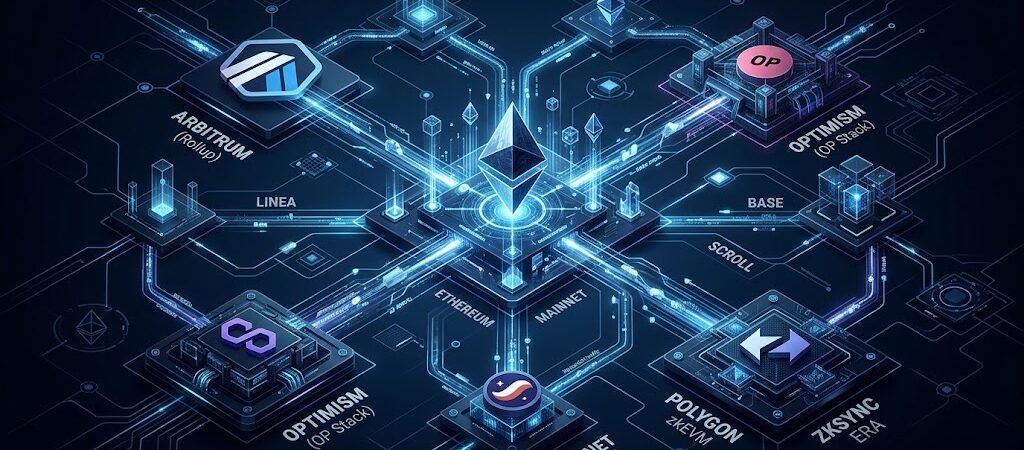
Today, the Layer 2 market is no longer dominated by a single approach. Different networks are competing through optimistic rollups, zero-knowledge technology, specialized infrastructure, ecosystem incentives, developer tools, liquidity, and user adoption. Major names such as Arbitrum, Base, and OP Mainnet have established significant positions, while networks such as Starknet, zkSync, and Linea continue developing alternative approaches to Ethereum scaling. L2BEAT currently tracks billions of dollars in value secured across Ethereum scaling networks, demonstrating the economic importance of the sector.
This competition has created a new question for the cryptocurrency industry: Which Layer 2 ecosystems are actually winning the scalability race?
The answer is more complicated than simply looking at transaction counts or total value locked. A successful Layer 2 must combine scalability with security, decentralization, liquidity, developer adoption, user activity, interoperability, and a sustainable economic model.
Understanding these differences is essential for investors, developers, institutions, and everyday crypto users who want to understand where Ethereum’s scaling infrastructure may be heading next.
What Are Layer 2 Ecosystems?
A Layer 2 ecosystem is a collection of blockchain infrastructure, applications, users, developers, liquidity, and services built around a scaling network that operates above an underlying Layer 1 blockchain.
In the Ethereum ecosystem, Layer 2 networks are generally designed to process transactions away from Ethereum’s main execution layer and then communicate important information back to Ethereum. Instead of requiring every transaction to be processed individually by Ethereum, Layer 2 systems can bundle large numbers of transactions and submit the resulting data or proofs to the Ethereum network.
Ethereum describes rollups as scaling systems that batch transactions together and send the output back to Ethereum. These systems can significantly reduce transaction costs while increasing throughput.
This architecture creates a division of responsibilities.
Ethereum can continue serving as a highly secure settlement and data-availability layer, while Layer 2 networks handle a larger share of transaction execution. Users therefore gain access to faster and cheaper blockchain applications without requiring every activity to happen directly on Ethereum.
The concept is similar to adding additional lanes to a busy highway. Ethereum remains the major settlement infrastructure, while Layer 2 networks provide additional routes that allow considerably more activity to occur without forcing every vehicle through the same narrow road.
However, Layer 2 ecosystems are more than technical scaling solutions.
They increasingly function as complete blockchain economies.
A successful Layer 2 can have decentralized exchanges, lending platforms, stablecoin markets, gaming applications, NFT marketplaces, payment systems, wallets, bridges, infrastructure providers, developers, and institutional applications. Layer 2 networks also provide a more efficient environment for applications built around smart contracts. This creates an ecosystem effect in which users attract applications, applications attract liquidity, and liquidity attracts more users.
Layer 2 networks can also provide a scalable environment for tokenized assets and other blockchain-based financial products.
That network effect has become one of the most important competitive advantages in the Layer 2 market.
Why Ethereum Needs Layer 2 Scaling
Ethereum’s security and decentralized architecture have made it a foundation for a large portion of the blockchain industry. However, using the Ethereum base layer for every transaction can become expensive and inefficient when network demand increases.
Every blockchain has limitations involving computation, block space, data availability, and network resources. If millions of users attempt to execute transactions directly on the same base layer, competition for block space can increase transaction costs and create congestion.
Layer 2 technology attempts to solve this problem without requiring Ethereum to sacrifice its fundamental security and decentralization goals.
Ethereum.org describes Layer 2 scaling as a core part of Ethereum’s scaling strategy and explains that rollups can make transactions substantially cheaper than executing them directly on Ethereum.
This is particularly important for applications where users may need to perform many transactions.
For example, a decentralized finance trader may execute multiple swaps, provide liquidity, adjust collateral, or interact with several smart contracts. Paying Ethereum mainnet fees for every action could make smaller transactions economically impractical.
A Layer 2 network can reduce that friction.
The same principle applies to blockchain gaming, micropayments, social applications, decentralized exchanges, stablecoin transfers, and tokenized financial products.
Lower transaction costs can turn blockchain applications from products designed mainly for high-value users into services that are accessible to a much broader audience.
How Layer 2 Networks Work
Although Layer 2 designs vary, the basic objective is similar: process more activity away from Ethereum while maintaining a connection to Ethereum’s security and settlement environment.
Rollups are currently among the most important Layer 2 technologies.
A rollup executes transactions on a separate environment and then publishes relevant information to Ethereum. Rather than requiring Ethereum to execute every individual transaction, the Layer 2 can process transactions in batches.
There are two major rollup approaches:
- Optimistic rollups
- Zero-knowledge rollups
Optimistic rollups generally assume submitted transaction results are valid unless someone challenges them during a designated dispute period. They use fraud-proof mechanisms to address invalid state transitions. Ethereum.org describes optimistic rollups as Layer 2 protocols that extend Ethereum’s throughput by reducing computation performed directly on Ethereum.
Zero-knowledge rollups use cryptographic validity proofs to demonstrate that transactions have been processed correctly.
Both approaches attempt to achieve the same broader objective: increase Ethereum’s capacity while maintaining strong security guarantees.
The difference lies largely in how correctness is established.
This technical distinction has produced two major competitive branches within the Layer 2 market.
Layer 2 Is Becoming an Ecosystem Competition
The early Layer 2 conversation focused primarily on technology.
Today, the competition is much broader.
A network may have excellent technology but struggle if developers do not build on it. Another network may have strong developer adoption but insufficient liquidity. A third network may have impressive transaction activity but face questions about decentralization or long-term sustainability.
This means the Layer 2 race is increasingly becoming an ecosystem competition rather than simply a technology competition.
Consider the factors that can determine whether a network succeeds:
Transaction Activity
A Layer 2 needs real users and real transactions. High activity can indicate that applications are attracting demand, although transaction counts alone do not necessarily demonstrate sustainable adoption.
Liquidity
Liquidity is essential for decentralized finance. Traders, lenders, borrowers, and stablecoin users generally prefer ecosystems where significant capital is already available.
Developer Adoption
Developers create the applications that give users a reason to use a network. Strong developer tooling, familiar programming environments, documentation, grants, and infrastructure can therefore become major competitive advantages.
Security
A Layer 2 ultimately needs credible security mechanisms. Users and institutions must understand how transactions are validated, how withdrawals work, what assumptions are required, and what happens if operators fail.
Fees and Performance
Lower fees and faster confirmation times can improve the user experience, particularly for applications involving frequent transactions.
Interoperability
As the number of Layer 2 networks increases, users do not want to feel trapped inside isolated ecosystems. Bridges, interoperability protocols, shared standards, and cross-chain applications are becoming increasingly important.
Ecosystem Depth
A network with hundreds of connected applications may have an advantage over a technically impressive network with very little economic activity.
These factors explain why determining the “winner” of the Layer 2 scalability war is difficult.
The Layer 2 Market Is Already Highly Competitive
The current market provides evidence of this competition.
L2BEAT’s current tracking shows Base and Arbitrum among the largest Ethereum rollup ecosystems by value secured, with Base at roughly $11.68 billion and Arbitrum One at roughly $10.27 billion in the data currently displayed by the platform.
Other major ecosystems also maintain significant activity. L2BEAT identifies Arbitrum One and OP Mainnet as optimistic rollups, while the broader Ethereum Layer 2 landscape includes both optimistic and zero-knowledge-based networks.
This shows that the scalability race is not simply a two-network contest.
Instead, several ecosystems are competing for different segments of the blockchain market.
Some prioritize general-purpose applications.
Others emphasize decentralized finance.
Some focus heavily on zero-knowledge technology.
Others are building interconnected networks designed to support a broader family of chains.
This diversification could ultimately make the Layer 2 industry more powerful, but it also creates a major challenge: fragmentation.
If users and liquidity become distributed across dozens of networks, moving assets and applications between ecosystems can become more complicated.
That issue will become increasingly important as Layer 2 adoption grows.
The New Definition of a Winning Layer 2
The definition of success is therefore changing.
In the early stages of Ethereum scaling, the main question was simple:
Can this technology process transactions more cheaply and efficiently than Ethereum mainnet?
Today, the question is much broader:
Can this Layer 2 create a sustainable, secure, liquid, developer-friendly, and interconnected blockchain economy?
That distinction is critical.
A network can achieve impressive throughput and still fail to develop a durable ecosystem. Conversely, a network with slightly less technical performance can become highly successful if it attracts developers, liquidity, users, institutions, and applications.
The strongest Layer 2 ecosystems may ultimately be those capable of combining technical scalability with economic network effects.
As the market develops, competition is likely to shift from simply offering cheaper transactions toward creating seamless blockchain environments where users barely notice whether they are operating on Ethereum or a Layer 2.
That could represent the next major stage of Ethereum’s scaling evolution.
The following sections will examine how the major Layer 2 networks approach this challenge, what makes each ecosystem different, and which networks currently appear best positioned in the race for long-term adoption.
Optimistic Rollups vs. ZK Rollups: Two Paths to Ethereum Scaling
The competition between optimistic rollups and zero-knowledge rollups is one of the defining technical debates in the Layer 2 industry. Both approaches aim to increase Ethereum’s transaction capacity while reducing costs, but they use different mechanisms to verify transactions.
Understanding this distinction helps explain why major Layer 2 ecosystems have developed different technical architectures and competitive strategies.
How Optimistic Rollups Work
Optimistic rollups process transactions outside Ethereum and periodically submit transaction data or state information to the Ethereum network. They generally operate under an assumption that submitted state transitions are valid unless someone challenges an incorrect result.
If an invalid transaction or state transition is detected, the system can use a fraud-proof or dispute mechanism to determine the correct result.
The approach has several advantages.
Optimistic rollups can support Ethereum-compatible smart contracts and provide developers with familiar development environments. This compatibility has helped networks such as Arbitrum and OP Mainnet attract large developer communities and extensive decentralized applications.
However, optimistic systems can introduce additional complexity around withdrawals and dispute periods. Depending on the bridge and architecture being used, moving assets back to Ethereum may involve waiting periods or relying on faster third-party liquidity systems.
How ZK Rollups Work
Zero-knowledge rollups take a different approach.
Instead of relying primarily on a challenge period, a ZK rollup generates a cryptographic validity proof demonstrating that a batch of transactions was processed according to the network’s rules.
Ethereum documentation explains that ZK-rollups execute transactions outside Ethereum while submitting validity proofs to Ethereum, allowing the main network to verify the correctness of the submitted state transition without executing every transaction itself.
This can provide powerful security and scalability properties.
However, generating validity proofs can require sophisticated cryptographic technology and significant computational resources. Building a fully compatible ZK system can also be technically challenging.
As the technology matures, these limitations are gradually being addressed.
Optimistic vs. ZK Rollups
The two approaches can be compared across several important dimensions.
| Feature | Optimistic Rollups | ZK Rollups |
|---|---|---|
| Main verification approach | Fraud proofs | Validity proofs |
| Ethereum compatibility | Generally strong | Varies by implementation |
| Technical complexity | Lower in many implementations | Higher |
| Withdrawal experience | Can involve challenge periods | Can potentially be faster |
| Proof generation | Not required for every batch | Cryptographic proofs required |
| Major examples | Arbitrum, OP Mainnet | Starknet, zkSync, Scroll, Linea |
| Long-term potential | Very strong | Very strong |
Neither technology has definitively won the scalability race.
Instead, the market is increasingly showing that different technologies can coexist.
Arbitrum: One of Ethereum’s Largest Layer 2 Ecosystems
Arbitrum has established itself as one of the most important Layer 2 ecosystems in the Ethereum market.
Developed by Offchain Labs, Arbitrum began with a strong focus on optimistic rollup technology and Ethereum compatibility. Its ecosystem has expanded beyond a single network, with Arbitrum One serving as its primary general-purpose rollup while the broader Arbitrum technology stack supports additional chains and applications.
L2BEAT currently ranks Arbitrum One among the largest Ethereum scaling systems by value secured.
Its strength is not based on one metric alone.
Arbitrum benefits from a combination of liquidity, decentralized finance activity, developer adoption, infrastructure, and a mature application ecosystem.
Arbitrum’s DeFi Advantage
Decentralized finance has historically been one of Arbitrum’s strongest areas.
A Layer 2 needs liquidity to become useful for trading, lending, borrowing, derivatives, and other financial applications. Arbitrum’s early success in attracting DeFi protocols helped establish a significant liquidity base.
Once liquidity is available, network effects can reinforce growth.
More liquidity can attract traders.
More traders can attract applications.
More applications can attract developers.
More developers can create additional use cases.
This creates a feedback loop that is difficult for newer networks to reproduce.
Arbitrum’s Developer Ecosystem
Developer adoption is another major competitive advantage.
Arbitrum’s close compatibility with Ethereum’s development environment makes it easier for developers familiar with Ethereum to deploy applications.
This is strategically important.
Developers generally do not want to rebuild applications from scratch simply to access another blockchain. A Layer 2 that reduces the technical friction of migration can therefore gain an advantage over platforms requiring substantially different development environments.
Arbitrum has also expanded its technology beyond its original rollup through the broader Orbit ecosystem.
Arbitrum Orbit allows developers and organizations to create customized chains using Arbitrum technology. This creates the possibility of an expanding family of application-specific or customized chains connected to the broader Arbitrum ecosystem.
That strategy changes the competitive question.
Instead of asking whether Arbitrum One can become the single dominant Layer 2, the more important question becomes whether Arbitrum technology can become infrastructure for a much larger network of chains.
Arbitrum’s Main Challenges
Despite its strong position, Arbitrum is not guaranteed to remain a long-term leader.
The Layer 2 market is highly competitive, and newer networks can benefit from improved technology, strong funding, ecosystem incentives, or connections to major companies.
Arbitrum must therefore continue improving several areas.
Competition From Base
Base has become a major competitor by combining Ethereum Layer 2 technology with Coinbase’s large user and distribution ecosystem.
The competition is significant because Base can potentially introduce millions of existing users to onchain applications through Coinbase’s infrastructure.
This gives Base a different growth model from Arbitrum.
Arbitrum developed primarily through the crypto-native ecosystem, while Base benefits from a major consumer-facing exchange and financial platform.
Competition From ZK Technology
Arbitrum’s optimistic rollup architecture also faces competition from zero-knowledge-based systems.
As ZK technology becomes more efficient and developer-friendly, ZK networks may reduce some of the historical disadvantages associated with proof generation and Ethereum compatibility.
This does not mean optimistic rollups will disappear.
Instead, both architectures are likely to continue evolving.
The Decentralization Challenge
Another important issue for every Layer 2 is decentralization.
A scaling network can provide impressive performance while still relying on centralized components such as sequencers, upgrade mechanisms, or permission structures.
The long-term goal is to move toward stronger decentralized infrastructure without sacrificing performance or usability.
This is particularly important for institutions and sophisticated users, who may evaluate not only transaction fees but also governance, operational resilience, censorship resistance, and security assumptions.
Why Arbitrum Still Matters
Arbitrum’s greatest strength may be its ecosystem maturity.
It has already demonstrated that a Layer 2 can support substantial economic activity rather than simply functioning as a technical experiment.
Its combination of DeFi liquidity, developers, applications, infrastructure, and expanding chain architecture gives it a strong position in the Layer 2 competition.
But being an early leader does not guarantee permanent dominance.
The next stage of the scalability race will likely depend on which ecosystems can attract the next wave of users beyond the existing crypto-native audience.
That is where Base, Optimism, and the emerging generation of ZK networks become particularly important.
The Bigger Picture
The competition between optimistic and ZK rollups should not be viewed as a simple winner-takes-all battle.
Ethereum may ultimately support many successful Layer 2 networks, each specializing in different applications, markets, and users.
Some networks may become major DeFi hubs.
Others could focus on payments.
Others may specialize in gaming, social applications, institutional finance, or tokenized real-world assets.
The strongest Layer 2 ecosystems may therefore not be the networks that eliminate their competitors.
They may be the networks that successfully establish themselves as important economic hubs while remaining connected to the wider Ethereum ecosystem.
Arbitrum currently has many of the characteristics associated with a mature Layer 2 leader. The bigger question is whether newer competitors can challenge that position through distribution, technology, liquidity, and ecosystem growth.
And among those challengers, Base has emerged as one of the most important.
Base: A Powerful Challenger in the Layer 2 Race
If Arbitrum represents one of the strongest crypto-native Layer 2 ecosystems, Base represents a different model for scaling Ethereum.
Base is an Ethereum Layer 2 developed by Coinbase using the OP Stack. Its connection to one of the world’s largest cryptocurrency exchanges gives the network an important distribution advantage.
That relationship could become one of Base’s greatest strengths.
Instead of depending entirely on users discovering a new blockchain ecosystem independently, Base can benefit from Coinbase’s existing user base, infrastructure, wallets, and institutional relationships.
This creates a powerful pathway between centralized crypto services and onchain applications.
Base and the Consumer Market
One of Base’s most important opportunities is expanding blockchain usage beyond traditional DeFi users.
The network has attracted applications across decentralized finance, payments, social platforms, trading, and consumer-focused applications. This broader approach is important because the next major wave of blockchain adoption may come from people who do not think of themselves primarily as crypto users.
For these users, technical details such as rollup architecture may matter less than whether an application is fast, inexpensive, reliable, and easy to use.
Base is well positioned to compete in this environment.
Its growing activity has also helped it become one of the largest Ethereum scaling networks by value secured, according to current L2BEAT data.
Base’s Strategic Advantage
Base’s competitive advantage is therefore not only technology.
It is distribution.
A technically excellent blockchain can struggle to attract users if nobody knows about it. Base has access to an established global crypto brand and a large ecosystem of products.
This could make Base particularly important as blockchain applications move toward mainstream adoption.
However, Base also faces questions around decentralization, competition, and its dependence on the broader OP Stack ecosystem.
Its long-term success will depend on whether it can transform initial distribution advantages into a sustainable, independent onchain economy.
Optimism and the Superchain Vision
Optimism is another major participant in the Layer 2 competition.
Rather than focusing only on OP Mainnet, Optimism has developed a broader strategy around the Superchain concept.
The idea is to create an interconnected ecosystem of chains using the OP Stack, allowing different networks to share technology and infrastructure while maintaining their own applications and economic activity.
This approach could become important as blockchain ecosystems become increasingly modular.
Instead of one blockchain attempting to process every application, specialized chains can handle different use cases while remaining connected through common infrastructure.
Why the Superchain Matters
The Superchain strategy changes the definition of a Layer 2 ecosystem.
The winner may not necessarily be one individual rollup.
Instead, the winner could be an underlying technology stack that powers many successful chains.
This is a major reason Optimism remains strategically important despite intense competition from Arbitrum and Base.
If more projects choose the OP Stack to launch their own networks, Optimism can potentially benefit from a network effect at the infrastructure level.
However, this strategy also creates challenges.
The ecosystem needs strong interoperability, consistent security standards, sufficient liquidity, and a compelling reason for users and developers to participate across multiple chains.
The Rise of Zero-Knowledge Layer 2 Networks
While optimistic rollups have established substantial market positions, zero-knowledge technology represents one of the most important long-term competitors.
Networks such as Starknet, zkSync, Scroll, and Linea are developing different approaches to ZK-based scaling.
The major attraction of ZK rollups is the ability to use zero-knowledge proofs to demonstrate that transactions have been processed correctly.
As proof-generation technology improves, ZK systems could become increasingly efficient and easier for developers to use.
This could make zero-knowledge technology particularly important for the next generation of blockchain infrastructure.
Starknet
Starknet has taken a distinct approach to ZK scaling, using its own technology stack and programming environment.
Its architecture is designed around validity proofs and high-performance computation.
The challenge for Starknet is not simply technical performance.
It must continue attracting developers, applications, liquidity, and users in a market where Ethereum-compatible environments have a significant adoption advantage.
zkSync
zkSync has also positioned itself as a major ZK scaling project.
Its strategy focuses on bringing zero-knowledge technology closer to the Ethereum developer experience while expanding the broader zkSync ecosystem.
The long-term opportunity is significant because ZK technology could eventually become an important foundation for high-throughput blockchain applications.
But technology alone is not enough.
A ZK network still needs liquidity, applications, users, infrastructure, and strong developer adoption.
Scroll and Linea
Scroll and Linea represent additional competitors in the ZK ecosystem.
Both seek to provide Ethereum-compatible scaling while benefiting from the security and efficiency potential of zero-knowledge proofs.
Their challenge is similar to that of many Layer 2 projects: attracting enough economic activity to create a sustainable network effect.
This highlights a critical lesson in the Layer 2 competition.
The best technology does not automatically create the largest ecosystem.
Distribution, liquidity, developers, applications, security, and user experience can be equally important.
Which Layer 2 Ecosystems Are Winning?
At this stage, there is no single winner.
Arbitrum has demonstrated strong ecosystem maturity and significant DeFi activity.
Base has gained major momentum through its connection with Coinbase and its focus on expanding onchain adoption.
Optimism has pursued a broader infrastructure strategy through the Superchain.
ZK-focused networks are competing on cryptographic technology and the possibility of more advanced scaling architectures.
The most successful networks will likely be those that combine several advantages rather than relying on one metric.
A useful way to evaluate Layer 2 ecosystems is to examine five major areas:
- Economic activity — How much value and liquidity exist on the network?
- Users and transactions — Are people actually using the network?
- Developers and applications — Is the ecosystem attracting builders?
- Security and decentralization — Can users trust its architecture?
- Distribution and interoperability — Can the network reach new users and connect with the wider blockchain economy?
Looking at all five provides a much clearer picture than simply ranking networks by transaction count.
The Scalability Race Is Becoming an Adoption Race
The first generation of Layer 2 competition focused heavily on reducing Ethereum transaction costs.
The next stage is likely to focus on adoption.
Users want applications that simply work.
Developers want reliable infrastructure.
Institutions want security and predictable execution.
Businesses want scalable payment and settlement systems.
If Layer 2 networks can hide much of the underlying technical complexity from users, blockchain applications could become significantly easier to use.
That could ultimately be more important than which rollup architecture wins the theoretical technology debate.
The future of Ethereum scaling may therefore be determined not only by cryptographic innovation, but by which Layer 2 ecosystems can build the strongest combination of technology, liquidity, applications, developers, and users.
The Biggest Challenge: Layer 2 Fragmentation
The rapid growth of Layer 2 ecosystems has solved an important part of Ethereum’s scalability problem, but it has also created a new challenge: fragmentation.
Instead of one Ethereum environment, users now have many different networks with their own applications, liquidity pools, bridges, wallets, and communities.
This can make the blockchain experience more complicated.
A user may hold USDC on one Layer 2 while an application they want to use operates on another. Moving assets between networks can require bridges or interoperability protocols, creating additional costs and security considerations.
For Layer 2 adoption to reach a much larger audience, this complexity will need to decline.
The strongest ecosystems may eventually be those that make movement between networks feel almost invisible to users.
Security Remains More Important Than Speed
Low fees and high transaction throughput are attractive, but security remains the foundation of any serious blockchain network.
Every Layer 2 has its own technical assumptions, upgrade mechanisms, smart contracts, sequencer design, proof systems, and withdrawal processes.
Users should therefore avoid judging networks solely by transaction speed.
A network processing thousands of transactions per second is not necessarily better if its security model is weaker or its infrastructure is heavily centralized.
For institutional users in particular, questions surrounding institutional-grade custody, governance, operational resilience, and censorship resistance can be just as important as transaction costs.
This means the future leaders of the Layer 2 market will need to demonstrate both performance and credible security.
Long-term blockchain security will also depend on the ability of Ethereum and its surrounding infrastructure to adapt to emerging cryptographic threats.
What Could Determine the Next Winners?
The Layer 2 competition is likely to become even more intense.
Several factors could determine which networks remain dominant over the next several years.
1. Strong Developer Communities
Developers create the applications that attract users.
Networks offering excellent tooling, documentation, liquidity infrastructure, grants, and Ethereum compatibility may have a significant advantage.
2. Sustainable Liquidity
Short-term incentives can attract capital, but sustainable ecosystems need genuine economic activity.
Networks that maintain deep liquidity across trading, lending, stablecoins, and other applications will be better positioned for long-term growth.
3. Better User Experience
Users should not need to understand rollups, bridges, sequencers, proofs, or data availability simply to make a transaction.
The networks that hide technical complexity may have the strongest mainstream adoption potential.
4. Interoperability
As the number of Layer 2 networks increases, seamless communication between ecosystems becomes increasingly important.
A fragmented market cannot provide the same user experience as a highly connected one.
5. Decentralization
The gradual decentralization of sequencers, governance, and other critical infrastructure could become an increasingly important competitive factor.
Networks that combine high performance with stronger decentralization may gain greater trust from both crypto-native users and institutions.
So, Which Networks Are Winning the Scalability War?
There is no single winner at this stage.
Arbitrum has demonstrated strong ecosystem maturity, substantial liquidity, and significant DeFi adoption.
Base has emerged as one of the strongest challengers, benefiting from Coinbase’s distribution and its growing onchain ecosystem.
Optimism is pursuing a different strategy through the Superchain and OP Stack, attempting to build an interconnected network of chains rather than relying exclusively on one Layer 2.
Meanwhile, Starknet, zkSync, Scroll, and Linea represent the continuing development of zero-knowledge scaling technology.
The most important point is that the Layer 2 market may not ultimately produce one winner.
Different networks could dominate different sectors.
One may become a major DeFi hub.
Another may specialize in consumer applications.
Another could focus on institutional finance or payments.
A ZK-based network could eventually become a major infrastructure layer for applications requiring advanced cryptographic scalability.
The scalability race may therefore produce a multi-network Ethereum ecosystem rather than a single dominant chain.
The Future of Layer 2 Ecosystems
The next phase of blockchain scaling will likely focus less on simply making transactions cheaper and more on making blockchain applications easier to use.
Ethereum’s broader scaling strategy is increasingly centered on an interconnected ecosystem of Layer 2 networks that can provide specialized execution while remaining connected to the Ethereum base layer.
Users will expect fast transactions, low costs, deep liquidity, reliable security, and seamless movement between networks.
Developers will expect infrastructure that allows them to deploy applications without worrying about fragmented liquidity or complicated bridging.
Institutions will increasingly evaluate Layer 2 networks based on security, compliance infrastructure, operational resilience, and predictable settlement.
These requirements could reshape the competitive landscape.
The strongest Layer 2 ecosystems will likely be those that combine technical performance with real economic activity and a strong developer and user network.
Ethereum’s scaling strategy is therefore becoming increasingly modular.
Instead of forcing every transaction onto the base layer, Ethereum can serve as a settlement and security foundation while multiple Layer 2 networks handle specialized execution environments.
That model could allow the Ethereum ecosystem to support a dramatically larger number of users and applications over time.
Layer 2 infrastructure could also support institutional applications involving tokenized U.S. Treasuries and other blockchain-based financial products.
Conclusion
Layer 2 networks have moved from being experimental scaling technologies to becoming a central part of Ethereum’s infrastructure.
Arbitrum, Base, Optimism, Starknet, zkSync, Scroll, Linea, and other networks are competing to attract developers, liquidity, applications, and users.
The competition is no longer simply about who can process the most transactions.
It is about who can build the strongest, safest, most connected, and most sustainable blockchain economy.
Arbitrum currently has the advantage of ecosystem maturity. Base has powerful distribution and growing adoption. Optimism is building an ambitious multi-chain infrastructure strategy, while ZK-focused networks are advancing an alternative technological path.
Ultimately, the winners of the scalability race may be determined by something bigger than transaction throughput.
The winning Layer 2 ecosystems will be the ones that make blockchain technology faster, cheaper, safer, and easier for millions of users to access.
And as Ethereum continues evolving, Layer 2 networks are likely to remain one of the most important battlegrounds in the next generation of blockchain infrastructure.