Introduction
On-chain lending security is becoming one of the most important issues in the rapidly evolving digital-asset lending market. Individuals, businesses, banks, and investment institutions borrow capital for everything from everyday operations to large-scale investments. Traditionally, lending depends heavily on intermediaries that evaluate borrowers, hold collateral, enforce agreements, process payments, and manage defaults.
The rise of blockchain technology is changing that model.
On-chain lending allows lending and borrowing activities to be conducted through blockchain-based protocols, with smart contracts handling many of the rules that would traditionally be managed by banks, brokers, custodians, and other financial intermediaries.
This creates an important shift in how financial trust is established.
Instead of relying entirely on a centralized institution to enforce a lending agreement, participants can interact with transparent software that automatically executes predefined rules. Collateral can be deposited directly into smart contracts, loan conditions can be programmed into blockchain infrastructure, On-chain lending security and repayments can be processed automatically.
This model has attracted significant attention across the decentralized finance (DeFi) ecosystem.
But one of its biggest promises goes beyond automation.
It is the potential to reduce counterparty risk.
In traditional lending, borrowers and lenders often depend on third parties. If a borrower fails to meet its obligations, the lender may need to rely on legal agreements, collection procedures, collateral managers, or courts to recover assets. On-chain lending security Even highly regulated financial institutions can face operational, credit, and settlement risks.
On-chain lending approaches the problem differently.
When properly designed, smart contracts can require borrowers to provide collateral before receiving a loan. On-chain lending security the collateral remains controlled by blockchain-based rules, while predefined conditions can trigger liquidations if the position becomes undercollateralized.
This can reduce the need to trust a borrower or intermediary to voluntarily follow every step of the agreement.
However, describing smart contracts as a complete solution to counterparty risk would be misleading.
Blockchain-based lending introduces its own risks. https://cryptopulsemagazine.com/x402-adoption-ai-agents-automated-trading/
Smart contracts are software, and software can contain vulnerabilities. On-chain lending security Price oracles can provide inaccurate information. Blockchain networks can experience congestion or technical failures. Governance decisions can change protocol parameters. Liquidity can disappear during periods of market stress. And poorly designed collateral systems can create cascading liquidations.
The central question is therefore not whether blockchain eliminates financial risk.
It is whether smart-contract-based lending can replace certain forms of counterparty dependence with transparent, automated, and measurable forms of risk management.
That distinction is becoming increasingly important as DeFi evolves from a primarily crypto-native experiment into infrastructure that financial institutions and sophisticated investors are beginning to examine more seriously.
What Is On-Chain Lending?
On-chain lending security refers to lending and borrowing activities in which key financial operations are executed or recorded directly on a blockchain.
Instead of submitting a loan application to a traditional bank and waiting for an institution to approve and administer the loan, users can interact with a decentralized lending protocol through a blockchain wallet.
The protocol can determine important parameters such as:
- Collateral requirements
- Loan-to-value ratios
- Interest rates
- Borrowing limits
- Liquidation thresholds
- Repayment conditions
- Asset availability
The smart contract then enforces these rules according to its programmed logic.
This creates a fundamentally different lending experience.
A traditional lender may rely on credit assessments, employment information, financial statements, legal contracts, and institutional judgment.
A blockchain lending protocol may instead rely heavily on collateral, market data, mathematical formulas, and automated execution.
That does not make the blockchain model universally better.
It simply means that the source of trust is different.
Why Counterparty Risk Matters
Counterparty risk is the possibility that one party in a financial agreement fails to meet its obligations.
In lending, the most obvious example is borrower default.
A lender provides capital with the expectation that the borrower will repay the principal and interest according to agreed terms. On-chain lending security If the borrower cannot repay, the lender may suffer a financial loss.
Traditional financial institutions manage this risk through a combination of:
- Credit assessments
- Collateral
- Guarantees
- Legal contracts
- Insurance
- Regulatory requirements
- Risk-management departments
- Recovery procedures
These mechanisms can be effective, but they depend on institutions and legal systems.
On-chain lending attempts to automate some of these functions.
Instead of waiting for a borrower to default and then beginning a recovery process, a smart contract can monitor collateral values continuously and execute predefined liquidation rules when required conditions are met.
This can make risk management faster and more transparent.
Smart Contracts as Automated Financial Agreements
Smart contracts are self-executing programs deployed on blockchain networks.
They can hold assets, verify conditions, calculate values, and execute transactions according to predefined rules.
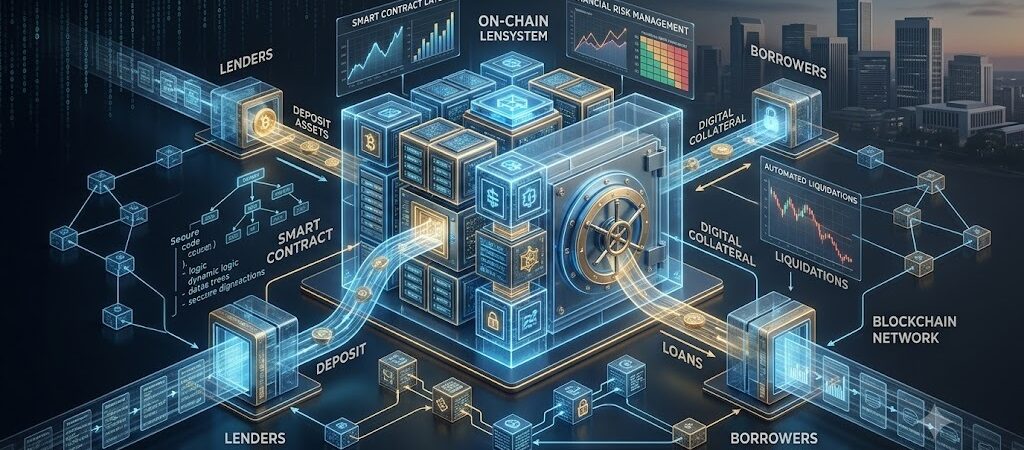
In an On-chain lending security system, a smart contract can effectively act as the automated engine connecting borrowers, lenders, collateral, interest calculations, and liquidations.
For example, a borrower may deposit digital assets worth $10,000 as collateral and borrow $5,000 in another asset.
The protocol can continuously monitor the value of the collateral.
If the collateral value falls significantly, the borrower’s position may approach a predefined liquidation threshold.
The smart contract can then initiate a liquidation process according to the protocol’s rules.
No employee needs to manually call the borrower.
No traditional loan officer needs to approve the liquidation.
The blockchain-based system executes the programmed conditions.
This automation is one of the strongest arguments for on-chain lending.
From Human Trust to Code-Based Rules
Traditional finance often relies on institutional trust.
A borrower trusts the bank to maintain records.
The bank trusts the borrower to repay.
Both parties trust legal agreements and regulatory institutions to provide enforcement when something goes wrong.
On-chain lending security attempts to move part of this trust relationship into software.
The user does not necessarily need to trust a centralized intermediary to manually execute every step.
Instead, the user interacts with a transparent protocol whose rules can potentially be inspected before funds are deposited.
This is an important philosophical shift.
The goal is not to eliminate trust entirely.
Rather, it is to reduce dependence on certain forms of human and institutional discretion.
Users still need to trust that the smart contract is correctly written, the blockchain is secure, the oracle data is reliable, and the protocol governance operates responsibly.
In other words, trust does not disappear; it changes form.
Why Collateral Is Central to On-Chain Lending
Collateral is one of the most important components of decentralized lending.
Because many blockchain lending protocols do not rely on traditional credit scores, On-chain lending security they generally require borrowers to provide assets that secure their loans.
This can create an overcollateralized structure.
For example, a protocol might require a borrower to deposit $150 worth of digital assets to borrow $100.
The extra collateral provides a buffer against price fluctuations.
If the collateral falls below the required threshold, the protocol can liquidate some or all of the position.
This approach reduces reliance on the borrower’s promise to repay.
The collateral is already controlled by the protocol’s smart-contract infrastructure.
That is fundamentally different from traditional unsecured lending.
Automated Liquidations
Liquidations are another major security mechanism.
Markets can move quickly, particularly in cryptocurrency.
A collateral position that appears healthy in the morning can become dangerously undercollateralized after a sharp market decline.
Smart contracts can monitor collateral ratios continuously.
If a position crosses the liquidation threshold, the protocol can automatically begin selling collateral or transferring it according to its rules.
This can reduce the time between detecting financial stress and taking protective action.
Traditional financial institutions may require human decisions and operational procedures.
Blockchain protocols can potentially respond within seconds or minutes, depending on network conditions and system design.
That speed can be particularly important during volatile markets.
The Benefits of Transparency
Transparency is another major advantage of on-chain lending.
Traditional financial systems can involve multiple private databases and institutions.
Blockchain-based lending can place key transactions and financial positions on a public or otherwise auditable ledger.
Users may be able to inspect:
- Collateral balances
- Loan positions
- Repayments
- Liquidations
- Interest rates
- Protocol reserves
- Smart-contract activity
This visibility can make it easier for users and analysts to understand how a lending protocol operates.
However, transparency should not be confused with safety.
A smart contract can be completely visible and still contain a serious vulnerability.
Open-source code allows people to inspect the system, but it does not guarantee that every flaw will be discovered.
The Security Trade-Off
This creates one of the most important concepts in on-chain lending.
Smart contracts can reduce counterparty dependence while increasing technological dependence.
A traditional lender may expose users to institutional and credit risks.
A DeFi lending protocol can reduce some of those risks through collateral and automation, On-chain lending security but it creates dependence on code, blockchain infrastructure, price oracles, governance systems, and digital asset liquidity.
The result is not a risk-free financial system.
It is a different risk architecture.
Understanding this architecture will be essential as on-chain lending continues to grow.
Why Security Is Becoming More Important
As the amount of capital entering decentralized lending increases, security becomes increasingly important.
A vulnerability that affects a small experimental protocol may have limited consequences.
A vulnerability in a major lending system with billions of dollars in assets could have much larger implications.
This means the industry needs stronger standards around:
- Smart-contract development
- Security audits
- Formal verification
- Oracle design
- Emergency controls
- Governance
- Risk monitoring
- Insurance mechanisms
- Liquidity management
The future of On-chain lending security will depend not only on attracting capital but also on protecting it.
The Next Stage of Lending
On-chain lending is still evolving.
The early DeFi ecosystem demonstrated that lending markets could operate without traditional banks at the center of every transaction.
The next stage is likely to focus on making these systems more secure, efficient, scalable, and compatible with institutional requirements.
If developers can reduce technical vulnerabilities while preserving transparency and automation, smart contracts could become an increasingly important component of digital lending infrastructure.
That does not mean banks will disappear.
Instead, traditional lenders and blockchain-based protocols may increasingly operate alongside one another.
The most important development may therefore be the creation of a financial system in which some lending relationships rely on institutional intermediaries while others rely on programmable blockchain infrastructure.
The central question will be how effectively each model manages risk.
And as that competition develops, on-chain lending security could become one of the defining issues shaping the next generation of decentralized and digital finance.
How Smart Contracts Reduce Counterparty Risk
The biggest difference between traditional lending and on-chain lending is not simply where the transaction is recorded.
It is how the agreement is enforced.
In traditional finance, a lending agreement can depend on institutions, employees, legal contracts, custodians, and court systems. On-chain lending security Even when the parties involved are highly reputable, the process can involve delays and operational dependencies.
On-chain lending attempts to automate many of these processes through smart contracts.
Once the lending rules are deployed, the software can enforce predetermined conditions without requiring one party to manually approve every transaction.
This can significantly reduce certain forms of counterparty risk.
Automated Enforcement of Loan Conditions
A traditional loan agreement may contain dozens of contractual conditions.
The borrower may be required to maintain collateral, make scheduled payments, comply with financial requirements, and provide specific information.
If those conditions are violated, the lender may need to take action.
A smart contract can automate many of these requirements.
For example, if a borrower must maintain a minimum collateral ratio, the protocol can continuously monitor the position.
If the ratio falls below the required level, the contract can initiate a liquidation according to predefined rules.
This creates a system where enforcement is embedded into the financial infrastructure itself.
The borrower does not need to voluntarily cooperate with the enforcement process.
That can reduce one of the most important weaknesses in traditional lending: the possibility that enforcement becomes slow, expensive, or uncertain.
Removing Certain Intermediary Dependencies
Traditional lending can involve several intermediaries.
A typical transaction may include a bank, custodian, payment processor, clearing organization, legal service provider, On-chain lending security and other parties.
Every additional participant can introduce another operational dependency.
On-chain lending can reduce the number of intermediaries required for certain transactions.
A smart contract can connect lenders and borrowers directly while automatically managing collateral and repayments.
This does not mean every intermediary disappears.
Legal, regulatory, custody, and compliance services may still be required, particularly for institutional products.
But fewer manual steps can potentially reduce operational complexity.
Collateral Held by Smart Contracts
One of the strongest security characteristics of decentralized lending is that collateral can be deposited directly into a smart contract.
This creates an important difference from traditional lending.
A borrower cannot necessarily withdraw the collateral while the loan remains outstanding.
The smart contract controls the assets according to the rules of the protocol.
This reduces the possibility of a borrower simply refusing to return collateral after receiving a loan.
The system is designed so that the collateral is already available to support the lending position.
This is one reason overcollateralized lending has become so common in DeFi.
Continuous Risk Monitoring
Traditional lending systems often operate through periodic reporting.
Financial institutions may review borrower information on a scheduled basis.
Blockchain systems can operate continuously.
A lending protocol can monitor collateral values and loan balances as blockchain transactions occur.
This creates the possibility of real-time risk management.
If the market value of collateral changes rapidly, the protocol can respond automatically rather than waiting for a human review.
The ability to continuously monitor positions is particularly valuable in cryptocurrency markets, where prices can move dramatically within a short period.
Automated Interest Calculations
Smart contracts can also automate interest calculations.
Instead of relying on a bank employee or centralized database to calculate accrued interest, the protocol can use predefined formulas.
Depending on the design, interest rates may be fixed, variable, or dynamically determined by supply On-chain lending security and demand.
The blockchain can record borrowing activity and calculate the amount owed according to the protocol’s rules.
This reduces the possibility of manual calculation errors and makes the lending mechanism more predictable.
Transparent Lending Rules
Another important feature is transparency.
In many On-chain lending security systems, users can inspect the rules governing the protocol before interacting with it.
They may be able to see:
- Collateral requirements
- Borrowing limits
- Interest-rate mechanisms
- Liquidation thresholds
- Supported assets
- Reserve information
- Smart-contract addresses
This transparency can help users understand the financial system they are entering.
Traditional financial products may also provide extensive documentation, but the actual operational processes can remain hidden behind institutional systems.
Blockchain can make more of the financial machinery directly observable.
Reducing Settlement Risk
Settlement risk occurs when one party has fulfilled its part of a transaction but the other side has not yet completed its obligation.
Traditional financial markets often use intermediaries and clearing systems to reduce this risk.
Blockchain networks can potentially shorten the settlement process.
When a transaction is executed through a smart contract, the transfer of assets can occur according to predefined atomic or near-atomic logic.
This can reduce certain forms of settlement uncertainty.
However, blockchain settlement does not eliminate every settlement risk.
Network congestion, failed transactions, liquidity shortages, and technical issues can still affect execution.
Reducing Custodial Friction
Traditional financial systems often require investors to place assets with custodians.
This can create another layer of counterparty exposure.
On-chain lending can allow users to interact with smart contracts directly through blockchain wallets.
The assets may remain under smart-contract control rather than being transferred to a conventional intermediary.
This can reduce certain custodial dependencies.
However, users still need to trust the smart contract and the broader infrastructure.
If the contract contains a vulnerability, direct blockchain interaction does not protect the user.
The Difference Between Credit Risk and Counterparty Risk
It is useful to distinguish credit risk from counterparty risk.
Credit risk is the possibility that a borrower cannot meet its financial obligations.
Counterparty risk is broader.
It includes the possibility that another party involved in the transaction fails to perform as expected.
In traditional lending, this could involve borrowers, banks, custodians, brokers, settlement institutions, or other service providers.
On-chain lending security can reduce some counterparty exposure by replacing manual obligations with automated execution.
But the underlying credit risk may not disappear.
If collateral prices collapse, a lending protocol can still experience losses.
The system therefore changes how risk is managed rather than eliminating risk completely.
Overcollateralization as a Risk Buffer
Overcollateralization is one of the most important mechanisms used to reduce lending risk.
Suppose a borrower deposits $150 worth of digital assets and receives a $100 loan.
The $50 difference creates a buffer.
If the collateral declines moderately in value, the loan can remain adequately secured.
If the collateral falls too far, the protocol can liquidate the position.
This structure means the system does not necessarily depend on the borrower’s creditworthiness.
Instead, it depends heavily on the value and liquidity of the collateral.
That is a major shift from traditional unsecured lending.
The Role of Loan-to-Value Ratios
Loan-to-value, or LTV, is another key risk-management tool.
LTV compares the amount borrowed with the value of the collateral.
For example, a $50,000 loan secured by $100,000 of collateral has an LTV of 50%.
Lower LTV ratios generally provide greater protection against collateral price declines.
Protocols can set maximum LTV levels based on the volatility and liquidity of different assets.
Highly volatile assets may require more collateral.
More liquid and stable assets may support higher borrowing ratios.
This creates a mathematical framework for managing lending risk.
Liquidation Thresholds
A liquidation threshold determines when a borrowing position becomes sufficiently risky that the protocol should begin liquidating collateral.
This threshold is not necessarily identical to the maximum borrowing ratio.
The difference creates a buffer between normal borrowing and forced liquidation.
For example, a user might open a position at a relatively conservative LTV level while liquidation occurs only after the collateral value falls substantially.
This gives the protocol time to respond to market movements.
However, during extreme volatility, prices can move so quickly that liquidation mechanisms may still face challenges.
Liquidators and Market Participants
Automated liquidation does not mean the smart contract necessarily sells collateral by itself in every system.
Many lending protocols rely on external market participants known as liquidators.
These participants monitor risky positions and compete to execute liquidations according to protocol rules.
In return, they may receive an incentive or discount. On-chain lending security.
This creates an automated ecosystem around risk management.
The borrower receives capital.
The lender provides liquidity.
The smart contract enforces the rules.
Liquidators help maintain the solvency of the system.
This structure can operate without a traditional loan-recovery department.
Why Liquidation Speed Matters
Crypto markets can move rapidly.
A collateral position can become undercollateralized in minutes.
Slow liquidation could leave a protocol exposed to losses.
Smart-contract-based systems can react much faster than traditional manual procedures.
Once the relevant market data is available, the protocol can trigger liquidation according to its programmed conditions.
However, speed also creates risks.
If market data is temporarily inaccurate or liquidity suddenly disappears, On-chain lending security rapid automated liquidation could make the situation worse. https://cryptopulsemagazine.com/ethereum-quantum-risks/
Automation therefore needs to be combined with strong safeguards.
Oracle Infrastructure
This brings us to one of the most important components of on-chain lending: price oracles.
Smart contracts cannot independently know the current market price of an asset.
They need external data sources.
Oracles provide information about asset prices so that lending protocols can calculate collateral values and determine whether positions are healthy.
If a protocol believes collateral is worth $100,000 when the actual market value is only $60,000, the system could become dangerously undercollateralized.
Therefore, reliable oracle infrastructure is essential.
Oracle Manipulation Risk
Oracle attacks are among the most important risks in DeFi.
If an attacker can manipulate the price data used by a lending protocol, they may be able to borrow more than they should, trigger unfair liquidations, or otherwise exploit the system.
This means smart-contract security is only one part of the overall security model.
The protocol also needs reliable external data.
Developers can use multiple data sources, decentralized oracle networks, time-weighted prices, circuit breakers, and other mechanisms to reduce manipulation risk.
But no oracle architecture is automatically perfect.
Smart-Contract Audits
Because code controls financial assets, smart-contract security is critical.
Before deploying a lending protocol, developers often use security audits to identify vulnerabilities.
Auditors can examine:
- Access controls
- Asset-transfer logic
- Liquidation mechanisms
- Price calculations
- Upgrade mechanisms
- Emergency functions
- Mathematical formulas
- External contract interactions
Audits can significantly improve security, but they are not guarantees.
A contract can pass an audit and still contain an undiscovered vulnerability.
For that reason, mature protocols often use multiple layers of security rather than relying on a single audit.
Formal Verification
Some high-value financial protocols can use formal verification techniques.
Formal verification attempts to mathematically demonstrate that certain properties of a smart contract behave according to defined specifications.
This approach can provide stronger assurance than conventional testing alone.
It is particularly useful for critical components such as:
- Asset accounting
- Liquidation calculations
- Access controls
- Interest calculations
- Core financial logic
However, formal verification can be expensive and complex.
It is therefore one component of a broader security strategy rather than a universal solution.
Bug Bounties and Continuous Monitoring
Security does not end when a smart contract is deployed.
Protocols can establish bug-bounty programs that reward security researchers for responsibly identifying vulnerabilities.
They can also use monitoring systems to detect unusual activity.
Examples include:
- Unexpected fund movements
- Abnormally large loans
- Rapid collateral changes
- Unusual contract interactions
- Suspicious governance activity
Continuous monitoring can help protocols identify potential attacks before losses become catastrophic.
This is increasingly important as the amount of capital held in smart contracts grows.
Upgradeability Creates Another Risk
Some smart contracts are immutable.
Others can be upgraded.
Upgradeability can be useful because developers can fix bugs and improve functionality without replacing the entire protocol.
But it also creates another form of trust.
If a small group controls the upgrade mechanism, those administrators may have significant power over user funds or protocol rules.
Users therefore need to understand who controls upgrade keys and what safeguards exist.
Possible protections include:
- Multi-signature controls
- Timelocks
- Governance voting
- Emergency procedures
- Independent monitoring
The goal is to prevent a centralized administrator from becoming a hidden single point of failure.
Governance Risk
Decentralized protocols often rely on governance systems to change parameters.
Token holders or designated governance bodies may vote on:
- Supported assets
- Collateral factors
- Interest-rate models
- Risk parameters
- Treasury management
- Contract upgrades
Governance can make protocols adaptable.
But it can also introduce risks.
Concentrated voting power, low participation, rushed proposals, or malicious governance actions can affect the security of the entire lending system.
Therefore, decentralization alone does not guarantee good governance.
Automation vs. Human Judgment
One of the biggest advantages of smart contracts is automation.
One of the biggest disadvantages can also be automation.
A human financial institution may recognize unusual circumstances and decide not to immediately liquidate a customer.
A smart contract generally follows its programmed rules.
This can make the system predictable, but it can also make it inflexible.
During extreme market events, rigid automation may produce outcomes that are technically correct according to the code but economically damaging.
The challenge is to design systems that preserve automation while including appropriate safeguards for exceptional circumstances.
A Different Definition of Trust
Ultimately, on-chain lending does not eliminate trust.
It redistributes it.
Instead of placing primary trust in a bank or lending company, users may place trust in:
- Smart-contract code
- Blockchain infrastructure
- Oracle providers
- Governance mechanisms
- Developers
- Auditors
- Liquidity providers
- Economic incentives
This is a very different trust model.
The advantage is that many components can be transparent and independently analyzed.
The disadvantage is that users need enough technical and financial understanding to evaluate those components.
The Security Stack of On-Chain Lending
A secure lending protocol therefore requires multiple layers working together.
Layer 1: Smart-contract security
The core code must correctly manage deposits, loans, repayments, and liquidations.
Layer 2: Oracle security
Market prices must be accurate and resistant to manipulation.
Layer 3: Economic security
Collateral ratios, incentives, and liquidation mechanisms must remain solvent during stress.
Layer 4: Blockchain security
The underlying network must provide reliable transaction execution.
Layer 5: Governance security
Protocol changes must be protected against malicious or concentrated control.
Layer 6: Operational security
Developers and administrators must protect keys, infrastructure, and emergency systems.
A failure in any one layer can potentially affect the entire lending system.
Why This Matters for the Future
The ability to reduce traditional counterparty dependence is one of blockchain lending’s most important innovations.
But the technology will only become a sustainable alternative if the industry can demonstrate that its new risk model is manageable.
The future of on-chain lending will therefore depend on more than attractive yields or rapid growth.
It will depend on security engineering, transparent governance, resilient oracle systems, reliable liquidity, On-chain lending security and strong economic design.
Smart contracts can automate enforcement.
Collateral can reduce credit exposure.
Blockchains can provide transparent settlement.
But the overall system still needs careful design.
That is the central lesson of on-chain lending:
The goal is not to eliminate every form of counterparty risk. The goal is to replace unnecessary dependence on intermediaries with transparent, automated, and measurable risk-management mechanisms — while responsibly managing the new risks created by blockchain technology itself.
Traditional Lending vs. On-Chain Lending
The differences between traditional lending and On-chain lending security become clearer when examining how each system manages trust, collateral, settlement, and enforcement.
Traditional lending has evolved over centuries and remains deeply integrated into the global economy. On-chain lending security Banks and financial institutions have developed sophisticated systems for evaluating borrowers, managing collateral, monitoring risk, and recovering assets.
On-chain lending security approaches these functions through programmable infrastructure.
Neither model is universally superior.
Instead, they represent two different approaches to financial intermediation.
Traditional Lending
In traditional lending, the lender usually controls the approval process.
A bank or financial institution can evaluate the borrower’s income, credit history, financial statements, assets, On-chain lending security and other information before deciding whether to provide capital.
The lender may also require collateral.
If the borrower defaults, the institution can use contractual and legal mechanisms to recover its funds.
This model works because borrowers and lenders operate within established legal and regulatory frameworks.
However, it can be slow and expensive.
Loan applications may require extensive documentation.
Cross-border lending can involve multiple intermediaries.
Settlement can take time.
Access can also be restricted by geography, credit history, or institutional requirements.
On-Chain Lending
On-chain lending security takes a different approach.
Users can interact with lending protocols through blockchain wallets.
The protocol can determine borrowing capacity based primarily on collateral and predefined rules.
Transactions can be recorded on-chain.
Interest calculations can be automated.
Liquidations can be executed through smart contracts.
This can reduce certain operational costs and create a more transparent financial environment.
But it also creates technical dependencies.
Users must trust the code, blockchain, oracle infrastructure, and protocol economics.
Accessibility and Global Participation
One of the most frequently discussed advantages of DeFi lending is accessibility.
Traditional financial services can depend on local banking systems, identification requirements, credit histories, and geographic restrictions.
Blockchain networks operate across borders.
A user with a compatible wallet and access to the relevant protocol may be able to interact with an on-chain lending market without opening a traditional bank account.
This can expand access to financial services.
However, accessibility does not mean universal availability.
Many lending protocols have restrictions based on jurisdiction, asset type, regulatory requirements, or user eligibility.
As institutional participation increases, compliance requirements may become even more important.
Transparency vs. Privacy
On-chain lending security also creates an interesting trade-off between transparency and privacy.
Blockchain transactions can often be publicly inspected.
This allows users, analysts, and researchers to examine protocol activity.
Large positions, liquidations, and asset movements may be visible on-chain.
Traditional banking systems generally keep customer-level financial information private.
That privacy can protect customers, but it also means outsiders cannot easily inspect the full financial activity of a bank.
On-chain systems provide greater public visibility but may expose financial behavior that users would prefer to keep private.
Future lending systems may therefore need privacy-preserving technologies that maintain regulatory transparency while protecting sensitive user information. https://cryptopulsemagazine.com/sec-crypto-guidance-2026/
Stablecoins and On-Chain Lending
Stablecoins have become central to the DeFi lending ecosystem.
They provide blockchain-based assets designed to maintain relatively stable value relative to traditional currencies.
Borrowers can use stablecoins as lending or borrowing assets without being exposed to the full price volatility of cryptocurrencies.
For example, a user may deposit a volatile digital asset as collateral and borrow a dollar-linked stablecoin.
This can allow the borrower to access liquidity without immediately selling the underlying asset.
Stablecoins also provide a common unit of account for decentralized financial applications.
Their growth could therefore be closely connected to the future expansion of On-chain lending security.
The Risks of Stablecoin-Based Lending
Stablecoins introduce their own risks.
Not all stablecoins are structured in the same way.
Some depend on reserves.
Others may use overcollateralized crypto assets.
Some rely on algorithmic mechanisms.
The security of an On-chain lending security system can therefore depend partly on the stability and liquidity of the stablecoins it supports.
If a major stablecoin loses its intended price relationship, collateral calculations and lending positions can be affected.
Protocols must therefore carefully evaluate the assets they allow users to borrow and supply.
Cross-Protocol Risk
The interconnected nature of DeFi creates another important challenge.
A lending protocol may depend on stablecoins, decentralized exchanges, oracle networks, bridges, liquidity pools, On-chain lending security and other applications.
This creates composability.
One protocol can interact with another.
Composability is one of DeFi’s greatest strengths.
It is also one of its greatest risks.
A failure in one major component can potentially spread through other protocols.
For example, if a collateral asset experiences a severe liquidity crisis, lending markets that accept that asset may also come under pressure.
This creates a financial ecosystem where risk can travel quickly.
The Importance of Liquidity
Liquidity is critical to lending security.
A protocol may have substantial collateral on paper but still face problems if that collateral cannot be sold quickly enough during a market crash.
This is particularly important for volatile or thinly traded digital assets.
A collateral asset may be worth $100 million under normal market conditions but become much harder to sell during extreme volatility.
If liquidators cannot efficiently sell collateral, losses can accumulate.
Therefore, collateral quality should be evaluated based on both price and market liquidity.
Liquidity Stress Events
A major market crash provides the ultimate test for an on-chain lending system.
During normal conditions, collateral prices may be stable and liquidations may occur smoothly.
During extreme volatility, however, multiple positions can approach liquidation simultaneously.
This can create a rush to sell collateral.
If liquidity disappears, the price of the collateral can fall even further.
That can create a feedback loop:
Price decline → liquidations → forced selling → additional price decline.
Lending protocols must therefore be designed to withstand periods of severe market stress.
Risk Parameters
Protocols use risk parameters to control how much capital can be borrowed against different assets.
These parameters can include:
- Maximum loan-to-value ratios
- Liquidation thresholds
- Liquidation penalties
- Borrowing caps
- Supply caps
- Reserve factors
- Interest-rate curves
These values are not permanent. On-chain lending security.
Governance or risk-management teams may adjust them as market conditions change.
A well-designed protocol should have mechanisms for responding to changing risks without creating excessive governance dependence.
Dynamic Interest Rates
Interest rates in many On-chain lending security protocols can change according to supply and demand.
When borrowing demand rises, rates can increase.
When liquidity is abundant and borrowing demand falls, rates can decrease.
This creates a market-based mechanism for balancing lenders and borrowers.
The model can be more transparent than some traditional lending structures because the formulas may be publicly visible.
However, variable rates can also create uncertainty for borrowers.
A borrower who takes a loan at one rate may face substantially higher costs if market demand changes.
The Role of Reserves
Lending protocols can maintain reserves to absorb unexpected losses.
A portion of interest or protocol revenue may be directed into a reserve pool.
These reserves can provide an additional layer of protection.
However, reserves should not be treated as unlimited insurance.
A sufficiently large exploit or market collapse can exceed available reserves.
Users should understand the size, structure, and governance of any reserve mechanism before assuming that losses will automatically be covered.
Insurance and Risk Protection
Some DeFi ecosystems have explored insurance mechanisms designed to protect users from certain smart-contract failures or other losses.
Insurance can improve confidence.
But decentralized insurance remains a developing market.
Coverage may be limited.
Claims may have specific conditions.
The amount of available capital may be insufficient during a major systemic event.
Therefore, users should treat insurance as an additional layer of protection rather than a guarantee against every possible loss.
Institutional On-Chain Lending
As blockchain infrastructure matures, institutions are increasingly examining On-chain lending security.
Banks, asset managers, fintech companies, and digital-asset firms are exploring how blockchain-based systems could improve lending, settlement, collateral management, and liquidity.
Institutional participation could bring substantial capital into the sector.
But institutions typically require stronger controls than retail DeFi users.
They may demand:
- Identity verification
- Permissioned access
- Legal documentation
- Auditable records
- Regulatory compliance
- Institutional custody
- Risk reporting
- Governance controls
This could lead to the development of a new category of institutional DeFi.
Permissionless vs. Permissioned Lending
The distinction between permissionless and permissioned lending will become increasingly important.
Permissionless protocols allow users to interact with the system without traditional institutional approval, subject to the protocol’s technical requirements.
Permissioned systems can restrict access to approved participants.
Permissioned lending may be more attractive to regulated institutions because it can incorporate compliance requirements directly into the system.
This does not necessarily mean permissionless DeFi will disappear.
Instead, the two models may develop in parallel.
Real-World Assets Entering DeFi
Tokenized real-world assets could further expand On-chain lending security.
Instead of using only crypto-native assets as collateral, future protocols may support tokenized:
- Treasury securities
- Corporate bonds
- Money-market funds
- Private credit
- Real estate
- Other financial instruments
This could dramatically expand the potential size of On-chain lending security markets.
Traditional assets could become digital collateral.
Digital financial applications could then interact with assets that have established economic value outside the blockchain ecosystem.
Tokenized Treasuries as Collateral
Tokenized U.S. Treasuries are particularly interesting because they could provide a lower-volatility collateral category than many crypto assets.
A regulated Treasury-backed token could potentially be used in institutional lending systems.
This would allow borrowers to access digital liquidity while maintaining exposure to government securities.
However, legal rights and transfer restrictions must be carefully addressed.
A tokenized security cannot automatically be used as collateral simply because it exists on a blockchain.
The legal framework must recognize the relevant ownership and enforcement rights.
On-Chain Credit Markets
The combination of smart contracts and tokenized assets could eventually produce more sophisticated credit markets.
For example, a financial institution could potentially use tokenized government securities as collateral for a blockchain-based loan.
A smart contract could monitor the collateral.
An oracle could provide market information.
A lending protocol could calculate the required collateral ratio.
A settlement network could process repayments. On-chain lending security.
This would create a digitally integrated credit system in which many financial functions operate through programmable infrastructure.
The Challenge of Under-Collateralized Lending
Overcollateralization provides strong protection, but it also limits capital efficiency.
If a borrower needs $1 million but must provide $1.5 million of collateral, the borrower is locking up significant capital.
Traditional financial systems can provide under-collateralized loans because lenders have access to credit histories, financial statements, legal enforcement, and long-term relationships.
On-chain lending has historically struggled to replicate these mechanisms.
The future of DeFi lending may therefore depend partly on developing reliable forms of blockchain-based credit assessment.
On-Chain Identity and Credit
Decentralized identity systems could eventually help lending protocols evaluate borrowers beyond their collateral.
A user could potentially build a verifiable financial identity based on previous repayments, asset ownership, business activity, On-chain lending security and other information.
This could allow lenders to offer more capital-efficient loans.
However, credit-based lending also introduces privacy concerns.
Users may not want all financial information permanently linked to a public blockchain address.
Privacy-preserving identity systems could therefore become important.
Zero-Knowledge Technology
Zero-knowledge technology may provide one possible solution.
It can allow users to prove that certain conditions are satisfied without necessarily revealing all underlying information.
For example, a borrower could potentially prove that they meet a specific financial requirement without exposing their complete financial history.
This could help combine blockchain-based lending with greater privacy.
The technology remains complex, but its development could expand the range of financial applications possible on-chain.
Compliance and Regulation
As On-chain lending security becomes more institutional, regulation will become increasingly important.
Financial regulators may examine:
- Whether lending tokens qualify as securities
- How borrowers and lenders are identified
- How consumer protections apply
- How assets are held
- How defaults are handled
- How protocols manage systemic risk
- How cross-border transactions are regulated
The regulatory environment will vary between jurisdictions.
This means global On-chain lending security platforms may need flexible compliance frameworks.
The Future of Digital Credit
The long-term potential of On-chain lending security extends beyond cryptocurrency.
Blockchain-based credit markets could eventually support businesses, institutions, investment funds, and other financial participants.
Smart contracts could automate collateral management.
Tokenized assets could expand the collateral base.
Oracles could provide real-time market information.
Digital identity could improve credit assessment.
Blockchain settlement could reduce operational friction.
Together, these technologies could create a more programmable credit market.
But reaching that stage will require significant progress in security, regulation, privacy, liquidity, and scalability.
Why the Industry Is Moving Toward Security
The early DeFi market demonstrated that users were willing to experiment with automated financial systems.
The next phase is likely to be defined by a different question:
Can these systems become reliable enough to support larger amounts of capital?
Growth without security can create fragile financial infrastructure. On-chain lending security.
Protocols that prioritize audits, risk management, transparent governance, and resilient economic models are more likely to survive long-term market cycles.
This means security is no longer simply a technical feature.
It is becoming a competitive advantage. https://cryptopulsemagazine.com/institutional-tokenization-2026/
The New Definition of Financial Infrastructure
Traditional financial infrastructure was built around institutions.
Blockchain financial infrastructure is increasingly built around networks, smart contracts, digital assets, On-chain lending security and programmable rules.
The most successful systems may combine both.
Banks can provide regulated access and institutional expertise.
Blockchain networks can provide transparent settlement.
Smart contracts can automate financial processes.
Tokenized assets can connect traditional markets to digital infrastructure.
This hybrid model could eventually become a major part of global finance.
Looking Ahead
On-chain lending security has already demonstrated that financial agreements can be automated through blockchain technology.
The next challenge is making those agreements safer, more scalable, and more economically resilient.
Smart contracts can reduce dependence on intermediaries.
Collateral can reduce certain forms of credit risk.
Automated liquidations can respond quickly to market changes.
Transparent ledgers can improve visibility.
But oracle failures, smart-contract vulnerabilities, governance problems, liquidity shortages, On-chain lending security and regulatory uncertainty remain significant challenges.
The future will therefore belong not simply to the protocols that attract the most capital, but to those that can manage risk most effectively.
As real-world assets become tokenized and institutional investors explore blockchain-based financial markets, secure On-chain lending security could evolve from a DeFi experiment into a major component of digital credit infrastructure.
The technology is still developing.
But the direction is becoming increasingly clear: lending is moving toward a world where financial agreements can be increasingly programmable, transparent, and automated.
Building Stronger On-Chain Lending Security
As On-chain lending security grows, security will increasingly determine which protocols survive long-term market cycles.
The early DeFi ecosystem demonstrated that blockchain-based lending is technically possible. On-chain lending security the next challenge is creating systems that can withstand extreme volatility, sophisticated attacks, liquidity shocks, and changing regulatory requirements.
This requires a security architecture that extends far beyond the smart contract itself.
A secure lending protocol must consider the entire financial system surrounding the contract.
That includes the blockchain network, oracle infrastructure, collateral markets, governance mechanisms, liquidity providers, developers, and users.
Defense in Depth
One of the strongest approaches to blockchain security is known as defense in depth.
Instead of depending on one security mechanism, protocols can create multiple independent layers of protection.
For an On-chain lending security system, those layers might include:
- Carefully designed smart contracts
- Independent security audits
- Formal verification
- Multiple oracle sources
- Conservative collateral ratios
- Borrowing and supply caps
- Emergency controls
- Timelocked upgrades
- Multisignature administration
- Continuous monitoring
- Bug-bounty programs
- Insurance or reserve mechanisms
If one layer fails, another may limit the potential damage.
This is particularly important because no individual security measure can protect a complex financial protocol against every possible failure.
Smart-Contract Architecture
The foundation of an On-chain lending security protocol is its smart-contract architecture.
Developers need to carefully design how assets enter and leave the system.
Every function that can move funds must be examined.
Security considerations include:
- Who can call a function?
- What conditions must be satisfied?
- Can a transaction be manipulated?
- Can a user withdraw more than they deposited?
- Can interest calculations overflow or behave unexpectedly?
- Can an attacker manipulate collateral values?
- Can an administrator change critical parameters?
Small coding errors can potentially create very large financial consequences.
This is why mature protocols often use extensive testing and independent security reviews before deploying major changes.
Minimizing the Attack Surface
Another important principle is minimizing the attack surface.
Every additional feature can introduce additional complexity.
A protocol that supports hundreds of assets, complex financial strategies, On-chain lending security and numerous external integrations may have more potential failure points than a simple lending system.
Developers therefore face a difficult balance.
More functionality can increase usefulness.
More complexity can increase security risk.
The most resilient protocols may ultimately be those that carefully limit unnecessary complexity while focusing on core financial functions.
Oracle Redundancy
Because lending protocols depend heavily on price information, oracle redundancy is particularly important.
Instead of relying on a single data source, On-chain lending security a protocol can potentially compare multiple sources.
If one price feed suddenly deviates significantly from others, the system can flag the discrepancy.
Additional safeguards can include:
- Price deviation limits
- Time-weighted prices
- Multiple data providers
- Circuit breakers
- Delayed liquidation mechanisms in specific circumstances
- Manual emergency controls
These mechanisms can reduce the probability that a single incorrect price causes major losses.
Circuit Breakers
Circuit breakers can provide an emergency layer of protection.
If an asset suddenly experiences an extreme price movement or unusual trading activity, On-chain lending security the protocol can temporarily restrict certain operations.
For example, borrowing against a particular asset could be paused if its price feed becomes unreliable.
This can give developers and governance participants time to investigate the problem.
However, circuit breakers must be designed carefully.
A poorly designed emergency mechanism can itself become a vulnerability or create excessive centralization.
Emergency Shutdown Mechanisms
Some protocols may include emergency procedures that can temporarily freeze certain operations.
These mechanisms can be valuable during major exploits or oracle failures.
But they create a fundamental trade-off.
The more emergency authority a small group has, the more centralized the system becomes.
The more decentralized the system is, the more difficult emergency intervention may become.
The challenge is finding an appropriate balance between resilience and decentralization.
Multisignature Security
Multisignature wallets can reduce the risk associated with a single administrator.
Instead of allowing one private key to control critical protocol functions, multiple authorized participants may be required to approve an action.
For example, a protocol might require several independent signers before changing a critical parameter.
This reduces the probability that a single compromised key can cause catastrophic damage.
Multisignature controls are particularly important for treasury management, emergency actions, On-chain lending security and upgrade systems. https://cryptopulsemagazine.com/crypto-industry-contributes-over-55-billion/
Timelocked Changes
Timelocks can provide another layer of protection.
A protocol change may be approved but not activated immediately.
Instead, users receive a waiting period during which they can review the proposed change.
This can help detect malicious or unexpected governance decisions before they affect user funds.
Timelocks are especially useful for major smart-contract upgrades and risk-parameter changes.
They give the community time to respond.
Bug Bounties as a Security Layer
Security researchers can play an important role in protecting on-chain lending systems.
Bug-bounty programs offer financial rewards to researchers who responsibly disclose vulnerabilities.
This creates an economic incentive for independent experts to examine the code.
A well-funded bug bounty can be significantly cheaper than dealing with a major exploit.
However, bounty programs need clear rules.
Researchers should know what systems they are allowed to test and how vulnerabilities should be reported.
Real-Time Monitoring
Security teams can also monitor blockchain activity continuously.
Automated systems can detect unusual behavior such as:
- Large unexpected withdrawals
- Sudden changes in borrowing activity
- Rapid liquidations
- Abnormal oracle updates
- Suspicious governance transactions
- Large transfers from protocol-controlled addresses
Real-time monitoring cannot prevent every attack.
But it can reduce response times. On-chain lending security.
In financial systems, early detection can make the difference between a contained incident and a major loss.
Economic Security
Technical security is only one side of the equation.
A lending protocol also needs strong economic design.
The protocol must create incentives that encourage participants to behave in ways that preserve system solvency.
For example, liquidators need sufficient incentives to purchase distressed collateral.
Lenders need compensation for providing liquidity.
Borrowers need incentives to maintain healthy positions.
Governance participants need incentives to protect long-term protocol value.
If the economic incentives are poorly designed, even technically secure code can fail.
The Importance of Collateral Quality
Not all collateral should be treated equally.
A highly liquid asset with deep global markets may be more suitable as collateral than a thinly traded token.
Risk-management systems can therefore assign different collateral parameters to different assets.
Factors may include:
- Market capitalization
- Trading volume
- Volatility
- Liquidity
- Price stability
- Correlation with other assets
- Historical drawdowns
Conservative collateral policies can reduce the probability of large losses.
Correlation Risk
Correlation is another important consideration.
A lending protocol may appear diversified because it accepts multiple assets.
But if those assets are highly correlated, they can all decline simultaneously.
For example, several crypto assets may fall sharply during the same market event.
This means the protocol should not only consider individual asset risk.
It should also consider portfolio-level risk.
Contagion Across Protocols
DeFi protocols are highly interconnected.
A lending market may use a stablecoin issued by another protocol.
That stablecoin may rely on collateral from another market.
A decentralized exchange may provide the liquidity used for liquidations.
An oracle may obtain pricing information from multiple exchanges.
This interconnected structure can create contagion.
A failure in one component can affect other components.
For this reason, risk analysis increasingly needs to consider the broader DeFi ecosystem rather than examining protocols in isolation.
Bridge and Cross-Chain Risks
Cross-chain lending introduces another layer of complexity.
Blockchain networks are often connected through bridges or interoperability systems.
If a lending protocol accepts assets that have been transferred across chains, On-chain lending security it may inherit risks from the bridge infrastructure.
A bridge exploit can potentially affect the value or validity of assets used as collateral.
This means cross-chain lending should be approached with additional caution.
The security of the underlying asset representation matters just as much as the security of the lending contract.
Governance as a Security Function
Governance is sometimes treated as an administrative feature.
In reality, it is a critical component of financial security.
Governance decisions can determine:
- Which assets are accepted
- How much can be borrowed
- What collateral ratios apply
- Which oracle is used
- How reserves are managed
- How contracts are upgraded
A malicious or poorly designed governance system can therefore create financial vulnerabilities even if the underlying code is secure.
Strong governance should prioritize transparency, participation, On-chain lending security risk analysis, and clear procedures.
Institutional Risk Management
Institutional investors are likely to demand additional security controls before committing substantial capital to On-chain lending security.
They may require:
- Independent audits
- Detailed risk reports
- Legal opinions
- Custody arrangements
- Compliance monitoring
- Operational controls
- Insurance
- Incident-response plans
These requirements could actually improve the broader DeFi ecosystem.
Institutional standards may encourage protocols to adopt more rigorous security and governance practices.
Institutional Lending Markets
Institutional on-chain lending could develop differently from retail DeFi.
Rather than anonymous borrowers interacting with permissionless protocols, institutions may operate through regulated platforms.
Borrowers could be identified. On-chain lending security.
Collateral could be legally documented.
Transactions could occur on permissioned or public networks with additional compliance layers.
Smart contracts could still automate settlement and collateral management.
This creates a hybrid model where institutional controls and blockchain automation work together.
Tokenized Government Securities
Tokenized government securities could become especially important in institutional lending.
Traditional government bonds are already widely used as collateral in financial markets.
Tokenizing them could make that collateral compatible with blockchain-based settlement.
An institution could potentially hold tokenized Treasury exposure and use it within an approved digital lending environment.
This could reduce the friction involved in moving between traditional securities and blockchain markets.
The Emergence of On-Chain Repo Markets
One potential long-term development is the tokenization of repurchase agreements, commonly known as repos.
Repo markets allow institutions to borrow cash against securities. On-chain lending security.
Because Treasuries are widely used as collateral in traditional repo markets, tokenization could eventually bring some of these activities onto blockchain infrastructure.
Smart contracts could automate collateral movements, interest calculations, and settlement.
This could become a major institutional use case for blockchain technology.
Programmable Credit Agreements
Smart contracts can also create programmable lending arrangements.
Instead of a static loan agreement, a digital contract could automatically adjust certain conditions based on predefined market events.
For example, collateral requirements could change if volatility rises.
Interest rates could adjust according to market conditions.
Borrowing limits could change as liquidity changes.
These mechanisms could create more responsive financial products.
However, programmable finance must be designed carefully.
Highly complex rules can make financial products difficult to understand and increase technical risk.
Artificial Intelligence and Lending Security
Artificial intelligence may eventually complement smart contracts.
AI systems can analyze large amounts of blockchain data and identify unusual patterns.
They could potentially help detect:
- Suspicious transactions
- Manipulation attempts
- Liquidity deterioration
- Unusual borrowing behavior
- Governance attacks
- Emerging systemic risks
AI could therefore become an additional monitoring layer.
However, AI should not automatically control critical financial functions without appropriate safeguards.
Smart contracts are deterministic.
AI systems can be probabilistic and may produce unexpected outputs.
The two technologies therefore need carefully defined boundaries.
Privacy-Preserving Lending
Privacy will become increasingly important as institutional capital enters on-chain markets.
Public blockchains can expose transaction activity. On-chain lending security.
A company may not want competitors to see its borrowing positions or liquidity strategies.
Privacy-preserving technologies could allow institutions to prove compliance or financial conditions without revealing every transaction detail.
This could make blockchain lending more attractive to professional market participants.
Scalability and Transaction Costs
Security is not the only challenge.
On-chain lending security must also be scalable.
During periods of heavy blockchain activity, transaction costs can increase and execution can become slower.
This can create problems for borrowers facing liquidation.
If a transaction becomes too expensive or cannot be confirmed quickly, risk-management mechanisms may not operate as intended.
Layer-2 networks and other scaling technologies could help address these challenges.
But they introduce additional infrastructure and security considerations.
The Balance Between Automation and Control
The ultimate goal of On-chain lending security should not be maximum automation.
It should be appropriate automation.
Some financial processes are well suited to deterministic smart contracts.
Collateral calculations and routine repayments are good examples.
Other situations may require human judgment.
Extreme market disruptions, legal disputes, or unexpected technical failures can fall into this category.
The strongest financial systems may therefore combine automated execution with carefully designed human oversight.
Security as a Competitive Advantage
As the On-chain lending security market becomes more mature, users may increasingly evaluate protocols based on security rather than headline yields.
High yields can attract capital quickly.
But sustainable financial systems require more than attractive returns.
Investors and institutions will increasingly ask:
- How secure is the code?
- Who controls upgrades?
- How reliable are the oracles?
- How liquid is the collateral?
- What happens during a market crash?
- What happens if the protocol is exploited?
- How are losses managed?
Protocols that can answer these questions clearly may gain a significant advantage.
The Future of Counterparty Risk
The evolution of On-chain lending security does not mean counterparty risk will disappear.
Instead, it could become more measurable.
Traditional lending often relies on assessing the trustworthiness and financial strength of institutions and borrowers.
Blockchain lending can make certain financial conditions visible in real time.
Collateral can be monitored.
Loan balances can be verified.
Transactions can be independently examined.
Smart contracts can enforce predefined rules.
This could make some aspects of financial risk more transparent than they are in traditional systems.
A New Model of Financial Trust
The deeper innovation of On-chain lending security is therefore not simply removing banks.
It is creating a different model of financial trust.
Traditional finance relies heavily on institutions and legal enforcement.
Blockchain finance can combine:
Code + collateral + transparency + economic incentives + cryptographic verification.
None of these elements is perfect individually.
Together, however, they can create a powerful alternative framework for financial agreements.
What Comes Next?
The next stage of On-chain lending security will likely focus on three major objectives:
Security
Reducing smart-contract, oracle, governance, and infrastructure vulnerabilities.
Capital efficiency
Allowing borrowers to access more useful amounts of capital without creating excessive systemic risk.
Institutional integration
Connecting blockchain lending systems with regulated financial institutions and tokenized real-world assets.
Progress across these areas could significantly expand the market. https://ethereum.org/
The Long-Term Opportunity
If developers successfully combine secure smart contracts with reliable collateral, high-quality data, strong governance, and institutional standards, On-chain lending security could become a major part of the global digital economy.
The technology could support everything from crypto-native lending to institutional credit markets.
It could make collateral programmable.
It could make settlement more automated.
It could make financial positions more transparent.
And it could reduce reliance on intermediaries for certain types of financial agreements.
But the industry must resist the temptation to describe blockchain lending as risk-free.
The more accurate argument is more powerful:
On-chain lending can reduce certain forms of counterparty risk by replacing manual enforcement with programmable financial rules, while creating a new responsibility to manage code, oracle, governance, liquidity, and infrastructure risks.
That distinction will be critical as the technology moves from experimentation toward mainstream financial infrastructure.
The Road Ahead for On-Chain Lending Security
The evolution of On-chain lending security is entering an important stage.
The first phase of decentralized finance proved that lending markets could operate through blockchain networks without relying entirely on traditional financial intermediaries. On-chain lending security the next phase will be judged by something more demanding: whether these systems can provide reliable financial infrastructure while managing the risks created by automation and decentralization.
That challenge is not small.
Financial markets operate under extreme conditions. Markets crash, liquidity disappears, technology fails, regulations change, and participants make mistakes.
A lending system designed for normal conditions may perform very differently during a crisis.
For On-chain lending security to mature, security must therefore become a continuous process rather than a one-time audit.
Security Must Evolve With the Market
A lending protocol that is secure today may face completely different risks tomorrow.
New assets may be added.
New blockchain networks may be integrated.
New oracle systems may be introduced.
Governance may change important parameters.
The amount of capital locked in the protocol may increase substantially.
Each change can alter the protocol’s risk profile.
This means security teams need to continuously evaluate the system.
Regular audits, monitoring, stress testing, economic simulations, and community-driven security research can all contribute to a stronger ecosystem.
Stress Testing the Financial System
Traditional financial institutions routinely perform stress tests to determine how their balance sheets might respond to extreme economic conditions.
On-chain lending security protocols can adopt similar approaches.
Developers and risk managers can simulate scenarios such as:
- A 30% decline in major collateral assets
- A sudden stablecoin depeg
- A sharp increase in borrowing demand
- Major oracle disruption
- Blockchain network congestion
- Large-scale liquidations
- Loss of liquidity in a collateral market
- A smart-contract exploit
- Governance manipulation
These simulations can reveal weaknesses before they become real-world problems.
Stress testing could become an increasingly important standard for institutional-grade DeFi.
The Importance of Transparency During Crises
Transparency becomes particularly valuable during financial stress.
If a lending protocol’s reserves, collateral, debt, and transactions can be independently examined, users On-chain lending security and risk managers can make decisions based on observable information.
This is one of blockchain’s most important potential advantages.
Instead of waiting for quarterly reports or institutional disclosures, market participants can potentially monitor important financial conditions continuously.
However, transparency only helps if the underlying data is correctly interpreted.
A blockchain can show exactly what happened.
It does not necessarily explain why it happened or whether the system remains economically healthy.
Human analysis will therefore continue to matter.
Better Risk Dashboards
As protocols mature, sophisticated risk dashboards could become standard.
These dashboards could display:
- Total supplied assets
- Total borrowed assets
- Collateral ratios
- Liquidation activity
- Available liquidity
- Reserve levels
- Oracle health
- Concentration risk
- Protocol revenue
- Governance changes
Such tools could help both retail users and institutional investors evaluate risk before committing capital.
The result could be a more informed lending market. https://www.coingecko.com/
Moving Beyond Simple Total Value Locked
Total value locked, or TVL, has become one of the most widely used metrics in DeFi.
However, TVL alone does not measure security. On-chain lending security.
A protocol can have a large amount of capital while still having significant vulnerabilities.
Future investors may therefore focus on more sophisticated indicators.
These could include:
- Collateral quality
- Liquidity depth
- Concentration
- Historical liquidation performance
- Smart-contract security
- Oracle resilience
- Governance distribution
- Insurance coverage
- Reserve strength
This would shift the industry’s focus from simply measuring growth to measuring financial resilience.
The Rise of Professional Risk Management
As institutional capital enters blockchain markets, professional risk management is likely to become more important.
Traditional financial institutions have dedicated teams that specialize in credit, liquidity, market, operational, and counterparty risk.
Blockchain-based financial institutions may increasingly develop similar capabilities.
Risk professionals could monitor smart-contract exposure alongside traditional financial metrics.
This could create a new category of digital-asset risk management.
DeFi and Traditional Finance May Converge
The long-term future may not involve DeFi completely replacing traditional finance.
A more realistic scenario is convergence. On-chain lending security.
Traditional financial institutions can provide:
- Regulatory compliance
- Legal structures
- Institutional custody
- Credit assessment
- Customer protection
Blockchain systems can provide:
- Programmable settlement
- Transparent transactions
- Automated collateral management
- Digital asset ownership
- Continuous financial data
Combining these strengths could produce financial products that are more efficient while retaining institutional safeguards.
The Institutionalization of On-Chain Lending
Institutional adoption could fundamentally change the perception of On-chain lending security.
Early DeFi was primarily associated with individual crypto users and experimental financial applications.
Institutional lending could introduce larger pools of capital and stricter standards.
Banks, asset managers, fintech firms, On-chain lending security and digital-asset companies could use blockchain infrastructure for specific financial functions without necessarily adopting fully permissionless systems.
This could lead to a spectrum of lending models rather than a single DeFi structure.
At one end would be permissionless lending.
At the other would be fully regulated, permissioned institutional lending.
Between them could exist hybrid systems combining blockchain transparency with compliance controls.
Tokenized Collateral Could Transform Lending
Tokenized real-world assets may become one of the most important developments in this transition.
Government securities, money-market instruments, corporate debt, and other financial assets can potentially be represented on blockchain networks.
Once tokenized, these assets could become part of digital collateral markets.
This creates a bridge between traditional capital markets and DeFi infrastructure.
Instead of crypto markets operating separately from traditional finance, the two could increasingly interact through tokenized assets.
Why Treasury Assets Matter
Government securities are particularly important because they are already widely used in traditional financial markets.
Tokenized Treasury products could potentially provide blockchain users with exposure to relatively conservative government debt while maintaining compatibility with digital financial infrastructure.
They may also serve as collateral in certain institutional lending arrangements.
However, investors must distinguish between the underlying Treasury security and the token representing an interest in that security.
The legal structure matters.
The issuer matters.
The custodian matters.
The redemption mechanism matters.
The blockchain representation alone does not determine the safety of the investment.
Stablecoins and Treasury Markets
The relationship between stablecoins and government securities could become increasingly important.
Many stablecoin structures rely on reserves or assets designed to support their value.
As tokenized government securities become more accessible, they could play a larger role in digital financial infrastructure.
This could strengthen the connection between traditional government debt markets and the crypto ecosystem.
At the same time, concentration in a small number of assets or issuers could create new systemic risks.
Diversification and transparent reserve management will therefore remain important. On-chain lending security.
Regulation Will Shape the Market
Regulation is likely to play a major role in determining how On-chain lending security develops.
Regulators may seek to ensure that digital lending products provide appropriate investor protections, maintain adequate disclosures, and comply with applicable financial rules.
Different jurisdictions may adopt different approaches.
Some may encourage blockchain-based financial innovation.
Others may impose stricter requirements.
Global platforms will therefore need to navigate a complex regulatory landscape.
Compliance as Programmable Infrastructure
One potential development is the integration of compliance directly into smart-contract systems.
Instead of treating compliance as a separate administrative process, future protocols could incorporate programmable controls.
For example, certain financial products could be available only to verified participants.
Transactions could be subject to predefined eligibility requirements.
Reporting information could be generated automatically.
This could reduce some operational costs while improving regulatory visibility.
However, programmable compliance also raises important questions about privacy and decentralization.
The Challenge of Legal Recognition
Smart contracts can execute code.
They cannot independently create legal rights unless those rights are recognized by the relevant legal framework.
This distinction is especially important for tokenized real-world assets.
If a token represents a bond, Treasury security, or other financial instrument, investors need to understand exactly what legal claim the token provides.
Questions around ownership, custody, redemption, insolvency, and dispute resolution remain essential.
Blockchain technology can improve the technical representation of an asset.
It does not automatically solve the legal framework surrounding that asset.
Security and User Education
Technology alone cannot protect users who do not understand the risks.
Users need to know:
- What asset they are depositing
- What smart contract controls their funds
- How liquidation works
- What oracle the protocol uses
- Who controls upgrades
- What happens during an emergency
- Whether the protocol is permissionless or restricted
- What risks are not covered by insurance
Better education can reduce preventable losses.
As On-chain lending security becomes more mainstream, financial literacy and blockchain literacy will become increasingly important.
The Importance of Responsible Yield
Yield is one of the strongest attractions of DeFi.
But high yields often come with higher risks.
Investors should therefore evaluate where yield comes from.
A sustainable return may be generated by genuine borrowing demand, transaction activity, On-chain lending security or underlying financial assets.
An unusually high return may instead depend on incentives, token emissions, leverage, or temporary market conditions.
Understanding the source of yield is essential.
A secure lending protocol should focus on sustainable economics rather than simply maximizing headline returns.
Security vs. Growth
There can be tension between rapid growth and security.
Launching new features quickly can attract users.
Adding more assets can increase borrowing activity.
Expanding across multiple blockchains can increase market reach.
But each additional feature can increase complexity.
The most sustainable protocols may therefore prioritize controlled growth.
Security should be treated as part of product development rather than something added after deployment.
What Investors Should Look For
Before using an on-chain lending protocol, investors should consider several factors.
Smart-Contract Security
Has the code been independently audited?
Are there known vulnerabilities?
Is the protocol open source?
Oracle Design
Where does the protocol obtain price information?
Does it rely on a single source?
What happens if the oracle fails?
Collateral Quality
What assets are accepted?
How liquid are those assets?
Could their prices fall sharply during market stress?
Governance
Who can change the protocol?
Are upgrades controlled by a single party?
Are changes subject to timelocks or community review?
Liquidity
Can collateral be liquidated efficiently during a market crash?
Are there sufficient reserves?
Transparency
Can users independently verify important financial information?
Regulatory Structure
Does the protocol operate within an identifiable legal framework?
Are there restrictions based on jurisdiction or investor type?
These questions do not eliminate risk.
But they can help investors understand what they are actually taking on.
Can Smart Contracts Really Reduce Counterparty Risk?
The answer is yes, but with an important qualification.
Smart contracts can reduce reliance on certain counterparties by automatically controlling collateral, executing transactions, calculating financial obligations, and enforcing predefined conditions.
This can reduce dependence on manual intervention.
But smart contracts do not eliminate every form of counterparty exposure.
Users may still depend on:
- Oracle providers
- Stablecoin issuers
- Custodians
- Developers
- Governance participants
- Blockchain infrastructure
- Liquidity providers
In some systems, these dependencies may be highly decentralized.
In others, they may remain concentrated.
The degree of counterparty-risk reduction therefore depends on the architecture of the specific protocol.
A More Accurate Way to Think About Risk
Instead of asking whether On-chain lending security is “safe,” investors should ask:
Which risks have been reduced, and which risks have been introduced?
This is a much more useful question.
Traditional lending may expose users to institutional, credit, and settlement risks.
On-chain lending security can reduce some of these risks through automation and collateral.
But it introduces technology, oracle, governance, liquidity, and infrastructure risks.
The overall risk profile changes.
Understanding that change is more important than simply labeling one system safer than another.
The Potential Economic Impact
If On-chain lending security becomes more secure and scalable, the economic impact could be significant.
Businesses could access capital through programmable financial markets.
Institutions could move collateral more efficiently.
Investors could participate in transparent lending pools.
Tokenized securities could become usable within digital financial systems.
Global markets could potentially operate with fewer settlement barriers.
These developments could reduce certain forms of financial friction.
But they will only succeed if users and institutions trust the underlying infrastructure.
A More Programmable Financial System
The broader trend is clear.
Finance is becoming increasingly programmable.
Payments can be automated.
Assets can be tokenized.
Collateral can be monitored continuously.
Interest can be calculated by code.
Liquidations can occur automatically.
Compliance rules can potentially be embedded into financial infrastructure.
On-chain lending security sits directly at the center of this transformation.
Its success could influence how other financial products are designed.
Final Outlook
On-chain lending represents one of the clearest examples of how blockchain technology can transform a traditional financial process.
Its greatest innovation is not simply removing intermediaries.
It is making parts of the lending relationship programmable.
Smart contracts can enforce rules.
Collateral can be controlled automatically.
Transactions can be recorded transparently.
Liquidations can respond to market conditions.
Risk parameters can be adjusted through governance.
These capabilities can reduce certain forms of counterparty risk and operational dependence.
But they do not create a risk-free financial system.
The code can fail.
Oracles can fail.
Markets can collapse.
Liquidity can disappear.
Governance can be attacked.
Blockchain networks can experience technical problems.
Regulatory frameworks can change.
The future of on-chain lending will therefore depend on whether the industry can manage these risks with the same discipline that traditional financial institutions have developed over decades.
The most successful protocols may not be those that promise to eliminate risk.
They may be the ones that measure it, disclose it, manage it, and respond to it transparently.
As tokenized assets, stablecoins, institutional blockchain infrastructure, and decentralized financial applications continue to develop, lending could become increasingly integrated with programmable financial networks.
The result could be a financial ecosystem where traditional institutions and blockchain protocols do not simply compete.
They work together.
Conclusion
Smart contracts are changing the architecture of lending.
By automating collateral management, interest calculations, loan conditions, and liquidation processes, they can reduce the need to rely on certain intermediaries and manual enforcement mechanisms.
That can significantly reduce some forms of counterparty and operational risk.
However, automation is not the same as safety.
A smart contract is only as reliable as its code, its data sources, its economic design, and the infrastructure supporting it.
For investors, the most important lesson is therefore straightforward:
On-chain lending should not be viewed as eliminating risk. It should be viewed as changing how risk is created, managed, and enforced.
The next generation of digital lending will likely combine blockchain transparency with stronger security standards, institutional risk management, tokenized real-world collateral, privacy-preserving technology, and clearer regulatory frameworks.
If those pieces come together successfully, on-chain lending could move beyond its DeFi origins and become a significant component of the broader global financial system.
The transformation has already begun.
The next question is not whether lending will become more programmable.
It is how securely it can be built.