Introduction — Why DeFi, Tokenization & Web3 Infrastructure Matter
Decentralized finance, asset tokenization, and Web3 infrastructure are becoming increasingly connected parts of the evolving digital financial system. What began largely as experimentation around cryptocurrencies and decentralized applications is expanding toward a broader infrastructure layer for payments, markets, asset management, settlement, and financial services.
In 2026, the conversation is shifting from whether blockchain can be used in finance to how blockchain-based systems can be integrated into real financial infrastructure. The World Economic Forum describes 2026 as an important period for digital assets, highlighting accelerating asset tokenization, increasing enterprise-grade blockchain deployment, and greater convergence between traditional finance and decentralized finance.
At the center of this transformation is tokenization. Traditional assets such as bonds, funds, real estate, commodities, and other financial instruments can be represented digitally on blockchain networks. Tokenized assets can potentially provide greater transparency, programmability, fractional ownership, and more efficient settlement while creating new ways for assets to move through financial markets.
DeFi adds another important layer. Decentralized exchanges, lending protocols, stablecoins, derivatives, liquidity markets, and other applications allow financial activities to operate through smart contracts rather than relying entirely on conventional intermediaries. As tokenized assets enter these environments, the boundary between traditional finance and decentralized finance is becoming increasingly interconnected.
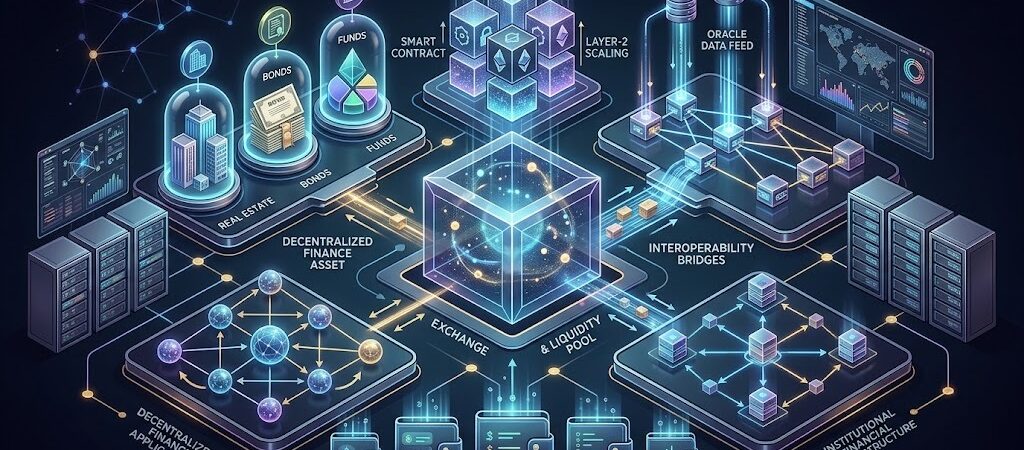
However, none of this can scale without reliable Web3 infrastructure. Blockchains provide settlement networks, Layer-2 systems improve scalability, oracles connect blockchain applications with external data, interoperability protocols connect different networks, and wallets and custody systems provide access and security. Together, these components form the infrastructure required for a more connected on-chain economy.
The transformation is therefore bigger than cryptocurrency alone. It involves the development of a financial environment where assets, money, applications, data, and settlement can increasingly operate on programmable blockchain networks.
Yet significant challenges remain. Regulation, cybersecurity, interoperability, privacy, liquidity, custody, scalability, and the connection between digital tokens and legally recognized assets all need to be addressed before tokenized markets can reach their full potential. The World Economic Forum similarly identifies interoperability, regulatory coordination, and resilient infrastructure as important priorities for the next phase of digital-asset adoption.
This article explores how DeFi, tokenization, and Web3 infrastructure are coming together, the technologies supporting this transformation, the opportunities they could create, and the challenges that could determine how quickly the next generation of financial markets develops.
Understanding the Web3 Financial Stack
The emerging Web3 financial system is not built around a single blockchain or application. Instead, it consists of multiple layers that work together to provide the networks, data, applications, assets, and user interfaces required for on-chain finance.
A useful way to understand this ecosystem is to think of it as a financial technology stack. At the foundation are blockchain networks that provide transaction execution and settlement. Above them are infrastructure services, smart contracts, wallets, data systems, and applications that allow users and institutions to interact with digital assets.
The Settlement Layer
At the bottom of the stack are blockchain networks that record transactions and provide the underlying settlement environment. These networks establish the rules for validating transactions, maintaining balances, and executing smart contracts.
Different networks can serve different purposes. Some prioritize decentralization and security, while others focus on speed, scalability, lower transaction costs, or specialized financial applications. Layer-2 networks can also process transactions on top of major Layer-1 blockchains, helping applications handle greater activity without placing every transaction directly on the underlying network.
This settlement layer is particularly important for tokenization because tokenized assets need a reliable environment where ownership records and transfers can be executed and verified.
The Smart Contract Layer
Smart contracts sit above the settlement infrastructure and provide programmable financial logic. Instead of requiring every transaction to be manually processed by a traditional intermediary, smart contracts can automatically execute predefined rules when specific conditions are met.
This functionality supports many DeFi applications, including decentralized exchanges, lending markets, borrowing platforms, derivatives, stablecoins, and automated asset-management strategies.
Smart contracts also make tokenized assets more programmable. A token can be designed with rules governing transfers, access, settlement, or other functions, depending on the underlying system and regulatory framework.
The Asset Layer
The next layer consists of the digital assets that move through these networks. This includes cryptocurrencies, stablecoins, governance tokens, tokenized securities, tokenized funds, and other representations of value.
Tokenization is particularly important because it can bring traditionally off-chain assets into programmable digital environments. However, the blockchain token itself does not automatically create legal ownership of an underlying asset. The relationship between the token, the underlying asset, the issuer, and the applicable legal framework remains essential.
This distinction becomes increasingly important as financial institutions move beyond experimental blockchain projects toward regulated tokenized products.
The Data and Oracle Layer
Blockchains cannot automatically access every piece of information outside their own networks. DeFi applications may need external information such as asset prices, interest rates, exchange rates, reserve information, or real-world events.
Oracles provide a mechanism for bringing external information into smart contracts. Ethereum’s documentation explains that smart contracts cannot directly access off-chain information and therefore rely on oracle systems to make external data available on-chain.
For example, a DeFi lending protocol may need a reliable market price to determine the value of collateral. A tokenized financial product may require external reference data to calculate its value or trigger a particular contractual condition.
This makes data infrastructure a critical part of the broader Web3 financial stack rather than simply an additional technical service.
The Application and User Layer
At the top of the stack are the applications that users actually interact with. These include decentralized exchanges, lending platforms, payment applications, tokenization platforms, portfolio-management tools, wallets, and institutional financial interfaces.
Modern Web3 applications therefore depend on many components working together. Developers may need blockchain networks, RPC infrastructure, indexing systems, smart contracts, wallets, storage, oracles, and application interfaces to deliver a complete product.
The result is an ecosystem in which DeFi provides financial applications, tokenization provides digital representations of assets, and Web3 infrastructure provides the underlying technology that connects everything together.
Understanding these layers is important because weaknesses in one part of the stack can affect the entire system. A highly secure smart contract, for example, may still depend on accurate oracle data, reliable blockchain infrastructure, secure wallets, and properly designed tokenization mechanisms.
As the industry develops, the competitive advantage may therefore come not from any single application, but from how effectively these different layers can work together.
DeFi — From Decentralized Applications to Financial Infrastructure
Decentralized finance, commonly known as DeFi, has evolved from a collection of experimental financial applications into an increasingly important part of the blockchain ecosystem. Its basic idea is straightforward: use blockchain networks and smart contracts to provide financial services without depending entirely on traditional centralized intermediaries.
Instead of a bank, brokerage, or centralized exchange controlling every stage of a transaction, DeFi protocols can use programmable smart contracts to manage assets, execute transactions, and enforce predefined rules.
What Makes DeFi Different?
Traditional financial systems generally rely on centralized institutions to maintain records, manage transactions, provide liquidity, and assess risk. DeFi changes this model by moving many of these functions onto publicly verifiable blockchain networks.
Users can interact directly with protocols through blockchain wallets. Depending on the application, they may exchange assets, provide liquidity, lend funds, borrow against collateral, or access other financial services.
This does not mean that DeFi eliminates every intermediary or risk. Instead, it changes where the rules and infrastructure reside. A financial service that traditionally depends on institutional processes can, in some cases, be implemented through transparent and programmable smart contracts.
Decentralized Exchanges and On-Chain Markets
Decentralized exchanges are one of the most recognizable applications within DeFi. Rather than matching trades through a conventional centralized order-book system, many decentralized exchanges use automated market makers and liquidity pools.
Users can contribute assets to these pools, while other participants can trade against the available liquidity. Smart contracts automatically manage the transactions according to the protocol’s rules.
This model helped demonstrate that blockchain networks could support financial markets that operate continuously and globally, subject to the rules and limitations of the underlying protocols.
Lending and Borrowing
DeFi lending platforms represent another major category. Users can deposit digital assets into liquidity pools and potentially earn returns, while borrowers can access funds by providing collateral.
Because these systems operate through smart contracts, collateral requirements, interest calculations, and liquidations can be handled programmatically.
However, DeFi lending also demonstrates why risk management is critical. Sharp market movements, inadequate collateral, smart-contract vulnerabilities, oracle failures, and liquidity problems can create significant losses.
Stablecoins as DeFi Infrastructure
Stablecoins have become particularly important to the DeFi ecosystem because they provide blockchain-based assets designed to maintain relatively stable values compared with highly volatile cryptocurrencies.
They can serve as trading pairs, collateral, settlement assets, and payment instruments across decentralized applications.
Their importance also extends beyond DeFi. As tokenization expands, stablecoins and other forms of blockchain-based money can potentially provide the settlement medium through which tokenized assets are transferred and exchanged.
This creates an important connection between DeFi and tokenization. Tokenized assets may provide new financial instruments, while stablecoins and DeFi protocols can provide markets and financial functionality around those assets.
DeFi Is Becoming More Modular
One of the defining characteristics of modern DeFi is its modular structure.
A single financial application may depend on several external components: a blockchain for settlement, an oracle for market data, a liquidity source for trading, another protocol for lending, and infrastructure services for accessing and indexing blockchain data.
This composability allows developers to combine existing protocols and create new financial products. At the same time, it creates interconnected risks because a failure in one important component can potentially affect applications that depend on it.
From DeFi Applications to Financial Infrastructure
The long-term significance of DeFi may therefore extend beyond individual decentralized applications.
As blockchain networks become more scalable and tokenized assets become more widely available, DeFi protocols could increasingly function as on-chain financial infrastructure for trading, lending, liquidity management, settlement, and other activities.
This evolution does not necessarily mean that traditional finance will disappear. A more realistic possibility is increasing interaction between traditional institutions and blockchain-based financial infrastructure.
Banks, asset managers, fintech companies, and other financial organizations can potentially use blockchain networks and DeFi-inspired technologies alongside existing systems, depending on regulatory requirements and risk controls.
The future of DeFi may consequently be less about replacing the entire financial system and more about building programmable financial markets that can connect with both digital-native and traditional assets.
That transition leads directly to one of the most important developments in the Web3 economy: tokenization. By bringing real-world financial assets onto blockchain networks, tokenization can provide DeFi with a much broader range of assets to work with.
Tokenization — Bringing Real-World Assets On-Chain
Tokenization is one of the most significant developments in the evolution of blockchain-based finance. In simple terms, tokenization is the process of creating a digital representation of an asset or financial claim on a blockchain network.
The concept goes beyond cryptocurrencies. Instead of using blockchain only for native digital assets, tokenization can potentially bring traditional financial instruments and real-world assets into programmable digital environments.
These assets can include government bonds, investment funds, private credit, equities, real estate, commodities, and other forms of financial or physical value.
How Tokenization Works
A tokenized asset typically involves more than simply creating a blockchain token.
First, an issuer or authorized entity identifies the underlying asset or financial claim. The asset is then represented through digital tokens according to a defined legal, technical, and operational structure.
The blockchain records transactions involving those tokens, while the issuer and other supporting institutions may remain responsible for custody, asset servicing, compliance, reporting, and the legal relationship between the token and the underlying asset.
This distinction is important.
A blockchain token does not automatically make the holder the legal owner of an underlying real-world asset. The legal rights attached to the token depend on the structure of the product, the issuer, the jurisdiction, and the applicable regulations.
Why Financial Institutions Are Exploring Tokenization
One reason institutions are interested in tokenization is the potential to make financial assets more programmable and easier to integrate with digital financial infrastructure.
Traditional financial markets often involve multiple systems and intermediaries for issuance, trading, clearing, settlement, custody, and reporting. Tokenization could potentially connect some of these functions through shared digital infrastructure.
The World Economic Forum has highlighted tokenization as a major development in financial markets, noting that assets including bonds, funds, and other financial instruments are increasingly being explored through blockchain-based systems.
Potential benefits include:
- Faster settlement — transactions may settle more efficiently depending on the underlying infrastructure.
- Greater transparency — blockchain records can provide a shared transaction history.
- Programmability — smart contracts can automate certain financial processes.
- Fractionalization — some assets can potentially be divided into smaller digital units.
- Improved accessibility — regulated tokenized products may eventually allow broader participation in certain markets.
- Integration with DeFi — tokenized assets can potentially interact with blockchain-based financial applications.
However, these benefits are not automatic. They depend heavily on the technology, legal framework, market structure, and operational design behind each tokenized product.
Tokenized Government Bonds and Funds
Government securities have become an important area for tokenization experiments.
A tokenized government bond or Treasury-related product can represent an economic interest in an underlying security while using blockchain infrastructure for issuance, transfer, and settlement.
Tokenized funds are another important development. Instead of maintaining ownership records exclusively through traditional systems, fund interests can potentially be represented through blockchain-based tokens.
This can create opportunities for more automated transfers, reporting, settlement, and integration with digital financial applications.
Tokenization and DeFi
The relationship between tokenization and DeFi could become increasingly important.
Traditional DeFi applications have historically relied heavily on crypto-native assets. Tokenization expands the potential asset universe by introducing representations of assets that originate outside blockchain networks.
For example, a tokenized financial asset could potentially be used within a lending protocol, traded through an on-chain marketplace, or integrated into another programmable financial application—provided that the relevant legal, technical, liquidity, and compliance requirements are satisfied.
This creates a possible cycle:
Real-world asset → Tokenization → Blockchain settlement → DeFi applications → On-chain liquidity
The more reliable this cycle becomes, the more closely traditional finance and decentralized finance could interact.
The Importance of Legal and Regulatory Infrastructure
Technology alone cannot solve the fundamental challenges of tokenization.
If a token represents a claim on a real-world asset, investors need clarity about what that claim actually means. Questions surrounding ownership, custody, bankruptcy protection, redemption rights, transfer restrictions, investor eligibility, and regulatory compliance can be just as important as the blockchain technology itself.
This is why tokenization should be viewed as a combination of technology, financial infrastructure, and legal architecture.
The International Monetary Fund has also emphasized that tokenization can affect the structure of financial markets and that the development of tokenized finance requires consideration of infrastructure, interoperability, regulation, and financial stability.
Tokenization Is More Than Putting Assets on a Blockchain
The real potential of tokenization lies not simply in creating digital versions of existing assets, but in making those assets part of a programmable financial environment.
A tokenized asset can potentially interact with automated settlement systems, digital identity solutions, compliance mechanisms, smart contracts, decentralized applications, and other blockchain-based services.
That could eventually create financial markets where assets and financial logic operate on shared digital infrastructure.
However, adoption will depend on whether tokenized markets can achieve sufficient liquidity, regulatory clarity, interoperability, security, and trust.
As tokenization expands, another component becomes increasingly important: the digital money used to settle these transactions. This brings stablecoins and tokenized forms of money into the center of the discussion.
Stablecoins and Tokenized Money
If tokenization brings assets onto blockchain networks, the financial system also needs digital forms of money that can move alongside those assets. This is where stablecoins and tokenized money become increasingly important.
Stablecoins are blockchain-based digital assets designed to maintain a relatively stable value, typically by referencing a fiat currency such as the U.S. dollar. They have become an important part of crypto markets and DeFi because they provide a less volatile medium for trading, settlement, lending, borrowing, and payments.
As blockchain-based financial markets develop, their role could extend beyond cryptocurrency trading.
Why Stablecoins Matter to DeFi
Stablecoins provide DeFi protocols with an asset that can be used for many financial functions without the same price volatility associated with assets such as Bitcoin or Ether.
For example, stablecoins can be used as:
- Trading pairs on decentralized exchanges
- Collateral in lending markets
- Settlement assets between blockchain users
- Liquidity within DeFi protocols
- Payment instruments for digital transactions
- A unit of account for certain on-chain applications
Their programmability also allows stablecoins to interact directly with smart contracts.
This creates a useful combination: smart contracts provide financial logic, while stablecoins provide blockchain-based money that can move according to that logic.
Stablecoins and Tokenized Assets
The relationship becomes even more interesting when tokenized real-world assets enter the same ecosystem.
Imagine an investor holding a tokenized government-security product on a blockchain. If the investor can exchange that asset for a stablecoin directly through an on-chain marketplace, several parts of the transaction can potentially occur within the same digital environment.
The result could be a more integrated system in which:
Tokenized assets + stablecoins + smart contracts + blockchain settlement = programmable financial markets
This does not necessarily mean every financial transaction will move entirely on-chain. Traditional banks, custodians, brokers, fund administrators, and other institutions can continue to perform important functions. Instead, blockchain infrastructure may become another settlement and transaction layer connected to existing financial systems.
Tokenized Deposits
Stablecoins are not the only form of blockchain-based money being explored.
Financial institutions are also examining tokenized deposits, which can represent deposits held with a regulated bank while using blockchain infrastructure to facilitate digital transfers and settlement.
Tokenized deposits can therefore differ fundamentally from privately issued stablecoins. Their design, issuer, legal status, redemption mechanism, and relationship with the banking system can be different.
The distinction is important because the future digital financial system may contain several forms of blockchain-based money rather than a single universal model.
Central Bank Digital Currencies
Central bank digital currencies, or CBDCs, are another potential component of the evolving digital-money landscape.
A CBDC is a digital form of central-bank money. Different jurisdictions are exploring CBDCs in different ways, including retail and wholesale applications.
Wholesale digital settlement assets could be particularly relevant to tokenized financial markets because financial institutions may eventually need efficient digital settlement mechanisms for transactions involving tokenized securities and other assets.
However, CBDCs, stablecoins, and tokenized deposits should not be treated as interchangeable. They can have substantially different issuers, risk structures, regulatory frameworks, and intended uses.
The Settlement Challenge
One of the major questions for tokenized finance is what happens after a tokenized asset is traded.
A market can tokenize a bond or fund, but buyers and sellers still need a reliable way to transfer value and complete settlement.
Blockchain-based money could potentially reduce friction by allowing the asset and payment leg of a transaction to operate within compatible digital infrastructure.
This could eventually support forms of atomic settlement, where the transfer of an asset and the corresponding payment occur together according to predefined rules.
Such systems could potentially reduce settlement risk and simplify parts of the transaction process, although achieving this at institutional scale requires robust technology, legal certainty, liquidity, compliance controls, and interoperability.
Stablecoins Also Introduce Risks
The growth of stablecoins does not eliminate financial risk.
Important issues include reserve quality, redemption mechanisms, issuer risk, operational security, liquidity, regulatory compliance, and the possibility that a stablecoin could lose its intended value.
There are also broader questions about how large-scale stablecoin adoption could interact with commercial banks, payment systems, monetary policy, and financial stability.
For these reasons, the development of digital money is likely to remain closely connected with regulation and financial-market oversight.
The Bigger Picture
Stablecoins and tokenized money can be viewed as the financial rails for an increasingly tokenized economy.
Tokenization provides digital representations of assets. DeFi provides markets and financial applications. Stablecoins and other forms of digital money can provide the means of payment and settlement.
But for this ecosystem to operate efficiently at scale, the underlying blockchain networks must be capable of handling large transaction volumes at reasonable costs.
That brings us to another critical component of Web3 infrastructure: Layer-2 networks and blockchain scalability.
Layer-2 Networks and Scalable Blockchain Infrastructure
As DeFi applications and tokenized assets expand, blockchain networks face a fundamental challenge: how to process significantly more activity without sacrificing security, decentralization, or efficiency.
A blockchain that becomes expensive or congested during periods of high demand can create problems for financial applications. If users must pay high transaction fees or wait for settlement, the advantages of programmable finance can become harder to realize.
This is where Layer-2 networks and other scaling technologies become increasingly important.
Why Blockchain Scalability Matters
A financial ecosystem supporting millions of users and large numbers of transactions requires infrastructure capable of handling substantial activity.
DeFi applications may generate frequent transactions through trading, lending, collateral management, liquidations, and other activities. Tokenized financial markets can also require transactions for issuance, transfers, redemptions, settlements, and asset servicing.
If all activity must be processed directly by a single Layer-1 blockchain, network capacity can become a limiting factor.
Scalability therefore isn’t simply a technical concern. It can directly influence the cost, speed, and usability of on-chain financial markets.
What Are Layer-2 Networks?
Layer-2 networks are systems designed to process transactions while using an underlying Layer-1 blockchain for security or settlement.
Rather than requiring every individual transaction to be processed independently on the main blockchain, Layer-2 systems can process transactions more efficiently and then submit relevant information or proofs back to the underlying network.
Ethereum’s documentation describes Layer-2 networks as scaling solutions that process transactions separately from Ethereum Mainnet while using Ethereum as part of their security and settlement framework. (ethereum.org)
This approach can significantly improve transaction capacity while reducing the amount of computation and data that must be handled directly by the base layer.
Rollups and Scaling
One of the major Layer-2 approaches is the rollup.
Rollups execute transactions outside the main Ethereum execution environment and then publish data or proofs back to Ethereum. Two major categories are commonly discussed:
Optimistic rollups generally assume transactions are valid unless challenged during a specified period.
Zero-knowledge rollups, often called ZK-rollups, use cryptographic proofs to demonstrate that transactions have been processed correctly.
Both approaches aim to increase blockchain capacity, although they differ in their technical designs, security assumptions, costs, and user experience.
Why Layer-2s Matter for DeFi
Lower transaction costs can make more types of financial activity economically practical.
For example, smaller trades, frequent portfolio adjustments, automated strategies, and other transactions may become more viable when fees are reduced.
Layer-2 networks can also give developers additional environments for building decentralized applications while still connecting to the broader blockchain ecosystem.
This creates a more scalable foundation for DeFi as activity grows.
Layer-2s and Tokenized Assets
Tokenization creates another reason to improve blockchain scalability.
A tokenized asset market could involve large numbers of transactions across issuance, trading, settlement, transfers, redemptions, and compliance processes.
If tokenized finance eventually reaches substantial institutional and retail adoption, the infrastructure supporting these transactions will need to provide predictable costs and reliable performance.
Layer-2 networks could potentially handle some of this activity while using established Layer-1 networks for settlement and security.
This creates a possible architecture:
Layer-1 → Layer-2 → Applications → Tokenized Assets → Users
Each layer can perform a different function while remaining connected to the broader blockchain ecosystem.
Scalability Is Not Only About Speed
It is tempting to define scalability simply as transactions per second, but financial infrastructure requires much more than raw transaction throughput.
A scalable blockchain environment must also consider:
- Security
- Transaction finality
- Reliability
- Data availability
- Liquidity
- Interoperability
- Transaction costs
- Developer tooling
- Regulatory requirements
A network that processes transactions extremely quickly but lacks sufficient security or reliable data infrastructure may not be appropriate for high-value financial applications.
The challenge is therefore to build infrastructure that can scale while maintaining the properties users and institutions require.
The Fragmentation Challenge
Layer-2 adoption also introduces a new challenge: fragmentation.
As more Layer-2 networks emerge, liquidity and applications can become distributed across multiple environments.
A user may hold assets on one network while a DeFi application operates on another. A tokenized asset could be issued on one blockchain while its users and liquidity exist elsewhere.
Without effective communication between these networks, the ecosystem can become fragmented.
This makes interoperability one of the next major infrastructure challenges for Web3 finance.
The future of scalable blockchain finance will therefore depend not only on building faster and cheaper networks, but also on making those networks work together efficiently and securely.
Interoperability — Connecting Blockchain Networks
The growth of multiple blockchain networks has created greater choice for developers, businesses, and users. Different Layer-1 blockchains, Layer-2 networks, and specialized blockchain environments can offer different combinations of security, scalability, cost, and functionality.
However, this diversity also creates a fundamental challenge: blockchains need ways to communicate with one another.
If every network operates as an isolated environment, assets, liquidity, applications, and users can become fragmented. For DeFi and tokenized finance to reach their full potential, different blockchain environments need reliable mechanisms for transferring information and, where appropriate, moving assets between networks.
Why Interoperability Matters
Imagine a financial ecosystem where a tokenized fund exists on one blockchain, a DeFi lending market operates on another network, and the user’s stablecoins are held somewhere else.
Without interoperability, moving between these systems can require additional steps, intermediaries, or specialized infrastructure.
Interoperability aims to reduce these barriers by allowing different blockchain networks to exchange information and coordinate transactions.
This can create a more connected environment in which users do not have to treat every blockchain as a completely separate financial system.
Bridges and Cross-Chain Infrastructure
One of the most familiar approaches to interoperability is the blockchain bridge.
Bridges can allow assets or information to move between different blockchain environments. Depending on the design, a bridge may lock an asset on one network and issue a corresponding representation on another.
However, bridges have also demonstrated that interoperability can introduce significant security risks.
A weakness in bridge smart contracts, validators, key-management systems, or verification mechanisms can potentially expose large amounts of value.
This means that cross-chain infrastructure must be designed with strong security assumptions rather than treating interoperability simply as a convenience feature.
Messaging Between Blockchains
Interoperability is broader than transferring tokens.
Blockchain networks may also need to exchange messages and data.
For example, an application on one network may need to know that a transaction occurred on another network. A decentralized application could potentially trigger an action based on information originating elsewhere.
Cross-chain messaging systems are designed to facilitate this type of communication.
As Web3 becomes more modular, secure messaging could become increasingly important because applications may depend on multiple networks rather than operating entirely within one blockchain.
Interoperability and DeFi
DeFi can benefit significantly from connected blockchain environments.
Liquidity distributed across several networks can potentially become more accessible through cross-chain infrastructure. Users may be able to interact with applications on different networks without manually managing every underlying technical process.
Interoperability can also help developers combine specialized capabilities.
One blockchain may provide a particular security model, another may offer lower-cost execution, and another may be optimized for a specific application. Connecting these environments can potentially allow developers to build more flexible financial systems.
However, greater connectivity also means that risks can spread across networks.
A vulnerability in one critical cross-chain component could affect multiple applications and ecosystems that depend on it.
Interoperability and Tokenized Assets
Tokenization makes interoperability even more important.
Financial institutions may not all choose the same blockchain. Different asset issuers could use different networks based on their technical requirements, regulatory considerations, institutional partnerships, or preferred infrastructure providers.
If tokenized assets become widely distributed across multiple networks, investors and institutions will need ways to interact with these assets without creating isolated liquidity pools.
For example, a tokenized bond issued on one network could eventually need to interact with:
- A stablecoin on another network
- A DeFi application on a Layer-2
- An institutional custody system
- An external identity or compliance service
- An oracle providing market information
The ability to connect these components could become a defining feature of the future Web3 financial stack.
The Security Trade-Off
Interoperability creates an important balance between connectivity and security.
Every additional connection between networks introduces another technical dependency. Systems must determine how transactions are verified, how messages are authenticated, how failures are handled, and who or what is responsible for securing the communication process.
For institutional finance, these questions become even more important because large amounts of capital and legally significant assets may eventually depend on cross-chain infrastructure.
As a result, the future of interoperability is unlikely to be determined simply by which network can connect to the largest number of chains. Security, reliability, transparency, and predictable behavior will be equally important.
Toward a More Connected Web3 Economy
The long-term objective is not necessarily to create one blockchain that replaces every other network.
Instead, the ecosystem may develop into a network of interconnected blockchains, each performing specialized functions while communicating through common standards and interoperability infrastructure.
In such an environment, users may interact with a financial application without needing to understand which blockchain processes each individual component behind the scenes.
For DeFi and tokenized finance, this could make the underlying blockchain ecosystem feel more like a connected financial network rather than a collection of isolated chains.
But interoperability alone cannot make decentralized finance reliable. Applications also need accurate information from outside blockchain networks.
That brings another critical component of Web3 infrastructure into focus: oracles and on-chain data.
Oracles, Data and On-Chain Intelligence
Blockchain networks are powerful because they can independently verify transactions and execute smart contracts according to predefined rules. However, blockchains generally cannot access every piece of information that exists outside their own networks.
A decentralized lending protocol, for example, may need the current market price of an asset to determine whether a borrower’s collateral remains sufficient. A tokenized financial product may require interest-rate information, exchange rates, or other external data.
This is where blockchain oracles become an essential part of Web3 infrastructure.
What Is a Blockchain Oracle?
An oracle is a system that provides external information to blockchain-based applications.
Ethereum’s documentation explains that smart contracts cannot directly retrieve off-chain information and therefore require oracle mechanisms to access external data.
The information supplied by an oracle can include:
- Asset prices
- Foreign exchange rates
- Interest rates
- Commodity prices
- Market data
- Weather information
- Blockchain events
- Real-world events
Once this information reaches a blockchain environment, smart contracts can use it to execute predefined actions.
Why DeFi Depends on Oracles
Many DeFi protocols cannot function correctly without reliable market data.
Consider a lending protocol where users deposit cryptocurrency as collateral. The protocol needs to know the current value of that collateral.
If the collateral value falls below a required threshold, the protocol may automatically initiate a liquidation.
This means the oracle is not simply displaying information. Its data can directly influence financial transactions.
A compromised, inaccurate, delayed, or manipulated price feed could therefore create serious consequences for users and protocols.
Decentralized Data Feeds
For this reason, many oracle systems use multiple data sources and verification mechanisms rather than relying on a single centralized provider.
The objective is to reduce the possibility that one inaccurate or manipulated data source can control a financial application’s behavior.
Different oracle architectures use different methods for collecting, validating, and delivering information. The design chosen can affect decentralization, speed, reliability, cost, and security.
This creates an important principle for Web3 finance:
The security of a smart contract depends not only on the contract’s code, but also on the reliability of the information it receives.
Oracles and Tokenized Assets
Tokenization introduces additional data requirements.
A tokenized security or financial product may need information about its underlying asset, valuation, interest calculations, corporate actions, or other external events.
For example, a tokenized financial instrument could require an external reference rate to calculate payments. A tokenized commodity could depend on market pricing information. A tokenized fund could require updated net asset value data.
Oracles can potentially connect these external data sources with blockchain-based applications.
This makes them an important bridge between on-chain financial systems and the real-world economy.
The Oracle Problem
The fundamental challenge is sometimes described as the oracle problem.
Blockchains are designed to provide strong guarantees about information recorded within their own networks. But when external information enters the system, the blockchain itself may not be able to independently determine whether that information is correct.
This creates a trust boundary.
The blockchain can verify that a particular oracle submitted a particular data value, but determining whether that value accurately represents reality may require additional mechanisms.
Therefore, robust oracle infrastructure needs to consider:
- Data-source quality
- Multiple independent sources
- Manipulation resistance
- Update frequency
- Validation mechanisms
- Economic incentives
- Failure handling
- Transparency
On-Chain Data and Analytics
Oracles are only one part of the broader blockchain data ecosystem.
Blockchain networks also generate enormous amounts of publicly accessible transaction data. Specialized indexing and analytics infrastructure can organize this information so developers, institutions, and users can understand activity across networks.
On-chain analytics can help monitor:
- Wallet activity
- Token transfers
- Exchange flows
- Liquidity
- DeFi usage
- Smart-contract interactions
- Network activity
- Asset movements
This information can support everything from individual investment research to institutional risk monitoring.
For a growing tokenized financial ecosystem, the ability to analyze blockchain activity efficiently could become increasingly important.
Data as Financial Infrastructure
As DeFi and tokenization mature, data should not be viewed as a secondary technical feature.
Reliable data is part of financial infrastructure.
Markets need accurate prices. Lending protocols need collateral information. Tokenized products need information about underlying assets. Compliance systems may need transaction histories and identity-related information. Risk-management systems need timely signals.
All of these functions depend on data moving accurately between different parts of the financial stack.
The combination of oracles, blockchain indexing, analytics, and external data services therefore creates an information layer connecting blockchain networks with financial markets.
Yet even with reliable networks and accurate data, users and institutions still need a secure way to hold and control their digital assets.
That leads to another critical part of the Web3 infrastructure stack: wallets, custody, and security.
Custody, Wallets and Security Infrastructure
As financial assets move onto blockchain networks, security and custody become fundamental components of the Web3 financial infrastructure.
In traditional finance, banks, brokers, custodians, and other institutions often manage assets and maintain records on behalf of customers. In blockchain-based systems, ownership and control can depend heavily on cryptographic keys.
This creates new possibilities for direct asset ownership, but it also introduces new responsibilities and risks.
The Role of Crypto Wallets
A cryptocurrency wallet provides users with an interface for managing blockchain assets and interacting with decentralized applications.
Importantly, a wallet does not usually store the blockchain asset itself. The blockchain records the asset and its ownership state, while the wallet helps users manage the private keys or credentials required to authorize transactions.
This distinction is important because losing control of the relevant private key can mean losing the ability to move or manage an asset.
Wallets can take several forms, including software wallets, hardware wallets, institutional custody systems, and other key-management solutions.
Each approach involves different trade-offs between convenience, security, accessibility, and control.
Self-Custody
One of the defining features of blockchain-based finance is self-custody.
With self-custody, users maintain control over the private keys associated with their assets rather than relying entirely on a centralized institution.
This can provide greater direct control and reduce dependence on third-party custodians.
However, self-custody also transfers responsibility to the user. Private keys, recovery phrases, and transaction approvals must be protected carefully.
Phishing attacks, malicious applications, compromised devices, social engineering, and signing fraudulent transactions can all create risks even when the underlying blockchain is functioning correctly.
Institutional Custody
Institutional participation creates a different set of requirements.
Large financial organizations may need sophisticated custody infrastructure that supports multiple authorization levels, transaction controls, compliance procedures, auditability, insurance considerations, and operational security.
Institutional custody can therefore involve more than simply storing private keys.
It may include:
- Multi-party authorization
- Secure key-management systems
- Transaction policies
- Access controls
- Monitoring and alerts
- Compliance procedures
- Audit trails
- Disaster recovery
- Separation of operational responsibilities
These mechanisms can help institutions manage blockchain assets while maintaining internal controls similar to those expected in traditional financial operations.
Smart-Contract Security
Custody is only one part of the security equation.
DeFi users often interact with smart contracts that can control substantial amounts of digital assets. A vulnerability in a smart contract can potentially result in funds being lost or exploited.
This makes code audits, testing, formal verification where appropriate, bug-bounty programs, upgrade controls, and ongoing monitoring important components of DeFi security.
However, an audit does not guarantee that a protocol is completely safe.
Smart-contract systems can contain complex interactions, and vulnerabilities may emerge from dependencies, economic incentives, governance mechanisms, or unexpected market conditions.
Security Across the Web3 Stack
The security challenge becomes even more complicated when multiple infrastructure layers interact.
A financial application may depend on:
Wallet → Smart Contract → Oracle → Blockchain → Layer-2 → Bridge → External Data
A weakness anywhere in this chain can potentially affect the overall system.
This is why security must be considered as a system-wide property, rather than focusing only on individual smart contracts.
For tokenized financial assets, the stakes can be even higher because the underlying assets may have significant economic or legal value.
Institutional-Grade Infrastructure
As traditional financial institutions enter digital assets, demand is growing for infrastructure that combines blockchain functionality with established financial controls.
Institutions may require:
- Secure custody
- Identity and access management
- Transaction screening
- Regulatory reporting
- Risk controls
- Asset segregation
- Reliable settlement
- Operational resilience
This is contributing to the development of a broader institutional Web3 infrastructure layer.
The objective is not necessarily to reproduce every traditional financial process on a blockchain. Instead, institutions can combine blockchain’s programmable capabilities with established controls designed for managing financial risk.
Security Will Determine Adoption
Technology alone cannot create trust.
For DeFi, tokenization, and Web3 infrastructure to support increasingly valuable financial activity, users and institutions need confidence that assets can be accessed securely, transactions can be authorized correctly, and infrastructure can continue operating during periods of stress.
This makes security one of the most important factors determining whether blockchain-based financial infrastructure can move from experimentation to large-scale adoption.
As more institutions explore tokenized assets and on-chain finance, the next question becomes increasingly important:
What happens when traditional financial institutions begin using this infrastructure at significant scale?
That leads us to the institutional adoption story.
Institutional Adoption and the New Financial Infrastructure
The development of DeFi, tokenization, and Web3 infrastructure is no longer limited to cryptocurrency-native companies and individual users. Traditional financial institutions are increasingly exploring blockchain technology as a potential component of the future financial system.
Banks, asset managers, payment companies, exchanges, and financial-technology providers are examining how blockchain can improve areas such as settlement, asset issuance, payments, collateral management, and financial-market infrastructure.
This does not necessarily mean that traditional institutions are abandoning existing systems. Instead, a more gradual transformation is taking place in which blockchain infrastructure is being integrated with established financial processes.
From Experimentation to Infrastructure
Early institutional blockchain projects often focused on proving that a particular process could work on a distributed ledger.
The focus is now increasingly shifting toward practical questions:
- Can the system operate reliably at scale?
- Can it meet regulatory requirements?
- Can institutions maintain appropriate controls?
- Can tokenized assets interact with existing financial systems?
- Can different blockchain networks communicate?
- Can institutions provide secure custody and settlement?
These questions reflect a transition from blockchain experimentation to financial infrastructure development.
The World Economic Forum has highlighted this broader shift, noting that tokenization and blockchain infrastructure are increasingly being explored as components of financial markets rather than simply as cryptocurrency technologies.
Tokenized Securities and Funds
One major area of institutional interest is the tokenization of traditional financial instruments.
Bonds, investment funds, private credit, and other financial assets can potentially be represented through blockchain-based tokens.
For institutions, the attraction is not simply creating a digital version of an existing asset. Tokenization can potentially allow financial products to interact with programmable settlement, automated compliance processes, digital ownership records, and blockchain-based applications.
The International Monetary Fund has similarly identified tokenization as a development capable of changing financial-market infrastructure and the way assets and transactions are organized.
Institutional Payments and Settlement
Payments are another important area.
Stablecoins, tokenized deposits, and other digital settlement mechanisms can potentially allow value to move through blockchain networks continuously rather than relying exclusively on traditional payment rails.
For international transactions, blockchain-based settlement could potentially reduce some of the friction created by multiple intermediaries and separate settlement systems.
However, actual benefits depend on factors such as regulation, liquidity, interoperability, transaction costs, and integration with existing banking infrastructure.
DeFi and Institutional Finance
Institutional participation does not necessarily require banks to use completely permissionless DeFi protocols in their existing form.
Instead, institutions may adopt DeFi-inspired financial mechanisms within controlled or regulated environments.
For example, programmable smart contracts could be used for automated settlement, collateral management, or financial calculations while access to the system is restricted according to regulatory and institutional requirements.
This could produce a hybrid model combining:
Traditional financial institutions + blockchain infrastructure + programmable financial logic
Such systems could retain institutional governance and regulatory controls while taking advantage of some blockchain capabilities.
The Importance of Compliance
For institutional adoption to grow, regulatory compliance must be built into the infrastructure.
Financial institutions operate under rules involving customer identification, anti-money-laundering controls, sanctions screening, investor eligibility, reporting, and asset protection.
A blockchain-based system therefore needs to accommodate these requirements rather than assuming that decentralization automatically removes them.
This is one reason why compliance infrastructure is becoming increasingly important within the tokenization ecosystem.
Identity systems, permissioning mechanisms, transaction monitoring, and automated compliance tools may become essential components of institutional blockchain applications.
Interoperability With Traditional Systems
Institutional adoption also depends on integration.
Financial institutions already operate complex technology stacks involving databases, payment systems, custody platforms, trading systems, accounting infrastructure, and regulatory reporting.
Blockchain networks must therefore connect with existing systems if they are to become part of mainstream financial infrastructure.
This creates another important layer of development: Web3 infrastructure must become interoperable not only with other blockchains, but also with traditional financial technology.
The institutions that successfully bridge these environments could play an important role in shaping the next generation of financial markets.
A Gradual Transformation
The future is unlikely to arrive as a single dramatic replacement of traditional finance.
Instead, adoption may occur gradually.
Some financial products may become tokenized first. Certain payment and settlement processes may move onto blockchain networks. Institutions may use blockchain-based infrastructure behind the scenes while customers interact with familiar financial interfaces.
Over time, these separate developments could become increasingly interconnected.
A tokenized asset could be issued through institutional infrastructure, settled using blockchain-based money, traded through an on-chain marketplace, protected by institutional custody, and supported by oracle and interoperability infrastructure.
This would represent something much larger than cryptocurrency adoption.
It would be the emergence of a programmable financial infrastructure layer connecting traditional and digital markets.
Why This Matters for the Future
Institutional adoption could provide the liquidity, capital, regulatory expertise, and infrastructure investment necessary to expand tokenized financial markets.
At the same time, institutional involvement may introduce more formal controls and reduce some of the experimental flexibility that characterized the early DeFi ecosystem.
The result could be a financial system that combines elements of both worlds: the programmability and transparency of blockchain networks with the governance, compliance, and risk-management structures of traditional finance.
But this transition is not guaranteed.
Significant technical, regulatory, economic, and security challenges remain—and understanding those challenges is essential before assessing how large the opportunity could become.
Key Risks and Challenges
The combination of DeFi, tokenization, and Web3 infrastructure has significant potential, but the technology is still developing. Moving financial assets and services onto blockchain networks introduces new opportunities while also creating technical, financial, legal, and operational challenges.
For widespread adoption to occur, these risks must be addressed across the entire ecosystem rather than at only one individual layer.
1. Smart-Contract Risk
Smart contracts are central to DeFi and many tokenization systems. They automate financial processes, but their code can contain vulnerabilities.
A programming error or unexpected interaction between contracts can potentially result in significant financial losses. Complex protocols may also depend on multiple external contracts, increasing the number of components that need to be secured.
Audits, testing, formal verification, bug-bounty programs, and careful upgrade mechanisms can reduce risk, but none can guarantee that a protocol is completely free from vulnerabilities.
2. Oracle and Data Risk
Financial applications often depend on external information.
If an oracle provides inaccurate, delayed, or manipulated data, a smart contract could make an incorrect financial decision.
This is particularly important for lending protocols, derivatives, stablecoins, and tokenized assets whose value or behavior may depend on external market information.
Reliable data infrastructure therefore remains a critical requirement for decentralized financial systems.
3. Interoperability Risk
Connecting multiple blockchains can increase flexibility, but it also creates additional security dependencies.
Bridges and cross-chain messaging systems must correctly verify transactions and messages between different networks. A vulnerability in an interoperability system could potentially affect assets and applications across several ecosystems.
As blockchain networks become increasingly interconnected, cross-chain security will become an increasingly important part of overall Web3 security.
4. Regulatory Uncertainty
Tokenization sits at the intersection of technology and financial regulation.
A tokenized asset may involve securities laws, banking regulations, investor-protection requirements, taxation, anti-money-laundering rules, custody requirements, and other legal frameworks depending on its structure and jurisdiction.
Regulatory uncertainty can make it difficult for institutions to design products that operate consistently across different markets.
Clear and practical regulatory frameworks could therefore play an important role in determining how quickly institutional tokenization develops.
5. Liquidity Fragmentation
Tokenized assets may exist across multiple blockchains, platforms, and financial systems.
If liquidity becomes fragmented, investors may have difficulty finding counterparties or obtaining efficient prices.
The same problem can affect DeFi. Liquidity spread across numerous networks and protocols can make markets less efficient and increase complexity.
Interoperability can help address this challenge, but connectivity alone does not guarantee deep and reliable liquidity.
6. Custody and Key-Management Risk
Blockchain-based assets require secure management of cryptographic credentials.
For individual users, losing access to a private key can create serious problems. For institutions, key management becomes a complex operational responsibility involving authorization policies, access controls, recovery mechanisms, and security procedures.
Institutional-grade custody therefore needs to combine blockchain technology with strong operational controls.
7. Scalability and Performance
As adoption increases, blockchain infrastructure must handle greater transaction volumes without becoming prohibitively expensive or unreliable.
Layer-2 networks and other scaling technologies can help increase capacity, but they also introduce additional infrastructure and interoperability requirements.
The challenge is not simply processing more transactions. Financial systems also require predictable costs, reliable settlement, strong security, and operational resilience.
8. Privacy and Confidentiality
Public blockchains can provide valuable transparency, but financial institutions often require confidentiality.
Businesses may not want competitors to see every transaction, position, or financial relationship on a public ledger.
This creates a difficult balance between transparency and privacy.
Technologies such as zero-knowledge proofs and privacy-preserving systems may help address this challenge by allowing certain information to be verified without revealing all underlying details.
9. Real-World Asset Verification
Tokenization creates another fundamental challenge: ensuring that the blockchain representation remains connected to the underlying real-world asset.
If a token represents a bond, fund, commodity, or other asset, users need confidence that the underlying asset actually exists, is properly controlled, and can be redeemed or transferred according to the terms of the product.
This requires reliable legal structures, custodians, issuers, auditors, reporting systems, and other supporting institutions.
Blockchain technology alone cannot solve this problem.
10. Governance and Centralization
Not every Web3 system is equally decentralized.
Some protocols rely on centralized development teams, administrators, validators, multisignature wallets, governance groups, or other entities with significant control.
This does not automatically make a system unsafe, but users and institutions need to understand where decision-making power exists.
Governance becomes particularly important when a protocol manages significant financial assets or can change critical system parameters.
Building Trust Across the Stack
These challenges demonstrate that the future of Web3 finance will depend on more than technological innovation.
A successful financial infrastructure must combine:
Security + scalability + reliable data + interoperability + liquidity + legal clarity + strong governance
Weakness in any one of these areas can limit adoption.
The most successful systems may therefore be those that recognize blockchain as part of a broader financial infrastructure rather than treating it as a standalone technology.
The good news is that many of these challenges are already driving innovation across the industry. Developers, financial institutions, infrastructure providers, and regulators are working on solutions that could make blockchain-based financial systems more secure and practical.
This raises an important question: what could the next stage of this transformation actually look like?
What Comes Next for DeFi, Tokenization & Web3
The next phase of blockchain adoption is likely to be defined less by individual cryptocurrencies and more by the development of connected financial infrastructure.
DeFi, tokenization, stablecoins, Layer-2 networks, interoperability systems, oracles, custody solutions, and institutional platforms are increasingly becoming parts of the same broader ecosystem.
Rather than operating as isolated technologies, these components can work together to create financial markets that are more programmable, automated, and digitally connected.
From Individual Tokens to Financial Networks
The early blockchain economy focused heavily on individual digital assets and cryptocurrency trading.
The emerging model is broader.
Instead of asking only whether an asset can exist on a blockchain, financial institutions and developers are increasingly considering how assets, money, applications, and settlement can interact on shared digital infrastructure.
This could lead to markets where tokenized securities, stablecoins, DeFi applications, and traditional financial services interact through programmable systems.
Tokenization Could Expand Beyond Traditional Assets
Tokenization is likely to continue expanding into different categories of financial and real-world assets.
Government securities and investment funds have already become important areas of experimentation, while private credit, real estate, commodities, and other asset classes could also become increasingly digitized.
The larger opportunity may come from combining these assets with programmable financial applications.
For example, a tokenized asset could potentially be used as collateral, traded through an on-chain marketplace, incorporated into a portfolio, or settled using blockchain-based money.
This creates possibilities that are difficult to achieve when assets and financial applications operate on completely separate systems.
DeFi Could Become More Institutional
The future of DeFi may involve greater participation from financial institutions.
However, institutional DeFi may look different from the permissionless applications that dominated the industry’s early years.
Institutions may require identity verification, compliance controls, permissioned access, institutional custody, transaction monitoring, and formal governance.
This could result in a broader range of on-chain financial markets, including systems designed specifically for regulated institutions.
The boundary between DeFi and traditional finance may therefore become increasingly difficult to define.
Blockchain Infrastructure Will Become More Modular
Another major trend is the increasing specialization of blockchain infrastructure.
Instead of one blockchain attempting to perform every function, different networks and services can specialize in areas such as:
- Settlement
- Execution
- Data availability
- Scaling
- Interoperability
- Storage
- Privacy
- Oracles
- Identity
- Asset issuance
These components can then connect through interoperability and messaging systems.
This modular approach could allow developers and institutions to select infrastructure according to their specific requirements.
Stablecoins Could Become Digital Settlement Rails
Stablecoins may also play a larger role in the future financial system.
Their ability to transfer value through blockchain networks makes them useful for trading, payments, DeFi, and settlement.
As tokenized assets expand, stablecoins and other forms of digital money could increasingly operate alongside tokenized securities and financial products.
This could create an environment where the asset leg and payment leg of a transaction can both operate digitally and potentially settle through compatible infrastructure.
The Rise of On-Chain Financial Markets
If the necessary infrastructure develops successfully, more financial activity could gradually move on-chain.
This does not necessarily mean that every bank account, stock, or financial transaction will exist entirely on a public blockchain.
Instead, certain parts of the financial process could become blockchain-based while other components remain within traditional systems.
For example:
Issuance → Trading → Settlement → Custody → Reporting
could involve a combination of blockchain infrastructure and conventional financial technology.
The result could be a hybrid financial system where blockchain provides programmable settlement and asset infrastructure while regulated institutions continue providing important financial services.
Regulation Will Shape the Outcome
Technology will not determine the future by itself.
Regulation will play a major role in determining which tokenized assets can be offered, who can access them, how they can be transferred, and what responsibilities issuers and service providers must follow.
Clear rules could encourage institutional investment and infrastructure development.
At the same time, poorly designed or fragmented regulation could increase costs and limit interoperability between markets.
The future therefore depends on technical innovation and regulatory evolution developing alongside each other.
Security Will Become a Competitive Advantage
As financial value moves on-chain, security is likely to become one of the most important differentiators between competing platforms.
Institutions will not only evaluate transaction speed and fees. They will also consider custody, resilience, smart-contract security, data reliability, governance, compliance, and operational controls.
Infrastructure providers capable of delivering these features consistently could become important parts of the future digital financial system.
A More Programmable Financial Economy
The long-term vision is a financial environment in which assets and financial rules can interact programmatically.
A tokenized asset could potentially carry information about ownership or transfer conditions. A smart contract could automate settlement. An oracle could provide external market information. A Layer-2 could process transactions efficiently. An interoperability system could connect multiple networks. A secure custody system could protect institutional assets.
Together, these technologies could create a financial ecosystem that operates with a greater degree of automation, connectivity, and programmability.
But this future is not guaranteed.
Adoption will depend on whether the industry can solve the challenges of security, regulation, liquidity, scalability, interoperability, privacy, and real-world asset verification.
The final question is therefore not whether blockchain technology has potential.
It is whether the ecosystem can build reliable infrastructure that people, businesses, and financial institutions are willing to trust.
That brings us to the final section.
Conclusion — Building the Next Generation of Financial Infrastructure
DeFi, tokenization, and Web3 infrastructure represent different parts of a much larger transformation taking place across the financial system.
DeFi provides programmable financial applications. Tokenization brings traditional assets into digital environments. Web3 infrastructure provides the networks, data, interoperability, scalability, custody, and security needed to connect these components.
Individually, each technology offers important possibilities. Together, they could create a more connected and programmable financial ecosystem.
Tokenization could expand the range of assets available on blockchain networks. Stablecoins and other forms of digital money could provide digital settlement mechanisms. DeFi applications could create markets and financial services around these assets, while Layer-2 networks could provide additional scalability.
At the same time, oracles and data infrastructure can connect blockchain applications with external information, while interoperability systems can connect different blockchain networks. Custody and security infrastructure can provide the controls required to protect assets and support institutional participation.
However, the transition will not happen automatically.
The industry still needs to address significant challenges involving security, regulation, scalability, liquidity, interoperability, privacy, governance, and the legal connection between digital tokens and real-world assets.
These challenges are particularly important because financial infrastructure requires a much higher level of reliability than experimental technology. A system handling valuable assets must remain secure and functional not only during normal market conditions but also during periods of extreme volatility and stress.
The future is therefore unlikely to be a simple replacement of traditional finance with decentralized systems.
A more realistic possibility is a hybrid financial ecosystem in which traditional institutions, blockchain networks, tokenized assets, stablecoins, DeFi protocols, and Web3 infrastructure operate alongside one another.
As this ecosystem develops, the most important innovation may not be any single token, blockchain, or application. It may be the infrastructure that allows all of these components to work together.
The broader vision is a financial system where assets can be represented digitally, transactions can be executed programmatically, settlement can become more efficient, and financial applications can interact across interconnected networks.
Whether that vision becomes mainstream will depend on technology, regulation, institutional adoption, market demand, and—most importantly—the ability to build systems that users and institutions can trust.
DeFi, tokenization, and Web3 infrastructure are therefore not simply three separate trends. They are increasingly becoming interconnected building blocks of the next generation of digital finance.