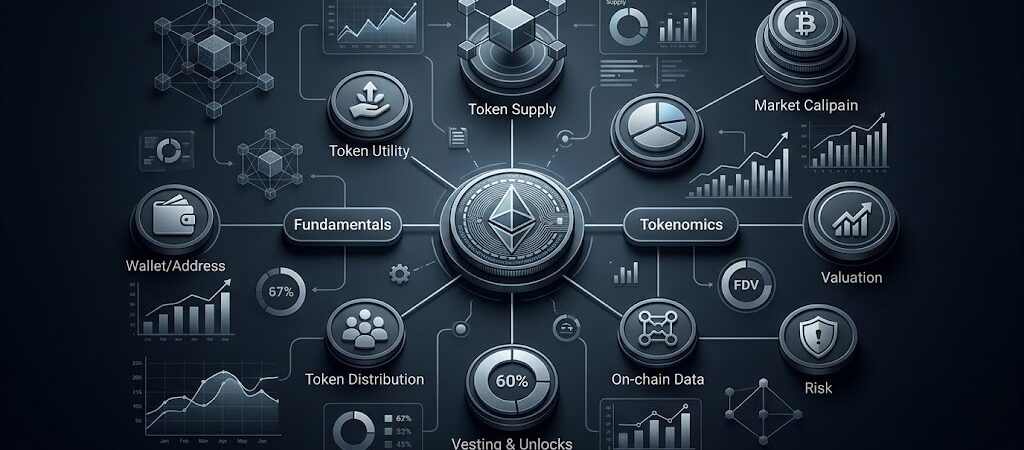
Introduction to Token Fundamentals and Tokenomics
The cryptocurrency market contains thousands of tokens, but not every project deserves an investment simply because its price is rising or its community is growing. Behind every serious crypto project are fundamental factors that can help investors understand its purpose, potential, risks, and long-term sustainability.
One of the most useful approaches is to evaluate a token through two connected areas: token fundamentals and tokenomics.
Token fundamentals focus on the underlying project. This includes the problem it aims to solve, the usefulness of its technology, the team and development activity, adoption, competition, ecosystem growth, and the demand that could potentially develop around the project.
Tokenomics, meanwhile, examines how the token itself is designed and how its supply and distribution can influence its value. Important factors include total supply, circulating supply, token allocation, vesting schedules, token unlocks, inflation, emissions, utility, and incentives.
Understanding both areas is important because a project can have impressive technology but weak tokenomics. Likewise, a token can have attractive supply characteristics while belonging to a project with limited real-world utility or declining adoption.
Why Token Evaluation Matters
Crypto markets can move quickly. Strong narratives, social-media activity, exchange listings, partnerships, and market momentum can push token prices higher in a short period of time. However, short-term price performance does not necessarily indicate that a project’s underlying fundamentals are strong.
A more disciplined evaluation process helps investors look beyond market hype.
For example, two tokens may have similar market capitalizations but very different structures. One may have a large percentage of its supply already circulating, while the other may have a significant amount of tokens scheduled to enter the market through future unlocks.
That difference can become important when evaluating potential selling pressure.
Similarly, a project may have a large and active community, but investors should still ask whether the token has meaningful utility, whether users actually need it, and whether demand can grow alongside supply.
This is why evaluating token fundamentals and tokenomics should be treated as a structured research process rather than a quick decision based on price charts.
Fundamentals vs. Tokenomics
Although the two concepts are closely related, they answer different questions.
Token fundamentals ask:
- What problem does the project solve?
- Does the technology provide meaningful value?
- Who uses the product or network?
- Is adoption growing?
- How strong is the development activity?
- What is the project’s competitive position?
- Does the token have a clear role within the ecosystem?
Tokenomics asks:
- How many tokens exist?
- How many tokens are currently circulating?
- Who controls or owns the supply?
- How are tokens distributed?
- When will locked tokens be released?
- Is the token inflationary or deflationary?
- What creates demand for the token?
- Could future emissions create significant selling pressure?
Looking at both sides provides a more complete picture.
A token with strong fundamentals but poor supply design may face difficulties as new tokens enter circulation. On the other hand, attractive tokenomics cannot compensate indefinitely for weak technology, poor adoption, or a lack of genuine demand.
A Step-by-Step Approach
This guide will use a structured process to evaluate a token from multiple perspectives.
The goal is not to predict exactly where a token’s price will move next. Instead, the objective is to understand what the token represents, how its economic model works, where demand may come from, and what risks could affect its long-term value.
The evaluation process will cover areas such as:
- Understanding the project’s purpose
- Evaluating the token’s utility
- Examining supply and distribution
- Studying vesting schedules and unlocks
- Assessing demand and adoption
- Comparing valuation metrics
- Analyzing on-chain and market data
- Identifying risks and red flags
- Building a complete investment research framework
By following these steps, investors can move from simply asking “Is this token going up?” to asking more important questions such as “Why should this token have value, who needs it, and how could its supply and demand change over time?”
That shift from price-focused thinking toward fundamental research is one of the most important skills for navigating the cryptocurrency market.
What Makes a Token Fundamentally Strong?
There is no single metric that automatically makes a cryptocurrency fundamentally strong. Instead, strength usually comes from several factors working together.
A strong project may have a clearly defined purpose, useful technology, active development, growing users, sustainable economic incentives, and a token that plays an important role within the ecosystem.
However, investors should also consider valuation.
A high-quality project can still be an unattractive investment if the market has already assigned an extremely high valuation to its future potential. Conversely, a smaller project may have interesting fundamentals but carry significantly higher execution and liquidity risks.
Therefore, fundamental analysis should not simply answer whether a project is “good” or “bad.” It should help investors understand the relationship between quality, adoption, token economics, valuation, and risk.
This is particularly important in crypto because expectations about future growth can become reflected in token prices long before the underlying network reaches widespread adoption.
The Importance of Looking Beyond the Token Price
Price is one of the easiest pieces of information to see, but it is not always the most useful.
A token trading at $0.10 may appear inexpensive compared with another token trading at $1,000. Yet the individual token price tells investors almost nothing about whether one asset is cheaper than the other.
The more useful questions involve market capitalization, circulating supply, fully diluted valuation, demand, and future supply.
For example:
Token Price × Circulating Supply = Market Capitalization
This simple relationship demonstrates why a low token price does not automatically mean that an asset is undervalued.
The same principle applies to tokenomics. Investors need to understand how much supply currently exists and how much additional supply may enter the market in the future.
That is where a detailed examination of fundamentals and tokenomics becomes essential.
Building a Research Mindset
Evaluating a token should not be about finding reasons to buy it.
A better approach is to actively search for both bullish and bearish evidence.
Ask what could make the project succeed, but also ask what could cause it to fail.
For example:
- Could user growth decline?
- Could competitors offer a better solution?
- Could token unlocks increase selling pressure?
- Is the token actually necessary for the product?
- Is supply concentrated among a small number of wallets?
- Does the valuation already assume extremely high future growth?
- Could regulation affect the project’s business model?
- Is development activity keeping pace with the project’s promises?
These questions can help reduce the influence of hype and confirmation bias.
A disciplined investor does not need to know with certainty what will happen next. Instead, the goal is to understand the major variables that could influence the token and determine whether the potential opportunity justifies the associated risks.
Understand the Project Behind the Token
Before analyzing token supply, market capitalization, or unlock schedules, investors should first understand the project that the token belongs to.
A token does not exist in isolation. In most cases, it is connected to a blockchain network, decentralized application, protocol, platform, or broader ecosystem. The project’s purpose, technology, users, and competitive position can strongly influence whether the token has sustainable demand.
This makes understanding the project one of the most important steps when evaluating token fundamentals and tokenomics.
1. Identify the Problem the Project Solves
The first question should be simple:
What problem is this project actually trying to solve?
A strong project should have a clearly defined purpose rather than relying entirely on a popular narrative.
For example, a blockchain project might focus on:
- Faster and cheaper transactions
- Decentralized finance
- Layer-2 scaling
- Cross-chain interoperability
- Tokenized real-world assets
- Decentralized physical infrastructure
- Data availability
- Privacy
- Blockchain gaming
- Artificial intelligence applications
The specific category is less important than whether the project addresses a meaningful problem.
Investors should be cautious when a project’s main selling point is simply that its token could increase in price. A sustainable project should have an underlying use case that exists independently of short-term speculation.
2. Understand the Product
After identifying the problem, examine what the project has actually built.
Read the project’s official documentation, explore its application if possible, and investigate the products or services it provides.
Ask questions such as:
- Is there a working product?
- Can users access it today?
- What does the product actually do?
- Is the technology being used?
- Is development continuing?
- Does the product provide an advantage over existing alternatives?
There is an important difference between a project with a detailed roadmap and a project that has already delivered a functioning product.
A roadmap can demonstrate ambition, but actual development and usage provide stronger evidence of execution.
3. Determine Whether the Token Is Necessary
One of the most important questions in token research is:
Why does this project need a token?
Not every blockchain-based product automatically requires a valuable token.
A token may be used for:
- Network transaction fees
- Governance
- Staking
- Validator incentives
- Access to specific services
- Collateral
- Liquidity incentives
- Payments within an ecosystem
- Security mechanisms
- Decentralized decision-making
However, investors should examine whether the token’s role is genuinely important or merely added to create an investable asset.
If users can use the product without holding the token, the relationship between product adoption and token demand may be weaker.
This does not automatically make the token worthless, but it creates an important question about how ecosystem growth could translate into token demand.
4. Examine the Technology
Technology is another important part of fundamental analysis.
Investors do not necessarily need to become blockchain engineers, but they should understand the project’s basic architecture.
For example, if evaluating a Layer-2 project, research whether it uses an optimistic rollup, zero-knowledge technology, or another scaling approach. If analyzing a DeFi protocol, understand what financial services it provides and how users interact with the protocol.
Important questions include:
- What blockchain or infrastructure does the project use?
- Is the technology innovative or largely similar to existing solutions?
- Is the network secure?
- Can the system scale?
- Has the technology been independently audited where appropriate?
- Has the project experienced major exploits or technical failures?
- Are developers actively improving the protocol?
Technical complexity should not automatically be interpreted as innovation.
A complicated system is not necessarily better than a simpler one. The more important question is whether the technology solves a real problem efficiently and securely.
5. Research Development Activity
Development activity can provide useful evidence about whether a project is actively being maintained.
Investors can examine public repositories, development updates, release notes, documentation changes, and other credible evidence of ongoing work.
However, raw developer counts should not be treated as a definitive measure of project quality.
A project may have many contributors but limited meaningful progress. Another project may have a smaller team producing significant improvements.
Instead of focusing on a single number, look for evidence of consistent development.
Questions to consider include:
- Are important upgrades being released?
- Is the codebase actively maintained?
- Are developers responding to technical issues?
- Is documentation updated?
- Does development activity match the project’s stated roadmap?
Consistency is often more informative than a temporary increase in activity.
6. Evaluate Adoption
A project’s technology can be impressive, but adoption determines whether people are actually using it.
Depending on the type of project, useful adoption indicators may include:
- Active users
- Transaction activity
- Total value locked
- Protocol revenue
- Fees generated
- Developer activity
- Number of applications
- Transaction volume
- Token holders
- Ecosystem growth
Different metrics matter for different projects.
For example, total value locked (TVL) can be useful when evaluating certain DeFi protocols, while transaction activity and active addresses may provide more useful information for some blockchain networks.
Investors should therefore avoid judging every project using the same metric.
The objective is to identify whether there is real and sustainable usage rather than simply temporary activity caused by incentives or speculation.
7. Analyze the Competitive Landscape
No project operates in a vacuum.
A token may have a strong product but still face intense competition from established protocols and newer projects.
Research:
- Direct competitors
- Alternative technologies
- Market share
- Unique advantages
- Switching costs
- Network effects
- Ecosystem size
- Developer adoption
- User experience
A project’s competitive advantage should be clearly identifiable.
For example, claiming that a network is “faster” is not enough if competitors can achieve similar performance. Investors should investigate whether the advantage is sustainable and difficult for competitors to replicate.
8. Examine the Team and Governance Structure
The people and organizations responsible for building a project can also matter.
Research the team’s experience, previous projects, technical background, and public involvement where information is available.
However, investors should avoid relying entirely on famous founders or prominent investors.
A well-known team does not guarantee success.
Also examine governance.
Ask:
- Who makes important decisions?
- How decentralized is governance?
- Can a small group change critical parameters?
- Who controls treasury funds?
- How are protocol upgrades approved?
- Are token holders given meaningful governance rights?
Governance concentration can become an important risk, particularly when a small group has significant control over protocol decisions or token supply.
9. Look for Evidence, Not Marketing
Project websites and social-media accounts are designed to promote the project. They can be useful starting points, but they should not be treated as independent evidence.
A disciplined research process compares project claims with external and on-chain data where available.
For example, if a project claims rapid adoption, investigate whether transaction activity, users, revenue, or other appropriate metrics support that claim.
If a project claims strong decentralization, examine validator or token-holder concentration where reliable data is available.
The goal is to separate what the project says from what the available evidence shows.
A Simple Project Evaluation Checklist
Before moving deeper into tokenomics, investors can create a basic checklist:
| Factor | Key Question |
|---|---|
| Problem | What real problem does the project solve? |
| Product | Does a working product exist? |
| Utility | Does the token have a meaningful role? |
| Technology | Is the technology useful and competitive? |
| Development | Is the project actively maintained? |
| Adoption | Are users actually using it? |
| Competition | Does it have a sustainable advantage? |
| Team | Does the team have relevant experience? |
| Governance | Who controls important decisions? |
| Evidence | Do independent data and on-chain metrics support the claims? |
This checklist does not determine whether a token is a good investment. Instead, it creates a foundation for deeper research.
Once the project itself has been evaluated, investors can move to one of the most important parts of the analysis: understanding exactly how the token is designed, supplied, distributed, and released into the market.
Evaluate Token Utility and Demand
After understanding the project itself, the next step is to examine the token.
A project can have useful technology, strong development activity, and growing adoption, but that does not automatically mean its native token will capture meaningful value. Investors need to understand why the token exists, what users can do with it, and what could create sustainable demand for it.
This is one of the most important steps when evaluating token fundamentals and tokenomics.
1. What Is Token Utility?
Token utility refers to the practical functions that a cryptocurrency performs within its ecosystem.
A token may have one primary function or several different uses.
Common forms of token utility include:
- Paying transaction or network fees
- Staking to help secure a network
- Participating in governance
- Providing collateral
- Accessing specific products or services
- Receiving protocol incentives
- Participating in decentralized applications
- Using the token as a settlement asset
- Supporting network validation
- Unlocking particular ecosystem features
The more clearly a token’s utility is connected to actual economic activity, the easier it can be to understand where potential demand may come from.
However, utility alone is not enough. A token can technically have several functions while still experiencing weak demand if users have little reason to hold it.
2. Ask Why Users Need the Token
One of the simplest ways to evaluate utility is to ask:
Does the user actually need this token?
Suppose a decentralized application has one million users but those users rarely need to acquire or hold its native token. The application’s growth may not translate directly into equivalent token demand.
Now consider a network where users must hold or spend the native asset to pay transaction fees, stake, access services, or participate in important parts of the ecosystem.
In that situation, increased network activity may have a more direct relationship with token usage.
This distinction is extremely important.
Investors should therefore avoid assuming:
More users = automatically higher token value.
Instead, ask:
More users = more demand for what?
If the answer is the native token, the connection between adoption and token economics may be stronger.
3. Transaction Fees and Network Usage
For blockchain networks, transaction fees can be an important source of token utility.
In some ecosystems, the native token is required to pay transaction fees. As network activity increases, demand for the token may increase because users need it to interact with the blockchain.
However, investors should look beyond transaction counts.
A network can process a large number of transactions while generating relatively little economic value if fees are extremely low or activity is heavily subsidized.
Useful questions include:
- How many transactions are being processed?
- How much in fees is being generated?
- Are fees paid using the native token?
- Is demand organic or incentive-driven?
- Are users returning after incentives end?
This helps distinguish genuine economic activity from temporary bursts of usage.
4. Staking Utility
Staking is another common source of token utility.
Proof-of-stake networks may require token holders to stake their assets to help secure the network. Staking can therefore create a reason to hold tokens rather than immediately sell them.
But investors should examine the economics carefully.
Important questions include:
- What percentage of the circulating supply is staked?
- What rewards are being paid?
- Where do those rewards come from?
- Are rewards funded by network revenue or newly issued tokens?
- What is the real yield after considering inflation?
- Can staked tokens be sold immediately, or is there an unbonding period?
A high staking yield may initially look attractive, but if the yield is primarily generated by issuing large amounts of new tokens, it can contribute to supply inflation.
Therefore, nominal staking yield should not be confused with sustainable economic value.
5. Governance Utility
Some tokens give holders voting rights over protocol decisions.
Governance may cover areas such as:
- Protocol upgrades
- Treasury spending
- Fee structures
- Incentive programs
- Risk parameters
- New asset listings
- Ecosystem development
Governance can provide genuine utility, particularly when token holders have meaningful influence over an economically important protocol.
However, investors should determine whether governance rights are actually meaningful.
If most voting power is concentrated among founders, investors, or a small number of wallets, the governance function may provide less practical influence to ordinary token holders.
6. Token Utility and Value Capture Are Different
This is a critical distinction.
A token can have utility without necessarily capturing a significant portion of the economic value generated by the protocol.
For example, a token might be used for governance while the protocol generates substantial revenue elsewhere. If that revenue does not benefit token holders through mechanisms such as buybacks, burns, staking distributions, or other forms of value accrual, investors should carefully evaluate the relationship between protocol success and token value.
Ask:
If the protocol becomes much more successful, how does the token benefit?
The answer should be clear.
Possible mechanisms can include:
- Increased demand for the token
- Required token usage
- Staking demand
- Fee-related value capture
- Token burns
- Buyback mechanisms
- Collateral requirements
- Governance demand
- Economic incentives tied to network activity
Not every mechanism is equally strong, and some may introduce additional risks.
7. Examine Token Demand Drivers
A useful way to analyze a token is to separate its demand into different categories.
Transactional Demand
Users acquire the token because they need it to perform transactions or interact with the network.
Staking Demand
Users hold and lock the token to participate in network security or earn rewards.
Governance Demand
Users hold the token because they want voting rights or influence over the protocol.
Ecosystem Demand
Applications, protocols, or services within the ecosystem create additional reasons to use the token.
Speculative Demand
Traders purchase the token because they expect its market price to increase.
Speculative demand can be powerful during bull markets, but it is generally less reliable as a long-term foundation.
A healthy token economy ideally has meaningful sources of demand beyond speculation.
8. Watch for Artificial Utility
Not every advertised use case creates sustainable demand.
Some projects introduce token incentives primarily to attract users. These incentives can generate impressive short-term statistics while the underlying economic activity remains weak.
For example, a protocol might offer unusually high token rewards to attract liquidity. Users may deposit capital to receive those rewards and leave once the incentives decline.
This can create the appearance of strong adoption without creating durable demand.
Investors should therefore ask:
Would users continue using the product if token incentives disappeared?
If the answer is no, the project’s adoption may be heavily dependent on subsidies.
9. Examine Token Velocity
Token velocity describes how frequently tokens circulate through an economy.
A token that users acquire and immediately sell after using may experience high velocity.
High velocity is not automatically negative, but it can make it more difficult for a token to maintain demand if there is little reason for users to hold it.
For example, if users only need a small amount of a token for a transaction and immediately convert it back into another asset, network growth may not require users to maintain large token balances.
This is why investors should examine both:
How much the token is used
and
How much of the token users need to hold.
The second question can be especially important when evaluating long-term demand.
10. Build a Token Demand Map
A practical approach is to create a simple demand map.
| Demand Driver | Key Question | Strength |
|---|---|---|
| Transaction fees | Is the token required for network activity? | Low / Medium / High |
| Staking | Is staking economically sustainable? | Low / Medium / High |
| Governance | Do holders have meaningful influence? | Low / Medium / High |
| Ecosystem use | Do applications require the token? | Low / Medium / High |
| Value capture | Does protocol growth benefit token holders? | Low / Medium / High |
| Speculation | Is demand primarily price-driven? | Low / Medium / High |
This framework helps investors identify whether a token has multiple independent demand drivers or whether most of its demand comes from speculation.
The Key Question
At the end of this stage, investors should be able to explain the token’s economic purpose in simple language.
If you cannot clearly answer:
“Why would someone need to buy, use, or hold this token?”
then more research is needed before moving forward.
A strong token does not necessarily need every possible utility. What matters is whether its functions are meaningful, connected to real economic activity, and capable of generating sustainable demand.
The next major step is to examine the other side of the equation: token supply.
Even when demand is growing, a rapidly expanding supply can create significant pressure on a token’s market value.
Analyze Token Supply
After evaluating token utility and potential demand, the next step is to examine the supply side of the equation.
Supply is one of the most important components of token fundamentals and tokenomics because the number of tokens available today can be very different from the number that will exist in the future.
A token may appear attractive because of its low market price, but that price alone does not tell investors whether the asset is undervalued. Understanding the token’s supply is essential for putting its valuation into context.
1. Circulating Supply
Circulating supply refers to the approximate number of tokens currently available in the market.
These are tokens that are generally available for trading, holding, or other forms of use.
Circulating supply is important because it is used to calculate market capitalization:
Market Capitalization = Token Price × Circulating Supply
For example, if a token trades at $2 and has 100 million tokens in circulation:
$2 × 100 million = $200 million market capitalization
This calculation provides a more useful measure of the token’s current market value than its individual price.
However, circulating supply can change over time as additional tokens are released.
2. Total Supply
Total supply generally represents the number of tokens that currently exist, excluding tokens that have been permanently removed from circulation through mechanisms such as burning, depending on how the data provider defines the metric.
Total supply can include tokens that are:
- Currently circulating
- Locked
- Held by the team
- Allocated to investors
- Reserved for ecosystem incentives
- Held in treasury wallets
The difference between circulating supply and total supply can therefore provide an early indication of how much additional supply may eventually become available.
3. Maximum Supply
Some tokens have a defined maximum supply.
Maximum supply represents the upper limit of tokens that can exist under the project’s current token design, although the exact definition can vary depending on the protocol.
Bitcoin is a well-known example of a cryptocurrency with a fixed maximum supply.
Other tokens may have:
- A fixed maximum supply
- A flexible or changing supply
- No hard maximum supply
- A supply that changes through protocol governance
Investors should not automatically assume that a fixed maximum supply makes a token valuable.
Scarcity can support an economic model, but scarcity alone does not create demand.
A token with a limited supply and little utility can still have weak market demand.
4. Fully Diluted Valuation
One of the most important metrics to understand is Fully Diluted Valuation, commonly abbreviated as FDV.
FDV estimates the value of a token if the relevant future token supply were already circulating, using the current token price.
A simplified formula is:
FDV = Token Price × Fully Diluted Supply
For example, imagine a token trades at $1 with 100 million tokens currently circulating, while its fully diluted supply is 1 billion tokens.
Its:
- Market capitalization = $100 million
- FDV = $1 billion
That difference is significant.
The current market capitalization may make the project appear relatively small, while its fully diluted valuation indicates that the market is already assigning a much larger value to the eventual token supply.
5. Market Cap vs. FDV
Comparing market capitalization with FDV can reveal potential future dilution. Market capitalization and fully diluted valuation are important metrics for understanding a token’s current and potential future valuation.
Consider two hypothetical projects:
| Metric | Project A | Project B |
|---|---|---|
| Token Price | $1 | $1 |
| Circulating Supply | 800M | 100M |
| Fully Diluted Supply | 1B | 1B |
| Market Cap | $800M | $100M |
| FDV | $1B | $1B |
| FDV / Market Cap | 1.25× | 10× |
Project B has a much larger gap between its current market capitalization and FDV.
This does not automatically mean Project B is a bad investment. However, it indicates that investors need to investigate where the remaining tokens are held and when they may enter circulation.
A large difference can mean significant future dilution if substantial amounts of locked tokens are eventually released.
6. Low Token Price Does Not Mean Cheap
One of the most common mistakes in crypto investing is judging valuation by token price alone.
A token trading at $0.01 may appear cheaper than one trading at $100.
But suppose:
- Token A = $0.01 × 100 billion tokens
- Token B = $100 × 10 million tokens
Token A would have a $1 billion market capitalization, while Token B would have a $1 billion market capitalization as well.
The individual token prices are dramatically different, but the overall market values are identical.
This is why investors should focus on market capitalization and supply, rather than asking whether a token has a “cheap” price.
7. Understand Supply Expansion
A token’s supply can increase through several mechanisms.
These may include:
- Token emissions
- Staking rewards
- Mining rewards
- Ecosystem incentives
- Treasury distributions
- Team allocations becoming unlocked
- Investor allocations becoming unlocked
- Liquidity incentives
When new tokens enter circulation, existing holders can experience dilution.
For example, if a project has 100 million circulating tokens and releases another 20 million into the market, the circulating supply could increase by 20%.
If demand does not increase sufficiently to absorb the additional supply, the additional selling pressure can affect the token’s market price.
This is why supply growth should always be analyzed alongside demand growth.
8. Inflation and Emissions
Some crypto networks intentionally issue new tokens to reward validators, stakers, developers, or ecosystem participants.
This can be an important part of the network’s economic design.
However, investors should determine whether the rate of new issuance is sustainable.
Useful questions include:
- How many new tokens are created each year?
- Who receives them?
- What percentage of current supply does the new issuance represent?
- Is token issuance decreasing or increasing?
- Does network activity grow fast enough to absorb the new supply?
- Are there mechanisms that remove tokens from circulation?
A high emission rate does not automatically make a token unattractive. In some networks, inflation is part of the security model.
The important issue is whether the economic benefits of the emissions justify the dilution experienced by existing holders.
9. Supply Is Only Half of the Equation
Supply analysis becomes much more useful when combined with demand.
Imagine a token’s circulating supply increases by 10% annually.
If genuine demand increases by 30%, the additional supply may be absorbed relatively easily.
But if demand increases by only 2%, the balance between supply and demand becomes less favorable.
Therefore, investors should avoid evaluating supply in isolation.
A useful framework is:
Token Value Dynamics = Demand Growth vs. Supply Growth
This is not a precise price-prediction formula. Instead, it is a way to think about the economic relationship between the two forces.
10. Where Is the Supply Going?
Knowing the total number of tokens is not enough.
Investors should also investigate who controls the supply.
Major allocation categories may include:
- Founders and team
- Early investors
- Venture capital firms
- Treasury
- Community
- Ecosystem incentives
- Marketing
- Advisors
- Public sale participants
- Liquidity providers
A token with highly concentrated ownership may carry different risks from one with a broad distribution.
Large holders can potentially influence governance, liquidity, and market activity depending on the project’s structure.
Wallet concentration should therefore become part of the broader tokenomics analysis.
Supply Analysis Checklist
Before moving to the next stage, investors should record:
- Circulating supply
- Total supply
- Maximum supply, if applicable
- Market capitalization
- Fully diluted valuation
- Supply inflation or emissions
- Major allocation categories
- Percentage of supply not yet circulating
- Major token holders
- Future supply expansion
This information provides the foundation for the next stage of the analysis.
The key lesson is simple:
Never evaluate a token’s market price without understanding its supply.
A low-priced token can have a massive valuation, while a high-priced token can have a relatively small valuation. The number of tokens in circulation and the amount that could enter the market in the future are critical pieces of the picture.
Token Distribution, Vesting, and Unlocks
Understanding how many tokens exist is only the beginning of tokenomics analysis. Investors also need to know who receives those tokens, when they can access them, and how quickly they may enter the market.
This is where token distribution, vesting schedules, and token unlocks become particularly important.
A project may have a strong product and growing adoption, but a poorly structured distribution model can create significant selling pressure or governance risks.
1. Examine the Initial Token Distribution
Most crypto projects divide their token supply among several groups.
Common allocation categories include:
- Founders and team members
- Early investors
- Venture capital investors
- Advisors
- Community
- Ecosystem development
- Treasury
- Marketing
- Partnerships
- Liquidity programs
- Public sale participants
The exact categories vary between projects.
The important question is not simply whether a particular allocation is large. Investors should understand why the allocation exists and whether the distribution creates balanced incentives.
A project that allocates a very large percentage of its supply to insiders may create greater concentration risk than a project with a broader distribution.
2. Team and Founder Allocation
Team allocations are common because founders and employees need incentives to build and maintain a project over the long term.
However, investors should examine:
- What percentage of supply is allocated to the team?
- When can team members access their tokens?
- How long is the vesting period?
- Is there a cliff?
- Are tokens released gradually?
- Are team tokens subject to the same conditions as other allocations?
A long vesting period can help align team incentives with long-term development.
A large allocation with a very short unlock period may create a different risk profile.
3. Early Investors and Venture Capital
Early investors often receive tokens at prices that are significantly lower than the eventual public market price.
This does not automatically mean that these investors will sell.
However, the difference between their acquisition price and the current market price can be relevant when evaluating potential selling pressure.
For example, if an early investor acquired tokens at $0.10 and the market price later reaches $2, the investor has a substantial unrealized gain.
When those tokens become unlocked, the investor has the ability to sell, although whether they actually do so depends on many factors.
Therefore, investors should avoid assuming:
Unlocked tokens = guaranteed selling.
Instead, think of an unlock as an increase in potential market supply.
4. What Is a Vesting Schedule?
A vesting schedule determines when allocated tokens become available to their recipients.
Instead of distributing all tokens immediately, a project may lock them for a period and release them gradually.
For example, a project might allocate tokens to its team under a four-year vesting schedule.
The schedule could include:
- A 12-month cliff
- Followed by monthly releases
- Completion after four years
The exact structure differs from project to project.
Vesting can help prevent insiders from receiving their entire allocation at launch and immediately selling it.
5. Understanding a Token Cliff
A cliff is a period during which no tokens from a particular allocation are released.
For example, suppose a team allocation has a one-year cliff.
During that first year, the team’s locked tokens remain unavailable.
After the cliff ends, tokens may begin unlocking according to the project’s vesting schedule.
This can create an important event for investors to monitor.
A large cliff followed by substantial token releases can temporarily increase the amount of supply available to the market.
6. What Is a Token Unlock?
A token unlock occurs when previously restricted tokens become available according to the project’s distribution and vesting rules.
Unlocks may occur:
- Daily
- Weekly
- Monthly
- Quarterly
- At specific milestones
- After a cliff period
Not every unlock creates immediate selling pressure.
Some tokens may be transferred to treasury wallets, staked, used for ecosystem development, or retained by recipients.
Nevertheless, a large unlock increases the potential supply that can become liquid.
This is why investors should monitor unlock schedules rather than simply looking at today’s circulating supply.
7. Measure Unlocks Relative to Circulating Supply
The size of an unlock becomes much easier to understand when compared with the existing circulating supply.
Imagine a token has:
100 million circulating tokens
and a scheduled unlock of:
20 million tokens
That single event represents an amount equal to 20% of the existing circulating supply.
That is potentially much more significant than a 20-million-token unlock for a project with 2 billion tokens already circulating.
This is why absolute token numbers can be misleading without context.
A useful calculation is:
Unlock Impact = Unlock Amount ÷ Current Circulating Supply × 100
This provides a simple way to estimate the relative size of a scheduled release.
8. Examine the Unlock Calendar
Investors should build a timeline of upcoming unlock events.
Record:
| Information | Why It Matters |
|---|---|
| Unlock date | Identifies when new supply may become available |
| Token amount | Measures the size of the release |
| Percentage of circulating supply | Shows relative impact |
| Recipient | Identifies who receives the tokens |
| Vesting type | Explains how the allocation is released |
| Frequency | Shows whether supply arrives gradually or in large events |
This makes it easier to identify periods when supply growth could become significant.
A token with small monthly releases may have a very different supply profile from one with large quarterly unlocks.
9. Look at the Recipient
Not all unlocks have the same economic implications.
For example, tokens allocated to an ecosystem treasury may be used for grants, development, or liquidity.
Tokens allocated to team members may be held for long-term compensation.
Tokens allocated to early investors may have different selling incentives.
Therefore, the recipient category matters just as much as the unlock size.
Investors should avoid treating every unlock as identical.
10. Large Unlocks and Market Psychology
Token unlocks can influence market expectations even before the actual release occurs.
If traders know that a large amount of supply is scheduled to enter circulation, some may anticipate future selling pressure and adjust their positions before the event.
This can create volatility around major unlock dates.
However, price movements should not be attributed automatically to token unlocks.
Markets respond to many variables simultaneously, including:
- Bitcoin price movements
- Overall market liquidity
- Investor sentiment
- Exchange activity
- Project developments
- Macroeconomic conditions
- Major announcements
- Changes in demand
Unlocks are therefore one factor within a larger market environment.
11. Unlocks Do Not Always Mean Selling
This point deserves special attention.
A common mistake is to see a large token unlock and immediately conclude that the token price must fall.
That conclusion is too simplistic.
An unlock changes potential available supply, but the actual market impact depends on what recipients do with the tokens.
They may:
- Sell them
- Hold them
- Stake them
- Provide liquidity
- Use them within the ecosystem
- Transfer them to another wallet
- Deposit them on an exchange
- Keep them in cold storage
Therefore, the correct question is not:
“Will unlocked tokens be sold?”
A better question is:
“How much additional liquid supply could realistically reach the market, and is there enough demand to absorb it?”
12. Distribution Concentration
Token distribution should also be evaluated from a concentration perspective.
If a small number of wallets or entities control a large percentage of the supply, the token may have greater concentration risk.
Concentration can affect:
- Market liquidity
- Governance
- Voting outcomes
- Price volatility
- Investor confidence
However, wallet data needs to be interpreted carefully.
A single wallet may represent an exchange, treasury, staking contract, bridge, or smart contract rather than an individual investor.
Therefore, investors should avoid assuming that every large wallet belongs to one person or organization.
13. A Practical Distribution Scorecard
A simple scorecard can help organize the research:
| Factor | Low Risk | Medium Risk | Higher Risk |
|---|---|---|---|
| Insider allocation | Relatively limited | Moderate | Very concentrated |
| Vesting period | Long | Moderate | Short |
| Unlock frequency | Gradual | Mixed | Large periodic releases |
| Upcoming unlocks | Small | Moderate | Large relative to supply |
| Distribution | Broad | Moderately concentrated | Highly concentrated |
| Transparency | Clear | Some uncertainty | Limited information |
This is not a universal scoring system. Different projects require different standards.
Its purpose is to encourage investors to examine the structure systematically rather than reacting to a single number.
The Bigger Picture
Token distribution and unlock schedules can reveal how the project’s incentives are structured.
A healthy token economy should ideally provide incentives for the team, investors, developers, users, and broader ecosystem while maintaining a supply structure that can support sustainable growth.
But even a well-designed distribution model does not guarantee success.
The next question is whether the token’s valuation makes sense relative to its fundamentals and future supply.
Evaluate Token Valuation
After examining the project, token utility, supply, distribution, and unlock schedule, the next step is to determine whether the token’s current valuation makes sense relative to its fundamentals and future potential.
A high-quality project is not automatically a good investment at every price.
If the market already expects extraordinary growth, even strong execution may not be enough to produce attractive returns. This is why valuation should be considered alongside token fundamentals and tokenomics.
1. Start With Market Capitalization
Market capitalization is one of the most useful starting points for comparing crypto assets.
The basic formula is:
Market Capitalization = Token Price × Circulating Supply
For example, if a token trades at $5 and has 200 million circulating tokens:
$5 × 200 million = $1 billion market capitalization
This tells investors how much the market currently values the circulating supply.
However, market capitalization should not be viewed alone.
Two projects with identical market caps can have very different supply structures, revenue models, adoption levels, and future dilution risks.
2. Compare Market Cap With Fully Diluted Valuation
As discussed earlier, Fully Diluted Valuation (FDV) estimates the value of the token based on its fully diluted supply at the current price.
Consider a hypothetical example:
- Token price: $2
- Circulating supply: 100 million
- Fully diluted supply: 1 billion
The market capitalization would be:
$2 × 100 million = $200 million
The FDV would be:
$2 × 1 billion = $2 billion
The token therefore has a large difference between current market capitalization and fully diluted valuation.
This does not automatically make the token overvalued, but it signals that investors should investigate future token releases carefully.
3. Understand the FDV-to-Market-Cap Relationship
A simple way to examine potential dilution is to compare FDV with market capitalization.
FDV / Market Cap
A relatively small difference may indicate that most of the token supply is already circulating.
A large difference means that a significant amount of supply remains outside the current circulating supply.
For example:
| Metric | Token A | Token B |
|---|---|---|
| Market Cap | $500M | $500M |
| FDV | $600M | $5B |
| FDV / Market Cap | 1.2× | 10× |
Both tokens have the same current market capitalization, but Token B has a much larger fully diluted valuation.
This does not prove that Token B is overpriced. It means its future supply structure deserves much closer examination.
4. Compare Valuation With Similar Projects
One useful method is relative valuation.
Instead of asking only:
“Is this token worth buying?”
ask:
“How is this token valued compared with similar projects?”
For example, a Layer-2 network could be compared with other Layer-2 networks, while a DeFi lending protocol could be compared with other lending protocols.
Potential comparison metrics include:
- Market capitalization
- FDV
- Revenue
- Fees
- Total value locked
- Active users
- Transaction activity
- Token supply
- Protocol growth
The comparison should always be made between reasonably similar projects.
Comparing a decentralized exchange with a blockchain infrastructure network using the exact same valuation framework may produce misleading conclusions.
5. Market Cap Does Not Equal Business Value
Traditional companies are often evaluated using revenue, earnings, cash flow, assets, and other financial measures.
Crypto networks can be more complicated.
A blockchain may generate transaction fees without functioning like a traditional company. A decentralized protocol may have users and economic activity without having a conventional corporate structure.
Therefore, investors should avoid blindly applying traditional valuation formulas to every cryptocurrency.
Instead, identify the economic activity that is most relevant to the specific protocol.
For a DeFi protocol, fees and revenue may be useful.
For a blockchain network, transaction activity, fees, developer adoption, and ecosystem growth may matter.
For a governance token, the relationship between protocol economics and token value may require additional analysis.
6. Examine Protocol Revenue and Fees
If a protocol generates revenue or fees, investors should examine how that value relates to the token.
Important questions include:
- How much revenue does the protocol generate?
- Is revenue growing?
- Where does the revenue come from?
- Is it organic or incentive-driven?
- Who receives the revenue?
- Do token holders benefit?
- Is revenue sustainable?
A protocol can generate substantial economic activity while its token captures little direct value.
This is another reason why token utility and value capture should be analyzed separately.
7. Use Valuation Ratios Carefully
Some crypto analysts use ratios that compare market capitalization or FDV with protocol revenue, fees, or other metrics.
For example:
Market Cap / Annualized Revenue
or:
FDV / Annualized Revenue
These ratios can help compare similar projects.
However, they should not be treated as precise indicators of future returns.
Revenue can change rapidly in crypto markets. A protocol generating high fees during a temporary speculative period may experience a sharp decline when market activity falls.
Therefore, investors should examine trends rather than relying on one snapshot.
8. Look at Growth Quality
Growth matters, but the quality of growth matters even more.
A project might report:
- Rapid user growth
- Rising transaction volume
- Increasing TVL
- Higher token holders
- Growing fees
These figures can look impressive.
But investors should ask what is driving the growth.
Is it:
- Organic demand?
- Temporary incentives?
- Airdrop farming?
- Speculation?
- Market-wide bull conditions?
- Genuine product adoption?
For example, a protocol can attract billions of dollars in deposits through extremely high temporary incentives. Once those incentives disappear, users may leave.
Sustainable growth should ideally continue even when promotional rewards are reduced.
9. Consider Future Growth Expectations
Valuation reflects expectations about the future, not just the present.
A token with a $10 billion valuation may appear expensive today but could potentially justify that valuation if the underlying network grows dramatically.
Conversely, a token with a $100 million valuation may still be expensive if its market is shrinking and its future prospects are weak.
Therefore, investors should build realistic scenarios.
Bear Case
What happens if:
- Adoption slows?
- Competition increases?
- Token demand weakens?
- Market liquidity declines?
- Major unlocks create additional selling pressure?
Base Case
What happens if:
- Adoption continues gradually?
- Development remains consistent?
- Token supply expands according to schedule?
- The broader market remains stable?
Bull Case
What happens if:
- User adoption accelerates?
- The ecosystem expands significantly?
- Revenue increases?
- Token demand grows faster than supply?
- The project becomes a major leader in its category?
Scenario analysis can help investors avoid relying on a single optimistic prediction.
10. Avoid Price-Target Thinking Too Early
Investors often begin research by asking:
“Can this token reach $10?”
This question can be misleading.
A better starting point is:
“What market capitalization would the token have at $10?”
Suppose a token has a fully diluted supply of 5 billion tokens.
At $10 per token:
5 billion × $10 = $50 billion FDV
Suddenly, the price target looks very different.
The token would need to support a $50 billion fully diluted valuation.
This illustrates why price targets should always be connected to supply and valuation.
11. Build a Valuation Comparison Table
A simple research table can help:
| Metric | Current | Competitors | What to Examine |
|---|---|---|---|
| Market Cap | — | — | Relative size |
| FDV | — | — | Future dilution |
| FDV / Market Cap | — | — | Supply gap |
| Revenue | — | — | Economic activity |
| Fees | — | — | User demand |
| TVL | — | — | Capital deposited |
| Active Users | — | — | Adoption |
| Token Inflation | — | — | Future supply |
| Unlocks | — | — | Potential selling pressure |
The purpose is not to find a single “correct” valuation.
Instead, the table helps investors identify whether the token’s current valuation appears reasonable compared with its adoption, economic activity, competition, and future supply.
12. The Most Important Valuation Question
After completing this stage, investors should be able to answer:
“What assumptions about future growth are already priced into this token?”
This is one of the most powerful questions in fundamental research.
If the current valuation requires extremely rapid adoption, exceptional revenue growth, and limited competition to justify the price, the investment may carry significant expectation risk.
If the valuation is more moderate relative to the project’s fundamentals and potential growth, the risk-reward profile may look different.
Neither conclusion guarantees what the market will do.
The purpose of valuation analysis is to understand what the current price is assuming.
Bringing Valuation and Tokenomics Together
Valuation becomes even more useful when combined with supply analysis.
A token can have:
- Strong utility
- Growing adoption
- Increasing revenue
- Attractive technology
but still face challenges if billions of additional tokens are scheduled to enter circulation.
Therefore, investors should evaluate:
Current valuation + future supply + expected demand growth
rather than looking at market capitalization alone.
This creates a more complete picture of the token’s potential economic dynamics.
Analyze On-Chain Data and Market Activity
Fundamental research should not depend entirely on information published by a project’s team.
One of the advantages of blockchain technology is that many forms of network activity can be observed directly on-chain. This data can help investors investigate whether claims about adoption, ownership, transactions, and market activity are supported by observable evidence.
For this reason, on-chain analytics can be an important part of evaluating token fundamentals and tokenomics.
However, blockchain data should be interpreted carefully. A large transaction count or rapidly increasing number of wallets does not automatically mean that a token has strong fundamentals.
The goal is to combine multiple indicators rather than relying on a single metric.
1. Examine Active Addresses
Active addresses can provide an indication of how many blockchain addresses are interacting with a network during a particular period.
Depending on the blockchain and data provider, this metric may include addresses that:
- Send transactions
- Receive transactions
- Interact with smart contracts
- Transfer tokens
- Perform other on-chain actions
Growing activity can be a positive signal, particularly when it reflects genuine usage.
But investors should be cautious.
One person can control multiple addresses, and automated systems can generate large numbers of transactions. Therefore, active addresses should be considered alongside other adoption and usage metrics.
2. Analyze Transaction Activity
Transaction volume can help reveal how actively a network or token is being used.
Investors can examine:
- Number of transactions
- Transaction value
- Transaction frequency
- Average transaction size
- Changes over time
A sustained increase in meaningful activity may indicate growing usage.
However, transaction counts alone can be misleading.
A network could process millions of low-value transactions without generating significant economic activity.
Therefore, investors should examine both transaction quantity and economic value.
3. Examine Token Holder Distribution
Token-holder distribution can reveal how concentrated ownership is.
A project where a small number of wallets control a large portion of the circulating supply may have greater concentration risk.
Important questions include:
- How many wallets hold the token?
- What percentage is controlled by the largest wallets?
- Is ownership becoming more distributed?
- Are large holders accumulating or reducing their positions?
- Are major wallets connected to exchanges, contracts, treasuries, or known entities?
This analysis can provide useful context for understanding potential market volatility and governance concentration.
But wallet labels matter.
An exchange wallet may hold tokens on behalf of thousands or millions of customers. Similarly, a smart contract address may hold substantial assets without representing a single investor.
Therefore, raw wallet rankings should not automatically be interpreted as individual ownership rankings.
4. Track Large Wallet Activity
Large token holders are often called whales.
Monitoring whale activity can provide clues about significant movements of capital.
Investors may watch for:
- Large accumulation
- Large transfers
- Deposits to exchanges
- Withdrawals from exchanges
- Transfers between known entities
- Changes in long-term holdings
A large transfer does not automatically mean that a whale is buying or selling.
For example, tokens can be moved between wallets for custody, staking, operational purposes, or internal transfers.
The context surrounding the transaction is therefore critical.
5. Monitor Exchange Inflows and Outflows
Exchange flows can provide another useful signal.
An exchange inflow occurs when tokens move into an exchange-controlled wallet.
An exchange outflow occurs when tokens move from exchange-controlled wallets to external addresses.
Large inflows can sometimes indicate that holders are preparing to trade or potentially sell.
Large outflows can sometimes indicate that holders are moving assets away from exchanges for longer-term storage, staking, or other uses.
But neither interpretation is guaranteed.
Institutional transfers, internal exchange movements, custody arrangements, and other operational activities can also affect exchange balances.
Therefore, exchange flows should be treated as contextual signals rather than automatic buy or sell indicators.
6. Examine Exchange Balances
Changes in exchange balances can help investors understand how much of a token is readily available on trading platforms.
If exchange balances decline over an extended period, it may indicate that more holders are moving tokens into self-custody or other destinations.
If balances rise significantly, more tokens may be available for trading.
However, exchange wallet labeling can be imperfect, and exchanges may change their wallet infrastructure.
This means exchange balance data should ideally be compared across reliable sources and analyzed over time rather than interpreted from a single day’s movement.
7. Look at Staking Activity
For proof-of-stake networks and other staking-based ecosystems, the amount of tokens being staked can be an important metric.
A higher staking ratio may indicate that a significant portion of supply is being committed to network participation.
Investors should examine:
- Percentage of supply staked
- Number of validators or participants
- Staking rewards
- Unstaking conditions
- Staking concentration
- Changes in the staking ratio
A rising staking ratio can reduce the amount of tokens immediately available for trading.
However, this does not automatically mean the token price will increase.
The economic sustainability of staking rewards and the source of those rewards remain important considerations.
8. Analyze Total Value Locked
For DeFi-related projects, Total Value Locked (TVL) can help measure the amount of capital deposited into protocols and applications.
TVL can provide useful information about ecosystem activity, but it should not be treated as a universal measure of project quality.
TVL can change because of:
- Token price movements
- Capital inflows
- Capital outflows
- Incentive programs
- Liquidity migration
- Market conditions
Therefore, investors should examine TVL trends alongside user activity, fees, revenue, and token demand.
A project with rising TVL but declining users and weak economic activity may require additional investigation.
9. Examine Protocol Fees and Revenue
On-chain activity becomes more meaningful when it generates economic value.
Depending on the project, investors may examine:
- Transaction fees
- Protocol fees
- Revenue
- Fees paid by users
- Revenue growth
- Revenue per user
The key question is:
Are people paying to use the product?
If users consistently pay for a service without requiring unusually large subsidies, that can provide stronger evidence of product-market fit.
But again, investors need to understand whether the token itself captures any of this economic value.
Protocol success and token success are related concepts, but they are not necessarily identical.
10. Watch for Organic vs. Incentivized Activity
One of the most important challenges in on-chain analysis is distinguishing genuine adoption from activity created by financial incentives.
A protocol may distribute large token rewards to attract liquidity or users.
This can increase:
- Wallet activity
- Transaction counts
- TVL
- Trading volume
- Token holders
But the activity may decline when incentives are reduced.
Investors should therefore compare growth with the incentive structure.
Ask:
What happens if the rewards disappear?
If users continue to use the product because it provides genuine value, the underlying adoption may be stronger.
11. Study Long-Term Trends
A single day’s on-chain data rarely provides enough information for a fundamental conclusion.
Instead, examine trends over multiple periods.
For example:
- 7-day activity
- 30-day activity
- 90-day activity
- Longer-term historical trends
Look for consistency.
A temporary spike may be caused by a launch, campaign, market event, or airdrop.
A sustained increase across several metrics can provide stronger evidence of growing adoption.
12. Combine Multiple On-Chain Signals
A useful framework is to combine several indicators:
| Metric | What It Can Tell You |
|---|---|
| Active Addresses | Network participation |
| Transactions | Usage intensity |
| Holder Distribution | Ownership concentration |
| Whale Activity | Large-holder behavior |
| Exchange Flows | Potential changes in liquid supply |
| Exchange Balances | Tokens potentially available for trading |
| Staking | Locked/committed supply |
| TVL | Capital deployed in DeFi |
| Fees | User economic activity |
| Revenue | Protocol value generation |
No single metric should determine an investment decision.
Instead, investors should look for confirmation across multiple signals.
13. Use On-Chain Data to Verify the Story
The strongest use of on-chain analysis is not simply to predict price.
It is to test the project’s narrative.
Suppose a project claims:
“Our ecosystem is experiencing rapid adoption.”
An investor can investigate whether:
- Active addresses are increasing
- Transactions are increasing
- Applications are attracting users
- TVL is growing where relevant
- Fees are increasing
- Developers are building on the network
- Token demand is expanding
If several independent indicators support the claim, confidence in the narrative may increase.
If the claims and the data strongly disagree, investors should investigate further.
A Practical On-Chain Research Framework
Before completing this stage, record the following:
Network Activity
- Active addresses
- Transaction activity
- Transaction value
Ownership
- Holder count
- Large-holder concentration
- Wallet distribution
Market Flows
- Exchange inflows
- Exchange outflows
- Exchange balances
Economic Activity
- Fees
- Revenue
- TVL where relevant
Token Behavior
- Staking ratio
- Large transfers
- Accumulation or distribution trends
The objective is to build a complete picture rather than react to one attractive metric.
The Key Lesson
Blockchain data can provide a valuable layer of transparency that traditional markets do not always offer.
But transparency does not automatically mean simplicity.
On-chain metrics require context, careful interpretation, and comparison with other evidence.
The strongest approach is to combine project fundamentals, tokenomics, valuation, and on-chain activity.
When these different areas tell a consistent story, investors have a stronger foundation for further research.
Identify Risks and Red Flags
A complete token analysis should not focus only on potential advantages.
Every cryptocurrency carries some level of risk, and even projects with strong technology, active communities, and growing adoption can experience serious problems. Before reaching a conclusion, investors should actively search for weaknesses that could affect the project’s sustainability and the token’s value.
Identifying these risks is an essential part of evaluating token fundamentals and tokenomics.
1. Weak or Unclear Token Utility
One of the first warning signs is a token that has no clear economic purpose.
A project may have an interesting product, but investors should ask whether the token is actually necessary.
If users can access the entire ecosystem without holding the token, demand may depend heavily on speculation.
Questions to ask include:
- What does the token actually do?
- Is it required for transactions?
- Does it provide meaningful governance?
- Is it needed for staking?
- Does ecosystem growth create token demand?
- What happens to the token if the project becomes successful?
If the answers are unclear, the relationship between project success and token value may be weak.
2. Excessive Insider Ownership
High concentration among founders, early investors, or related entities can create additional risk.
Large holders may have significant influence over:
- Governance
- Protocol decisions
- Market liquidity
- Token distribution
- Future supply
Concentration does not automatically mean that a project is unsafe.
Early-stage projects often need to allocate meaningful amounts of tokens to teams and investors.
The important issue is whether the concentration is transparent and whether appropriate vesting and governance protections exist.
3. Large Upcoming Token Unlocks
Large future unlocks can increase potential market supply.
This is especially important when the unlock represents a substantial percentage of the existing circulating supply.
Investors should ask:
- How large is the upcoming unlock?
- Who receives the tokens?
- What was the original acquisition price?
- How frequently do additional unlocks occur?
- How much supply remains locked?
- Is demand growing quickly enough to absorb new supply?
A large unlock is not automatically bearish, but it deserves careful attention.
4. High Inflation Without Sufficient Demand
Some projects issue large quantities of new tokens to reward validators, stakers, developers, or ecosystem participants.
If supply expands rapidly while demand remains weak, existing holders may experience significant dilution.
This does not mean every inflationary token is poorly designed.
Inflation can serve important functions, particularly in network security.
The key question is whether the economic benefits generated by the network are strong enough to justify the additional issuance.
5. Extreme Valuation
A project can have excellent technology and still be priced too aggressively.
If a token has a very high market capitalization or FDV compared with its current adoption and economic activity, investors should examine what assumptions are already reflected in the price.
Ask:
What would need to happen for this valuation to make sense?
If the answer requires extremely rapid growth, dominant market share, massive user adoption, and years of flawless execution, the token may carry substantial expectation risk.
6. Weak Product-Market Fit
A project can generate attention without creating lasting demand.
Warning signs may include:
- Falling active users
- Declining transaction activity
- Weak developer adoption
- Declining TVL
- Low protocol revenue
- Dependence on token incentives
- Little organic usage
Marketing activity should not be confused with product-market fit.
A large social-media following can increase awareness, but it does not prove that users need the product.
7. Unsustainable Incentives
High rewards can make a project appear more attractive than it actually is.
For example, a protocol might offer unusually high token rewards to attract liquidity or users.
This can create rapid growth, but investors should determine whether the activity can survive after incentives decline.
A useful question is:
Would users remain if the financial rewards were significantly reduced?
If not, the project’s reported activity may be heavily dependent on subsidies.
8. Security and Smart Contract Risks
Technical vulnerabilities can create severe consequences in crypto.
Depending on the project, investors should investigate:
- Smart contract audits
- Previous exploits
- Security incidents
- Bug bounty programs
- Upgrade mechanisms
- Admin privileges
- Emergency controls
- Multisignature arrangements
An audit does not guarantee that a protocol is completely secure.
Audits reduce certain risks by identifying potential vulnerabilities, but they cannot eliminate every possible technical or operational failure.
Investors should therefore consider the project’s broader security practices.
9. Excessive Centralization
Decentralization can be difficult to measure, but certain forms of concentration deserve attention.
For example:
- A small number of validators control most network activity
- A small group controls governance
- One entity controls important infrastructure
- A small number of wallets hold a large portion of supply
- Upgrade authority is concentrated in a small team
Centralization is not necessarily an immediate failure.
Some projects deliberately begin with centralized components while gradually moving toward more decentralized structures.
The key question is whether the level of centralization is understood, transparent, and appropriate for the project’s stated goals.
10. Anonymous or Unverifiable Claims
Privacy can be legitimate in the cryptocurrency industry, and anonymity alone does not prove that a project is fraudulent.
However, investors should be cautious when important claims cannot be independently verified.
Be especially careful with claims involving:
- Partnerships
- User numbers
- Revenue
- Institutional adoption
- Exchange relationships
- Technology capabilities
- Investment commitments
The more important the claim, the more valuable independent verification becomes.
11. Misleading Token Metrics
Token data can sometimes create a misleading impression.
For example, a project may highlight:
- Large total supply
- High transaction counts
- Large token-holder numbers
- Large TVL
- Huge social-media engagement
without providing sufficient context.
Investors should always ask what the metric actually measures.
A large number is not automatically a positive number.
The important question is whether the metric demonstrates real economic activity, sustainable adoption, or meaningful token demand.
12. Wash Trading and Artificial Activity
Trading volume can sometimes be inflated through artificial activity.
This is why investors should be cautious when a token reports unusually high trading volume without corresponding increases in:
- Liquidity
- Users
- Market depth
- Network activity
- Genuine adoption
A large reported volume figure does not automatically indicate a healthy market.
Where possible, investors should compare volume across multiple reputable market-data sources and examine liquidity conditions.
13. Poor Transparency
Transparency is particularly important when evaluating tokenomics.
Investors should be able to find reasonably clear information about:
- Token supply
- Token allocations
- Vesting
- Unlocks
- Treasury holdings
- Governance
- Development
- Major wallets
If important information is difficult to find or frequently changes without explanation, that should increase the level of caution.
A transparent project makes it easier for investors to understand both its opportunities and its risks.
14. Changing Tokenomics
Tokenomics should not be treated as permanently fixed.
Projects can sometimes change:
- Token emissions
- Staking rewards
- Supply caps
- Governance rules
- Treasury allocations
- Token utility
- Fee structures
Governance changes can be legitimate and necessary.
However, investors should monitor whether major changes could materially affect token holders.
A token that looked attractive under one economic model may have a very different risk profile after significant changes.
15. Regulatory and Legal Risk
Crypto projects can also face regulatory uncertainty.
Depending on the jurisdiction and project structure, issues may involve:
- Token classification
- Securities regulations
- Exchange restrictions
- Stablecoin rules
- DeFi regulation
- Privacy requirements
- Licensing obligations
Regulatory treatment can change over time.
Investors should therefore avoid assuming that today’s regulatory environment will remain unchanged.
For projects with significant exposure to a particular jurisdiction, understanding the relevant regulatory environment can be especially important.
16. The “Too Good to Be True” Test
One of the simplest risk checks is also one of the most useful.
If a project promises:
- Extremely high guaranteed returns
- Unlimited passive income
- No risk
- Constant price appreciation
- Guaranteed token buybacks
- Guaranteed adoption
- Exclusive partnerships that cannot be verified
investors should immediately investigate further.
Legitimate projects can still be highly speculative, but guaranteed returns are fundamentally different from potential returns.
Crypto markets are volatile, and no token can reliably eliminate market, technical, liquidity, regulatory, or execution risk.
Red-Flag Checklist
Before moving forward, investors can review the following checklist:
| Risk Area | Warning Sign |
|---|---|
| Token Utility | Token has little meaningful purpose |
| Ownership | Supply is highly concentrated |
| Unlocks | Large releases are approaching |
| Inflation | Supply expands faster than demand |
| Valuation | FDV requires unrealistic growth |
| Adoption | Activity depends heavily on incentives |
| Security | Major unresolved vulnerabilities |
| Centralization | Critical control is concentrated |
| Transparency | Important information is difficult to verify |
| Trading | Volume appears inconsistent with liquidity |
| Governance | Token holders have limited meaningful influence |
| Regulation | Significant unresolved legal uncertainty |
Do Not Ignore Negative Evidence
A common research mistake is to collect only information that supports an investment thesis.
For example, an investor may find:
- Strong partnerships
- Growing users
- Active development
- Rising TVL
- Increasing token holders
and stop researching.
A stronger approach is to actively search for evidence that challenges the thesis.
Ask:
“What could make this investment wrong?”
This question can reveal risks that a purely bullish analysis might overlook.
The Risk-Reward Perspective
The purpose of identifying red flags is not to eliminate every possible risk.
That would be impossible in cryptocurrency markets.
Instead, investors should determine whether the potential opportunity justifies the risks they are taking.
A project with higher risk may potentially offer greater upside, but that does not mean every high-risk token is attractive.
The goal is to understand:
Potential return + probability of success + potential loss + uncertainty
This creates a more balanced investment framework.
Build a Practical Token Evaluation Framework
After examining the project, token utility, supply, distribution, valuation, on-chain activity, and potential risks, the next step is to bring everything together into a practical evaluation framework.
A good token analysis should not depend on one metric or one attractive feature. A project may have strong technology but poor tokenomics. Another may have impressive adoption but an extremely high valuation. A token can also have limited supply but weak utility.
The goal is therefore to evaluate the complete picture rather than searching for a single reason to buy or avoid a token.
9.1 Start With the Project Fundamentals
The first stage is determining whether the underlying project has a credible reason to exist.
Ask:
- What problem does the project solve?
- Is the problem meaningful?
- Does the product actually work?
- Are people using it?
- Is adoption growing?
- Does the project have meaningful competitors?
- Is the technology differentiated?
- Is development activity continuing?
- Is the team transparent enough to evaluate?
- Does the project have a realistic long-term strategy?
Strong fundamentals do not automatically make a token valuable, but weak fundamentals can make even impressive tokenomics difficult to justify.
A useful principle is:
Evaluate the project before evaluating the token price.
The token exists within an ecosystem, so understanding that ecosystem provides the foundation for the rest of the analysis.
9.2 Evaluate the Token’s Role in the Ecosystem
Next, determine whether the token has a meaningful role.
A strong token should ideally have a clear connection to the product or network.
For example, the token might be required for:
- Network transaction fees
- Staking
- Governance
- Access to specific services
- Collateral
- Economic incentives
- Resource payments
- Security mechanisms
- Participation in an application
However, simply having several utilities does not guarantee value.
The more important question is:
Does real ecosystem activity create genuine demand for the token?
If users can use the product without holding the token, the connection between product adoption and token demand may be weak.
9.3 Examine Supply and Tokenomics
Once the token’s role is understood, analyze its economic structure.
Review:
| Metric | What to Examine |
|---|---|
| Circulating supply | How many tokens are currently available |
| Total supply | Current issued supply |
| Maximum supply | Whether supply has a defined limit |
| Inflation | How quickly new tokens enter circulation |
| Team allocation | Percentage controlled by insiders |
| Investor allocation | Early investor ownership |
| Community allocation | Distribution to users and ecosystem |
| Vesting | How allocations become available |
| Unlocks | Upcoming supply entering the market |
| Utility | Reasons users need the token |
This stage can reveal risks that are not obvious from the token’s current price.
For example, a token trading at $1 may appear inexpensive, but if only a small percentage of its eventual supply is circulating, substantial future dilution may exist.
9.4 Compare Market Cap With Fully Diluted Valuation
Market capitalization and fully diluted valuation should be examined together.
A simple calculation is:
Market Cap = Token Price × Circulating Supply
While:
FDV = Token Price × Maximum or Fully Diluted Supply
The relationship between these numbers can provide useful context.
If the circulating supply represents only a small percentage of the eventual supply, investors should investigate how and when the remaining tokens will enter circulation.
This does not automatically make a token unattractive. A growing network may eventually justify a larger valuation.
The important question is whether future growth can reasonably support the additional supply entering the market.
9.5 Analyze Distribution and Concentration
Token ownership can significantly affect risk.
A project with a highly concentrated supply may be more vulnerable to large holders influencing the market.
Check:
- Largest wallet balances
- Team and foundation holdings
- Investor allocations
- Treasury holdings
- Exchange-held supply
- Locked versus unlocked tokens
- Community distribution
Wallet concentration should also be interpreted carefully because exchange wallets, treasury wallets, smart contracts, and bridges can make raw wallet rankings misleading.
The objective is not simply to count large wallets. It is to understand who controls meaningful portions of the supply and what they can potentially do with those holdings.
9.6 Verify the Story With On-Chain Data
The project’s public narrative should be compared with measurable activity.
If a project claims strong adoption, examine:
- Active addresses
- Transaction activity
- TVL
- Protocol fees
- Revenue
- Staking participation
- Token transfers
- Holder growth
- Exchange flows
No single metric should determine the conclusion.
A broader fundamental analysis can combine on-chain activity with project fundamentals, tokenomics, and financial metrics
For example, high transaction activity could result from bots or incentives rather than genuine users. Similarly, a large number of wallet addresses does not necessarily mean that thousands of independent users are actively using the product.
Look for consistent evidence across multiple metrics.
9.7 Score Each Major Category
A simple scoring system can make research more organized.
For example:
| Category | Score |
|---|---|
| Project Fundamentals | /10 |
| Product and Adoption | /10 |
| Token Utility | /10 |
| Supply Structure | /10 |
| Distribution & Unlocks | /10 |
| Valuation | /10 |
| On-Chain Activity | /10 |
| Security & Governance | /10 |
| Transparency | /10 |
| Risk Profile | /10 |
| Total | /100 |
This score should not be treated as a precise prediction of future performance.
Its purpose is to force the researcher to examine multiple dimensions instead of becoming overly focused on price charts or market hype.
A token scoring highly in one category but poorly in several others deserves further investigation rather than an automatic positive conclusion.
9.8 Separate Quality From Valuation
One of the most important parts of the framework is separating project quality from token valuation.
A high-quality project can still have an overpriced token.
Likewise, a lower-profile project can sometimes have a more attractive valuation if its fundamentals are improving and the market has not fully recognized that development.
Think about two separate questions:
Question 1: Is this a strong project?
Question 2: Is the current token valuation reasonable relative to its fundamentals and future potential?
These questions should not be combined too early.
9.9 Create Bull, Base, and Bear Scenarios
Instead of assuming that the token will rise, construct several possible outcomes.
Bull Case
The project achieves strong adoption, token demand increases, supply expansion is absorbed, and valuation grows with the ecosystem.
Base Case
The project continues developing gradually, adoption grows moderately, and token demand increases but remains competitive with the expanding supply.
Bear Case
Adoption weakens, token demand remains limited, large unlocks increase selling pressure, and valuation contracts.
This approach helps prevent analysis from becoming a one-sided prediction.
9.10 Use a Final Research Checklist
Before reaching a conclusion, ask:
Fundamentals
- Does the project solve a real problem?
- Does the product work?
- Is adoption measurable?
- Is development continuing?
Token Utility
- Why is the token necessary?
- Does ecosystem growth create token demand?
- Is value actually captured by the token?
Tokenomics
- How much supply is circulating?
- How much remains locked?
- What are the upcoming unlocks?
- Who owns the supply?
- How much inflation exists?
Valuation
- What is the current market cap?
- What is the FDV?
- How does the valuation compare with similar projects?
- What growth assumptions are already priced in?
On-Chain Activity
- Are users increasing?
- Is network activity growing?
- Are fees or revenue increasing?
- Is activity organic or heavily incentivized?
Risks
- Are insiders highly concentrated?
- Are large unlocks approaching?
- Is the token heavily inflationary?
- Are there security or governance concerns?
- Is the project overly dependent on speculation?
If several answers remain unclear, the research is not finished.
9.11 Avoid Confirmation Bias
One of the biggest problems in crypto research is looking only for information that supports an existing opinion.
If someone already owns a token, they may naturally focus on:
- Positive partnerships
- Rising prices
- New exchange listings
- Growing social media activity
- Bullish announcements
while ignoring:
- Token unlocks
- Insider concentration
- Falling usage
- Weak revenue
- Increasing supply
- Security concerns
A stronger research process deliberately searches for both positive and negative evidence.
The question should not be:
“Why will this token go up?”
Instead, ask:
“What evidence supports the project, and what evidence could invalidate the thesis?”
This produces a much more balanced evaluation.
9.12 Build a Repeatable Token Research Process
The framework can be simplified into nine practical steps:
Step 1: Understand the project.
Step 2: Identify the real problem and product.
Step 3: Evaluate token utility and demand.
Step 4: Analyze supply and inflation.
Step 5: Examine distribution, vesting, and unlocks.
Step 6: Compare market capitalization and FDV.
Step 7: Verify adoption using on-chain data.
Step 8: Identify risks and red flags.
Step 9: Combine the evidence into a balanced conclusion.
This process can be repeated for different tokens and updated as new information becomes available.
9.13 Final Perspective
Evaluating token fundamentals and tokenomics is not about finding a perfect token or predicting the exact future price.
It is about understanding how a project works, why its token exists, how supply is distributed, where future supply may come from, whether users create genuine demand, whether the current valuation is reasonable, and what risks could change the investment thesis.
The strongest research combines fundamentals, tokenomics, valuation, on-chain data, and risk analysis.
Crypto markets can change rapidly, and even strong projects can experience major volatility. A disciplined evaluation framework therefore provides a better foundation for research than relying on hype, short-term price movements, or social media narratives alone.
Conclusion — A Complete Framework for Evaluating Tokens
Evaluating a cryptocurrency token requires more than checking its current price, market capitalization, or recent performance. A token can attract significant attention while having weak fundamentals, poor tokenomics, excessive dilution, or limited real-world demand.
A disciplined research process looks beyond short-term market movements and examines the complete economic and technological structure behind the asset.
Start With the Project
The first question should always be whether the underlying project has a meaningful purpose.
Understand the problem it is trying to solve, the product it has developed, the technology behind it, its competitors, development activity, and evidence of real adoption.
A strong narrative is not enough. Investors and researchers should look for measurable evidence that the project is actually building something useful.
Understand Why the Token Exists
The next step is determining whether the token has genuine utility.
A token may be used for fees, staking, governance, collateral, access, incentives, or other functions. However, having utility on paper does not necessarily mean that the token will capture value from ecosystem growth.
The key question is:
Does increasing use of the project create sustainable demand for the token?
If the answer is unclear, the relationship between project success and token value may be weaker than it initially appears.
Study the Supply Before Looking Only at Price
Token supply is one of the most important parts of crypto analysis.
Researchers should examine circulating supply, total supply, maximum supply, inflation, emissions, and future supply expansion.
Market capitalization and fully diluted valuation should also be considered together.
A low token price does not automatically mean that a token is cheap. The number of tokens in circulation and the amount that could eventually enter the market are equally important.
Investigate Who Owns the Tokens
Distribution provides another important layer of analysis.
Team members, founders, venture investors, foundations, treasuries, communities, and other participants may hold different portions of the supply.
Vesting schedules and token unlocks can also significantly change circulating supply over time.
Understanding these factors helps researchers determine whether future supply pressure could become an important risk.
Compare Valuation With Fundamentals
Valuation should always be considered in relation to the project’s current development and future potential.
Instead of asking only whether the token price can rise, consider:
- What is the current market capitalization?
- What is the fully diluted valuation?
- How does the project compare with competitors?
- Is adoption growing?
- Is revenue or fee generation increasing?
- Does the valuation require extremely optimistic growth assumptions?
This encourages a more realistic assessment of whether the market’s expectations are already too high.
Use On-Chain Data as Evidence
On-chain data can help confirm or challenge the project’s public narrative.
Metrics such as active addresses, transaction activity, holder distribution, exchange flows, staking participation, TVL, fees, and revenue can provide additional evidence about network activity.
However, individual metrics should never be interpreted in isolation.
A high number of transactions does not automatically prove strong adoption. A large number of wallets does not necessarily represent independent users. High TVL may also depend heavily on temporary incentives.
The strongest conclusions come from multiple independent signals pointing in the same direction.
Always Search for Risks
A balanced analysis must include reasons why the token thesis could fail.
Potential risks include:
- Weak token utility
- High insider concentration
- Large upcoming unlocks
- Excessive inflation
- Unsustainable incentives
- Extreme valuation
- Weak product-market fit
- Smart contract vulnerabilities
- Governance problems
- Centralization
- Poor transparency
- Regulatory uncertainty
- Artificial or incentivized activity
Finding risks does not automatically mean a project is bad.
Instead, it helps determine whether the potential opportunity is appropriate relative to the risks involved.
Turn Research Into a Repeatable Process
The biggest advantage of a structured framework is consistency.
Rather than analyzing one token based on excitement and another based on fear, researchers can apply the same process to every project:
Project → Utility → Supply → Distribution → Valuation → On-Chain Data → Risks → Final Assessment
This makes comparisons easier and reduces the influence of emotions.
The Most Important Lesson
There is no single metric that can tell you whether a token is fundamentally strong.
A token with excellent technology may have poor economics. A token with attractive tokenomics may have weak adoption. A project with strong growth may already have an excessive valuation.
The strongest research comes from connecting all these pieces.
Ultimately, evaluating token fundamentals and tokenomics is about asking better questions, verifying claims with evidence, understanding supply and demand, and recognizing the risks that could change the underlying thesis.
Crypto markets will always contain uncertainty. No framework can eliminate that uncertainty or guarantee future performance. But a systematic research process can help investors and readers make more informed decisions and avoid relying solely on hype, speculation, or short-term price movements.
Before making any investment decision, conduct independent research, verify current project and token data, and consider your own risk tolerance.
Final Takeaway
A token should not be judged simply by how much its price has risen or fallen.
Understand the project.
Understand the token.
Understand the supply.
Understand the demand.
Understand the valuation.
Understand the risks.
That is the foundation of responsible cryptocurrency research.