Introduction
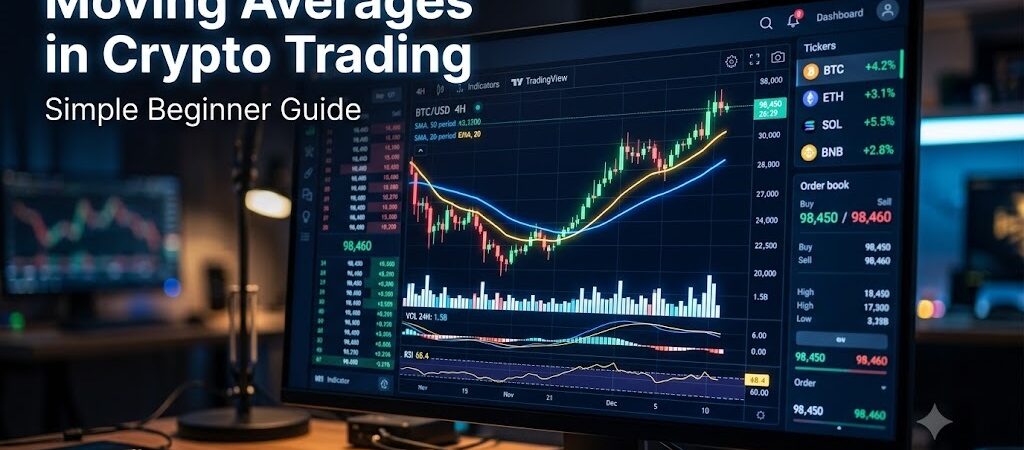
Moving Averages in Crypto Trading are one of the most popular technical analysis tools used by cryptocurrency traders to identify trends, reduce market noise, and make informed trading decisions. Whether you are trading Bitcoin, Ethereum, or altcoins, understanding how moving averages work can help you spot potential buying and selling opportunities. In this beginner-friendly guide, you’ll learn what moving averages are, the different types, how to use them effectively, and the common mistakes to avoid. https://cryptopulsemagazine.com/blockchain-networks-in-2026/
What Is a Moving Average?
A moving average (MA) is a technical indicator that calculates the average price of a cryptocurrency over a specific period.
Instead of focusing on every price movement, it creates a smoother line that helps traders identify the overall market trend.
For example:
- 10-day Moving Average
- 20-day Moving Average
- 50-day Moving Average
- 100-day Moving Average
- 200-day Moving Average
The longer the period, the smoother the moving average becomes.
Why Are Moving Averages Important?
Moving averages help traders:
- Identify market trends
- Filter market noise
- Find support and resistance levels
- Spot trend reversals
- Confirm trading signals
- Improve entry and exit decisions
Understanding Moving Averages in Crypto Trading can help beginners recognize market trends and improve trading decisions.
Many professional traders use moving averages as part of their trading strategy.
Types of Moving Averages
There are two main types used in cryptocurrency trading.
1. Simple Moving Average (SMA)
The Simple Moving Average (SMA) calculates the average closing price over a selected number of days.
Example:
A 20-day SMA averages the last 20 closing prices.
It gives equal importance to every price.
Advantages
- Easy to understand
- Good for identifying long-term trends
- Less affected by short-term volatility
Disadvantages
- Reacts slowly to price changes
- Can generate delayed signals
2. Exponential Moving Average (EMA)
The Exponential Moving Average (EMA) gives more weight to recent prices.
Because of this, it reacts faster to new market movements.
Advantages
- Faster trading signals
- Better for short-term traders
- More responsive during strong trends
Disadvantages
- Can produce more false signals
- More sensitive during volatile markets
SMA vs EMA
| Feature | SMA | EMA |
|---|---|---|
| Speed | Slower | Faster |
| Best For | Long-term investing | Short-term trading |
| Reacts to Price | Slowly | Quickly |
| Noise | Less | More |
Neither indicator is better than the other—they simply serve different trading styles.
Popular Moving Average Periods
Many crypto traders commonly use:
9 EMA
Used for short-term momentum.
20 EMA
Popular among swing traders.
50 SMA
Shows the medium-term trend.
100 SMA
Helps identify stronger trends.
200 SMA
One of the most important long-term indicators.
If the price remains above the 200 SMA, many traders consider the market to be in a long-term uptrend. https://cryptopulsemagazine.com/altcoins-vs-bitcoin-investment-strategy/
How Moving Averages Identify Trends
Uptrend
When price stays above the moving average and the line slopes upward.
Downtrend
When price remains below the moving average and the line slopes downward.
Sideways Market
When the moving average becomes flat and price moves around it.
Moving Average Crossovers
One popular strategy is using two moving averages together.
Golden Cross
Occurs when the shorter moving average crosses above the longer moving average.
Example:
50 SMA crosses above the 200 SMA.
This is often viewed as a bullish signal.
Death Cross
Occurs when the shorter moving average crosses below the longer moving average.
Example:
50 SMA crosses below the 200 SMA.
This may indicate increasing bearish momentum.
Using Moving Averages as Support and Resistance
Moving averages often act as dynamic support and resistance.
During an uptrend:
- Price may bounce from the 20 EMA or 50 SMA.
During a downtrend:
- Price may struggle to move above these levels.
Many traders monitor these areas before entering trades.
Combining Moving Averages with Other Indicators
Moving averages work best when used alongside other technical indicators.
Common combinations include:
- Relative Strength Index (RSI)
- MACD
- Volume analysis
- Bollinger Bands
- Trendlines
- Support and resistance zones
Using multiple indicators can help confirm trading signals and reduce the chance of acting on false breakouts. Moving Averages in Crypto Trading
Common Beginner Mistakes
Avoid these mistakes:
- Using only one indicator
- Ignoring overall market trends
- Trading every crossover signal
- Forgetting risk management
- Entering trades without confirmation
Successful trading requires patience and a well-planned strategy.
Tips for Beginners
If you’re new to crypto trading:
- Start with the 20 EMA and 50 SMA.
- Practice on demo accounts before trading real funds.
- Use stop-loss orders.
- Never risk more than you can afford to lose.
- Follow your trading plan consistently.
- Continue learning technical analysis.
Conclusion
Learning Moving Averages in Crypto Trading is an important step toward becoming a more confident cryptocurrency trader.
Moving averages are among the most useful tools in cryptocurrency trading. Moving Averages in Crypto Trading They simplify price action, help identify trends, and improve decision-making for both beginners and experienced traders. https://www.coindesk.com/
While no indicator guarantees success, combining moving averages with sound risk management and additional technical analysis can significantly improve your trading strategy. Moving Averages in Crypto Trading As you gain experience, you’ll learn which moving averages best match your trading style and market conditions.