Introduction:
1. The Exchange Battle Entering a New Era
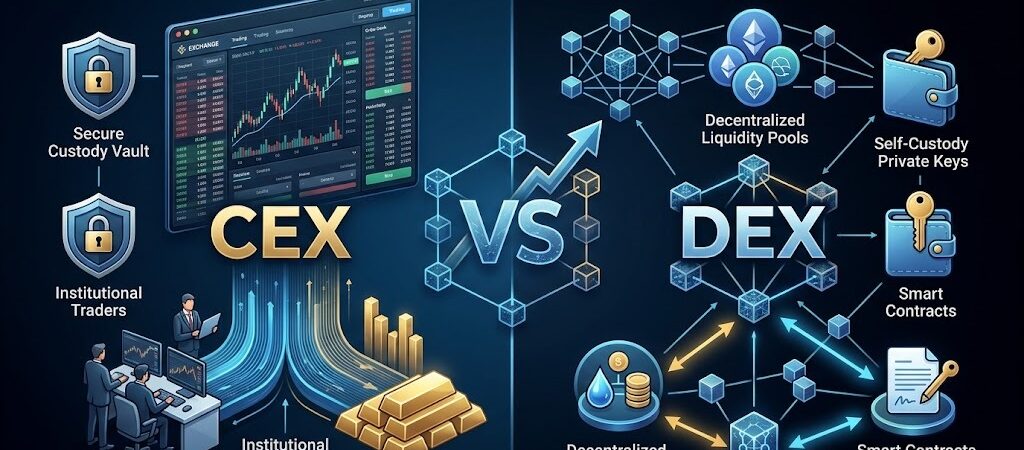
Crypto exchanges have always been at the center of digital-asset markets. Whether investors are buying Bitcoin, trading Ethereum, searching for emerging altcoins, or managing sophisticated derivatives positions, exchanges provide the infrastructure that connects market participants with liquidity.
For most of crypto’s history, centralized exchanges (CEXs) have dominated this role. They offered familiar interfaces, deep liquidity, fast execution, fiat on-ramps, customer support, and a relatively simple experience for users who did not want to interact directly with blockchain infrastructure.
But the market is changing.
Decentralized exchanges (DEXs) have evolved significantly from their early reputation as slow, technically complicated platforms primarily used by experienced DeFi traders. Improvements in blockchain scalability, wallet infrastructure, liquidity aggregation, automated market makers, perpetual futures, and on-chain execution have made decentralized trading considerably more competitive.
This creates an important question for the next major crypto bull cycle:
Will centralized exchanges remain dominant, or will decentralized exchanges capture a much larger share of global crypto trading?
The answer is unlikely to be as simple as CEX versus DEX.
Current market data already shows that decentralized trading is gaining ground while centralized platforms continue to control substantial liquidity and trading activity. CoinGecko reported that DEX spot trading share increased from 6.9% in January 2024 to 13.6% in January 2026. At the same time, centralized exchanges continued to process more than $1 trillion in monthly spot volume during the period analyzed.
More recent data shows the trend becoming even more interesting. In July 2026, DEXs reached a record 19.5% share of total spot trading volume, while centralized exchange volumes declined more sharply.
These numbers do not mean that CEXs are disappearing. Instead, they suggest that the exchange market is becoming more competitive and fragmented.
The next bull cycle could therefore produce an entirely different exchange landscape—one where CEXs and DEXs compete directly in some markets while serving complementary roles in others.
2. Why the CEX vs DEX Debate Matters
The CEX vs DEX discussion is important because exchanges influence far more than where users execute trades.
They affect:
- Liquidity
- Trading costs
- Price discovery
- Market accessibility
- Asset availability
- Custody
- Security
- Regulatory exposure
- User privacy
- Trading speed
- Leverage and derivatives
- Institutional participation
A major shift in exchange dominance could therefore change the structure of the entire cryptocurrency market.
During a bull cycle, trading activity typically expands rapidly. New investors enter the market, existing holders become more active, and demand for altcoins and speculative assets increases. At the same time, professional traders search for deeper liquidity, lower execution costs, sophisticated derivatives, and faster access to opportunities.
This creates opportunities for both centralized and decentralized platforms.
CEXs have several structural advantages. Their centralized order books can provide deep liquidity, sophisticated matching engines, advanced trading interfaces, and familiar account-based experiences. They can also integrate fiat deposits, withdrawals, derivatives, lending, custody, and other financial services into one platform.
DEXs have a different advantage.
They allow users to trade directly from blockchain wallets without necessarily depositing assets into a centralized intermediary. Transactions can be settled through smart contracts, while liquidity and trading activity can be visible on-chain. DEXs can also provide access to a much broader range of newly created tokens than traditional exchanges.
CoinGecko’s 2026 analysis illustrates this difference clearly. Major centralized exchanges listed hundreds or thousands of tokens during the period examined, while large DEX ecosystems provided access to millions of token contracts.
That difference could become particularly important during the next bull market, when new tokens and emerging narratives can appear extremely quickly.
3. The Current Balance: CEXs Still Lead, But DEXs Are Closing the Gap
The most important point to understand is that decentralized exchanges have not yet replaced centralized exchanges.
CEXs remain extremely important to the global crypto market.
In 2026, centralized platforms continue to handle enormous spot and derivatives volumes. CoinGecko’s Q2 2026 industry report, for example, recorded $1.95 trillion in spot volume across the top 10 centralized exchanges during the quarter.
This demonstrates the scale of the centralized market.
However, looking only at absolute CEX volume can hide an important structural development: DEX market share is increasing.
CoinGecko found that DEX spot market share doubled from approximately 6.9% in January 2024 to 13.6% in January 2026. DEX spot volume also increased substantially over the same period.
By July 2026, another market review showed DEX spot share reaching a record 19.5%.
This means the key question is not whether DEXs are already bigger than CEXs.
They are not.
The more important question is:
How much market share can DEXs capture during the next major expansion in crypto activity?
If decentralized platforms continue improving at their current pace, even a relatively modest increase in market share could represent hundreds of billions of dollars in additional trading activity.
4. The Evolution of Centralized Exchanges
To understand the future of the CEX vs DEX market, it is necessary to recognize that centralized exchanges are not standing still.
Modern CEXs have expanded far beyond simple Bitcoin buying and selling.
Many now operate as broader financial ecosystems offering combinations of:
- Spot cryptocurrency trading
- Perpetual futures
- Options
- Margin trading
- Staking
- Lending
- Earn products
- Stablecoin services
- Fiat payment infrastructure
- Institutional custody
- Copy trading
- Token launches
- Real-world asset products
This diversification gives centralized platforms a significant competitive advantage.
For a new investor, opening one account that provides access to spot trading, derivatives, deposits, withdrawals, portfolio management, and other financial products can be considerably easier than managing multiple blockchain wallets and decentralized applications.
Institutional investors also have different requirements.
Large funds and professional trading firms may prioritize deep liquidity, predictable execution, compliance infrastructure, reporting, custody arrangements, and operational controls. These requirements can continue supporting centralized venues even as decentralized technology improves.
In other words, the growth of DEXs does not automatically translate into the collapse of CEXs.
Instead, CEXs may continue evolving into comprehensive digital-asset financial platforms.
5. DEXs Are Becoming More Competitive
The other side of the CEX vs DEX equation is equally important.
DEX infrastructure has improved dramatically.
Earlier decentralized exchanges often suffered from high transaction costs, slow blockchain confirmation, limited liquidity, complicated interfaces, and significant price impact on larger trades.
Many of those limitations have been reduced through technological development.
Layer-2 networks, faster blockchains, improved liquidity mechanisms, sophisticated routing systems, and specialized decentralized derivatives platforms have made on-chain trading more practical.
The growth of decentralized perpetual-futures platforms is particularly significant.
CoinGecko reported that perpetual DEX volume increased roughly eightfold between January 2024 and January 2026, with DEX share of perpetual trading rising from about 2% to 10.2%.
That is an important signal.
DEX competition is no longer limited to simple token swaps.
Decentralized platforms are increasingly competing in markets that were historically dominated by centralized exchanges, including leveraged and perpetual trading.
This could become one of the most important developments in the next bull cycle.
6. What the Next Bull Cycle Could Change
Bull markets create a unique environment for exchange competition.
When cryptocurrency prices rise rapidly, several things happen simultaneously:
- New users enter the market.
- Existing users increase trading activity.
- Altcoin speculation accelerates.
- New tokens receive greater attention.
- Trading volumes increase.
- Derivatives activity expands.
- Liquidity becomes more valuable.
- Traders become more sensitive to execution speed and fees.
Both CEXs and DEXs can benefit from these conditions.
CEXs may attract newcomers because of their simpler interfaces and established liquidity.
DEXs may benefit from traders searching for newly launched tokens, self-custody, on-chain transparency, and access to assets before they appear on major centralized platforms.
This creates the possibility of a dual-track bull market.
Some traders may begin on a CEX, move assets to a wallet, use a DEX to access emerging tokens, and later return to a centralized platform for fiat conversion or advanced derivatives.
The future may therefore be less about one exchange model completely defeating the other and more about how effectively each model integrates into the broader crypto economy.
7. The Real Battle: Liquidity, Trust, and User Experience
Ultimately, the CEX vs DEX competition will not be decided by the labels “centralized” and “decentralized.”
It will be decided by performance.
Users want:
- Competitive prices
- Deep liquidity
- Low fees
- Fast execution
- Reliable infrastructure
- Secure custody
- Broad asset access
- Simple interfaces
- Transparent operations
The platform that can deliver the best combination of these factors will have a major advantage.
For CEXs, the challenge will be maintaining user trust while responding to increasing demand for transparency, self-custody, and regulatory clarity.
For DEXs, the challenge will be delivering institutional-grade execution and user experience without sacrificing the core benefits of decentralization.
The next bull cycle could become the first major test of whether decentralized infrastructure can compete with centralized platforms across a much wider range of trading activities.
And that is where the future of crypto exchanges becomes particularly interesting.
8. Liquidity: The Biggest Advantage in the CEX vs DEX Competition
Liquidity may be one of the most important factors determining the future of crypto exchanges.
A trading platform can have excellent technology and an attractive interface, but if there is not enough liquidity, traders may experience wider spreads, greater slippage, and difficulty executing larger orders.
Historically, this has been one of the strongest advantages of centralized exchanges.
Large CEX platforms aggregate enormous amounts of trading activity into centralized order books. Market makers can operate efficiently, professional traders can execute large positions, and users can generally expect relatively deep liquidity in major trading pairs.
This is especially important for Bitcoin and Ethereum, where institutional and professional traders may execute transactions worth millions of dollars.
DEXs have approached liquidity differently.
Instead of relying primarily on a centralized order book, many decentralized exchanges use automated market makers (AMMs), concentrated liquidity systems, or increasingly sophisticated on-chain order books. Liquidity can also be distributed across multiple pools and blockchain networks.
This model creates both advantages and challenges.
Liquidity Fragmentation
One major issue for DEXs is fragmentation.
Liquidity may exist across:
- Multiple blockchains
- Different DEX protocols
- Separate liquidity pools
- Layer-2 networks
- Different stablecoins
- Different versions of the same asset
A trader may therefore receive different prices depending on which network or protocol is used.
However, aggregation technology is helping solve this problem.
DEX aggregators can search across multiple liquidity sources and identify routes designed to achieve better execution. Cross-chain infrastructure can also make liquidity more accessible across different blockchain ecosystems.
If these systems continue improving, one of the historical disadvantages of decentralized trading could become significantly smaller.
9. User Experience Could Decide the Next Winner
Technology alone does not determine which exchange model succeeds.
User experience matters enormously.
For many newcomers, the first interaction with cryptocurrency is still a centralized exchange account. Creating an account, completing identity verification, depositing fiat currency, buying Bitcoin, and viewing a portfolio can be relatively straightforward.
DEXs traditionally required a different process.
A user might need to:
- Create a self-custody wallet.
- Secure a seed phrase.
- Purchase cryptocurrency.
- Transfer it to the wallet.
- Select the correct blockchain network.
- Maintain enough native tokens to pay transaction fees.
- Connect the wallet to a decentralized application.
- Approve token transactions.
- Execute the trade.
- Manage the resulting assets independently.
For experienced crypto users, this process can be normal.
For beginners, it can be intimidating.
This is one of the most important areas where the future CEX vs DEX competition could change.
Wallet providers and DEX developers are working toward simpler interfaces, account abstraction, embedded wallets, better transaction routing, and more intuitive trading experiences.
If decentralized applications eventually become as simple to use as traditional exchange interfaces, one of the strongest barriers to DEX adoption could disappear.
10. Self-Custody Is a Major DEX Advantage
One of the strongest arguments for decentralized exchanges is self-custody.
With a traditional centralized exchange, users generally deposit their assets into infrastructure controlled by the exchange.
This creates convenience, but it also introduces counterparty risk.
The exchange controls the custody infrastructure, manages withdrawals, maintains internal accounting systems, and becomes a critical point of failure.
A DEX can offer a different model.
Users can keep assets in their own wallets and interact directly with smart contracts when executing trades.
This does not eliminate risk.
Self-custody introduces its own responsibilities.
Users must protect:
- Private keys
- Seed phrases
- Wallet access
- Transaction approvals
- Hardware devices
- Smart-contract permissions
A mistake can potentially result in permanent loss of funds.
Therefore, the real debate is not simply custody versus no custody.
It is about which type of risk users are willing to accept.
CEX users generally exchange some degree of control for convenience.
DEX users generally accept greater personal responsibility in exchange for greater control.
The next bull cycle could reveal how many mainstream investors are willing to make that trade-off.
11. Security: Different Models, Different Risks
Security will remain one of the most important issues in the CEX vs DEX competition.
Centralized exchanges face risks associated with centralized infrastructure.
Potential threats include:
- Exchange hacks
- Internal security failures
- Account takeovers
- Withdrawal attacks
- Insider threats
- Operational failures
- Custody vulnerabilities
A major centralized exchange can therefore become a highly valuable target for attackers.
DEXs eliminate some centralized custody risks, but they introduce another category of vulnerabilities.
Smart-contract bugs, malicious tokens, compromised wallets, phishing attacks, oracle manipulation, and flawed protocol logic can all create significant risks.
This means neither model is automatically “safe.”
Instead, the security architecture is different.
A mature CEX may invest heavily in institutional-grade custody, cold storage, monitoring, risk management, and account protection.
A mature DEX may rely on audited smart contracts, decentralized infrastructure, transparent code, bug bounties, multisignature controls, and on-chain monitoring.
For users, understanding these differences will become increasingly important.
12. Regulation Could Shape CEX and DEX Dominance
Regulation may become one of the biggest external forces influencing exchange competition.
Centralized exchanges are identifiable businesses. This makes them easier for regulators to engage with, license, supervise, and require to implement compliance procedures.
CEX platforms may therefore have to meet requirements involving:
- Know Your Customer procedures
- Anti-money-laundering controls
- Transaction monitoring
- Reporting
- Consumer protection
- Asset custody
- Market surveillance
These requirements can increase operating costs, but they can also create greater confidence among institutions and mainstream users.
DEXs operate differently.
Because protocols can be deployed through smart contracts and users may interact with them directly through self-custody wallets, determining who is responsible for a decentralized protocol can be considerably more complicated.
This creates both opportunities and uncertainty.
Regulatory developments could either slow certain forms of decentralized trading or encourage clearer frameworks that allow legitimate on-chain markets to grow.
For the next bull cycle, regulation may therefore become a major competitive factor rather than merely a background issue.
13. Institutional Adoption May Keep CEXs Relevant
Institutional participation could be another major reason centralized exchanges remain powerful.
Professional investors often require infrastructure that goes beyond basic trading.
They may need:
- Advanced execution tools
- Institutional custody
- Compliance systems
- Auditable records
- Deep liquidity
- Risk controls
- Derivatives
- Portfolio reporting
- Dedicated support
- Reliable APIs
CEX platforms are already structured around many of these requirements.
However, institutions are also becoming more comfortable with blockchain-based infrastructure.
As tokenized assets, stablecoins, on-chain settlement, and decentralized financial markets expand, institutions may increasingly interact directly with blockchain protocols.
This could create a hybrid institutional model.
An investment firm might maintain assets through a regulated custodian, execute certain trades through a centralized exchange, use an on-chain venue for specific assets, and settle transactions through blockchain infrastructure.
The future may therefore involve institutions using both exchange models rather than choosing only one.
14. The Rise of On-Chain Market Infrastructure
One of the most important developments behind DEX growth is the expansion of the broader on-chain financial ecosystem.
A DEX does not operate in isolation.
It can connect with:
- Stablecoins
- Lending protocols
- Liquid staking
- Tokenized real-world assets
- Blockchain bridges
- Oracles
- Wallets
- Layer-2 networks
- Automated trading systems
This creates a powerful characteristic of decentralized markets:
Composability.
A trader can potentially move assets from one decentralized application to another without leaving the blockchain ecosystem.
For example, a user could hold a stablecoin, deposit it into a decentralized lending protocol, receive a yield-bearing asset, and later use that asset within another on-chain financial application.
This interconnected structure is difficult to reproduce within a traditional exchange environment.
If the next bull cycle accelerates the growth of on-chain finance, DEXs could benefit from becoming a core trading layer within a much larger decentralized financial ecosystem.
15. CEXs Are Also Becoming More On-Chain
The competition is not one-directional.
Just as DEXs are adopting features traditionally associated with centralized exchanges, CEXs are increasingly exploring blockchain-based infrastructure.
Centralized platforms can integrate:
- On-chain wallets
- Blockchain transfers
- Tokenized assets
- Stablecoin payments
- Web3 applications
- On-chain trading
- Self-custody options
- Decentralized application access
This creates an important possibility.
The future may not consist of completely separate centralized and decentralized worlds.
Instead, major platforms could gradually combine both models.
A centralized exchange could provide the convenience of a traditional trading platform while giving users access to on-chain applications and self-custody tools.
Likewise, decentralized protocols could continue adding professional trading features traditionally associated with CEXs.
This convergence could make the CEX vs DEX distinction less obvious to ordinary users.
16. The Hybrid Exchange Model
The most realistic future may ultimately be a hybrid model.
Imagine an exchange ecosystem where users can choose between different levels of control.
A beginner could use a simple custodial account.
An experienced trader could connect a self-custody wallet.
An institution could use regulated custody and professional execution infrastructure.
A DeFi user could interact directly with on-chain liquidity.
All of these users could potentially access the same broader market.
Such a model would combine the strongest characteristics of both systems.
CEX strengths:
- Convenience
- Fiat access
- Deep liquidity
- Professional trading tools
- Institutional services
- Customer support
DEX strengths:
- Self-custody
- On-chain transparency
- Permissionless access
- Broad token availability
- Composability
- Direct blockchain settlement
The exchange that can combine these advantages most effectively could become one of the strongest competitors in the next bull cycle.
17. Why the Next Bull Cycle Could Be Different
Previous crypto bull markets were heavily dominated by centralized trading infrastructure.
The next major cycle could be different because blockchain infrastructure itself has matured.
Users now have access to faster networks, better wallets, more sophisticated DEXs, improved aggregators, stablecoin liquidity, decentralized derivatives, and increasingly powerful on-chain analytics.
This means the next wave of capital entering crypto will have more choices than previous generations of investors.
Some capital will probably continue flowing through CEXs.
Some will move directly on-chain.
And an increasing amount may move between both environments depending on the asset, strategy, and user.
The most important question is therefore not simply:
Will DEXs defeat CEXs?
A better question is:
Which exchange model can capture the greatest share of the next generation of crypto activity—and how much of the market will ultimately become hybrid?
That question will shape the future of crypto trading.
18. Trading Fees and Execution Costs
Trading costs will be another major factor in the CEX vs DEX competition.
At first glance, comparing exchange fees may seem simple. A centralized exchange can advertise a maker and taker fee, while a DEX may charge a protocol fee. However, the actual cost of executing a trade can involve several additional components.
For CEX users, the total trading cost may include:
- Trading fees
- Withdrawal fees
- Deposit costs
- Spread
- Slippage
- Funding rates for derivatives
- Conversion fees
For DEX users, costs can include:
- Protocol fees
- Blockchain transaction fees
- Slippage
- Price impact
- Routing costs
- Bridge fees
- MEV-related execution effects
The difference becomes particularly important during periods of extreme market activity.
When blockchain networks become congested, transaction costs can increase rapidly. A trade that appears inexpensive at the DEX level may become more expensive once network fees and execution costs are included.
However, scaling improvements are changing this equation.
Layer-2 networks and newer high-throughput blockchains can reduce transaction costs significantly. As infrastructure becomes more efficient, decentralized trading may become increasingly competitive with centralized platforms.
At the same time, CEXs can use their internal infrastructure to execute trades efficiently without requiring every transaction to be recorded directly on a public blockchain.
This means the cost advantage could vary depending on the asset, blockchain, trading size, and market conditions.
19. Speed and Trade Execution
Professional traders care about execution speed.
In fast-moving markets, a difference of a few seconds—or even milliseconds—can affect profitability.
Centralized exchanges have traditionally held a strong advantage here.
Their matching engines can process orders through highly optimized infrastructure without waiting for every internal trade to receive blockchain confirmation.
DEXs have historically faced greater latency because transactions interact with blockchain networks.
But this is changing.
Modern decentralized trading platforms can use specialized infrastructure, high-performance chains, Layer-2 networks, off-chain order matching, and other techniques to improve execution.
Some decentralized derivatives platforms are already designed to provide trading experiences that feel much closer to centralized exchanges.
The long-term question is whether decentralized infrastructure can achieve the same combination of:
speed + liquidity + reliability + transparency.
If it can, one of the strongest arguments for centralized exchanges could weaken.
20. Market Transparency Gives DEXs a Unique Advantage
Transparency is another area where decentralized exchanges have a powerful advantage.
Blockchain transactions are publicly verifiable.
Users and analysts can potentially inspect:
- Trading volumes
- Liquidity pools
- Wallet activity
- Token movements
- Smart-contract interactions
- Protocol balances
- Transaction history
This creates an entirely different approach to market transparency.
Centralized exchanges maintain internal order books and account balances that are not fully visible on-chain.
They can publish proof-of-reserves reports and other transparency information, but users generally still rely on the exchange’s internal systems for important parts of the trading process.
DEXs can provide greater visibility because much of the underlying activity occurs directly on public blockchains.
This does not mean every DEX is automatically transparent or trustworthy.
Smart-contract complexity, liquidity-provider behavior, oracle design, and token contracts can introduce their own risks.
Nevertheless, on-chain transparency could become increasingly valuable as investors demand stronger evidence about how financial platforms operate.
21. MEV and the Hidden Costs of Decentralized Trading
While DEX transparency provides advantages, it also creates challenges.
One of those challenges is Maximal Extractable Value (MEV).
MEV refers broadly to the value that can be extracted by influencing or taking advantage of transaction ordering within blockchain systems.
In decentralized markets, traders can potentially face:
- Front-running
- Sandwich attacks
- Transaction reordering
- Arbitrage
- Priority bidding
These mechanisms can affect the effective cost of trading.
Developers are actively working on solutions, including improved transaction sequencing, private transaction mechanisms, better routing, and specialized infrastructure.
If these technologies reduce harmful forms of MEV, decentralized trading could become more attractive to larger traders.
This is particularly important because professional investors generally care about the real execution cost, not simply the advertised trading fee.
A DEX with a low protocol fee can still be expensive if slippage and execution inefficiencies are high.
Likewise, a CEX with a higher stated fee could still offer better overall execution if it provides deeper liquidity and tighter spreads.
22. Token Listings Could Become a Major DEX Advantage
One of the most important differences in the CEX vs DEX market is asset availability.
Centralized exchanges generally have listing procedures.
A project may need to satisfy technical, legal, compliance, liquidity, and business requirements before its token becomes available for trading.
This can protect users from some low-quality assets, but it also creates a barrier.
DEXs operate differently.
If a token exists on a compatible blockchain and sufficient liquidity is available, users may often be able to trade it without waiting for approval from a centralized exchange.
This creates an enormous advantage during emerging market narratives.
When a new sector suddenly becomes popular, DEX users can sometimes access newly created tokens much earlier than centralized exchange users.
This pattern has repeatedly appeared across crypto market cycles.
However, the same advantage creates substantial risks.
Permissionless listings mean users may encounter:
- Scam tokens
- Fake contracts
- Honeypots
- Extremely low liquidity
- Manipulated prices
- Rug pulls
- Malicious token permissions
Therefore, broader asset access is not automatically better.
It shifts more responsibility to the user.
23. Stablecoins Could Become the Bridge Between CEXs and DEXs
Stablecoins may play a central role in the future exchange ecosystem.
They provide a common settlement asset across centralized and decentralized markets.
A trader may purchase a stablecoin through a CEX, transfer it to a self-custody wallet, trade through a DEX, provide liquidity to a DeFi protocol, and later return the asset to a centralized exchange.
This creates a bridge between two different financial environments.
As stablecoin adoption expands, the distinction between centralized and decentralized markets could become less important at the settlement layer.
Stablecoins can move across blockchain networks and can be integrated into both custodial and non-custodial platforms.
This may encourage a more interconnected exchange ecosystem in the next bull cycle.
24. Cross-Chain Trading Will Become Increasingly Important
The crypto market is no longer concentrated around one blockchain.
Ethereum remains a major ecosystem, but traders can also interact with networks such as Solana, BNB Chain, Arbitrum, Base, Avalanche, Sui, and many others.
This creates another challenge for exchanges:
Where does liquidity actually live?
A token may have meaningful liquidity on several networks simultaneously.
A trader therefore needs infrastructure capable of finding the best execution across different environments.
Cross-chain bridges, aggregators, intent-based trading systems, and interoperability protocols could become increasingly important.
For DEXs, this technology could significantly expand the addressable market.
Instead of competing for liquidity on one chain, decentralized protocols could potentially route orders across multiple networks.
For CEXs, cross-chain functionality may also become increasingly important because users expect seamless deposits, withdrawals, and access to assets across ecosystems.
The winning platforms may ultimately be those that make blockchain fragmentation almost invisible to the user.
25. The Role of Wallets Could Change Exchange Competition
Another important development is the growing importance of crypto wallets.
Historically, users thought about exchanges first and wallets second.
The next bull cycle could reverse that relationship for some users.
A self-custody wallet can become the primary interface through which users access:
- DEXs
- Lending
- Staking
- NFTs
- Stablecoins
- Tokenized assets
- Payments
- On-chain applications
Instead of asking which exchange account to open, a user may first choose a wallet and then access multiple financial platforms through that wallet.
This could weaken the traditional exchange’s position as the primary gateway to crypto.
However, centralized exchanges are also responding.
Many major platforms are integrating wallet functionality and Web3 services into their existing products.
This means the competition may increasingly shift from exchange versus exchange to financial interface versus financial interface.
26. AI Could Transform Exchange Trading
Artificial intelligence may become another important factor in the next bull cycle.
AI-powered systems can analyze enormous quantities of market information, identify patterns, monitor liquidity, detect anomalies, and automate trading strategies.
Both CEXs and DEXs can benefit.
Centralized platforms can integrate AI directly into their trading interfaces.
Potential applications include:
- Automated portfolio analysis
- Risk alerts
- Market summaries
- Strategy development
- Trade execution
- Fraud detection
- Customer support
DEX ecosystems can also integrate AI agents capable of interacting directly with blockchain protocols.
An AI agent could potentially analyze market conditions, identify a trading opportunity, find liquidity, estimate execution costs, and interact with a decentralized protocol.
This could make decentralized finance considerably easier for ordinary users.
If AI reduces the complexity of interacting with blockchain infrastructure, it could remove another important barrier to DEX adoption.
27. Social Trading and Community-Driven Markets
The next bull cycle may also see greater integration between social platforms and exchanges.
Crypto trading is heavily influenced by online communities.
Market narratives can spread rapidly through:
- X
- Telegram
- Discord
- YouTube
- Crypto communities
- Influencer networks
DEXs are particularly connected to these communities because new tokens can often emerge and gain liquidity on-chain before receiving major centralized exchange listings.
This can create a rapid cycle:
Narrative → Token Launch → DEX Liquidity → Community Adoption → Price Discovery → CEX Listing
If the cycle becomes faster, DEXs could become increasingly important during the earliest stages of new market narratives.
CEXs may then become more important once assets mature and larger pools of capital enter the market.
This could reinforce a complementary relationship between the two models.
28. CEXs May Continue Dominating Mature Assets
Despite DEX growth, centralized exchanges are likely to remain highly competitive in established assets.
Bitcoin and Ethereum have deep global liquidity, institutional participation, sophisticated derivatives markets, and large professional trading communities.
These characteristics favor platforms capable of supporting substantial order flow and advanced trading infrastructure.
CEXs may therefore continue to dominate certain mature markets even while DEXs gain substantial share elsewhere.
The market could become segmented.
For example:
CEX strength: mature assets, institutional trading, fiat access, professional derivatives.
DEX strength: emerging tokens, on-chain assets, permissionless markets, DeFi trading.
If this segmentation develops, asking whether CEXs or DEXs will “win” may become less meaningful.
The more useful question will be:
Which platform is best suited to each type of market activity?
29. What Traders Should Watch During the Next Bull Cycle
Investors should monitor several indicators to understand whether the balance between centralized and decentralized exchanges is changing.
Important metrics include:
DEX Spot Market Share
If DEX spot share continues increasing, it would indicate that decentralized trading is capturing a larger portion of the market.
Perpetual DEX Volume
Growth in decentralized derivatives could be particularly significant because it demonstrates that DEXs are moving beyond simple token swaps.
Liquidity Depth
Higher liquidity would make decentralized platforms more attractive to larger traders.
Average Trading Costs
The gap between effective CEX and DEX execution costs will help determine which model provides better value.
User Growth
The number of active wallets and exchange users can indicate whether decentralized trading is moving beyond crypto-native participants.
Institutional Participation
Increasing institutional activity on-chain could be one of the strongest signals that DEX infrastructure is becoming mainstream.
Stablecoin Settlement
Greater stablecoin movement between centralized and decentralized platforms could demonstrate deeper integration between the two ecosystems.
Regulatory Developments
New regulations could materially affect the growth of both exchange models.
These indicators will provide a much better picture of exchange competition than simply comparing the number of users on individual platforms.
30. The Exchange Market May Become More Competitive, Not Less
The next bull cycle is unlikely to produce a single winner.
Instead, the market could become more competitive.
CEXs have enormous advantages in liquidity, user experience, fiat connectivity, institutional infrastructure, and mature trading products.
DEXs have powerful advantages in self-custody, permissionless access, transparency, asset availability, and blockchain composability.
Both models are improving.
That is the most important development.
The future of crypto exchanges may therefore be defined not by the disappearance of centralized platforms, but by the rapid improvement of decentralized alternatives—and by how effectively centralized platforms respond.
The companies and protocols that adapt fastest could capture the next generation of crypto trading activity.
And as the next bull cycle approaches, the battle between centralized and decentralized exchanges could become one of the most important structural stories in the digital-asset market.
31. Will DEXs Really Overtake CEXs?
The possibility of decentralized exchanges eventually overtaking centralized exchanges is one of the biggest questions surrounding the future of crypto trading.
The answer depends on what “overtake” actually means.
If it means controlling the majority of total trading volume across every crypto market, DEXs still face significant challenges.
Centralized exchanges have built extensive infrastructure over many years. They have established brands, large user bases, professional market makers, institutional relationships, fiat gateways, and sophisticated derivatives products.
However, if overtaking means becoming the preferred venue for certain categories of trading, DEXs may already be moving in that direction.
Decentralized platforms can be particularly competitive in:
- Newly launched tokens
- On-chain assets
- DeFi tokens
- Stablecoin trading
- Permissionless markets
- Certain perpetual markets
- Cross-chain opportunities
This distinction is important.
DEX dominance does not necessarily require CEX collapse.
A decentralized platform can become dominant within specific segments while centralized exchanges remain dominant in others.
The result could be a fragmented but highly competitive market.
32. The Bull Market Liquidity Effect
Bull markets can amplify exchange competition because liquidity tends to move toward areas generating the greatest trading opportunities.
When prices rise rapidly, traders search for new narratives and higher-return opportunities.
Capital can move from Bitcoin into Ethereum, from Ethereum into large-cap altcoins, and eventually into smaller emerging assets.
This progression can benefit DEXs.
New tokens often appear on decentralized markets before gaining listings on major centralized exchanges.
As traders search for early opportunities, DEXs can become the first destination.
Once a token gains liquidity, recognition, and market capitalization, centralized exchanges may eventually list it.
This creates a possible lifecycle:
Launch → DEX discovery → Liquidity growth → Community adoption → Price discovery → CEX listing → Institutional participation
If this pattern becomes more common, DEXs could become increasingly important as the discovery layer of the crypto market.
CEXs could then remain the primary liquidity and access layer for mature assets.
33. The Importance of Market Discovery
Market discovery may become one of the strongest long-term advantages of decentralized exchanges.
Traditional financial markets generally have structured listing processes.
Crypto markets are different.
Permissionless blockchain infrastructure allows developers to create new tokens and markets at extremely high speed.
This means the number of potential assets can grow far faster than centralized exchanges can manually evaluate and list them.
DEXs can therefore act as an experimental layer for the market.
Thousands of projects may launch, but only a small percentage may develop meaningful liquidity and long-term demand.
The decentralized market can effectively filter these assets through open trading activity.
However, this creates enormous risks for inexperienced traders.
High availability does not mean high quality.
The ability to trade an asset immediately does not guarantee that the project is legitimate.
As DEX adoption increases, tools for token verification, liquidity analysis, contract monitoring, wallet reputation, and scam detection will become increasingly important.
34. Professional Traders May Demand Better DEX Infrastructure
Retail adoption is only one part of the equation.
For DEXs to capture a much larger share of global trading activity, professional traders will need reliable infrastructure.
Professional participants typically care about:
- Execution quality
- Liquidity
- Latency
- Market depth
- API connectivity
- Risk management
- Position limits
- Reliable settlement
- Data quality
DEX infrastructure is improving in all of these areas, but the standards are extremely high.
A professional trading firm cannot simply accept unpredictable execution because a protocol is decentralized.
The technology must deliver competitive performance.
This creates an opportunity for decentralized exchanges to develop institutional-grade infrastructure.
If they can combine blockchain settlement with professional execution, they could unlock a much larger pool of capital.
35. The Rise of On-Chain Order Books
Automated market makers transformed decentralized trading, but the next phase may involve greater use of order-book systems.
Traditional order books allow traders to place:
- Limit orders
- Market orders
- Stop orders
- Conditional orders
They also allow professional market makers to manage liquidity more precisely.
Historically, blockchain networks were not efficient enough to support sophisticated order books at scale.
That is changing.
Faster networks and specialized infrastructure can support more complex trading systems.
This could bring DEXs closer to the experience of centralized exchanges while maintaining blockchain-based settlement.
If decentralized order books become highly efficient, the distinction between CEX and DEX trading could become increasingly difficult for ordinary users to notice.
36. Intent-Based Trading Could Change the User Experience
Another emerging concept is intent-based trading.
Instead of telling a protocol exactly how to execute a transaction, users can specify what they want.
For example, a trader might effectively express an intention such as:
“I want to exchange this amount of one asset for another at the best available price.”
The infrastructure can then determine how to execute that intention.
This can simplify complex blockchain interactions.
Behind the scenes, specialized solvers or liquidity providers may compete to fulfill the user’s request.
For users, the experience can become much closer to a traditional exchange.
This technology could be especially important for mainstream adoption because users do not necessarily care about the technical process.
They care about the outcome:
Did I receive a good price, quickly and securely?
If decentralized infrastructure can abstract away blockchain complexity, DEX adoption could accelerate.
37. Privacy Could Become a Competitive Advantage
Privacy may also influence the CEX vs DEX landscape.
Centralized exchanges generally require users to provide identifying information in order to access many services.
This is often necessary for regulatory compliance, but it means users give up a significant amount of personal information.
Public blockchains offer a different model.
Users can transact through blockchain addresses without necessarily revealing their legal identity directly on every transaction.
However, public blockchain activity is not automatically private.
Blockchain transactions can be analyzed, linked, and monitored through sophisticated analytics systems.
Therefore, the future privacy landscape may involve a combination of:
- Self-custody
- Zero-knowledge technology
- Privacy-preserving infrastructure
- Selective disclosure
- Regulatory compliance
If privacy-preserving technologies mature, decentralized finance could offer new ways to balance user privacy with legitimate compliance requirements.
38. Compliance Technology Could Become More Advanced
Regulation does not necessarily have to be a permanent disadvantage for decentralized markets.
Technology can potentially make compliance more sophisticated.
On-chain analytics can help identify suspicious transactions and monitor wallet activity.
Zero-knowledge systems could eventually allow users to prove certain facts without revealing unnecessary personal information.
For example, a system could potentially verify that a user satisfies a particular requirement without exposing all of the user’s underlying information.
This creates the possibility of a new generation of financial infrastructure:
compliant without being unnecessarily intrusive.
If such systems become practical at scale, they could help bridge the gap between decentralized finance and regulated financial markets.
39. Security Will Remain a Deciding Factor
No discussion of exchange dominance is complete without security.
The next bull cycle will almost certainly attract large amounts of new capital.
Unfortunately, rising market activity also attracts attackers.
CEX users may face:
- Phishing
- Account takeover
- SIM-swap attacks
- Exchange breaches
- Withdrawal manipulation
- Insider threats
DEX users may face:
- Malicious smart contracts
- Fake tokens
- Wallet drainers
- Phishing signatures
- Oracle manipulation
- Bridge vulnerabilities
- Protocol exploits
The security challenge is therefore different rather than absent.
A successful exchange ecosystem must make security understandable to ordinary users.
This could become one of the biggest opportunities for wallet providers, security companies, analytics platforms, and exchange developers.
The platform that can provide powerful security without making the user experience complicated will have a major advantage.
40. Custody Could Become More Flexible
The future may also bring more choices between full custody and full self-custody.
Instead of forcing users into one model, exchange platforms could provide several options.
For example:
Custodial account:
The exchange manages the assets and provides a simple user experience.
Self-custody wallet:
The user controls the private keys and interacts directly with blockchain applications.
Hybrid custody:
Certain assets remain with a regulated custodian while others remain under the user’s direct control.
Institutional custody:
Professional investors receive specialized custody, reporting, and compliance infrastructure.
This flexibility could reduce the importance of the CEX vs DEX divide.
Users would no longer have to choose one system permanently.
They could choose the appropriate custody model for each activity.
41. Derivatives Could Be the Next Major Battleground
Spot trading receives much of the public attention, but derivatives could become one of the most important areas of competition.
Centralized exchanges have historically dominated crypto futures and perpetual markets.
They offer:
- High leverage
- Deep liquidity
- Advanced order types
- Sophisticated risk engines
- Professional interfaces
But decentralized perpetual exchanges have been growing rapidly.
The increase in decentralized perpetual volume suggests that traders are willing to use on-chain infrastructure for more sophisticated financial products.
If DEX derivatives continue expanding, the competitive landscape could change substantially.
A decentralized platform capable of providing deep liquidity, reliable pricing, efficient liquidation systems, and low-cost execution could attract increasingly sophisticated traders.
This would represent a major shift from the earlier generation of DEXs.
42. Tokenized Real-World Assets Could Expand Exchange Demand
The growth of tokenized real-world assets could also reshape the exchange market.
Assets such as:
- Government securities
- Private credit
- Real estate
- Funds
- Commodities
- Other financial instruments
can increasingly be represented on blockchain networks.
If tokenized assets become more widely adopted, the demand for compliant trading infrastructure could increase dramatically.
CEXs may have advantages because regulated financial institutions already understand centralized custody and compliance structures.
DEXs may have advantages because blockchain settlement allows tokenized assets to interact with programmable financial infrastructure.
The result could be another area where centralized and decentralized systems compete—and potentially cooperate.
43. Exchange Aggregators Could Become More Important Than Individual Exchanges
Users may increasingly stop caring which individual exchange provides their liquidity.
Instead, they may use aggregation systems that compare multiple venues.
An aggregator can potentially evaluate:
- CEX liquidity
- DEX liquidity
- Cross-chain liquidity
- Trading fees
- Slippage
- Execution speed
and then select an appropriate route.
This could fundamentally change the exchange business.
Instead of competing only for direct customers, exchanges and protocols may compete to become the best liquidity source within a larger routing network.
The user may simply enter the trade they want.
The infrastructure handles the rest.
This would make liquidity more interconnected and potentially reduce the importance of individual exchange brands.
44. The Importance of Stablecoin Liquidity
Stablecoins will likely remain central to this development.
Many crypto trades are effectively exchanges between volatile assets and dollar-linked assets.
Stablecoins provide the liquidity layer connecting different markets.
If stablecoin supply continues expanding, both CEX and DEX markets could benefit.
DEXs can use stablecoins as liquidity-pool assets.
CEXs can use them for trading pairs, settlement, deposits, withdrawals, and institutional transactions.
Stablecoins therefore have the potential to connect centralized and decentralized markets rather than forcing them into separate ecosystems.
45. Why CEXs Are Unlikely to Disappear
Despite the rapid development of decentralized infrastructure, there are strong reasons to believe CEXs will remain relevant.
Millions of users still prefer convenience.
For many people, managing private keys is unnecessary complexity.
A centralized platform can provide a familiar financial experience:
Create account → Deposit money → Buy crypto → Trade → Withdraw.
That simplicity matters.
CEXs also have significant advantages in customer support, compliance, fiat integration, institutional services, derivatives, and liquidity.
Unless DEXs can replicate these advantages without compromising their decentralized characteristics, centralized exchanges will continue serving an important portion of the market.
The future therefore does not necessarily require CEXs to lose.
It may simply require them to evolve.
46. Why DEXs Are Unlikely to Stop Growing
At the same time, decentralized exchanges have powerful structural advantages.
Blockchain infrastructure is becoming faster.
Wallets are becoming easier to use.
Liquidity is becoming more sophisticated.
Cross-chain systems are improving.
On-chain derivatives are expanding.
Stablecoins are becoming more important.
And users are becoming more familiar with self-custody.
These trends create a favorable environment for DEX growth.
The question is no longer whether decentralized trading will remain a niche part of crypto.
It has already become an important component of the market.
The larger question is how far that growth can continue.
47. The Most Likely Outcome: Coexistence and Convergence
The strongest long-term possibility may be neither CEX dominance nor DEX dominance.
It may be coexistence and convergence.
CEXs could continue to dominate areas where centralized infrastructure provides clear advantages.
DEXs could continue expanding in areas where decentralization provides unique benefits.
Meanwhile, both models could increasingly integrate features from the other.
Centralized exchanges may add self-custody and on-chain functionality.
Decentralized exchanges may add better interfaces, professional trading systems, and sophisticated execution.
The result could be an exchange ecosystem where users barely notice whether a transaction is ultimately being processed through centralized or decentralized infrastructure.
What matters will be:
price, speed, liquidity, security, accessibility, and control.
That could be the real future of crypto exchanges.
48. What Could Give DEXs the Edge in the Next Bull Cycle?
If decentralized exchanges are going to capture a significantly larger share of the market, several developments could give them an advantage during the next bull cycle.
The first is continued improvement in blockchain infrastructure.
Faster transaction processing, lower fees, better interoperability, and more reliable scaling can make on-chain trading increasingly practical.
The second is better wallet technology.
If users can interact with decentralized applications without worrying about complicated transaction approvals, network selection, or gas management, the barrier to DEX adoption will continue to fall.
The third is better liquidity aggregation.
Instead of forcing users to search through individual protocols, aggregators can combine liquidity from multiple sources and provide more competitive execution.
The fourth is growth in on-chain derivatives.
If decentralized perpetual and options markets continue attracting professional traders, DEXs could move beyond their traditional role as venues for token swaps.
Finally, the continued growth of stablecoins and tokenized assets could expand the overall size of on-chain financial markets.
Together, these developments could make decentralized exchanges significantly more competitive during the next major market expansion.
49. What Could Keep CEXs Ahead?
Centralized exchanges also have several powerful advantages that should not be underestimated.
Fiat Connectivity
Most mainstream users still need an easy way to move between traditional currency and cryptocurrency.
CEXs are well positioned to provide bank transfers, card purchases, withdrawals, and other fiat services.
Institutional Infrastructure
Large investors often require regulated custody, reporting, compliance, risk controls, and professional execution.
Established centralized platforms can provide these services more easily than many decentralized protocols.
Deep Liquidity
Large CEXs continue to benefit from concentrated liquidity and extensive market-making relationships.
For major trading pairs, this can create highly competitive execution.
User Support
Centralized platforms can provide customer support teams and account recovery processes.
For inexperienced users, this can be extremely valuable.
Advanced Trading Products
CEXs continue to offer sophisticated derivatives, options, margin products, and trading tools.
These services can attract professional traders who require more than simple spot swaps.
These advantages explain why the CEX vs DEX debate is unlikely to produce an immediate winner.
50. The New User May Not Care About CEX vs DEX
One of the most interesting possibilities is that future users may not even think about the distinction.
Imagine a new investor opening an application and entering:
“Buy $500 of Bitcoin.”
The interface could automatically determine whether the best execution comes from:
- A centralized exchange
- A decentralized exchange
- Multiple liquidity pools
- A cross-chain route
- An institutional liquidity provider
The user may never know.
This could transform the exchange industry.
Instead of choosing an exchange first, users may simply choose the financial outcome they want.
The underlying infrastructure could determine the optimal route.
If this happens, the CEX vs DEX competition would move from the front end to the infrastructure layer.
51. Exchange Aggregation Could Become the New Standard
Aggregation technology could therefore become one of the most important developments in crypto trading.
A sophisticated aggregator could compare multiple sources simultaneously.
For a particular trade, it could evaluate:
- Price
- Liquidity
- Slippage
- Fees
- Network costs
- Execution probability
- Settlement time
- Counterparty considerations
The system could then select the most efficient route.
This approach has an important implication:
Liquidity becomes more important than branding.
An exchange does not necessarily need to be the place where users hold their assets.
It simply needs to provide competitive liquidity that aggregators can access.
This could create a much more interconnected market.
52. Market Makers Will Remain Critical
Regardless of whether trading occurs on a CEX or DEX, market makers will remain essential.
Market makers provide liquidity by continuously offering to buy and sell assets.
Their activities help reduce spreads and improve execution.
On centralized exchanges, professional market-making firms can operate sophisticated strategies through APIs and order books.
On DEXs, liquidity providers and specialized market-making systems can perform similar functions through automated or algorithmic mechanisms.
The technology may differ, but the underlying economic purpose is similar:
provide liquidity so other traders can transact efficiently.
During a bull cycle, demand for liquidity can increase dramatically.
The exchange infrastructure capable of attracting the deepest and most reliable liquidity could gain a major competitive advantage.
53. Liquidity Incentives Could Shape DEX Growth
DEXs can use economic incentives to attract liquidity.
Liquidity providers may receive:
- Trading fees
- Protocol incentives
- Governance tokens
- Additional rewards
These incentives can help bootstrap new markets.
However, incentive-driven liquidity can also be unstable.
If rewards decline, liquidity providers may move their capital elsewhere.
This creates a major challenge for DEX protocols.
Long-term success requires liquidity that remains because the market is economically attractive—not simply because temporary rewards are being distributed.
As the DEX sector matures, sustainable liquidity models are likely to become increasingly important.
54. The Importance of Real Trading Demand
A strong exchange cannot depend entirely on speculation.
Long-term trading activity requires real demand.
This could come from:
- Payments
- Stablecoin transfers
- Tokenized assets
- DeFi applications
- Institutional settlement
- Portfolio management
- Treasury operations
- Global remittances
If blockchain-based financial activity expands beyond speculative cryptocurrency trading, both CEXs and DEXs could benefit from a much larger addressable market.
The next bull cycle may therefore be more than a period of rising token prices.
It could become a test of whether crypto infrastructure is becoming a genuine financial market layer.
55. Regulation Could Create a Two-Tier Market
One possible future is a two-tier exchange environment.
The first tier could consist of highly regulated centralized platforms serving:
- Institutions
- Banks
- Asset managers
- Corporate treasuries
- Mainstream investors
The second tier could consist of decentralized protocols serving:
- Crypto-native traders
- Early-stage assets
- DeFi users
- Permissionless markets
- On-chain applications
There would still be substantial overlap.
But different users could naturally gravitate toward different infrastructure.
This would not necessarily be a weakness.
Traditional finance already contains many different market venues serving different purposes.
Crypto could evolve in a similar direction.
56. Could CEXs Become the Fiat Gateway While DEXs Become the Trading Layer?
One particularly plausible model is specialization.
CEXs could become the primary gateway between traditional finance and crypto.
A user could deposit dollars, euros, or another fiat currency through a regulated centralized platform.
After purchasing stablecoins or major cryptocurrencies, the user could move assets to self-custody and access decentralized markets.
In this model:
CEX = fiat gateway and institutional infrastructure
DEX = on-chain trading and financial applications
The distinction would remain, but the two systems would become interconnected.
This model already exists in various forms and could expand substantially during the next bull cycle.
57. The Role of Regulation in Institutional DEX Adoption
Institutional participation in decentralized markets will depend heavily on regulatory clarity.
Large financial institutions cannot simply ignore legal obligations because a market operates through smart contracts.
They need clear answers to questions involving:
- Asset ownership
- Counterparty exposure
- Reporting
- Compliance
- Custody
- Market manipulation
- Taxation
- Risk management
If regulators develop clearer frameworks for institutional participation in on-chain markets, DEX adoption could accelerate.
If uncertainty remains high, institutions may continue preferring centralized platforms.
Therefore, regulation may not determine whether DEXs exist.
Instead, it could determine how much institutional capital they can attract.
58. Tokenized Securities Could Blur the Exchange Boundary
Tokenization could create another major shift.
Traditional financial assets can increasingly be represented digitally on blockchain networks.
If tokenized securities become widely available, investors may expect these assets to trade using blockchain-based infrastructure.
This creates an unusual situation.
A tokenized bond, fund, or other financial instrument could potentially be issued through a regulated entity while being settled through blockchain infrastructure.
The trading venue could then combine centralized compliance with decentralized settlement.
This hybrid architecture could make the traditional CEX vs DEX distinction less meaningful.
The future exchange may not be purely centralized or purely decentralized.
It could be a regulated interface connected to decentralized settlement infrastructure.
59. The Importance of User Education
Technology can improve, but education will remain essential.
New users need to understand the differences between custodial and non-custodial trading.
They should know that:
- Exchange accounts are not the same as self-custody wallets.
- Private keys must be protected.
- Blockchain transactions can be irreversible.
- Smart contracts can contain vulnerabilities.
- Not every listed token is legitimate.
- High returns usually involve high risk.
- Low fees do not automatically mean low total trading costs.
The next bull cycle could bring millions of new users into crypto.
If educational tools improve alongside exchange technology, users may be better prepared to choose the infrastructure that suits their needs.
60. Security Education Could Become Part of the Exchange Experience
Exchanges may increasingly incorporate security education directly into their platforms.
Instead of simply displaying a warning, future interfaces could explain:
What am I signing?
Which contract am I interacting with?
What permissions am I granting?
What could happen if this transaction is malicious?
This type of contextual education could reduce user mistakes.
For DEXs, this could be particularly valuable because users have historically been expected to understand technical blockchain concepts themselves.
Better interfaces could turn complex security decisions into understandable choices.
61. The Next Generation of Traders Will Be More Comfortable On-Chain
Crypto adoption is also changing generationally.
Users entering the market today are more familiar with:
- Mobile wallets
- Digital payments
- Online financial applications
- Tokenized assets
- Stablecoins
- Blockchain games
- Web3 applications
As blockchain technology becomes less novel, interacting with decentralized infrastructure may become more normal.
This could gradually reduce the psychological advantage CEXs have enjoyed as the familiar option.
However, simplicity will still matter.
New users may become comfortable with self-custody only if wallets and decentralized applications become significantly easier to use.
62. The Exchange Experience Could Become Invisible
The ultimate evolution of the market could be an environment where the exchange itself becomes almost invisible.
A user could interact with a single financial application.
Behind the interface, the application might access:
- CEX order books
- DEX liquidity pools
- Cross-chain markets
- Stablecoin liquidity
- Institutional market makers
- Tokenized asset venues
Artificial intelligence could determine the best route.
Smart contracts could handle settlement.
Custody could be selected according to user preference.
Compliance systems could operate in the background.
The user would simply see:
Best available execution.
This would represent a fundamental change in how people think about exchanges.
The competition would no longer be primarily between centralized and decentralized platforms.
It would be between financial infrastructures capable of delivering the best overall experience.
63. What Could Trigger a Major DEX Breakthrough?
Several events could accelerate decentralized exchange adoption during the next bull cycle.
A Major CEX Security Failure
A serious centralized exchange failure could increase demand for self-custody and decentralized trading.
A Major DEX Technology Breakthrough
A significant improvement in speed, liquidity, or user experience could attract mainstream traders.
Regulatory Clarity
Clear rules for decentralized financial infrastructure could encourage institutional participation.
Stablecoin Expansion
More stablecoin liquidity could increase on-chain trading activity.
Lower Blockchain Costs
Cheaper transactions could make DEXs more attractive to smaller traders.
AI-Powered Trading Interfaces
AI could remove much of the complexity associated with decentralized applications.
Institutional On-Chain Adoption
Large financial institutions entering on-chain markets could provide enormous liquidity and legitimacy.
Any combination of these developments could significantly accelerate the shift toward decentralized trading.
64. What Could Slow DEX Adoption?
The opposite is also possible.
Several factors could limit decentralized exchange growth.
These include:
- Smart-contract exploits
- Regulatory restrictions
- Persistent liquidity fragmentation
- Poor user experience
- High transaction costs
- Wallet security problems
- Complex cross-chain interactions
- Low institutional participation
- Market manipulation
- Weak consumer protections
The next bull cycle will therefore not automatically guarantee DEX success.
Decentralized platforms will need to solve real problems.
65. What Could Strengthen CEX Dominance?
Centralized exchanges could strengthen their position if they continue improving faster than expected.
Potential advantages include:
- Better institutional custody
- Stronger regulatory licenses
- Lower trading fees
- Improved proof-of-reserves systems
- Better security
- Integrated Web3 wallets
- On-chain trading access
- AI-powered interfaces
- More tokenized assets
- Global fiat connectivity
If major CEX platforms successfully combine convenience with blockchain functionality, they could remain dominant for much longer.
This is why the future should not be analyzed as a simple battle where one side is guaranteed to win.
Both sides are adapting.
66. The Next Bull Cycle Could Be a Technology Stress Test
Ultimately, the next bull cycle will test the entire crypto exchange ecosystem.
It will test whether:
- Blockchains can handle massive transaction demand.
- DEX liquidity can scale with global trading activity.
- CEX infrastructure can maintain reliability under extreme volume.
- Wallets can protect millions of new users.
- Stablecoins can support larger settlement flows.
- Cross-chain systems can remain secure.
- Regulatory frameworks can adapt to new financial infrastructure.
The winners will not necessarily be determined by today’s market share.
They will be determined by which systems can handle tomorrow’s demand.
And that is why the CEX vs DEX debate matters so much.
The next bull cycle could reveal whether decentralized exchanges are simply an important alternative—or the beginning of a fundamental restructuring of how digital assets are traded.
67. A New Competition for Global Liquidity
The future of crypto exchanges will increasingly be determined by access to global liquidity.
Crypto markets operate around the clock and across geographic borders. Unlike traditional stock markets, there is no single global opening bell or closing session.
This creates a unique environment.
A trader in Asia can interact with liquidity created by a market participant in Europe. An institution in the United States can provide liquidity to a market operating on a blockchain used globally.
CEXs have historically benefited from concentrating liquidity within large platforms.
DEXs can potentially create a different model in which liquidity is distributed across blockchain networks but remains accessible through open protocols.
The competition will therefore involve a fundamental question:
Which system can connect the largest amount of global capital with the least friction?
The answer may eventually depend less on whether a platform is centralized or decentralized and more on how efficiently it can aggregate liquidity.
68. The Geographic Advantage of DEXs
Decentralized exchanges can offer an important advantage to users in regions where access to traditional financial infrastructure is limited.
A user with an internet connection and a compatible wallet may be able to interact with decentralized protocols without opening a conventional brokerage account.
This does not mean that every DEX is accessible everywhere or that regulatory restrictions do not apply.
However, the underlying technology is inherently global.
This could become increasingly important as cryptocurrency adoption expands across emerging markets.
In regions where banking access is limited, stablecoins and decentralized financial applications may provide additional financial connectivity.
CEXs can also serve these markets, particularly when they provide local payment methods and fiat gateways.
Therefore, the competition may depend on the specific needs of each region.
69. Mobile Trading Could Accelerate Adoption
The next generation of crypto users will increasingly access markets through smartphones.
This places significant importance on mobile wallet and exchange design.
A successful mobile trading experience needs to make complicated processes feel simple.
Users should be able to:
- View balances
- Compare prices
- Execute trades
- Monitor positions
- Manage security
- Move assets
- Review transaction history
without needing to understand every technical detail underneath the application.
CEXs already have considerable experience in mobile trading.
DEXs are catching up through mobile wallets, embedded applications, and simplified interfaces.
If decentralized applications become as easy to use on mobile devices as centralized exchanges, DEX adoption could expand substantially.
70. Embedded Wallets Could Remove a Major Barrier
Embedded wallets represent another potentially important development.
Instead of forcing users to install a separate wallet and manually manage complex credentials, applications can integrate wallet functionality directly into the user experience.
This can reduce friction.
For a new user, the process could eventually feel more like opening a traditional financial application than interacting with blockchain infrastructure.
This is important because many people are interested in crypto but are uncomfortable with seed phrases, gas fees, and transaction confirmations.
If wallet technology hides unnecessary complexity while preserving user control, the traditional advantage of CEX simplicity could become smaller.
71. Account Abstraction and Smart Accounts
Smart-account technology could further simplify decentralized trading.
Traditional blockchain wallets often require users to manage a private key and approve transactions individually.
Smart accounts can support more flexible rules and programmable transaction behavior.
Potential benefits include:
- Social recovery
- Spending limits
- Batch transactions
- Automated approvals
- Gas abstraction
- Enhanced security policies
These features can make self-custody more accessible to mainstream users.
For the CEX vs DEX market, this could be a significant development.
If users can maintain greater control over their assets without dealing with the technical complexity of traditional wallets, decentralized platforms become more competitive.
72. Gas Abstraction Could Improve DEX Adoption
Transaction fees remain one of the most confusing aspects of blockchain applications.
A user may have the asset they want to trade but lack the network’s native token required to pay transaction fees.
Gas abstraction can reduce this friction.
Instead of requiring users to manually maintain multiple gas tokens, applications can potentially handle transaction costs through alternative mechanisms.
This may appear like a small improvement.
In reality, it can make decentralized applications considerably easier to use.
Mainstream users generally do not want to understand blockchain fee mechanics before making a simple trade.
They want the application to handle the technical details.
73. Security and Recovery Could Become Competitive Features
Self-custody has historically required users to accept significant responsibility.
Lose a private key and access to assets may be permanently lost.
This is very different from traditional financial accounts, where users can often recover access through customer support.
Future wallet technology may provide better recovery mechanisms without returning complete control to a centralized institution.
Possible approaches include:
- Social recovery
- Multi-party recovery
- Hardware authentication
- Smart-account recovery
- Institutional backup services
If these systems become reliable and easy to understand, they could make self-custody more attractive to mainstream investors.
74. The Battle for Institutional Liquidity
Retail users are important, but institutional capital could ultimately determine the scale of exchange competition.
Large financial institutions can bring enormous liquidity into crypto markets.
Their participation can increase:
- Trading volume
- Market depth
- Price efficiency
- Derivatives activity
- Stablecoin demand
- Tokenized asset adoption
CEXs currently have a strong advantage because institutional investors are already familiar with centralized financial infrastructure.
But the institutional world is becoming increasingly interested in blockchain settlement.
As tokenized funds, stablecoins, and other blockchain-based financial products expand, institutions may become more comfortable interacting with decentralized infrastructure.
This could create a major opportunity for DEXs.
75. Institutional Trading May Become Hybrid
Institutional investors are unlikely to adopt a single infrastructure model for every transaction.
A professional investor could use:
CEX infrastructure for regulated custody and large liquid markets.
DEX infrastructure for specific on-chain assets.
Blockchain settlement for tokenized instruments.
Stablecoins for transfers and settlement.
Traditional banks for fiat operations.
This hybrid approach may become the standard.
Instead of replacing one financial system with another, institutions may combine multiple systems depending on the transaction.
That would further reduce the importance of a simple CEX versus DEX distinction.
76. Tokenized Funds Could Create New Exchange Demand
Tokenized assets are another area worth watching.
Traditional investment products can increasingly be represented through blockchain-based tokens.
These products could potentially offer:
- Faster settlement
- Programmable ownership
- Transparent transaction records
- Global accessibility
- Integration with decentralized applications
However, tokenized financial products also require regulatory compliance.
This creates an interesting opportunity for hybrid exchange infrastructure.
A regulated entity could issue the product while blockchain-based systems provide settlement and trading functionality.
CEXs could provide the regulated interface.
DEX infrastructure could provide programmable liquidity and settlement.
The resulting system could combine characteristics of both models.
77. Stablecoins Could Become the Main Trading Currency
Stablecoins may eventually become one of the most important forms of settlement in digital-asset markets.
Instead of converting between fiat currencies every time they trade, users can maintain stablecoin balances and move them between platforms.
This could create a common liquidity layer connecting:
- CEXs
- DEXs
- Wallets
- DeFi protocols
- Payment systems
- Tokenized assets
The larger the stablecoin economy becomes, the easier it may be for capital to move between centralized and decentralized environments.
This could accelerate market integration.
78. The Rise of On-Chain Order Routing
As liquidity becomes fragmented across networks, order routing will become increasingly important.
A sophisticated routing system can evaluate multiple markets and determine where a transaction should be executed.
For example, a single trade might be split across several liquidity sources to minimize price impact.
This approach can potentially improve execution for large orders.
It also changes the role of the exchange.
The exchange may no longer need to own all of the liquidity.
Instead, it can become part of a broader network that routes orders toward the best available market.
This could benefit both CEXs and DEXs.
79. Competition May Shift From Trading Volume to Execution Quality
Trading volume has traditionally been one of the most visible measurements of exchange success.
But volume alone does not tell the whole story.
A better evaluation may consider:
- Effective spread
- Slippage
- Liquidity depth
- Execution speed
- Settlement reliability
- Fees
- Failed transactions
- Price impact
A platform with lower reported volume may still provide better execution for certain users.
As trading becomes more sophisticated, professional investors are likely to focus increasingly on these measurements.
This could encourage exchanges to compete on actual execution quality rather than simply attempting to increase headline volume.
80. MEV Protection Could Become a Major Feature
As DEX trading becomes more sophisticated, protection against harmful MEV could become an important selling point.
Users may prefer platforms that reduce:
- Sandwich attacks
- Front-running
- Unfavorable transaction ordering
- Excessive price impact
Protocols that can provide stronger execution guarantees could attract professional traders.
This may eventually become similar to how centralized exchanges compete on execution quality and market-making relationships.
In other words, decentralized platforms may increasingly compete on the same professional standards that have historically benefited CEXs.
81. Compliance and Privacy Could Converge
A major challenge for the future is balancing privacy with regulatory requirements.
Traditional exchanges generally know who their customers are.
Public blockchains can provide pseudonymous transactions.
Neither approach is perfect.
Future infrastructure could use cryptographic technologies to allow users to prove compliance without revealing more information than necessary.
This could create a new category of financial infrastructure where:
privacy, compliance, and decentralization coexist.
If this becomes technically and legally practical, it could significantly expand institutional participation in decentralized markets.
82. The Role of Zero-Knowledge Technology
Zero-knowledge technology could become especially important in this area.
A zero-knowledge system can allow one party to prove something is true without revealing all of the underlying information.
In financial applications, this could potentially support:
- Compliance verification
- Identity checks
- Eligibility proofs
- Transaction privacy
- Selective disclosure
For exchanges, this could reduce the tension between transparency and privacy.
DEXs could potentially maintain blockchain-based settlement while using cryptographic systems to satisfy specific regulatory requirements.
This is still an evolving area, but its long-term implications could be significant.
83. The Next Bull Cycle May Accelerate Financial Convergence
The most important trend may ultimately be convergence.
Traditional finance is becoming more digital.
Crypto markets are becoming more sophisticated.
Banks are exploring blockchain settlement.
Crypto exchanges are developing broader financial services.
DEXs are improving trading infrastructure.
Tokenized assets are connecting traditional investments with blockchain networks.
These trends are moving in the same direction.
The result may be a financial system where centralized and decentralized infrastructure operate side by side.
The next bull cycle could accelerate this convergence because rising demand creates pressure for every part of the market to become faster, cheaper, safer, and more accessible.
84. A Three-Layer Exchange Ecosystem
The future exchange market could eventually develop into three interconnected layers.
Layer 1: User Interface
This is where investors interact with the market.
It may be a mobile application, wallet, trading platform, or AI-powered financial assistant.
Layer 2: Liquidity and Execution
This layer determines where trades are actually executed.
It could connect CEX order books, DEX liquidity pools, market makers, and cross-chain markets.
Layer 3: Settlement and Custody
This layer determines where assets are held and how transactions are finalized.
It could involve centralized custodians, self-custody wallets, smart contracts, stablecoins, and blockchain networks.
This architecture would make the traditional distinction between centralized and decentralized exchanges increasingly difficult to define.
A single user transaction could involve elements of both systems.
85. The Exchange of the Future May Be an Aggregator
The ultimate winner may not be a traditional exchange at all.
It could be an aggregator.
An aggregator could connect:
- Multiple CEXs
- Multiple DEXs
- Multiple blockchains
- Multiple liquidity providers
- Multiple custody options
The user would simply specify what they want.
The system would determine the optimal path.
Artificial intelligence could improve this process further by considering user preferences, risk tolerance, liquidity, fees, and execution conditions.
This would represent a major evolution from today’s exchange model.
Instead of asking:
“Which exchange should I use?”
Users could ask:
“What is the best way to execute this transaction?”
The infrastructure would handle the rest.
86. What This Means for Crypto Investors
For investors, the changing exchange landscape creates both opportunities and responsibilities.
Users should not assume that one exchange model is always superior.
Instead, they should evaluate:
- Security
- Liquidity
- Fees
- Custody
- Regulation
- Asset availability
- User experience
- Withdrawal policies
- Smart-contract risks
- Personal trading requirements
A long-term investor may have different needs from an active derivatives trader.
A beginner may prioritize simplicity.
A DeFi-native user may prioritize self-custody.
An institution may prioritize compliance and execution.
The best platform depends on the user.
87. The Next Bull Cycle Will Reward Adaptability
Crypto markets change quickly.
The platforms that dominate one cycle may not dominate the next.
New technologies can alter user behavior within a few years.
This means exchange operators need to remain adaptable.
CEXs must continue improving security, transparency, custody, and Web3 integration.
DEXs must continue improving liquidity, user experience, security, scalability, and compliance compatibility.
Neither side can afford to remain static.
The next bull cycle will likely reward platforms that can respond quickly to changing user expectations.
88. Final Outlook Before the Conclusion
The future of crypto exchanges is unlikely to be a simple story of CEXs versus DEXs.
Centralized exchanges have too many structural advantages to disappear quickly.
Decentralized exchanges have too many technological and economic advantages to remain a small niche.
Both are likely to grow.
The real competition will be over market share, liquidity, users, institutional capital, execution quality, and financial infrastructure.
If DEXs continue gaining market share while improving their user experience and security, they could become a much larger part of global crypto trading during the next bull cycle.
If CEXs successfully integrate self-custody, on-chain markets, tokenized assets, and decentralized applications, they could maintain their leadership while becoming more hybrid.
And if aggregation technology matures, users may eventually stop caring which model sits behind the transaction.
That possibility could define the next generation of crypto exchanges.
89. The Case for Continued CEX Dominance
Although DEX adoption is growing rapidly, there is a strong argument that centralized exchanges could remain the dominant trading venues throughout the next bull cycle.
The first reason is simple: liquidity attracts liquidity.
Large exchanges already have established relationships with market makers, professional traders, institutions, and retail investors.
When a platform has deep liquidity, traders receive better execution.
Better execution attracts more traders.
More traders create even deeper liquidity.
This creates a powerful network effect.
Breaking that cycle is difficult.
DEXs can grow rapidly, but they must compete against centralized platforms that have spent years building global liquidity networks.
Familiarity Also Matters
User familiarity is another advantage.
Many investors entering crypto for the first time during a bull market will likely choose a centralized exchange because the experience resembles traditional online finance.
They understand the basic process:
Create an account → deposit funds → buy cryptocurrency → trade → withdraw.
This simplicity can be extremely powerful during periods of rapid adoption.
Even if DEX interfaces improve significantly, centralized platforms may continue attracting mainstream users because of their familiar account structures and support systems.
90. The Case for a Major DEX Expansion
The argument for DEX growth is equally strong.
Decentralized exchanges are no longer limited to basic token swaps.
They increasingly support:
- Spot markets
- Perpetual futures
- Advanced trading
- Stablecoin markets
- Cross-chain liquidity
- Tokenized assets
- Automated strategies
- On-chain settlement
This expanding functionality creates a much larger opportunity.
More importantly, decentralized infrastructure benefits from the underlying growth of blockchain networks.
As more assets become tokenized and more financial activity moves on-chain, DEXs can naturally become part of that ecosystem.
If on-chain finance grows faster than centralized exchange infrastructure, DEX market share could increase significantly.
91. Why Market Share Could Shift Quickly
Crypto markets can experience extremely rapid changes.
A technology that seems relatively small today can become mainstream within a single market cycle.
This has happened repeatedly throughout crypto history.
Narratives can accelerate adoption because users, developers, liquidity providers, and investors respond simultaneously.
DEX adoption could follow a similar pattern.
A breakthrough in:
- Wallet usability
- Trading speed
- Liquidity
- AI integration
- Cross-chain execution
- Security
could potentially trigger rapid growth.
Once users become comfortable with decentralized trading, adoption could accelerate through network effects.
This is one reason exchange market share should not be viewed as static.
92. The Importance of Developer Ecosystems
Another factor favoring DEX growth is the developer ecosystem.
Open blockchain infrastructure allows developers to build applications that connect directly with decentralized liquidity.
A new financial application does not necessarily need to create an exchange from scratch.
It can integrate existing decentralized liquidity and build new functionality around it.
This composability can accelerate innovation.
Developers can experiment with:
- New trading models
- Automated strategies
- Prediction markets
- Tokenized assets
- Lending systems
- Derivatives
- Portfolio tools
If developers continue building around decentralized liquidity, DEXs could benefit from an expanding network of applications.
93. CEXs Have Their Own Innovation Advantage
Centralized platforms also have a strong innovation advantage.
Because they control their infrastructure, they can rapidly deploy new features.
They can introduce:
- New trading interfaces
- Advanced order types
- Institutional products
- Mobile features
- AI assistants
- Integrated wallets
- New payment methods
They can also use customer data and centralized infrastructure to improve the user experience.
This ability to move quickly could help CEXs maintain their competitive position.
The exchange battle is therefore also an innovation battle.
94. The Role of Artificial Intelligence in Exchange Competition
AI could become one of the biggest differentiators between competing platforms.
A future exchange may provide an AI trading assistant capable of answering questions such as:
“What happened to my portfolio today?”
“Which assets have the highest liquidity?”
“Find the lowest-cost route for this trade.”
“Explain why this token’s price moved.”
“Show me the risks before I execute this transaction.”
These capabilities could make sophisticated financial tools accessible to ordinary users.
AI could also monitor smart contracts, analyze wallet activity, identify suspicious transactions, and provide real-time risk warnings.
Both CEXs and DEXs are likely to integrate these capabilities.
The winners may be platforms that use AI to simplify complexity rather than encourage unnecessary trading.
95. AI Agents Could Become On-Chain Traders
A more advanced possibility is the emergence of autonomous or semi-autonomous AI agents.
Instead of manually executing every transaction, users could give an AI system a set of instructions.
For example:
“Maintain a certain percentage of my portfolio in stablecoins and rebalance when market conditions change.”
The system could potentially evaluate markets, identify liquidity, estimate execution costs, and interact with blockchain protocols.
This could make decentralized finance much more accessible.
However, it also introduces significant risks.
Users would need strong safeguards around:
- Spending limits
- Transaction permissions
- Smart-contract access
- Risk management
- Agent security
If these systems mature safely, they could significantly change how users interact with exchanges.
96. The Rise of Intent-Centric Finance
AI and intent-based systems could eventually merge.
Instead of manually selecting an exchange, blockchain, liquidity pool, and transaction route, a user could simply state the desired outcome.
For example:
“Exchange $10,000 of this asset for the best available price with minimal slippage.”
The system could compare centralized and decentralized liquidity sources and select the optimal execution path.
This would make exchange infrastructure increasingly invisible.
It could also create a more competitive market because liquidity providers would have to compete directly for user intents.
97. Liquidity Could Become a Global Commodity
As aggregation improves, liquidity may become increasingly interchangeable.
Today, traders often think in terms of individual exchanges.
In the future, they may think in terms of global liquidity.
If an aggregator can access multiple venues efficiently, the location of liquidity becomes less important.
This could reduce the power of individual exchanges while increasing the importance of market makers and routing infrastructure.
A platform might not need to control the largest user base.
It may simply need to provide access to highly competitive liquidity.
98. The Importance of Trust
Despite all the technological innovation, trust will remain fundamental.
Users need confidence that:
- Their assets are secure.
- Their trades are executed fairly.
- Withdrawals will work.
- The platform will remain operational.
- Rules will not change unexpectedly.
- Smart contracts behave as intended.
- Financial information is accurate.
CEXs build trust through brands, regulation, custody systems, and customer support.
DEXs build trust differently through transparency, open-source code, blockchain settlement, audits, and community verification.
Neither approach is perfect.
Trust will continue to be earned through performance.
99. Transparency Could Become the New Standard
The growth of on-chain analytics could increase pressure on centralized exchanges to become more transparent.
Users may increasingly expect exchanges to demonstrate:
- Proof of reserves
- Asset segregation
- Liquidity information
- Risk controls
- Security practices
- Operational resilience
This could be a positive development for the entire industry.
Greater transparency would make it easier for users and institutions to evaluate platforms.
It could also reduce the information gap between centralized and decentralized financial systems.
100. Proof of Reserves and Its Limits
Proof of reserves can provide useful information, but it is not a complete picture of an exchange’s financial health.
Users also need to consider:
- Liabilities
- Asset quality
- Custody arrangements
- Operational controls
- Counterparty exposure
- Withdrawal procedures
A platform may demonstrate that it controls certain assets without proving that every aspect of its balance sheet and operations is risk-free.
Therefore, transparency should be broader than a single report.
The future exchange industry may increasingly combine on-chain verification with independent audits and regulatory oversight.
101. DEX Transparency Has Limits Too
Decentralized systems are not automatically transparent in every meaningful sense.
While blockchain transactions may be visible, users may still struggle to understand:
- Smart-contract risks
- Token ownership concentration
- Governance structures
- Oracle dependencies
- Liquidity-provider incentives
- Hidden protocol assumptions
Code can be public while remaining difficult for ordinary users to understand.
This means DEXs also need better transparency tools.
Analytics dashboards, risk scoring, contract warnings, and understandable explanations could become important parts of the user experience.
102. Exchange Security Will Become a Market Differentiator
Security could eventually become one of the most important competitive advantages.
Instead of users simply asking:
“Which exchange has the lowest fee?”
they may ask:
“Which platform has the strongest security architecture?”
This could include:
- Multi-factor authentication
- Hardware security
- Withdrawal controls
- Smart-contract monitoring
- Transaction simulation
- Real-time threat detection
- Insurance or protection mechanisms
- Institutional custody
Platforms that demonstrate strong security could attract higher-value users.
103. The Human Factor Will Still Matter
Technology can improve systems, but people remain a major part of financial markets.
Users make mistakes.
Traders panic.
Investors chase narratives.
Security procedures are ignored.
Private keys are lost.
Phishing attacks succeed because people click malicious links.
This means the best exchange technology must account for human behavior.
The simplest and safest system is often more valuable than the most technically advanced system that ordinary users cannot understand.
This could become a major advantage for platforms that combine sophisticated infrastructure with clear user education.
104. The Next Bull Cycle May Create Multiple Winners
The most realistic outcome is that the next bull cycle creates multiple winners.
A few major CEXs may dominate:
- Fiat access
- Institutional trading
- Bitcoin and Ethereum liquidity
- Advanced derivatives
At the same time, major DEXs may dominate:
- Emerging tokens
- On-chain assets
- DeFi
- Permissionless markets
- Certain derivatives
Wallets and aggregators may become important gateways connecting both sides.
Stablecoins may connect settlement between them.
AI may connect the user to all of them.
This would create a much more interconnected exchange ecosystem.
105. Three Possible Futures
The future can be summarized through three broad scenarios.
Scenario 1: CEX Dominance Continues
Centralized exchanges maintain the majority of global trading volume.
DEXs continue growing but remain a secondary market.
This scenario is possible if CEXs maintain strong liquidity, improve Web3 integration, and remain trusted by institutions and mainstream investors.
Scenario 2: DEXs Become the Majority
Decentralized exchanges eventually capture more than half of important trading markets.
This could happen if scalability, liquidity, user experience, and regulation improve dramatically.
In this scenario, CEXs may evolve into fiat gateways and regulated financial platforms.
Scenario 3: Hybrid Market
This may be the most realistic outcome.
CEXs remain dominant in some areas.
DEXs dominate others.
Aggregators connect the two.
Users move between centralized and decentralized infrastructure without thinking about the technical distinction.
The market becomes integrated rather than divided.
106. The Hybrid Scenario Deserves the Most Attention
The hybrid scenario is particularly compelling because it reflects how financial markets usually evolve.
New technology rarely destroys every existing system overnight.
Instead, new infrastructure tends to coexist with older infrastructure before the two gradually integrate.
Crypto may follow the same pattern.
CEXs have built strong financial infrastructure.
DEXs have introduced new models of ownership and settlement.
Both provide useful capabilities.
The future may combine them.
107. What Would a Hybrid Exchange Look Like?
A future hybrid platform could provide:
Centralized account management
for users who prefer convenience.
Self-custody options
for users who want direct control.
CEX liquidity
for major assets and institutional trading.
DEX liquidity
for emerging tokens and on-chain markets.
Stablecoin settlement
for rapid global transfers.
AI routing
for selecting the best execution path.
Blockchain settlement
for transparent asset movement.
Regulatory controls
for compliant financial activity.
Such a platform could potentially serve beginners, experienced traders, institutions, and DeFi users within one ecosystem.
108. The Meaning of Dominance Could Change
The word “dominance” itself may become less useful.
If users can seamlessly access both CEX and DEX liquidity through a single interface, measuring which model is dominant becomes difficult.
A transaction could begin through a centralized application, route through decentralized liquidity, settle on a blockchain, and return to a regulated custody account.
Which model executed the trade?
The answer could be both.
This is why future exchange analysis should focus increasingly on infrastructure layers and user behavior, rather than simply counting exchange platforms.
109. The Bull Cycle as a Final Test
The next bull cycle will provide a natural stress test.
When trading volumes surge, users will discover which systems can handle extreme demand.
When new tokens launch rapidly, investors will discover which platforms provide reliable access.
When volatility increases, traders will discover which venues offer the best execution.
When regulators respond, businesses will discover which models can adapt.
When security threats increase, users will discover which platforms can protect them.
The result could significantly reshape exchange market share.
110. The Biggest Opportunity May Be Cooperation
Competition will remain strong, but cooperation could also become increasingly important.
CEXs can provide liquidity and fiat access.
DEXs can provide permissionless markets and blockchain settlement.
Wallets can connect users to both.
Aggregators can connect liquidity.
Stablecoins can connect settlement.
Analytics providers can connect information.
Regulated custodians can connect institutions.
Together, these components could create a much larger financial ecosystem.
The future may therefore be less about one side defeating another and more about different systems becoming interoperable.
111. Final Perspective Before the Conclusion
The CEX vs DEX competition is ultimately a competition between different approaches to financial infrastructure.
CEXs emphasize:
Convenience, liquidity, regulation, custody, and professional services.
DEXs emphasize:
Self-custody, transparency, permissionless access, composability, and on-chain settlement.
Both models have strengths.
Both have weaknesses.
Both are evolving.
The next bull cycle could dramatically increase demand for both.
The biggest winners may not be the platforms that choose one philosophy exclusively.
They may be the platforms that understand what users actually need and combine the strongest features of centralized and decentralized infrastructure.
That is where the future of crypto exchanges may ultimately be heading.
112. How Traders Can Prepare for the Next Exchange Era
The changing exchange landscape creates an important responsibility for crypto investors.
Rather than assuming that one platform type will dominate forever, traders should understand how both centralized and decentralized infrastructure works.
The goal is not to predict the winner with absolute certainty.
The goal is to understand the strengths and weaknesses of each model and use the appropriate infrastructure for each situation.
Start With Security
Security should come before trading fees or convenience.
Users should consider:
- Two-factor authentication
- Hardware security keys where appropriate
- Strong unique passwords
- Withdrawal protections
- Wallet security
- Smart-contract permissions
- Phishing awareness
- Backup and recovery procedures
A slightly lower trading fee is meaningless if security practices are weak.
Understand Custody
Every trader should understand where their assets are held.
With a CEX, the platform generally controls custody while the user has an account claim to the assets.
With a DEX, the user generally maintains control through a self-custody wallet.
Neither model is automatically perfect.
The important point is understanding the responsibility associated with each.
113. Do Not Choose an Exchange Based Only on Fees
Low fees can be attractive, but they are only one component of trading costs.
Users should also evaluate:
- Spread
- Slippage
- Liquidity
- Withdrawal costs
- Network fees
- Funding rates
- Price impact
- Execution quality
A platform advertising very low fees may not necessarily provide the cheapest overall execution.
For larger trades, liquidity can be more important than the headline fee.
114. Use CEXs and DEXs for Different Purposes
There is no requirement to choose one model permanently.
A trader may use a CEX for:
- Fiat deposits
- Bitcoin purchases
- Major trading pairs
- Professional derivatives
- Institutional services
The same trader may use a DEX for:
- Emerging tokens
- DeFi assets
- On-chain liquidity
- Permissionless markets
- Self-custody trading
This flexible approach may become increasingly common during the next bull cycle.
115. Verify Tokens Before Trading
DEXs provide enormous asset access, but this creates additional responsibility.
Before purchasing a newly launched token, users should investigate:
- Official contract address
- Liquidity depth
- Token distribution
- Contract permissions
- Holder concentration
- Project documentation
- Trading volume
- Audit information where available
- Developer activity
A token being available on a DEX does not mean it has been independently verified.
Permissionless access is one of the greatest strengths of decentralized markets, but it is also one of their greatest risks.
116. Beware of Fake Liquidity
Trading volume and liquidity should also be evaluated carefully.
Some markets can display activity that does not represent genuine organic demand.
Users should look beyond a single metric.
Important indicators include:
- Real liquidity depth
- Trading history
- Buy/sell balance
- Holder distribution
- Price impact
- Liquidity-lock information where relevant
- Wallet activity
Better on-chain analytics can help traders identify unusual market behavior.
117. Keep Long-Term Holdings Separate From Active Trading
Another useful risk-management principle is separating long-term holdings from active trading capital.
A long-term investor may not need the same infrastructure as a short-term trader.
Long-term assets may be better suited to secure custody arrangements appropriate to the investor’s circumstances.
Trading capital can then be used separately for active market participation.
This separation can reduce the consequences of trading-related mistakes.
118. Understand Blockchain Network Risks
DEX users should also understand that blockchain selection matters.
Different networks can have different:
- Transaction costs
- Confirmation times
- Liquidity
- Security assumptions
- Ecosystem maturity
- Bridge risks
A cheap transaction is not necessarily a better transaction if the underlying infrastructure introduces significant additional risk.
Users should evaluate the complete environment rather than focusing only on fees.
119. Cross-Chain Trading Requires Extra Caution
Cross-chain infrastructure creates additional complexity.
Moving assets between networks can involve bridges, wrapped assets, liquidity providers, and smart contracts.
Each additional layer can introduce another potential failure point.
Before using a cross-chain system, traders should understand:
- Which network holds the original asset
- How the asset is represented on the destination chain
- Which bridge or protocol is being used
- What security assumptions apply
- Whether sufficient liquidity exists
As interoperability improves, these risks may decline, but they should not be ignored.
120. Institutional Investors Will Need a Different Strategy
Institutions face additional considerations.
A professional organization may need:
- Regulated custody
- Internal controls
- Compliance procedures
- Accounting systems
- Reporting
- Risk management
- Transaction monitoring
- Counterparty assessment
This means institutional adoption of DEXs will likely occur through specialized infrastructure rather than simply copying retail behavior.
The institutional market may therefore become one of the strongest drivers of hybrid exchange development.
121. What Exchanges Must Do to Stay Competitive
The next bull cycle will also challenge exchange operators.
CEXs should focus on:
- Security
- Transparency
- Proof-of-reserves improvements
- Reliable withdrawals
- Regulatory compliance
- Better Web3 integration
- Self-custody options
- Institutional infrastructure
DEXs should focus on:
- User experience
- Liquidity
- Smart-contract security
- Transaction efficiency
- MEV protection
- Wallet integration
- Cross-chain reliability
- Regulatory compatibility
The platforms that ignore these priorities could lose market share.
122. The Next Generation of Exchange Competition
The next generation of competition may not be between individual exchanges.
It may be between ecosystems.
One ecosystem could combine:
Wallet + CEX + DEX + Stablecoin + AI + Custody + Payments
while another could offer a different combination.
Users may choose ecosystems based on convenience, security, liquidity, and functionality.
This would make the exchange industry much broader than simple trading.
The exchange could become the central financial interface for an entire digital-asset ecosystem.
123. From Exchange Platforms to Financial Operating Systems
This evolution could eventually transform major exchanges into financial operating systems.
Instead of simply allowing users to buy and sell cryptocurrencies, platforms could provide:
- Payments
- Savings
- Trading
- Lending
- Staking
- Tokenized assets
- Stablecoins
- Portfolio management
- Custody
- DeFi access
- Institutional services
This development is already visible across the broader crypto industry.
If it accelerates during the next bull cycle, the exchange category itself could become much harder to define.
124. The Role of Stablecoins in the Future Financial System
Stablecoins could sit at the center of this transformation.
They can provide a common digital settlement asset across different financial environments.
A stablecoin can potentially move:
Bank → CEX → Wallet → DEX → DeFi Protocol → Wallet → CEX → Bank
without requiring every stage to use the same infrastructure.
This flexibility could make stablecoins one of the most important bridges between centralized and decentralized finance.
As stablecoin adoption grows, exchange competition could increasingly revolve around who can provide the most efficient access to stablecoin liquidity.
125. Crypto Exchanges Could Become More Global
Traditional financial markets remain influenced by national borders, banking systems, and local operating hours.
Crypto markets operate differently.
Blockchain networks can function continuously.
This creates the possibility of a truly global trading environment.
CEXs can provide regulated regional access.
DEXs can provide permissionless on-chain markets.
Stablecoins can facilitate global settlement.
Wallets can connect users to the ecosystem.
The combination could produce a financial market that is increasingly global and always available.
126. The Next Bull Cycle Could Bring Millions of New Users
Every major bull market attracts new participants.
These investors may have little experience with blockchain technology.
Their expectations will be different from those of early crypto users.
They will expect:
- Fast applications
- Simple interfaces
- Strong security
- Clear explanations
- Easy payments
- Reliable customer service
This puts pressure on both CEXs and DEXs.
The next wave of adoption will likely reward platforms that make advanced technology feel simple.
127. Simplicity Could Become the Ultimate Competitive Advantage
The most advanced exchange technology may not be the platform with the most features.
It may be the platform that hides complexity most effectively.
Users should not need to understand:
- Blockchain routing
- Gas estimation
- Liquidity pools
- Smart-contract calls
- MEV
- Cross-chain messaging
just to complete a simple trade.
The infrastructure can remain complicated behind the scenes.
The user experience should remain simple.
This principle could determine which platforms become mainstream.
128. Security Must Become Invisible Too
The same principle applies to security.
Users should not have to become cybersecurity experts to protect their assets.
Future platforms may increasingly provide:
- Transaction simulation
- Automatic scam detection
- Address warnings
- Contract-risk alerts
- Spending controls
- Hardware authentication
- Intelligent withdrawal monitoring
Security should operate in the background while giving users clear choices when risk is detected.
This could significantly improve mainstream adoption.
129. The Most Important Metric May Be User Trust
Ultimately, technology and volume can only go so far.
Users must trust the infrastructure.
That trust comes from consistent performance.
A platform that executes trades efficiently for years, protects assets, processes withdrawals reliably, and communicates transparently can build strong user loyalty.
The next bull cycle may therefore reward platforms that have built trust during quieter market conditions.
130. What Could Happen After the Next Bull Cycle?
The next bull market will eventually end.
When prices decline, speculative trading activity will likely decrease.
That period will reveal which exchange platforms have genuine long-term utility.
Projects and platforms that depend entirely on speculation may struggle.
Infrastructure supporting:
- Payments
- Stablecoins
- Tokenized assets
- Institutional finance
- DeFi
- Global settlement
may continue growing even during weaker market conditions.
This suggests that the most important exchange developments may extend well beyond the next bull cycle.
131. The Long-Term Convergence of CEX and DEX
Over time, the difference between centralized and decentralized exchanges may continue to shrink.
CEXs may adopt:
- Self-custody
- On-chain settlement
- Decentralized applications
- Tokenized assets
DEXs may adopt:
- Better interfaces
- Professional execution
- Advanced trading
- Compliance tools
- Institutional infrastructure
The two models could gradually converge.
The final result may be neither fully centralized nor fully decentralized.
It may be a flexible financial system combining both.
132. Final Answer: Who Will Dominate?
So, who is more likely to dominate the next crypto bull cycle?
The most reasonable answer is:
Neither CEXs nor DEXs are likely to completely eliminate the other.
CEXs have too many advantages in liquidity, fiat access, institutional infrastructure, derivatives, and user familiarity.
DEXs have too many advantages in self-custody, permissionless access, transparency, composability, and on-chain innovation.
The more likely outcome is a hybrid market.
CEXs could remain dominant in mature and institutional markets.
DEXs could continue gaining share in emerging assets, DeFi, on-chain markets, and permissionless trading.
Aggregators, wallets, stablecoins, and AI-powered interfaces could connect both sides.
The next bull cycle may therefore not be remembered as the moment when DEXs defeated CEXs.
It may be remembered as the period when CEX and DEX infrastructure became deeply integrated.
133. Final Conclusion
The future of crypto exchanges is entering a new phase.
For years, centralized exchanges represented the primary gateway into digital assets. They provided liquidity, convenience, fiat access, trading tools, and institutional infrastructure.
Decentralized exchanges introduced a different vision.
Instead of placing trading activity entirely under the control of an intermediary, DEXs brought markets directly onto blockchain networks.
That model has evolved rapidly.
DEXs now compete in spot markets, perpetual futures, stablecoin trading, emerging tokens, and broader decentralized financial applications.
At the same time, CEXs are evolving.
They are integrating wallets, Web3 applications, stablecoins, tokenized assets, institutional services, and blockchain-based functionality.
This means the future is unlikely to be defined by a simple victory for one side.
The next bull cycle could instead produce a more interconnected financial ecosystem.
CEXs may provide the regulated gateway.
DEXs may provide the permissionless trading layer.
Wallets may provide the user interface.
Stablecoins may provide settlement.
Aggregators may connect liquidity.
AI may optimize execution.
Blockchain networks may provide the underlying settlement infrastructure.
Together, these technologies could create an exchange ecosystem that is faster, more global, more transparent, and more flexible than the market that exists today.
For investors, the key lesson is simple:
Do not focus only on whether CEXs or DEXs win. Watch how the two models evolve, integrate, and compete for liquidity, users, and institutional capital.
The next bull cycle will provide one of the clearest tests yet of how far decentralized trading has progressed.
And regardless of which model captures the largest share, one thing is increasingly clear:
The future of crypto exchanges will be more competitive, more interconnected, and increasingly shaped by both centralized and decentralized infrastructure.
134. CEX vs DEX: The Core Differences at a Glance
The debate becomes easier to understand when the two models are compared directly.
| Factor | Centralized Exchanges (CEXs) | Decentralized Exchanges (DEXs) |
|---|---|---|
| Custody | Usually exchange-controlled custody | Usually user-controlled self-custody |
| Liquidity | Generally strong in major markets | Increasingly deep but fragmented across protocols |
| User Experience | Familiar and beginner-friendly | Improving rapidly |
| Fiat Access | Major advantage | Usually more limited |
| Token Access | Controlled listings | Permissionless in many cases |
| Transparency | Internal systems plus published disclosures | On-chain transaction visibility |
| Security Model | Centralized infrastructure and custody | Smart contracts and user-controlled wallets |
| Derivatives | Highly developed | Rapidly expanding |
| Institutional Adoption | Currently strong | Emerging |
| Self-Custody | Usually optional | Core feature |
| Composability | Limited compared with DeFi | Major advantage |
| Regulatory Structure | Easier to identify and regulate | More complex |
| Transaction Settlement | Internal settlement plus blockchain withdrawals | Generally on-chain |
| Asset Discovery | Curated | Permissionless |
| Cross-Chain Access | Platform-dependent | Increasingly built into decentralized infrastructure |
Neither column represents an automatic winner.
The correct choice depends on the user’s objectives, risk tolerance, technical experience, and trading strategy.
135. CEXs Are Built for Convenience
The strongest argument for centralized exchanges remains convenience.
A new investor can often open an account, complete required verification, deposit traditional currency, and purchase cryptocurrency through a familiar interface.
The platform handles many technical processes in the background.
For mainstream adoption, this is extremely valuable.
Most new users do not initially want to understand blockchain infrastructure.
They want to buy an asset, monitor its value, and eventually sell or transfer it.
CEXs are well positioned to provide this experience.
This is why centralized platforms are likely to remain important even if DEX market share continues increasing.
136. DEXs Are Built for Control and Access
The strongest argument for decentralized exchanges is control.
Users can interact with blockchain-based markets without necessarily transferring custody of their assets to a centralized intermediary.
This can provide:
- Direct ownership
- Permissionless access
- On-chain settlement
- Broad token availability
- DeFi integration
- Greater transparency
For experienced users, these characteristics can be extremely attractive.
The challenge is making them accessible to everyone else.
The future success of DEXs may therefore depend as much on user experience as on blockchain technology.
137. Why Neither Model Is Perfect
It is important not to romanticize either side.
CEXs have risks.
A centralized platform can suffer from:
- Security breaches
- Operational failures
- Custody problems
- Regulatory restrictions
- Withdrawal interruptions
- Counterparty risk
DEXs have different risks.
Users can encounter:
- Smart-contract vulnerabilities
- Malicious tokens
- Wallet compromises
- Phishing attacks
- Liquidity problems
- MEV
- Cross-chain risks
The correct question is therefore not:
Which model has zero risk?
Neither does.
The better question is:
Which risks does each model create, and how effectively can users and platforms manage them?
138. The Importance of Risk-Adjusted Trading
Future exchange competition may increasingly be measured through risk-adjusted performance.
A platform offering slightly cheaper trades is not necessarily better if the infrastructure is unreliable.
Similarly, a decentralized platform offering complete self-custody may not be appropriate for every investor.
Users need to consider the complete risk-return equation.
For example:
Lower fees + high slippage = potentially poor execution.
Self-custody + poor wallet security = significant personal risk.
Deep liquidity + strong custody controls = potentially better suitability for certain users.
The best platform depends on the complete picture.
139. The Role of Exchange Reputation
Reputation will continue to matter.
Crypto markets can move extremely quickly, and users need confidence that their exchange will remain operational during periods of extreme volatility.
A platform’s reputation can influence:
- New-user acquisition
- Institutional participation
- Market-maker relationships
- Liquidity
- Trading volume
- Token listings
This creates another network effect.
Strong reputation attracts users.
More users attract liquidity.
More liquidity improves execution.
Better execution attracts more users.
DEXs can develop similar network effects through protocol adoption, liquidity, developers, and integrations.
140. Liquidity Network Effects Could Decide the Battle
Liquidity is not simply a technical feature.
It is a competitive moat.
Suppose two exchanges offer similar fees and security.
If one has substantially deeper liquidity, professional traders may prefer it because large orders can be executed with less price impact.
This attracts additional traders.
Market makers then have greater incentive to provide liquidity.
The cycle reinforces itself.
DEXs can also develop liquidity network effects.
A popular DEX attracts more traders.
More traders generate more fees.
Higher fees can attract liquidity providers.
More liquidity improves execution.
This attracts even more traders.
The next bull cycle could therefore accelerate whichever platforms already have strong liquidity foundations.
141. The Importance of Liquidity Aggregators
Aggregators can partially weaken these network effects.
If a trader can access multiple liquidity sources through one interface, the user does not need to choose a single exchange based purely on its own liquidity.
This can make the market more competitive.
An aggregator may effectively transform several exchanges into one larger liquidity network.
That could be particularly beneficial for DEX ecosystems, where liquidity is naturally fragmented across protocols and blockchains.
But CEX liquidity could also become part of broader aggregation systems.
This creates another path toward convergence.
142. Exchange Competition Could Move to the Infrastructure Layer
In the future, users may interact with one application while several different systems execute the underlying transaction.
For example:
User Interface → AI Router → Liquidity Aggregator → CEX/DEX → Blockchain Settlement
The user may only see the first layer.
The complexity is handled by the infrastructure.
This could fundamentally change the exchange industry.
The exchange brand may become less important than the quality of the underlying routing system.
143. The Rise of Financial Intent
Intent-based systems could push this evolution further.
Instead of selecting every parameter manually, users could define a financial objective.
Examples might include:
- “Buy this asset at the best available price.”
- “Reduce my exposure to this token.”
- “Maintain this percentage in stablecoins.”
- “Find the lowest-cost route.”
- “Move my assets to the safest available custody option.”
The infrastructure could determine the best way to accomplish the objective.
This would transform the user’s relationship with exchanges.
Instead of navigating financial infrastructure, users would simply state what they want.
144. AI Could Make Exchange Competition More Invisible
AI may eventually sit above the entire exchange ecosystem.
An AI assistant could compare:
- CEX liquidity
- DEX liquidity
- Fees
- Slippage
- Market conditions
- Network costs
- Risk factors
It could then present the user with several execution choices.
This does not mean AI should automatically control user funds.
Strong permission controls and user confirmation would remain important.
But AI could reduce the amount of technical knowledge required to participate in decentralized markets.
145. The Next Bull Cycle Could Create a Liquidity Migration
During a major market expansion, liquidity can move rapidly between assets and venues.
A typical cycle could look like:
Bitcoin rally → Ethereum expansion → Large-cap altcoins → Emerging narratives → New token launches
Each stage creates different exchange requirements.
Major CEXs may benefit from the early stages because they provide deep liquidity for established assets.
DEXs may benefit increasingly as traders move toward newer and more speculative assets.
Later, successful projects may migrate back toward centralized platforms through major listings.
This could create a recurring liquidity cycle between CEX and DEX markets.
146. Exchange Dominance May Differ by Asset Class
Another important point is that there may not be one universal winner.
Different asset classes can favor different exchange models.
Bitcoin and Ethereum
CEXs may remain highly competitive because of institutional demand and deep liquidity.
Emerging Altcoins
DEXs may have an advantage because of faster and permissionless listings.
Stablecoins
Both CEXs and DEXs could remain highly active.
Perpetual Futures
Competition could become especially intense as decentralized derivatives mature.
Tokenized Real-World Assets
Regulated and hybrid infrastructure may have an advantage.
This suggests that future market-share analysis should examine individual asset classes rather than only total trading volume.
147. Exchange Dominance May Also Differ by User Type
The same pattern can occur across different user groups.
Beginners
CEXs may remain the preferred starting point.
Crypto-Native Traders
DEXs may become increasingly attractive.
Professional Traders
The decision may depend heavily on execution quality and liquidity.
Institutions
Regulation, custody, compliance, and operational controls will remain critical.
Developers
DEX infrastructure may be particularly attractive because of composability.
This diversity makes a single prediction difficult.
148. The Most Likely Market Structure
Considering these factors together, the most likely structure is a multi-layer exchange ecosystem.
CEXs will likely remain major financial gateways.
DEXs will likely continue expanding on-chain market activity.
Wallets will become increasingly important.
Aggregators will connect liquidity.
Stablecoins will connect settlement.
AI will connect users to infrastructure.
Blockchain networks will provide the underlying settlement layer.
This is more likely than a complete victory for one model.
149. Five Signals That Could Confirm a DEX Breakthrough
Investors watching the next bull cycle should pay particular attention to five signals.
1. DEX Spot Share
A sustained increase would demonstrate that decentralized trading is capturing structural market share rather than experiencing temporary volume spikes.
2. DEX Derivatives Growth
Continued expansion in perpetual and other derivatives markets would demonstrate that DEXs can compete with professional trading infrastructure.
3. Institutional On-Chain Activity
Large institutions entering decentralized markets would provide strong evidence of mainstream infrastructure adoption.
4. Lower User Friction
If wallets, transaction signing, and blockchain interactions become dramatically easier, mainstream DEX adoption could accelerate.
5. Improved Liquidity
If decentralized markets can consistently provide deep liquidity with competitive spreads, one of the biggest historical CEX advantages would weaken.
Together, these indicators could provide a much stronger signal than headlines about individual exchange launches.
150. Five Signals That Could Confirm Continued CEX Dominance
The opposite trend should also be monitored.
1. CEX Liquidity Continues Growing
Deepening centralized liquidity would make it harder for DEXs to capture major trading segments.
2. Institutional CEX Adoption Accelerates
If institutions continue concentrating trading activity on centralized platforms, CEX dominance could remain strong.
3. CEXs Successfully Integrate Web3
Self-custody wallets, DEX access, and on-chain applications could allow centralized platforms to capture decentralized activity indirectly.
4. DEX Security Problems Persist
Repeated exploits could slow mainstream adoption.
5. Regulatory Barriers Increase
If decentralized trading faces significant restrictions in major markets, growth could slow.
These indicators could signal that the market is moving toward continued centralized dominance.
151. A Balanced Forecast for the Next Bull Cycle
A balanced forecast is more useful than an extreme prediction.
The next bull cycle is likely to produce:
- Higher CEX trading activity
- Higher DEX trading activity
- Greater DEX market share
- More decentralized derivatives
- More stablecoin settlement
- Greater wallet adoption
- More institutional experimentation with on-chain markets
- Increased exchange integration
- Stronger liquidity aggregation
This suggests that the total crypto trading market can grow while the distribution of activity changes.
DEX growth does not require CEX decline in absolute terms.
Both can expand simultaneously.
152. The Biggest Structural Change May Be Integration
Perhaps the most important conclusion is that the next exchange revolution may not be about replacement.
It may be about integration.
CEXs can provide what decentralized systems traditionally lack.
DEXs can provide what centralized systems traditionally lack.
Aggregators can combine their liquidity.
Wallets can provide access.
Stablecoins can connect settlement.
AI can simplify the entire process.
This creates a financial ecosystem where centralized and decentralized technologies become complementary.
153. Final Investor Checklist
Before using any crypto exchange, investors should ask:
- Is the platform secure?
- Who controls custody?
- How deep is the liquidity?
- What are the real trading costs?
- How reliable are withdrawals?
- What assets are supported?
- What regulatory requirements apply?
- What smart-contract risks exist?
- How easy is it to recover access?
- Is the platform suitable for my trading strategy?
These questions are more important than simply asking whether the exchange is centralized or decentralized.
154. Final Verdict: CEX vs DEX
The future of crypto exchanges is unlikely to be a winner-takes-all battle.
Centralized exchanges have established advantages that will be difficult to remove quickly.
Decentralized exchanges have structural advantages that are becoming increasingly powerful as blockchain technology improves.
The next bull cycle could therefore produce a market where:
CEXs dominate convenience and mature liquidity.
DEXs dominate permissionless and emerging markets.
Aggregators connect both.
Wallets connect users.
Stablecoins connect settlement.
AI connects the entire experience.
That is a much more realistic vision of the future than assuming one model will completely replace the other.
155. Final Conclusion: The Future Is Bigger Than CEX vs DEX
The CEX vs DEX debate is ultimately about more than exchanges.
It is about how financial markets will operate in a world where traditional centralized infrastructure and blockchain-based systems increasingly overlap.
CEXs represent efficiency, convenience, liquidity, regulation, and institutional infrastructure.
DEXs represent self-custody, transparency, permissionless access, composability, and on-chain settlement.
Both approaches have genuine strengths.
Both face meaningful risks.
And both are likely to remain important.
The next bull cycle could become a defining period for this competition.
If decentralized infrastructure continues improving, DEXs could capture a substantially larger share of global trading activity.
If centralized platforms successfully integrate Web3 technology, they could maintain their leadership while becoming increasingly hybrid.
The most likely outcome is a market where CEXs and DEXs coexist, compete, and increasingly connect with one another.
For investors, the important lesson is not to choose a side blindly.
Instead, understand the infrastructure behind every trade.
Understand where your assets are held.
Understand the costs.
Understand the liquidity.
Understand the security model.
And most importantly, understand that the crypto exchange landscape is still evolving.
The next bull cycle may not determine whether CEXs or DEXs completely win.
It may determine something much more important:
how centralized and decentralized finance will work together for the next generation of digital-asset markets.
And that could be the real beginning of the future of crypto exchanges.