
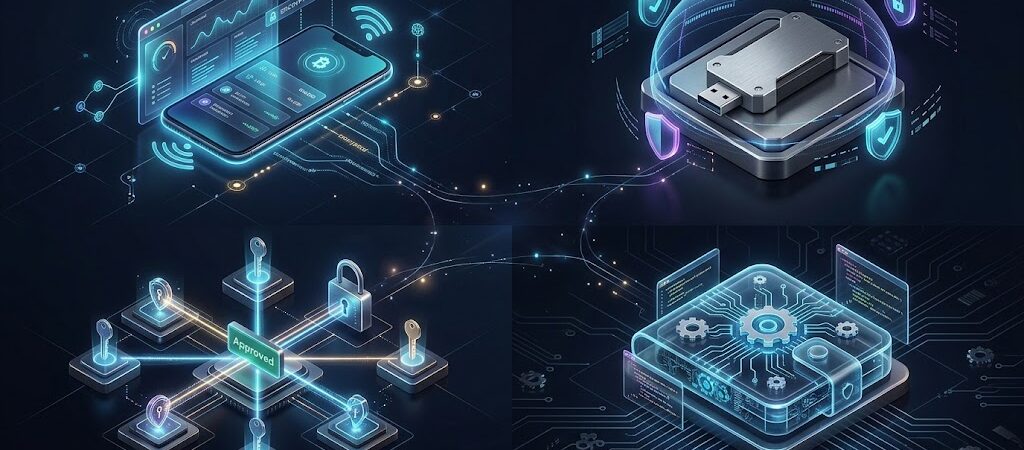
Introduction to Crypto Wallet Architecture
Cryptocurrency wallets are often described simply as tools for storing and sending digital assets. In reality, a modern wallet is much more than a place to “keep” cryptocurrency. A wallet is part of a broader security architecture that determines how blockchain transactions are authorized, how private keys are protected, how users recover access, and how control over digital assets is distributed.
Understanding crypto wallet architecture is therefore essential for anyone who wants to evaluate the security and practical design of a cryptocurrency wallet.
Different wallet architectures solve different problems. Hot wallets are designed around convenient access and frequent connectivity, while cold wallets emphasize offline key protection. Multisignature wallets distribute transaction authority among multiple keys, reducing reliance on a single signer. Smart wallets can introduce programmable rules that govern how transactions are authorized, recovered, or restricted.
These approaches are not always mutually exclusive. A wallet can combine multiple architectural concepts. For example, an organization might use several hardware devices to protect keys while also implementing a multisignature approval process. Similarly, a smart wallet can use programmable authorization rules to provide functionality that traditional single-key wallets cannot easily support.
The important question is therefore not simply which wallet type exists, but how a wallet is architected and where its security controls are placed.
Why Crypto Wallet Architecture Matters
Blockchain transactions are generally irreversible once confirmed. If the private keys or authorization mechanisms controlling an address are compromised, incorrectly configured, or permanently lost, recovering the associated assets may be difficult or impossible.
This makes wallet architecture an important part of cryptocurrency security.
A well-designed architecture can help address several risks, including:
- Unauthorized access to private keys
- Theft caused by compromised devices
- Loss of a single signing key
- Poor backup procedures
- Accidental transactions
- Excessive dependence on one person or device
- Weak recovery mechanisms
- Operational mistakes during transaction approval
At the same time, stronger security controls can introduce additional complexity. A wallet requiring several approvals may provide greater protection against a single compromised key, but it can also make routine transactions more complicated. Offline storage can reduce exposure to online attacks, but accessing funds may require additional operational steps.
This creates an important principle in crypto wallet architecture: security is not determined by one feature alone. It depends on how keys, devices, authorization mechanisms, recovery procedures, and users interact with one another.
From Simple Private Keys to Programmable Wallets
Early cryptocurrency wallet designs were largely centered around private keys. A user controlled a private key, and that key could be used to authorize transactions from the corresponding blockchain account.
Modern wallet architecture has expanded considerably.
Hardware wallets can isolate key operations from internet-connected computers. Multisignature systems can require several independent keys before a transaction is authorized. Smart contract wallets can introduce programmable transaction rules, alternative recovery mechanisms, and more flexible authorization models.
This evolution reflects a broader change in the cryptocurrency ecosystem.
As digital assets became more valuable and blockchain applications became more complex, users needed wallet systems capable of handling more than basic transfers. Individuals may want stronger protection for long-term holdings, while businesses and institutions may require multiple approval layers, role-based controls, recovery procedures, and operational safeguards.
As a result, wallet architecture has become an important component of digital-asset security and custody.
What This Article Covers
This guide examines four major wallet architectures: hot wallets, cold wallets, multisig wallets, and smart wallets.
The goal is not simply to define these terms, but to explain how each architecture works and what trade-offs it introduces.
We will examine how private keys are generated and protected, how transactions are authorized, where potential attack surfaces exist, and how recovery can be handled. We will also compare the practical differences between architectures for individual users, businesses, and organizations managing significant digital assets.
By understanding these architectural differences, users can better evaluate whether a particular wallet design matches their security requirements, transaction frequency, custody model, and operational needs.
The future of cryptocurrency wallets is increasingly moving beyond the idea of a single private key controlling everything. Instead, wallet systems are becoming more flexible, programmable, and security-focused.
Understanding that transition begins with understanding the architecture underneath the wallet.
What Is a Crypto Wallet?
Before comparing hot, cold, multisignature, and smart wallets, it is important to understand what a cryptocurrency wallet actually does.
The phrase “crypto wallet” can be misleading because digital assets such as Bitcoin and many other cryptocurrencies are not physically stored inside a wallet. The assets remain recorded on their respective blockchain networks. A wallet instead provides the tools and cryptographic credentials required to interact with those assets, including blockchain accounts such as Ethereum accounts and wallets.
At the center of this system are cryptographic keys.
A wallet generally manages one or more private keys or other authorization mechanisms that allow a user to approve blockchain transactions. The corresponding public information can be used to derive addresses that receive assets.
This means the fundamental purpose of a wallet is not simply storage. It is control and authorization.
A Wallet Connects Users to Blockchain Networks
A blockchain network maintains a shared record of transactions and account balances. Users interact with that network by submitting transactions that satisfy the network’s rules.
A wallet provides the interface and cryptographic functionality needed to create and authorize those transactions.
For example, when a user sends cryptocurrency to another address, the wallet may:
- Identify the assets and account involved.
- Construct the required transaction.
- Calculate or estimate applicable network fees.
- Request authorization from the appropriate key or signing mechanism.
- Cryptographically sign the transaction.
- Broadcast the transaction to the relevant blockchain network.
The blockchain then verifies the transaction according to its consensus and validation rules.
The wallet therefore acts as an important bridge between the user and the underlying blockchain infrastructure.
Private Keys and Control
For many traditional cryptocurrency accounts, the private key is one of the most important security components.
A private key is a secret cryptographic value that can be used to create valid digital signatures for transactions. Whoever controls the necessary private key or keys may be able to authorize transactions from the associated account.
This is why protecting private keys is fundamental to cryptocurrency security.
A private key should never be treated like an ordinary password. It is generally not something that can simply be reset through a centralized service if it is lost or compromised.
If a wallet’s authorization credentials are permanently lost and there is no suitable recovery mechanism, access to the associated assets may also be lost.
Conversely, if an unauthorized person obtains sufficient control over those credentials, that person may be able to move assets without the legitimate owner’s permission.
This creates the central security challenge that crypto wallet architecture attempts to address: how can transaction authority be made available to legitimate users while reducing unnecessary exposure to unauthorized access?
Public Keys and Wallet Addresses
Wallet systems also use public cryptographic information.
A public key can be derived from a private key through cryptographic processes. Depending on the blockchain and wallet design, addresses are then generated from public information according to the network’s address format and rules.
Unlike private keys, addresses are normally intended to be shared. A user can provide an address to another person or service to receive cryptocurrency.
However, an address should not be confused with the private key that controls it.
A simplified way to understand the relationship is:
Private authorization → Public cryptographic information → Blockchain address
The exact process varies between blockchain networks and wallet architectures, but the underlying principle remains important: public receiving information can generally be shared, while the secret information required to authorize transactions must be protected.
Seed Phrases and Wallet Recovery
Many cryptocurrency wallets use a recovery phrase, often called a seed phrase, to help users restore wallet access.
Instead of requiring users to manually record individual private keys, a wallet can generate a sequence of words from which the wallet’s key hierarchy can be deterministically recreated.
This makes backups more practical, particularly for wallets that manage multiple accounts or addresses.
However, the recovery phrase becomes a highly sensitive security credential. Anyone who obtains a wallet’s recovery phrase may potentially be able to recreate the wallet and access its assets, depending on the wallet’s architecture and additional security controls.
For this reason, recovery phrases should generally be protected from:
- Online storage
- Unencrypted cloud services
- Public websites
- Messaging applications
- Screenshots
- Untrusted devices
- Unauthorized people
The recovery process is therefore an important component of wallet architecture, not merely an emergency feature.
Wallet Architecture Determines Where Control Resides
Different wallet designs place transaction authority in different locations.
A conventional hot wallet may keep signing credentials accessible through software running on an internet-connected device.
A hardware-based cold wallet can isolate sensitive signing operations from the connected computer.
A multisignature wallet can distribute authorization across several independent keys.
A smart wallet can use programmable rules and smart-contract logic to determine how transactions are authorized.
These differences affect both security and usability.
The architecture determines how a transaction moves from a user’s intention to an authorized blockchain transaction. It also determines what happens if a device is lost, a key is compromised, an employee leaves an organization, or a recovery procedure needs to be activated.
Understanding this distinction provides the foundation for comparing the major wallet architectures covered in the following sections.
How Wallets Interact With Blockchain Networks
Understanding how a wallet interacts with a blockchain is essential for understanding crypto wallet architecture. A wallet does not independently determine whether a transaction is valid or change the blockchain’s underlying ledger. Instead, it prepares and authorizes transactions that are then processed according to the rules of the relevant blockchain network.
The exact process varies between blockchains, but the basic interaction follows a recognizable sequence.
From Transaction Request to Blockchain Confirmation
When a user decides to send cryptocurrency, the process begins with an instruction.
For example, a user may enter a recipient address, select an asset, specify an amount, and review the estimated network fee. The wallet then converts this information into a transaction format that the relevant blockchain can understand.
A simplified transaction flow looks like this:
User instruction → Transaction construction → Authorization → Broadcast → Network validation → Confirmation
Each stage has a different security responsibility.
The wallet is primarily responsible for constructing the transaction and obtaining the required authorization. The blockchain network is responsible for validating the transaction according to its protocol rules and incorporating valid transactions into the ledger.
This separation is important because a wallet does not simply “send coins” in isolation. It creates a cryptographically authorized instruction that the blockchain network can evaluate.
Transaction Construction
The first technical stage is transaction construction.
Depending on the blockchain, a transaction can contain information such as:
- The source account or inputs
- The destination address
- The amount being transferred
- Network-specific transaction parameters
- A transaction nonce or sequence value
- Applicable fees
- Smart contract instructions, when relevant
Different networks use different transaction models.
For example, some blockchains use account-based systems, while others use an unspent transaction output (UTXO) model. This means wallet software must understand the specific rules of the blockchain it supports.
A well-designed wallet abstracts much of this complexity from the user.
The user may simply see a balance, recipient field, amount, and fee estimate, while the wallet handles the technical transaction structure in the background.
Transaction Authorization
After the transaction has been constructed, it generally needs to be authorized.
For a traditional single-key wallet, this can involve using the relevant private key to create a digital signature.
The signature provides cryptographic evidence that the transaction was authorized by the holder of the required credential.
Importantly, the private key itself does not need to be publicly transmitted to the blockchain.
Instead, the wallet uses the key to generate a signature, and the blockchain network can use the corresponding public information to verify that signature according to the network’s rules.
This is one of the most important principles in wallet security:
The signing secret should remain protected while the resulting authorization can be verified by the network.
Different Architectures Can Change the Authorization Process
The authorization stage is where different wallet architectures begin to show major differences.
A conventional single-key wallet may require one private key to authorize a transaction.
A hardware wallet can perform the signing operation in a dedicated device designed to keep the private key isolated from the user’s general-purpose computer.
A multisignature wallet may require signatures from several different keys before a transaction becomes valid.
A smart wallet can use programmable logic to determine whether a proposed transaction satisfies predefined authorization conditions.
Therefore, the same basic user intention—such as sending cryptocurrency—can involve very different security processes depending on the wallet architecture.
Broadcasting the Transaction
Once the required authorization has been completed, the wallet can broadcast the transaction to the relevant blockchain network.
The transaction is typically transmitted through a blockchain node or another network-connected service.
At this point, the wallet has performed its primary authorization role, but the transaction has not necessarily been permanently recorded on the blockchain.
The network still needs to process and validate it.
Depending on the blockchain, transactions may initially enter a pool of pending transactions before being selected for inclusion in a block or another consensus-confirmed data structure.
Network Validation
Blockchain nodes and other network participants validate transactions according to the rules of the protocol.
Validation can involve checking whether:
- The transaction follows the required format
- The authorization or signature is valid
- The account or inputs have sufficient available funds
- Required transaction parameters are valid
- The transaction does not violate protocol rules
- Any referenced smart contract logic permits the requested operation
If the transaction passes the relevant checks, it can proceed toward confirmation.
The wallet itself cannot simply override these network rules.
This distinction is important when evaluating wallet security. A wallet can protect keys and improve transaction authorization, but the blockchain ultimately determines whether a transaction satisfies the network’s consensus and execution rules.
Confirmation and Finality
After a valid transaction is included in the blockchain, users generally wait for confirmation or finality according to the network’s design.
The meaning of confirmation varies across blockchain systems.
Some networks rely on additional blocks or validator processes to increase confidence that a transaction will not be reversed. Others use different mechanisms to establish finality.
Wallet interfaces often simplify this process by displaying statuses such as:
- Pending
- Confirmed
- Failed
- Finalized
These labels are useful for users, but the underlying process depends on the specific blockchain.
Why This Process Matters for Wallet Architecture
The transaction lifecycle demonstrates why wallet architecture is more than a question of where a private key is stored.
A complete wallet architecture can involve:
Key generation → Key protection → Transaction construction → Authorization → Broadcasting → Network validation → Recovery and backup
Different wallet designs make different choices at each stage.
For example, a hot wallet may prioritize rapid access and convenient signing. A cold-wallet architecture may introduce an offline signing step. A multisignature architecture can distribute authorization across multiple independent credentials. A smart wallet can move some authorization logic into programmable blockchain-based infrastructure.
These differences create different combinations of security, convenience, flexibility, and operational complexity.
Understanding the transaction lifecycle therefore provides the foundation for examining the individual wallet architectures in detail, beginning with the most common category.
Hot Wallet Architecture Explained
Hot wallets are cryptocurrency wallets whose key-management environment is connected to the internet or designed for frequent online interaction. They are widely used because they provide convenient access to digital assets and decentralized applications.
From a crypto wallet architecture perspective, the defining characteristic of a hot wallet is not simply that it is an application on a phone or computer. The important consideration is that the wallet’s transaction-signing environment is generally available within an online or connected computing environment.
This architecture makes frequent transactions easier, but it also creates a larger exposure surface than an appropriately isolated offline signing environment.
How Hot Wallet Architecture Works
A typical software-based hot wallet can contain several functional components.
These may include:
- A user interface
- Key-generation and key-management functions
- Transaction construction
- Transaction-signing functionality
- Blockchain network connectivity
- Address and balance management
- Application or decentralized application connectivity
When a user initiates a transaction, the wallet prepares the transaction and obtains the required authorization from the wallet’s signing credentials.
Because the wallet is designed for connected use, the process can usually happen quickly without requiring the user to physically move information between separate offline systems.
This makes hot wallets particularly suitable for activities where users interact with blockchain networks frequently.
Common Types of Hot Wallets
Hot wallets can take several forms.
Mobile Wallets
Mobile wallets operate through applications installed on smartphones or tablets.
They can provide convenient access to cryptocurrency while allowing users to interact with blockchain applications, scan addresses, and approve transactions directly from a mobile device.
Their security depends on multiple factors, including the wallet software, device security, operating-system protections, backup procedures, and how the user handles recovery credentials.
Desktop Wallets
Desktop wallets run on computers and can provide more functionality than some mobile applications.
They may support advanced transaction settings, multiple blockchain networks, hardware-wallet integration, or other specialized features.
However, the security of a desktop wallet can also be affected by the security condition of the underlying computer.
Malware, malicious software, compromised browser extensions, or unauthorized access to the operating system can create risks for users who keep sensitive wallet credentials in an exposed environment.
Browser-Based and Web Wallets
Some wallets operate through web applications or browser extensions.
These wallets can make decentralized applications particularly convenient because users can connect directly to websites and approve blockchain transactions through the wallet interface.
However, browser-based interaction introduces another layer that users must consider.
A malicious website can attempt to trick users into signing an unintended transaction, while a compromised browser environment can potentially expose sensitive information or manipulate transaction-related interactions.
The wallet may therefore be secure at the cryptographic level while the surrounding user environment remains vulnerable.
Advantages of Hot Wallet Architecture
The main advantage of a hot wallet is accessibility.
Users can generally initiate transactions quickly without retrieving a physically isolated device or moving signing information between separate environments.
This makes hot wallets useful for:
- Frequent cryptocurrency transactions
- Decentralized finance applications
- NFT and digital-asset applications
- On-chain gaming
- Smaller operational balances
- Regular payments
- Testing blockchain applications
Another advantage is integration.
Many hot wallets are designed to connect directly with decentralized applications and blockchain services. This reduces friction when users need to interact with smart contracts or other on-chain functionality.
Security Exposure of Hot Wallets
The same connectivity that makes hot wallets convenient can also increase their exposure to online threats.
Potential risks include:
- Malware
- Phishing attacks
- Malicious websites
- Compromised devices
- Fake wallet applications
- Social engineering
- Unsafe browser extensions
- Exposure of recovery credentials
- Accidental approval of malicious transactions
Not every threat involves directly stealing a private key.
For example, an attacker may attempt to convince a user to approve a transaction that transfers assets or grants an unintended permission. In such situations, the user may technically authorize the transaction even though the underlying action was malicious or deceptive.
This demonstrates why wallet security involves both cryptographic protection and transaction awareness.
Hot Wallets and Transaction Permissions
Smart-contract-based applications introduce additional considerations.
When interacting with decentralized applications, users may be asked to approve certain permissions or sign specific transactions. Depending on the blockchain and application, these permissions can allow a contract or another mechanism to interact with particular assets.
Users should therefore understand what they are authorizing rather than treating every wallet prompt as a routine confirmation.
A wallet interface can display transaction information, but users remain responsible for reviewing the destination, amount, permissions, and other relevant details whenever possible.
Hot Wallets Are Not Automatically “Unsafe”
It is important to avoid treating hot wallets as inherently insecure.
Their security depends on how the wallet is designed, how keys are protected, how the device is secured, and how the user interacts with blockchain applications.
A reputable hot wallet used on a well-secured device with appropriate operational practices can be useful for everyday blockchain activity.
The architectural trade-off is primarily about connectivity versus isolation.
A connected environment provides convenience and rapid access, while an offline environment can reduce certain categories of online exposure.
For this reason, many users do not need to choose one architecture for every asset.
A practical setup may involve keeping a limited operational balance in a hot wallet for routine activity while using a more isolated architecture for assets that do not need frequent access.
The Role of Hot Wallets in a Broader Wallet Architecture
Hot wallets are best understood as one component of a larger digital-asset security strategy.
An individual user might use a hot wallet for everyday transactions and a cold wallet for longer-term holdings.
A business might use hot wallets for operational payments while maintaining larger reserves under a multisignature or other controlled custody structure.
A more advanced setup can combine hot and cold environments with multisignature authorization, hardware signing devices, and programmable wallet controls.
This layered approach demonstrates an important principle:
Crypto wallet architecture does not require every asset to use the same wallet design.
Different assets, transaction frequencies, users, and risk levels can justify different security arrangements.
Cold Wallet Architecture Explained
Cold wallets take a different approach to key security by keeping the signing environment isolated from continuous internet connectivity. Instead of maintaining transaction-signing credentials in an environment that is routinely online, a cold-wallet architecture is designed to reduce exposure to internet-based threats.
This makes cold storage particularly relevant for cryptocurrency holders who prioritize the protection of assets that do not need to be accessed frequently.
The term “cold wallet” can describe several different approaches, but the central architectural idea is isolation.
What Makes a Wallet “Cold”?
A wallet is generally considered cold when the credentials required to authorize transactions are kept in an environment that is offline or otherwise strongly isolated from network-connected systems.
This distinction is important because simply owning a physical device does not automatically make every wallet interaction completely offline.
For example, a hardware wallet may remain disconnected from a computer except when a transaction needs to be prepared or signed. During that process, the signing device can be designed so that the private key remains inside the device rather than being exposed to the connected computer.
Cold storage therefore focuses on protecting the signing environment, rather than simply storing cryptocurrency inside a physical object.
Hardware Wallets
Hardware wallets are one of the most recognizable forms of cold-storage architecture.
A hardware wallet is a specialized device designed to generate, protect, and use cryptographic keys for blockchain transactions.
A typical transaction process can look like this:
Connected computer → Transaction preparation → Hardware device → User verification → Signature → Connected computer → Blockchain network
The important architectural feature is that the private key can remain inside the hardware device.
The connected computer may prepare the transaction and display information to the user, but the signing operation can occur within the dedicated device.
This separation can reduce the impact of certain threats affecting the host computer.
Why Offline Signing Matters
Consider a computer that has been infected with malicious software.
If a wallet’s private key is directly accessible to that computer, the malware may have opportunities to compromise the key or interfere with wallet operations.
With an appropriately designed hardware-wallet architecture, the private key can remain isolated from the computer.
The computer can request a signature, but the sensitive signing credential remains inside the protected environment.
The user can then review important transaction information on the signing device before approving it.
This creates a security boundary between the general-purpose computer and the key-management environment.
However, cold storage does not eliminate every risk.
Users still need to consider malicious transaction details, phishing, physical theft, device security, recovery backups, supply-chain concerns, and operational mistakes.
Air-Gapped Wallet Architectures
Some cold-storage systems take isolation further by using an air-gapped signing environment.
An air-gapped system is designed to remain physically separated from networks. Instead of relying on a persistent internet connection, transaction information can be transferred through controlled mechanisms such as QR codes, removable media, or other dedicated communication methods.
A simplified process might be:
- Prepare an unsigned transaction on an online system.
- Transfer the transaction data to the offline signing environment.
- Review the transaction details.
- Sign the transaction in the isolated environment.
- Transfer the signed transaction back to an online system.
- Broadcast it to the blockchain network.
The private key can remain entirely within the offline environment.
This architecture can significantly reduce direct network exposure, although it introduces additional operational complexity.
Cold Storage and Recovery
Cold storage also requires a carefully designed recovery strategy.
Keeping a private key offline is only useful if the legitimate owner can recover access when necessary.
Depending on the wallet architecture, recovery may involve:
- A seed phrase
- Backup keys
- Multiple backup devices
- Secure physical storage
- Additional authentication information
- Multisignature recovery arrangements
The backup itself must be protected.
An offline recovery phrase that is photographed and uploaded to cloud storage, for example, can undermine much of the security gained from offline key storage.
This illustrates an important principle of crypto wallet architecture:
The security of a wallet is influenced by the entire key lifecycle, not only the primary signing device.
Cold Wallets and Physical Security
Cold storage reduces certain online risks, but it introduces greater emphasis on physical security.
Users need to consider what happens if:
- The hardware device is lost
- The device is damaged
- A backup is destroyed
- A recovery phrase is exposed
- An unauthorized person gains physical access
- The owner becomes unable to access the recovery materials
For significant holdings, relying on a single physical device or a single copy of a recovery phrase can create a different type of concentration risk.
This is why sophisticated custody arrangements may distribute backups across separate secure locations or combine cold storage with multisignature authorization.
Cold Storage and Usability
The primary trade-off with cold wallets is usually convenience.
A hot wallet can allow a user to approve a transaction within seconds from a connected device.
A cold-storage process may require:
- Retrieving a physical device
- Connecting or accessing an isolated environment
- Reviewing transaction information
- Confirming the transaction
- Completing the signing process
- Returning the device to secure storage
For users making frequent transactions, these additional steps can become inconvenient.
For long-term holdings, however, reduced online exposure may be more valuable than immediate accessibility.
Cold Wallets Are Not a Complete Security Strategy
Cold storage should not be treated as a guarantee against cryptocurrency theft.
A user could still lose assets through compromised recovery information, malicious transaction approval, physical attacks, poor backup practices, or other operational failures.
The architecture simply changes the risk profile by reducing the amount of time sensitive signing credentials spend in connected environments.
This distinction is important when comparing cold wallets with other architectures.
A cold wallet primarily emphasizes isolation and key protection. A multisignature wallet addresses a different problem by distributing transaction authority among multiple keys.
These two approaches can also be combined.
For example, an organization could store several signing keys on separate hardware devices and require a defined number of those keys to authorize a transaction.
Multisig Wallet Architecture Explained
Multisignature, commonly shortened to multisig, changes the traditional single-key model by requiring authorization from multiple keys before certain transactions can be executed.
Instead of depending on one private key, a multisig arrangement can distribute transaction authority among several independent keys or signers.
This creates a different security model.
If one key is lost, stolen, or compromised, the attacker may not automatically have enough authority to move the assets. Similarly, a single authorized person may not be able to execute a transaction without the required additional approvals.
How Multisig Works
A multisig wallet uses a predefined authorization threshold.
For example, a wallet might be configured as:
2-of-3 multisig
This means three authorized signing keys exist, but at least two valid signatures are required for a transaction to be approved.
Another arrangement could be:
3-of-5 multisig
Five authorized keys exist, while three signatures are required to authorize a transaction.
The exact implementation depends on the blockchain and wallet technology, but the core concept is the same:
Multiple authorization credentials → Defined threshold → Transaction approval
This is fundamentally different from a traditional wallet that depends on one signing key.
Why Multisig Reduces Single-Key Dependence
Single-key wallets create a straightforward security relationship.
If the required private key is compromised, the attacker may gain the ability to authorize transactions.
Multisig introduces additional separation.
Suppose an organization uses a 2-of-3 arrangement. One key is compromised, but the attacker does not possess either of the other two keys. The compromised key alone may therefore be insufficient to authorize a transaction.
This can reduce the consequences of a single-key compromise.
However, multisig does not automatically make every wallet secure. The security of the overall arrangement depends on how the individual keys are generated, stored, backed up, and protected.
If multiple keys are stored on the same compromised device or in the same vulnerable location, the benefits of distributing authorization can be reduced.
Multisig as a Distribution of Trust
One of the most important features of multisig architecture is the ability to distribute responsibility.
Consider a company managing a cryptocurrency treasury.
Instead of allowing one employee to control the treasury wallet, the company could distribute signing authority among several authorized individuals.
A transaction might require approvals from multiple people before it can be executed.
This can provide an additional operational control layer.
It can help reduce dependence on a single employee and create a formal approval process for significant transactions.
Common Multisig Configurations
Different threshold structures can serve different operational purposes.
1-of-2
Two keys exist, but only one is required.
This provides redundancy but does not provide strong multi-party authorization because either key can independently approve a transaction.
2-of-3
Three keys exist and two are required.
This can provide a balance between redundancy and shared authorization.
If one key is lost, the remaining two can still potentially authorize transactions.
3-of-5
Five keys exist and three are required.
This provides a larger group of authorized signers and can be useful where responsibility needs to be distributed across several people or locations.
The correct configuration depends on the organization’s operational requirements, threat model, recovery procedures, and governance structure.
There is no universal threshold that works for every situation.
Multisig and Key Independence
The security value of multisig depends heavily on key independence.
If all signing keys are controlled through the same device, stored together, or exposed to the same failure, a nominally multi-key system may still have a concentrated point of failure.
A stronger architecture can separate keys across:
- Different physical devices
- Different geographic locations
- Different authorized individuals
- Different backup arrangements
- Different security environments
For example, a 3-of-5 treasury architecture might distribute five signing devices among several trusted personnel and secure locations.
The objective is not simply to create more keys, but to make unauthorized control of the required threshold substantially more difficult.
Multisig and Cold Storage
Multisig and cold storage can work together.
A multisig wallet defines how many approvals are required, while cold storage can determine how individual signing keys are protected.
For example, an organization could use a 3-of-5 multisig wallet where each signing credential is held on a separate hardware device.
The resulting architecture combines:
Distributed authorization + Offline key protection
This can provide stronger separation than relying on a single hardware wallet.
However, additional complexity must also be managed carefully.
The organization needs to document which devices correspond to which signing keys, how backups are maintained, who can authorize transactions, and what happens if one or more signers become unavailable.
Recovery and Loss Scenarios
One of the major advantages of a threshold-based architecture is that the loss of one key does not necessarily mean immediate loss of access.
Consider a 2-of-3 configuration.
If one signing key is destroyed, the remaining two keys can potentially satisfy the authorization threshold.
This creates redundancy.
However, recovery procedures still need to be designed in advance.
An organization should understand what happens if:
- One signer loses a device
- A signing device is stolen
- A signer becomes unavailable
- A backup is damaged
- A key is suspected of being compromised
- The organization needs to replace a signer
The exact recovery process depends on the multisig implementation and blockchain.
Multisig Does Not Eliminate Human Risk
Multisig changes the authorization structure, but it does not remove human error.
For example, multiple signers could accidentally approve the same malicious transaction if they fail to review the transaction details carefully.
Likewise, poor coordination, unclear procedures, or inadequate backups can create operational problems.
Multisig therefore works best when combined with clear policies and transaction-review procedures.
The technical threshold is only one part of the overall security architecture.
Multisig for Personal and Institutional Use
Individual users can use multisig to distribute control of significant personal holdings.
Organizations may use it for treasury management, shared custody, governance, and transaction approval.
The architecture can be particularly relevant when several people need to share responsibility without giving any single person unilateral control.
At the same time, multisig introduces additional operational requirements compared with a simple single-key wallet.
This trade-off between distributed security and operational complexity is central to understanding multisig architecture.
Smart Wallet Architecture Explained
Smart wallets represent a major evolution in crypto wallet architecture. Instead of relying exclusively on the traditional model of a single externally controlled private key, smart wallets can use Ethereum account abstraction and programmable blockchain logic to define how transactions are authorized and executed.
This allows wallet behavior to become more flexible.
Depending on the implementation, a smart wallet can support features such as multiple authorization methods, spending limits, recovery mechanisms, transaction batching, and more sophisticated transaction rules.
The exact capabilities vary by blockchain and wallet implementation, but the central idea is that authorization can become programmable.
What Is a Smart Wallet?
A smart wallet generally refers to a wallet whose transaction-control logic is implemented through smart-contract functionality rather than being limited to the basic authorization model of a conventional externally controlled account.
On Ethereum and compatible networks, smart contract wallets can define rules for how transactions are validated and executed.
Instead of asking only:
“Does this transaction have the correct private-key signature?”
a programmable wallet can potentially evaluate additional conditions.
For example:
- Is the transaction properly authorized?
- Does the requested amount exceed a predefined limit?
- Is an additional approval required?
- Is the transaction being made during an allowed period?
- Does the transaction satisfy a recovery or security rule?
The specific rules depend on the wallet’s implementation.
Programmable Authorization
Programmability is one of the defining characteristics of smart-wallet architecture.
A conventional single-key wallet generally has a relatively straightforward authorization model.
A smart wallet can introduce additional logic.
For example, a user could potentially configure a spending policy where small transactions require normal authorization while larger transactions require additional approval.
An organization could potentially establish different authorization rules for different types of transactions.
This flexibility can make wallet architecture more adaptable to complex operational requirements.
Smart Wallets and Account Abstraction
Smart wallets are closely associated with the concept of account abstraction.
Account abstraction aims to make blockchain accounts more flexible by separating some aspects of transaction authorization and execution from the limitations of traditional externally owned accounts.
On Ethereum, standards and infrastructure associated with account abstraction can enable smart-contract-based accounts to use more flexible validation and execution mechanisms.
This can support features such as:
- Alternative authentication methods
- Transaction batching
- Sponsored transaction fees
- Programmable recovery
- Multiple authorization mechanisms
- Custom transaction-validation rules
These capabilities can make blockchain applications easier to design around user-specific requirements.
However, the exact functionality depends on the smart-wallet implementation and the surrounding blockchain infrastructure.
Smart Wallets and Recovery
Recovery is an important area where programmable wallet architecture can provide additional flexibility.
Traditional wallet users often rely heavily on a seed phrase or private-key backup.
A smart wallet can potentially implement alternative recovery mechanisms.
For example, a wallet could be designed so that a predefined recovery process allows authorized recovery participants to help restore control after the primary authentication method is lost.
This does not mean that smart wallets eliminate the need for secure backups.
Instead, they can provide additional ways to structure recovery.
The recovery rules themselves become part of the wallet’s security architecture and therefore need to be carefully designed.
Spending Limits and Transaction Policies
Smart-contract logic can also support transaction restrictions.
A wallet could potentially define limits for certain transactions or require additional authorization when those limits are exceeded.
For example, an organization might establish an operational policy where routine payments can be authorized through one process while larger treasury transfers require additional approval.
This can create a more granular security model than simply allowing every transaction to be approved through one unrestricted signing credential.
Such controls can be particularly relevant to businesses, decentralized applications, and users managing substantial on-chain activity.
Transaction Batching
Another potential advantage of smart-wallet architecture is transaction batching.
Instead of requiring multiple separate transactions, a smart wallet can potentially combine compatible operations into a single user interaction.
For example, a decentralized application could require several blockchain actions as part of one workflow.
A smart-wallet architecture can make it possible to structure those actions together when supported by the relevant infrastructure.
This can improve usability and may reduce unnecessary transaction-management steps.
The actual network fee implications depend on the blockchain and implementation.
Sponsored Transaction Fees
Smart-wallet infrastructure can also support alternative approaches to transaction fees.
In traditional blockchain interactions, users generally need the appropriate network-native asset to pay transaction fees.
Account-abstraction systems can introduce mechanisms through which another party or service helps sponsor transaction costs under defined conditions.
This can make blockchain applications easier for new users because the application can potentially handle some of the complexity associated with network fees.
However, sponsored transactions still depend on infrastructure, policies, and economic arrangements established by the application or service provider.
Smart Wallet Security
Programmability introduces both opportunities and additional considerations.
A traditional private-key wallet has a relatively concentrated security boundary around its key.
A smart wallet can have additional components, including:
- Smart-contract code
- Authorization logic
- Recovery mechanisms
- External services
- Relayers or transaction infrastructure
- User interfaces
Each additional component can introduce another area that needs to be reviewed and secured.
A programming error or poorly designed authorization rule could potentially affect wallet behavior.
Therefore, smart-wallet security depends not only on protecting cryptographic credentials but also on the quality of the underlying smart-contract and account-abstraction infrastructure.
Smart Wallets Are Not Simply “Better” Traditional Wallets
Smart wallets should not be viewed as a universal replacement for every other wallet architecture.
They solve different problems.
A traditional wallet can provide a straightforward signing model.
A cold wallet emphasizes isolation.
A multisig wallet distributes authorization.
A smart wallet can introduce programmable rules and flexible account behavior.
These approaches can also overlap.
For example, a smart wallet architecture can incorporate multiple authorization mechanisms, while the credentials used by those mechanisms may themselves be protected using hardware devices.
This means the future of crypto wallet architecture is likely to involve combinations of these concepts rather than a single architecture replacing all others.
Hot vs Cold vs Multisig vs Smart Wallets
Hot, cold, multisignature, and smart wallets are often presented as four competing wallet types. However, that description can be misleading because these terms can refer to different architectural characteristics.
Hot and cold primarily describe the connectivity and isolation of the wallet’s signing environment. Multisig describes how transaction authorization is distributed among multiple keys. Smart wallets describe an architecture in which programmable logic can control account behavior and transaction validation.
Understanding these distinctions makes it easier to compare wallet designs without treating them as mutually exclusive categories.
Hot Wallets: Accessibility and Connectivity
A hot wallet is designed for frequent online access.
Its architecture generally makes transaction signing readily available within a connected environment. This provides a smooth user experience and makes hot wallets practical for everyday blockchain activity.
Typical characteristics include:
- Fast transaction access
- Convenient application connectivity
- Easy interaction with decentralized applications
- Greater exposure to connected-device threats
- Dependence on the security of the surrounding device and software
Hot wallets are therefore often associated with operational convenience.
The trade-off is that the signing environment is more closely connected to systems that may be exposed to online threats.
Cold Wallets: Isolation and Protection
Cold-wallet architecture emphasizes isolation.
The signing credentials are maintained in an offline or strongly separated environment, reducing continuous exposure to internet-connected systems.
Typical characteristics include:
- Reduced online exposure
- Stronger separation between signing and general computing
- Greater emphasis on physical security
- More deliberate transaction procedures
- Additional recovery and backup considerations
Cold storage can therefore be useful when immediate transaction access is less important than reducing exposure to online threats.
However, physical security and recovery planning become particularly important.
Multisig: Distributed Authorization
Multisig addresses a different architectural problem.
Rather than asking whether the signing environment is online or offline, multisig asks:
How many independent authorizations are required before a transaction can proceed?
A 2-of-3 configuration, for example, requires two valid signatures from three authorized keys.
Typical characteristics include:
- Reduced dependence on one key
- Shared transaction authority
- Threshold-based approvals
- Greater redundancy
- Increased operational complexity
Multisig can therefore be useful where transaction control needs to be distributed among several people or security devices.
Smart Wallets: Programmable Control
Smart wallets introduce programmable authorization and transaction logic.
Instead of relying solely on a basic single-key authorization model, the wallet can potentially evaluate additional rules through smart-contract functionality.
Depending on the implementation, these rules can support:
- Multiple authorization methods
- Recovery mechanisms
- Spending limits
- Transaction batching
- Sponsored transaction fees
- Custom validation logic
This can make smart wallets highly flexible, particularly for applications and users requiring more sophisticated account behavior.
However, smart-contract logic also introduces additional components that must be properly designed, tested, and secured.
A Direct Architectural Comparison
| Architecture | Primary characteristic | Main security concept | Typical strength | Main consideration |
|---|---|---|---|---|
| Hot wallet | Online connectivity | Convenient access | Fast and accessible transactions | Greater online exposure |
| Cold wallet | Offline or isolated signing | Key isolation | Reduced network exposure | Less convenient access |
| Multisig wallet | Multiple required signers | Distributed authorization | Reduced single-key dependence | More operational complexity |
| Smart wallet | Programmable account logic | Flexible authorization | Custom transaction controls | Smart-contract and implementation risk |
This table should be understood as a conceptual comparison rather than a ranking.
Each architecture addresses different requirements.
These Architectures Can Be Combined
One of the most important points in modern crypto wallet architecture is that these categories can overlap.
For example, consider a hypothetical organizational treasury.
The organization could use:
Cold storage to isolate signing devices.
Multisig to require several independent approvals.
Hardware wallets to protect individual signing credentials.
Smart-contract functionality to implement additional transaction rules where supported.
In this arrangement, the technologies are not competing with one another. They are different layers of the same security architecture.
Similarly, an individual user might maintain a hot wallet for routine transactions while storing long-term assets using a cold-storage arrangement.
Security Is a System, Not a Single Feature
Comparing wallet architectures also reveals why no individual feature should be treated as a complete security solution.
A wallet’s security can depend on:
- Key generation
- Key storage
- Device security
- Transaction authorization
- Recovery procedures
- Backup design
- User verification
- Smart-contract code
- Physical security
- Operational policies
A technically sophisticated wallet can still be poorly protected if its recovery phrase is exposed.
Likewise, a multisig system can lose much of its intended security if the required keys are all stored in the same vulnerable environment.
A cold wallet can reduce online exposure but cannot prevent a user from approving a malicious transaction.
A smart wallet can provide powerful authorization rules but may introduce additional smart-contract risks.
The architecture must therefore be evaluated as a complete system.
Choosing Architecture Based on Use Case
Different users may have different requirements.
Someone making frequent blockchain transactions may prioritize accessibility.
A long-term holder may place greater emphasis on isolation and secure recovery.
A business may require distributed authorization and documented approval procedures.
A decentralized application may benefit from programmable account functionality.
These needs can also change over time.
A user does not necessarily need to place every asset under one wallet architecture. Separating operational funds from long-term holdings can allow different security models to serve different purposes.
The most useful way to think about wallet architecture is therefore not “Which wallet type is universally best?” but rather:
“Which combination of security controls matches the assets, users, transactions, and risks involved?”
Security Trade-Offs and Wallet Attack Surfaces
Every cryptocurrency wallet architecture introduces a particular combination of security controls, usability requirements, and potential attack surfaces. Understanding these trade-offs is an important part of evaluating crypto wallet architecture.
An attack surface is the collection of components, interactions, and processes through which a wallet or its users could potentially be exposed to unauthorized access, manipulation, or loss.
No wallet architecture removes every possible risk. Instead, different architectures change where those risks are concentrated.
Hot Wallet Attack Surfaces
Hot wallets operate in connected environments, which can create several potential attack paths.
The surrounding device is an important security boundary.
A compromised smartphone or computer could potentially expose sensitive information or interfere with wallet activity. Malicious applications, browser extensions, phishing websites, and other forms of malware can also create risks.
Another important attack surface is the user interface.
A fraudulent website may imitate a legitimate decentralized application and persuade a user to approve a transaction they did not intend to authorize.
This means hot-wallet security involves more than protecting private keys.
Users must also evaluate:
- The software they install
- The websites they connect to
- The transactions they approve
- The permissions they grant
- The security of their devices
- The protection of recovery credentials
The convenience of a hot wallet therefore comes with greater dependence on the security of the connected environment.
Cold Wallet Attack Surfaces
Cold wallets reduce certain online risks by separating sensitive signing operations from continuously connected systems.
However, the attack surface does not disappear.
Physical access becomes more important.
Potential concerns include:
- Device theft
- Physical damage
- Loss of recovery information
- Unauthorized access to backups
- Counterfeit or tampered hardware
- Unsafe initialization procedures
- Incorrect transaction verification
The recovery phrase is particularly important.
If an attacker obtains sufficient recovery information, the physical wallet device itself may no longer be the primary security barrier.
Cold storage therefore shifts some security responsibility from the online environment toward physical protection and recovery management.
Multisig Attack Surfaces
Multisignature architecture distributes transaction authorization, which can reduce dependence on a single key.
However, it also creates more components that need to be managed correctly.
Potential risks include:
- Compromise of multiple signing keys
- Poor key distribution
- Insecure backups
- Loss of too many keys
- Incorrect signer configuration
- Operational coordination failures
- Misunderstanding of the authorization threshold
Key independence is especially important.
If several signing credentials are exposed through the same computer, cloud account, physical location, or operational process, an attacker may have a pathway to compromise multiple signers.
A well-designed multisig arrangement therefore considers not only the number of keys but also their independence.
Smart Wallet Attack Surfaces
Smart wallets introduce another category of risk because programmable wallet behavior depends on software logic.
Potential components include:
- Smart contracts
- Validation rules
- Recovery mechanisms
- Transaction execution logic
- Relayer infrastructure
- External services
- Wallet interfaces
A vulnerability in smart-contract code or an incorrectly designed authorization rule could potentially affect wallet operations.
This does not mean that smart wallets are inherently insecure. It means their security model includes additional technical dependencies that traditional single-key wallets may not have.
Users and organizations therefore need to consider both cryptographic security and software security.
Phishing and Social Engineering
Many wallet attacks do not require an attacker to break the cryptography.
Instead, attackers may attempt to manipulate users.
Common techniques include:
- Fake wallet websites
- Fraudulent support messages
- Impersonation
- Fake airdrops
- Malicious decentralized applications
- Urgent transaction requests
- Fake wallet updates
- Requests for recovery phrases
Social engineering can affect almost every wallet architecture.
Even a highly isolated wallet can be exposed if a user voluntarily reveals a recovery phrase or authorizes an unintended transaction.
This is why human verification remains an important layer of wallet security.
Transaction Simulation and User Awareness
Some modern wallet systems provide transaction previews or simulations that attempt to show users what a proposed blockchain interaction will do.
These tools can help users identify unexpected transfers, contract interactions, or permission changes before signing.
However, simulations are not a replacement for careful review.
Users should still verify important transaction information, including:
- Recipient address
- Asset
- Amount
- Network
- Contract interaction
- Requested permissions
- Applicable fees
The exact information available depends on the wallet and blockchain.
Recovery as an Attack Surface
Recovery mechanisms are essential because users can lose devices, keys, or access credentials.
At the same time, recovery creates another potential security boundary.
A recovery process that is too easy for an unauthorized person to trigger can weaken the wallet’s security.
A recovery process that is excessively complicated can increase the risk of permanent loss.
This creates a delicate balance.
Traditional wallets may rely heavily on seed-phrase backups.
Multisig systems can distribute recovery responsibility across multiple keys.
Smart wallets can potentially implement programmable recovery mechanisms.
Each approach requires careful consideration of who can recover the account, what evidence is required, and how recovery credentials are protected.
The Human Factor
Technology cannot completely eliminate operational mistakes.
A user can send funds to the wrong address.
A signer can approve a malicious transaction.
An organization can misconfigure a multisig threshold.
A recovery phrase can be stored insecurely.
A hardware device can be lost.
A smart-contract upgrade can introduce unexpected behavior.
These examples demonstrate that crypto wallet architecture should be designed around realistic human behavior rather than assuming perfect operation.
Clear procedures, transaction review, secure backups, and appropriate access controls can complement technical security mechanisms.
Security Versus Convenience
The major architectural trade-off can often be expressed as:
More isolation and control → More operational complexity
More accessibility and automation → Greater dependence on connected systems and software
Neither side automatically represents a universal solution.
A wallet intended for frequent everyday transactions may need a different design from one protecting long-term reserves.
Likewise, a small personal wallet may require a different operational model from an organization’s treasury containing multiple assets and several authorized users.
The appropriate architecture depends on the specific threat model and operational requirements.
Defense in Depth
A strong wallet security strategy can use multiple layers rather than depending on one feature.
For example:
Secure device + hardware signing + multisig + geographic key separation + controlled recovery
Each layer addresses a different category of risk.
This principle is often called defense in depth.
The objective is to ensure that the failure of one security control does not automatically result in total loss of control.
Custody, Recovery, and Backup Architecture
A wallet’s security architecture extends beyond the moment when a transaction is signed. Long-term control of digital assets also depends on how keys are backed up, who has authority to access them, and what happens when a device, credential, or authorized user becomes unavailable.
This makes custody, recovery, and backup essential components of crypto wallet architecture.
A wallet can have strong transaction security but still create significant risk if its recovery process is poorly designed.
What Is Crypto Custody?
Crypto custody refers broadly to how control over digital assets and their authorization credentials is maintained.
In a self-custody arrangement, the user or organization controls the credentials needed to authorize transactions.
In a custodial arrangement, a third party may control those credentials on behalf of the user.
Wallet architecture is particularly important in self-custody because the security and availability of the authorization credentials directly affect access to assets.
The central question is:
Who can authorize a transaction, and how can that authority be recovered if something goes wrong?
Single-Key Recovery
A conventional wallet may depend heavily on a recovery phrase or another backup representation of its key material.
If the primary device is lost, a compatible wallet can potentially recreate the necessary keys from the recovery information.
This provides a straightforward recovery model.
However, it also creates concentration risk.
If the recovery phrase is the only way to restore the wallet and that phrase is lost, access may be permanently unavailable.
Conversely, if the phrase is copied by an unauthorized person, the backup itself can become a pathway to asset theft.
The recovery credential therefore requires the same level of protection as the underlying wallet authority.
Backup Design
A backup should be designed around both availability and confidentiality.
The owner needs to be able to recover the wallet when necessary, while unauthorized people must not be able to use the backup to gain control.
Important considerations can include:
- Where the backup is stored
- Who can access it
- Whether multiple copies exist
- Whether copies are physically separated
- How damage is handled
- How recovery is tested
- Whether the backup exposes the complete signing authority
Simply creating multiple copies does not automatically create a secure backup strategy.
For example, storing several copies in the same physical location does little to protect against a single catastrophic event affecting that location.
Multisig Recovery Architecture
Multisig can change the recovery model by distributing authorization among multiple keys.
Consider a 2-of-3 arrangement.
If one key becomes unavailable, the remaining two keys can potentially continue to authorize transactions.
This provides redundancy without requiring every key to remain available at all times.
However, the recovery plan must account for more than individual key loss.
The organization or user also needs to understand what happens if multiple keys become unavailable or if one key is suspected of compromise.
The architecture should therefore define:
Who holds each key → Where each key is stored → What threshold is required → How replacement occurs
These decisions should ideally be established before an emergency occurs.
Geographic Separation
For significant holdings, separating key locations can reduce certain forms of concentration risk.
For example, multiple signing devices or backups can be stored in different secure physical locations.
The purpose is to reduce the possibility that one event affects every recovery component simultaneously.
Potential events include:
- Fire
- Flooding
- Theft
- Physical destruction
- Local access restrictions
- Loss of a facility
Geographic separation does not guarantee recovery, but it can improve resilience when combined with appropriate backup procedures.
Organizational Recovery
Businesses face additional recovery requirements because wallet authority may depend on multiple people.
An employee who controls one signing key may leave the organization.
Another signer may lose a device.
A new executive or authorized employee may need to replace an existing signer.
These situations require formal procedures.
An organizational wallet architecture can therefore include policies for:
- Adding authorized signers
- Removing signers
- Replacing compromised keys
- Rotating credentials
- Approving emergency transactions
- Documenting wallet ownership
- Maintaining secure backups
The technical wallet configuration and the organization’s internal governance should work together.
Smart Wallet Recovery
Smart wallets can potentially introduce more flexible recovery mechanisms.
Depending on the implementation, recovery logic may allow alternative authentication or designated recovery participants to restore control under predefined conditions.
This can reduce dependence on a single traditional recovery phrase.
However, recovery logic itself becomes part of the wallet’s security model.
If recovery participants are compromised, or if the recovery rules are poorly designed, the mechanism could create an unintended attack path.
The key question is therefore not simply whether a wallet offers recovery, but how recovery authority is structured and protected.
Emergency Access
Long-term custody planning should also consider emergencies.
For personal holdings, an owner may become temporarily unable to access a wallet.
For organizations, several key holders may become unavailable at the same time.
A robust architecture can define procedures for legitimate emergency access without making unauthorized access unnecessarily easy.
This is particularly important for assets intended to remain under custody for many years.
Testing Recovery Procedures
A backup that has never been tested may not provide the expected protection.
Recovery procedures can fail because of:
- Incorrect recovery information
- Incompatible wallet software
- Missing devices
- Forgotten passwords or authentication details
- Incorrect multisig configuration
- Poor documentation
- Loss of required signers
Testing can help identify these problems before an actual emergency occurs.
However, recovery testing should itself be performed carefully so that sensitive credentials are not unnecessarily exposed.
Recovery Versus Security
Recovery and security can sometimes pull in opposite directions.
A recovery process that gives many people access may improve availability but increase the number of potential attack paths.
A highly restrictive recovery process may reduce unauthorized access but increase the consequences of lost credentials.
This is another reason why crypto wallet architecture must be designed around the specific user and threat model.
There is no single recovery structure that fits every individual, business, or institutional custody arrangement.
The Complete Custody Lifecycle
A mature wallet architecture considers the entire lifecycle of authorization:
Generation → Storage → Backup → Transaction approval → Monitoring → Recovery → Replacement
Each stage can introduce different risks.
The strongest architecture is therefore not necessarily the one with the most complicated technology. It is the one where the entire lifecycle is understood, documented, and appropriate for the assets and people involved.
With custody and recovery established, the next question is how these architectures can be applied in real-world situations.
Wallet Architecture for Individual Users
Individual cryptocurrency users rarely have identical security requirements. Someone who makes frequent on-chain transactions may need a different wallet architecture from someone who primarily holds digital assets for the long term.
This is why crypto wallet architecture should be considered in relation to transaction frequency, asset value, technical experience, recovery requirements, and exposure to online applications.
Rather than relying on one wallet for every activity, users can separate their digital assets according to how they intend to use them.
Everyday Transaction Wallets
Users who frequently send cryptocurrency or interact with decentralized applications may prioritize accessibility.
A hot wallet can provide a convenient environment for:
- Routine transfers
- Decentralized applications
- Token swaps
- NFT interactions
- Blockchain games
- Small operational balances
The main architectural advantage is speed.
Transactions can generally be prepared and authorized without retrieving an offline signing device each time.
However, users should recognize that the convenience of a connected wallet comes with greater dependence on the security of the device, software, websites, and applications involved.
Long-Term Holdings
Assets that do not need frequent access can be managed differently.
A cold-storage architecture can reduce the amount of time signing credentials remain exposed to connected environments.
For example, a user may keep a smaller operational balance in a hot wallet while maintaining longer-term holdings through a hardware-based cold-storage arrangement.
This creates a basic separation between:
Daily access → Connected wallet
Long-term custody → More isolated wallet
Such separation can limit the amount of assets directly exposed to routine online activity.
Separating Operational and Reserve Funds
One useful architectural concept is the separation of operational funds from reserve funds.
Operational funds are intended for regular transactions.
Reserve funds are intended for longer-term storage and may require stronger controls before they can be accessed.
This separation can reduce the consequences of a compromise affecting the operational wallet.
For example, if an attacker gains control of a hot wallet containing a limited operational balance, the user’s long-term reserves may remain under a separate custody arrangement.
The exact amounts and architecture depend on the individual’s circumstances and risk tolerance.
Personal Multisig
Multisig is not limited to businesses.
An individual managing significant digital assets can potentially use a multisignature architecture to reduce dependence on one signing credential.
For example, a 2-of-3 configuration can provide redundancy.
If one signing device is lost or becomes unavailable, the other two may still be sufficient to authorize transactions.
The architecture can also distribute keys across separate physical locations.
However, personal multisig requires careful planning.
The user must understand:
- How each key is backed up
- Where each key is stored
- Which threshold is required
- How wallet recovery works
- How replacement procedures work
- How transactions are coordinated
A more complicated architecture can provide additional controls but also creates more opportunities for operational mistakes.
Hardware Wallets as a Signing Layer
Hardware wallets can also be incorporated into different wallet architectures.
A user does not necessarily have to view a hardware wallet as an entirely separate category from multisig or smart wallets.
For example, individual signing credentials for a multisig arrangement can be protected using separate hardware devices.
Similarly, hardware devices can potentially be used as secure authorization tools for compatible smart-wallet systems.
This demonstrates the layered nature of modern wallet architecture.
The hardware device protects the signing credential, while the broader wallet design determines how that credential participates in transaction authorization.
Managing Decentralized Application Exposure
Users who regularly interact with decentralized applications should also consider application connectivity as part of their wallet architecture.
A wallet used for many unfamiliar applications may have greater exposure to potentially malicious websites, contracts, or transaction requests.
One possible approach is to separate application activity from long-term holdings.
For example:
Application wallet → Frequent blockchain interactions
Storage wallet → Long-term assets
This structure can create an additional barrier between experimental or high-frequency activity and assets intended for long-term custody.
Again, the effectiveness of such separation depends on how securely the wallets and recovery credentials are managed.
Recovery Planning for Individuals
Individual users should consider recovery before an emergency occurs.
Important questions include:
- What happens if the phone is lost?
- What happens if the computer fails?
- Where is the recovery information stored?
- Can the wallet be restored?
- What happens if a hardware device stops working?
- Can trusted family members or designated recovery participants access assets when appropriate?
The answers depend heavily on the wallet architecture.
A traditional wallet may depend on a recovery phrase.
A multisig arrangement can distribute recovery across several keys.
A smart wallet may provide programmable recovery mechanisms where supported.
Each model has different security and operational implications.
Avoiding a Single Point of Failure
A central goal of more advanced wallet architecture is reducing unnecessary single points of failure.
A single device, single key, single backup location, or single person can become a critical dependency.
However, eliminating one single point of failure does not mean creating as many components as possible.
Every additional component must be understood and maintained.
For an individual, a simple architecture that can be reliably operated may be more practical than a highly complicated system that the user does not fully understand.
The key principle is appropriate complexity.
Matching Architecture to Activity
Different activities can justify different security arrangements.
| Activity | Possible architectural approach |
|---|---|
| Frequent small transactions | Hot wallet |
| Regular decentralized application activity | Hot wallet with controlled operational balance |
| Long-term holdings | Cold-storage architecture |
| Higher-value personal custody | Cold storage with additional backup controls |
| Shared personal control | Multisig architecture |
| Programmable transaction requirements | Smart wallet |
| Multiple security requirements | Combination of architectures |
These are examples of architectural patterns, not universal prescriptions.
The appropriate setup depends on the user’s specific circumstances, assets, technical understanding, and recovery requirements.
Building a Layered Personal Wallet Architecture
A user can combine several approaches into a layered structure.
For example:
Layer 1: Hot wallet
Used for routine transactions and decentralized applications.
Layer 2: Cold wallet
Used for assets that require less frequent access.
Layer 3: Multisig or advanced authorization
Used where additional separation of transaction authority is required.
Layer 4: Secure recovery system
Protects the information and procedures required to restore legitimate access.
This layered approach demonstrates the broader purpose of crypto wallet architecture.
Instead of asking one wallet to provide maximum convenience, maximum isolation, flexible recovery, and complex authorization simultaneously, users can assign different responsibilities to different components.
For individuals with larger or more complex holdings, this type of separation can provide a clearer security model.
The same principles become even more important when multiple people are responsible for managing digital assets.
Wallet Architecture for Businesses and Crypto Treasuries
Businesses managing cryptocurrency face a different set of wallet requirements from individual users. A company may have multiple employees, departments, transaction types, assets, and locations involved in digital-asset operations.
For these organizations, crypto wallet architecture is not only about protecting private keys. It is also about controlling authorization, separating responsibilities, maintaining operational continuity, and establishing reliable recovery procedures.
The larger the organization and the more valuable its digital assets, the more important these architectural considerations can become.
Why Businesses Need Different Wallet Structures
Businesses often manage crypto assets for several different purposes, making crypto treasury management an important part of designing an appropriate wallet structure.
- Treasury management
- Payments
- Trading operations
- Payroll or contractor payments
- DeFi activity
- Customer settlements
- Digital-asset investments
- Blockchain application operations
These activities do not necessarily require identical security controls.
A wallet used for frequent operational payments may need faster access than a wallet holding long-term treasury reserves.
This creates a natural reason to separate wallet functions.
Operational Wallets
An operational wallet can be used for regular transactions.
For example, a company may maintain a wallet containing funds needed for routine payments or blockchain application activity.
Because these transactions can occur frequently, the organization may prioritize accessibility.
A connected wallet can provide operational convenience, but the balance can be limited to the amount required for normal activities.
This creates a separation between:
Operational liquidity → Frequent access
Treasury reserves → Stronger custody controls
Such separation can reduce the potential impact of a compromise affecting an operational wallet.
Treasury Reserve Architecture
Long-term company reserves may require stronger controls.
A treasury wallet can use cold-storage devices, multisignature authorization, or other controlled custody mechanisms.
The objective is to reduce unnecessary access to funds that do not need to participate in daily transactions.
A treasury architecture can also establish formal approval procedures.
For example, a company may require several authorized people to approve significant transfers before they are executed.
This can reduce reliance on a single employee or device.
Multisig for Organizational Control
Multisig is particularly relevant when transaction authority needs to be distributed.
A company could use a threshold such as 2-of-3, 3-of-5, or another configuration appropriate to its governance structure.
The important consideration is how the signers are selected and how independently their credentials are protected.
For example, different signing keys could be assigned to different authorized personnel and maintained on separate hardware devices.
This can create separation between individuals and reduce the consequences of losing one credential.
However, organizations should document exactly how the threshold operates and what procedures apply when a signer becomes unavailable.
Separation of Duties
Businesses can use wallet architecture to support separation of duties.
Instead of giving one person complete control over a treasury, different responsibilities can be divided.
For example:
- One employee prepares a transaction.
- Another reviews the transaction.
- Additional authorized signers approve it.
- A separate system or person monitors the resulting blockchain activity.
The exact structure depends on the organization’s governance model.
The underlying principle is to avoid unnecessary concentration of authority.
Employee and Signer Changes
Organizations are not static.
Employees may change roles, leave the company, or become unavailable.
This means wallet architecture must account for changes in authorized personnel.
A business should understand how to:
- Add a new signer
- Remove an existing signer
- Replace a lost signing device
- Respond to suspected key compromise
- Update authorization thresholds
- Maintain secure backups
- Document changes in wallet control
These procedures are particularly important for long-lived treasury arrangements.
Without a defined process, an organization can become dependent on former employees or unavailable signing credentials.
Geographic and Organizational Distribution
Businesses can also distribute wallet authority across locations.
For example, signing devices can be stored separately rather than keeping every credential in one office.
This can reduce the risk that a single physical incident affects all signing components.
Organizational distribution can also reduce dependence on one department or individual.
The goal is not simply to create physical distance. The distribution should be meaningful from a security and governance perspective.
If every key ultimately depends on the same compromised account or administrative system, physical separation alone may not provide the intended protection.
Smart Wallets for Business Operations
Smart wallets can provide programmable controls that may be useful for organizations with complex transaction requirements.
Depending on the implementation, programmable wallet logic can support:
- Spending limits
- Multiple authorization methods
- Transaction policies
- Recovery mechanisms
- Batch operations
- Automated workflows
For example, a business could design a wallet architecture in which routine transactions follow one authorization path while larger transactions require additional controls.
Smart-contract functionality can therefore become part of the organization’s broader financial-control infrastructure.
However, smart-wallet implementations introduce additional software dependencies and must be evaluated carefully.
Monitoring and Transaction Review
Wallet security does not end after a transaction has been approved.
Businesses can also monitor wallet activity and establish procedures for reviewing transactions.
Monitoring can help identify:
- Unexpected transfers
- Unusual transaction patterns
- Unauthorized wallet activity
- Unexpected contract interactions
- Changes to wallet configuration
A monitoring system does not prevent every attack, but it can provide an additional detection layer.
This is especially useful when multiple wallets and blockchain networks are involved.
Emergency Procedures
Organizations should also define what happens during a suspected security incident.
An emergency procedure may address:
- Identifying the affected wallet or key.
- Restricting further authorization where possible.
- Reviewing recent transactions.
- Activating predefined recovery procedures.
- Moving assets to a controlled recovery environment when appropriate.
- Replacing compromised credentials.
- Documenting the incident and subsequent changes.
The exact procedure depends on the wallet architecture and blockchain.
The important principle is that emergency actions should be planned before an incident occurs.
Balancing Security and Business Operations
Excessive complexity can also become an operational problem.
If every transaction requires too many manual steps, employees may attempt to bypass established procedures or make mistakes under time pressure.
A business therefore needs an architecture that provides appropriate controls without making legitimate operations unnecessarily difficult.
This is where layered wallet design becomes useful.
An organization might maintain:
Hot operational wallets for routine transactions.
Cold treasury wallets for long-term reserves.
Multisig authorization for significant transfers.
Smart-wallet controls where programmable policies are useful.
Monitoring and recovery systems across the entire environment.
These components can work together rather than operating as isolated technologies.
Documenting the Wallet Architecture
A business should be able to clearly explain its wallet structure.
Documentation can include:
- Wallet addresses
- Supported networks
- Authorized signers
- Approval thresholds
- Key-storage locations
- Backup procedures
- Recovery procedures
- Transaction limits
- Emergency contacts
- Signer replacement procedures
Good documentation reduces dependence on institutional memory.
This becomes particularly important when wallet systems remain in operation for many years or when personnel change.
From Individual Wallets to Institutional Architecture
The transition from personal custody to business custody demonstrates why wallet architecture is fundamentally about control systems.
The technical wallet determines how transactions can be authorized, while organizational procedures determine who is permitted to authorize them and under what circumstances.
A secure architecture therefore needs both technical and operational layers.
How Different Wallet Architectures Can Work Together
One of the most important ideas in crypto wallet architecture is that hot, cold, multisig, and smart wallets do not have to be treated as completely separate alternatives.
In many practical environments, different wallet architectures can work together.
A user may keep a small operational balance in a hot wallet while storing larger reserves in cold storage. A business may combine hardware devices with multisig authorization, while using a hot wallet for routine payments and a smart wallet for specific programmable transactions.
This layered approach recognizes that different wallet architectures solve different problems.
Hot wallets primarily address accessibility and frequent interaction. Cold wallets emphasize isolation. Multisig distributes authorization across multiple keys. Smart wallets introduce programmable account logic.
When these characteristics are combined carefully, they can form a broader custody and transaction-control system.
Combining Connectivity and Isolation
Hot and cold architectures represent different approaches to connectivity.
A hot wallet is designed for convenient online interaction, while a cold wallet is designed to reduce the exposure of signing credentials to connected environments.
Instead of choosing one architecture for every transaction, users can assign different wallets to different purposes.
For example, a personal setup could include:
- A hot wallet for small everyday transactions
- A separate hot wallet for decentralized application activity
- A hardware wallet for long-term holdings
- A backup device or recovery arrangement for important reserves
The purpose is not simply to create more wallets.
The purpose is to reduce the consequences of a problem affecting one wallet.
If a hot wallet is compromised, an attacker may gain access to the funds controlled by that wallet. Separating operational funds from long-term reserves can prevent the compromised wallet from becoming the single access point to an entire portfolio.
This is an example of risk segmentation.
Instead of placing every asset under one security model, the user creates separate environments based on transaction frequency, value, and risk.
Combining Cold Storage With Multisig
Cold storage and multisig can also complement each other.
Cold storage focuses on where and how signing credentials are protected.
Multisig focuses on how many independent approvals are required before a transaction can be authorized.
These are different security dimensions.
Consider a 2-of-3 multisig arrangement.
Three independent signing devices or key locations participate in the authorization structure, but any two are required to approve a transaction.
Those signing devices can themselves be protected using offline or hardware-based methods.
This creates multiple layers:
Cold storage helps isolate individual signing credentials.
Multisig reduces dependence on a single credential.
The combination can therefore address both online exposure and single-key dependence.
However, adding layers also introduces operational complexity.
The participants need to know where the keys are stored, how transactions are proposed and approved, how recovery works, and what happens if one device becomes unavailable.
Security architecture therefore has to include procedures as well as technology.
Using Hot Wallets for Operational Activity
Hot wallets are often useful for activities that require frequent blockchain interaction.
Examples include:
- Small payments
- Routine transfers
- Decentralized application interactions
- Trading activity
- Testing new applications
- Receiving smaller amounts
- Managing frequently used blockchain accounts
Keeping these activities separate from long-term reserves can create a useful operational boundary.
For example, a user might maintain only the amount needed for regular activity in a hot wallet.
Larger holdings can remain in a more isolated environment.
This does not make the hot wallet risk-free. Malware, phishing, malicious approvals, compromised applications, and fraudulent transaction requests can still create losses.
The architectural objective is to limit the potential impact.
A compromised operational wallet should not automatically expose the user’s entire long-term portfolio.
Using Smart Wallets With Other Security Layers
Smart wallets introduce another dimension because their account behavior can be controlled through programmable logic.
Depending on the implementation, smart-wallet architecture can support features such as spending limits, recovery mechanisms, multiple authorization methods, transaction batching, or other customized rules.
These capabilities can be combined with other wallet architectures.
For example, a smart wallet may be used for routine transactions while larger reserves remain in cold storage.
A smart wallet may also be configured around multiple authorization mechanisms rather than relying on a single traditional private-key workflow.
However, programmable functionality introduces additional dependencies.
The security of the wallet can depend on smart-contract implementation, authorization logic, recovery mechanisms, upgrade processes, and other components.
This means smart-wallet functionality should be evaluated as part of the complete architecture rather than as an isolated feature.
A Layered Wallet Architecture
A useful way to visualize a combined architecture is to divide wallet activity into layers.
Layer 1: Daily Operations
The first layer handles routine transactions.
A hot wallet can provide convenient access for small-value activities and frequent blockchain interactions.
Because this layer is more exposed to online environments, balances can be limited according to the user’s needs.
Layer 2: Controlled Transactions
The second layer can be used for transactions requiring additional authorization.
Multisig or smart-wallet mechanisms can introduce additional controls before funds move.
This layer can be useful when transaction value, operational importance, or organizational requirements increase.
Layer 3: Long-Term Reserves
The third layer can focus on long-term holdings.
Cold storage can reduce direct online exposure by keeping signing credentials in an isolated environment.
These funds generally do not need the same level of accessibility as operational balances.
Layer 4: Recovery and Backup
The final layer addresses what happens when something goes wrong.
Recovery devices, backup credentials, documented procedures, geographic separation, and emergency processes can determine whether the wallet architecture remains usable after device loss, key loss, or other disruptions.
A wallet system without a recovery architecture may be secure during normal operation but difficult to restore during an emergency.
Example of a Combined Personal Architecture
A personal crypto user could design a wallet structure around three main purposes.
Wallet A — Daily Wallet
This could be a hot wallet containing a relatively small operational balance.
It could be used for everyday transactions and routine decentralized application interactions.
Wallet B — Strategic Holdings
This could use a hardware-based cold-storage approach.
The wallet would remain largely disconnected from online activity, with transactions performed only when necessary.
Wallet C — Higher-Control Account
For larger or shared holdings, a multisig structure could distribute authorization among multiple keys.
Some or all of those keys could be protected using hardware devices and stored separately.
This arrangement creates different security environments rather than forcing every activity through one wallet.
Example of a Combined Business Architecture
Businesses can apply the same principle at a larger scale.
A company might maintain:
Operational Wallets
Used for regular payments and blockchain transactions.
Treasury Wallets
Used for larger balances that require stronger authorization.
Cold Reserve
Used for long-term assets that do not require frequent access.
Multisig Treasury Control
Used to require multiple authorized individuals before significant transfers occur.
Smart-Contract-Based Operations
Used when programmable transaction rules or specialized blockchain applications are necessary.
The exact configuration depends on the company’s size, transaction volume, regulatory environment, internal controls, and risk model.
The important point is that one wallet does not necessarily need to perform every function.
Avoiding Unnecessary Complexity
Combining wallet architectures can improve separation of risks, but more complexity is not automatically better.
Every additional wallet, signer, recovery mechanism, device, or authorization layer creates another operational responsibility.
For example, a complicated multisig arrangement may create problems if participants do not understand the signing process.
Likewise, maintaining many wallets without clear documentation can make it difficult to determine which wallet contains which assets or which credentials are responsible for authorization.
A practical architecture should therefore balance:
- Security
- Accessibility
- Recovery
- Operational simplicity
- Transaction frequency
- Asset value
- Number of participants
- Technical expertise
The objective is not to maximize the number of security features.
The objective is to create an architecture that can be operated correctly and consistently.
The Importance of Clear Wallet Boundaries
Combined architectures work best when each wallet has a clearly defined purpose.
For example, a user could establish rules such as:
- Hot wallet for routine transactions
- Separate hot wallet for higher-risk applications
- Cold wallet for long-term reserves
- Multisig for shared or high-value authorization
- Smart wallet for programmable transaction requirements
These boundaries make it easier to understand where funds should be held and which wallet should be used for a particular activity.
They can also make incident response easier.
If suspicious activity is detected in one operational wallet, the user can focus investigation and containment on that environment rather than assuming that every wallet is compromised.
Wallet Architecture as Defense in Depth
The broader concept behind combining wallet architectures is defense in depth.
Defense in depth means that security does not depend on a single protective mechanism.
Instead, multiple layers address different failure scenarios.
For example:
Connectivity control can reduce online exposure.
Hardware protection can protect signing credentials.
Multisig authorization can reduce dependence on one key.
Smart-wallet rules can add programmable transaction controls.
Transaction limits can restrict potential losses.
Monitoring can help identify unusual activity.
Recovery procedures can improve resilience after failures.
No individual layer is guaranteed to prevent every possible problem.
The strength comes from how the layers interact.
Architecture Should Match the Risk
There is no universal wallet architecture that fits every crypto user.
Someone making occasional small transactions may need a relatively simple structure.
A long-term holder may prioritize isolation and recovery.
A business handling substantial treasury assets may require multiple signers, documented procedures, monitoring, and separated operational and reserve wallets.
A developer or active decentralized application user may need convenient access while maintaining strict limits on the funds exposed to applications.
Therefore, wallet architecture should begin with the risks and requirements of the activity.
The question is not simply:
“Which wallet is the safest?”
A more useful architectural question is:
“Which combination of controls is appropriate for this particular activity and risk level?”
That shift in perspective helps explain why hot, cold, multisig, and smart wallets can coexist within the same overall system.
The Architecture Is More Important Than the Label
Wallet labels can sometimes make security appear simpler than it really is.
Calling something a “cold wallet” does not explain how its recovery credentials are stored.
Calling something a “multisig wallet” does not explain where the signers are located or how transaction approvals are coordinated.
Calling something a “smart wallet” does not explain the quality of its account logic or recovery design.
Likewise, calling something a “hot wallet” does not automatically determine the amount of risk involved.
The architecture underneath the label matters.
Users should therefore evaluate how keys are generated, where they are stored, how transactions are authorized, how recovery works, what software is trusted, and what happens when individual components fail.
Building a Resilient Wallet System
A resilient wallet architecture should consider both normal operations and abnormal events.
Normal operation asks:
- How are transactions initiated?
- Who can authorize them?
- Which wallet is used?
- How much value is exposed?
- How are transactions monitored?
Failure planning asks different questions:
- What happens if a device is lost?
- What happens if a signing key becomes unavailable?
- What happens if a participant leaves an organization?
- What happens if a recovery credential is compromised?
- What happens if a smart-wallet component fails?
- How quickly can access be restored?
Answering these questions before an incident occurs can make the architecture significantly easier to operate.
Ultimately, combining wallet architectures is about assigning different security and operational responsibilities to different components.
Hot wallets can provide accessibility.
Cold storage can provide isolation.
Multisig can distribute authorization.
Smart wallets can provide programmable control.
Hardware devices can strengthen key isolation.
Recovery systems can provide resilience.
When these components are designed together, they form a wallet architecture rather than simply a collection of wallets.
Common Wallet Architecture Mistakes
Designing a secure crypto wallet architecture requires more than choosing a wallet with advanced features. A wallet can use hardware protection, multisig authorization, cold storage, or programmable account logic and still become vulnerable if the surrounding architecture is poorly designed.
Many wallet-related problems occur because users focus on individual features rather than the complete system.
A secure architecture should consider key management, transaction authorization, recovery, device security, human behavior, operational procedures, and the relationship between different wallets.
Understanding common mistakes can help users identify weaknesses before those weaknesses result in lost or compromised assets.
Using One Wallet for Everything
One of the simplest architectural mistakes is placing every crypto activity into a single wallet.
A user might use the same wallet for:
- Everyday transactions
- Long-term holdings
- Decentralized applications
- Trading
- NFT activity
- Experimental applications
- Receiving payments
- High-value transfers
This creates a concentration of risk.
If the wallet becomes compromised, the attacker may gain access to assets associated with multiple activities.
A better architecture can separate wallets according to purpose.
For example, a user may maintain one wallet for routine transactions and another for long-term holdings.
The goal is not to create unnecessary complexity. It is to prevent one compromised environment from automatically affecting everything else.
Keeping Large Reserves in a Hot Wallet
Hot wallets are convenient because they are designed for frequent online interaction.
That convenience can become a weakness when substantial long-term holdings are kept in an environment that is regularly exposed to connected devices, websites, applications, and transaction requests.
A hot wallet may be appropriate for operational funds, but users should consider whether it is necessary to expose their entire portfolio to the same environment.
Separating operational balances from long-term reserves can reduce the amount of value directly exposed to everyday online activity.
This is particularly relevant when the wallet is frequently connected to decentralized applications or unfamiliar websites.
Assuming Cold Storage Eliminates Risk
Cold storage can reduce the online exposure of signing credentials, but it does not eliminate every security risk.
A cold-storage setup can still be affected by:
- Lost recovery credentials
- Incorrect backups
- Physical theft
- Damaged devices
- Poor recovery procedures
- Fake devices or software
- User mistakes
- Incorrect transaction verification
- Poor physical storage practices
Offline protection addresses one category of risk.
It does not automatically solve recovery, physical security, operational security, or human error.
A complete cold-storage architecture therefore needs both isolation and resilience.
Treating Multisig as a Complete Security Solution
Multisig can distribute authorization across multiple keys, but simply enabling multisig does not guarantee a secure system.
The architecture still depends on how the keys are managed.
For example, placing multiple signing devices in the same physical location may reduce some of the benefits of geographic distribution.
Likewise, if all participants use similar devices, identical backup practices, and the same vulnerable operational process, a common failure could affect multiple signers.
A well-designed multisig architecture should consider:
- Key independence
- Signer independence
- Physical distribution
- Backup procedures
- Threshold selection
- Transaction coordination
- Participant changes
- Emergency recovery
Multisig changes the authorization model, but the surrounding operational design remains important.
Storing Multiple Keys Together
Another common mistake is creating the appearance of distributed security without actually distributing the underlying risk.
Imagine a user has three signing keys but stores all three recovery credentials in the same location.
The system may technically have multiple keys, but a single physical incident could affect the entire authorization structure.
The same issue can occur digitally.
If multiple credentials are protected by the same compromised device, account, password, or storage location, their independence may be weaker than expected.
Key separation should therefore be considered from both technical and physical perspectives.
Keeping Recovery Phrases in Unsafe Locations
A recovery phrase can provide powerful access to a wallet.
That makes its storage extremely important.
Common unsafe practices can include storing recovery information in:
- Unencrypted cloud documents
- Email accounts
- Messaging applications
- Public notes
- Screenshots
- Unprotected computer files
- Easily accessible photographs
Digital convenience can create additional attack surfaces.
A recovery system should protect the confidentiality of the recovery information while also ensuring that legitimate access remains possible when required.
The exact backup method depends on the wallet and the user’s circumstances, but the underlying principle remains the same:
The recovery mechanism is part of the wallet architecture.
It should not be treated as an afterthought.
Ignoring Recovery Until an Emergency
Some users focus heavily on preventing unauthorized access but spend little time planning legitimate recovery.
This creates an important architectural imbalance.
A wallet may be extremely difficult for an attacker to access but also difficult for the rightful owner to restore after a device is lost or damaged.
Recovery planning should therefore answer practical questions before an emergency occurs.
For example:
- Where are recovery credentials stored?
- Who can access them?
- What happens if a device fails?
- What happens if a signer becomes unavailable?
- How is a replacement device configured?
- Can the recovery process be tested safely?
- What happens if the primary recovery method is compromised?
A recovery plan should be designed alongside the original wallet architecture.
Reusing the Same Security Credentials
Reusing passwords, PINs, authentication methods, or recovery information across different services can create unnecessary dependencies.
If one account becomes compromised, attackers may attempt to use the same information elsewhere.
Wallet architecture should therefore avoid unnecessary credential reuse.
This principle extends beyond the wallet itself.
Email accounts, password managers, exchange accounts, cloud storage, and administrative systems can all become part of the broader security environment surrounding crypto custody.
Protecting the wallet while leaving a connected account poorly secured can undermine the overall architecture.
Approving Transactions Without Verification
Transaction authorization is one of the most important points in a wallet’s security lifecycle.
A user may receive a request that appears legitimate but actually transfers assets, grants token permissions, or interacts with an unexpected contract.
Blindly approving transactions can therefore create significant risk.
Users should understand what they are authorizing whenever practical.
Important details can include:
- Recipient address
- Transaction amount
- Network
- Contract interaction
- Token approval
- Fee
- Requested permissions
- Destination
Hardware devices can provide an additional signing interface, but users still need to verify transaction information.
Security tools cannot replace careful authorization.
Connecting a Valuable Wallet to Every Application
A common architectural mistake is using the same valuable wallet for every decentralized application.
Some applications may require broader permissions or interact with unfamiliar smart contracts.
Connecting a wallet containing substantial long-term holdings to many applications can increase the potential consequences of a malicious or compromised interaction.
A layered architecture can separate application activity from strategic reserves.
For example, a dedicated operational wallet can be used for decentralized application interactions while larger holdings remain isolated.
This creates a boundary between experimental or high-interaction environments and long-term custody.
Ignoring Smart-Contract Risk
Smart wallets and decentralized applications can introduce programmable logic into the transaction process.
This can provide useful functionality, but it also means users may depend on software components that contain implementation risks.
Potential areas of concern include:
- Smart-contract vulnerabilities
- Authorization logic
- Upgrade mechanisms
- Recovery modules
- External service dependencies
- Incorrect configuration
- Integration failures
Users should therefore understand which components are responsible for controlling or validating transactions.
A programmable wallet should be evaluated as software infrastructure rather than simply as a different user interface.
Creating Excessive Complexity
Security architecture can become counterproductive when it becomes too complicated to operate correctly.
A system with many wallets, numerous signers, multiple recovery methods, and complicated procedures may look highly secure on paper.
But if users cannot remember which wallet should be used, participants do not understand their responsibilities, or recovery procedures have never been tested, complexity can introduce new risks.
The objective should be appropriate complexity.
Every additional component should have a clear purpose.
If a security layer does not address a meaningful risk, it may create more operational burden than practical benefit.
Failing to Document the Architecture
A wallet system can become difficult to manage when its structure exists only in the owner’s memory.
Documentation can describe:
- Wallet purpose
- Authorization requirements
- Signers
- Backup locations
- Recovery procedures
- Transaction limits
- Operational responsibilities
- Emergency contacts or procedures
- Device ownership
- Replacement procedures
For businesses, documentation becomes particularly important because personnel can change over time.
A wallet architecture should remain understandable even when the original person who created it is no longer responsible for daily operations.
Failing to Test Recovery
A recovery plan that has never been tested may contain hidden problems.
For example, a backup may appear to exist but contain incorrect information. A replacement device may not be configured as expected. A multisig participant may discover that their signing device does not work when an urgent transaction is required.
Controlled testing can reveal these problems before a real emergency.
Testing should be performed carefully so that the recovery process itself does not expose sensitive credentials.
The objective is to verify that the intended recovery path actually works.
Concentrating Signers in One Location
Multisig can distribute authorization across several participants, but physical concentration can reduce resilience.
If all signers, devices, and backups are located in one place, a single physical event could affect multiple components.
For organizations, geographic distribution can therefore become an important part of treasury architecture.
However, geographic distribution should be balanced against practical coordination and recovery requirements.
The goal is to reduce common points of failure without making the system impossible to operate.
Not Planning for Personnel Changes
Businesses often change employees, executives, contractors, or authorized signers.
A wallet architecture that works perfectly with the original team may become difficult to manage after personnel changes.
Organizations should therefore establish procedures for:
- Adding new authorized signers
- Removing former signers
- Replacing lost devices
- Rotating credentials where appropriate
- Updating documentation
- Reviewing authorization policies
- Handling emergency situations
Signer management should be treated as a normal part of wallet administration rather than an unusual event.
Mixing Personal and Business Funds
Using personal wallets for business assets, or business wallets for personal funds, can create accounting, operational, and authorization problems.
Separate wallet structures can make ownership and transaction history easier to understand.
For businesses, wallet separation can also support internal controls by making it clearer which funds are operational, treasury-related, investment-related, or associated with another business function.
The specific accounting and legal requirements vary by jurisdiction and organization, but clear separation generally makes the underlying financial activity easier to manage.
Focusing Only on Technology
Wallet security is sometimes discussed entirely in terms of devices, software, encryption, smart contracts, and blockchain infrastructure.
Technology is important, but human processes are equally significant.
A technically strong wallet can still be compromised through:
- Phishing
- Social engineering
- Poor credential management
- Incorrect transaction approval
- Accidental disclosure
- Misconfigured permissions
- Poor recovery practices
This is why wallet architecture should include people and procedures.
The strongest technical component can still be undermined by a weak operational process.
Failing to Monitor Wallet Activity
Security does not end when a wallet is created.
Monitoring can help users identify unusual transactions, unexpected approvals, or other activity that requires investigation.
For businesses, monitoring can become part of a broader treasury-control system.
Useful monitoring practices can include:
- Transaction notifications
- Balance monitoring
- Approval tracking
- Signer activity review
- Periodic wallet audits
- Review of connected applications
- Investigation of unexpected transactions
Monitoring does not prevent every incident, but it can improve visibility and response.
Neglecting Wallet Lifecycle Management
Wallets should not necessarily remain unchanged forever.
The surrounding environment can change.
Devices become outdated. Employees leave organizations. Applications change. Smart-wallet modules may evolve. Backup procedures may need updating. New security requirements may emerge.
A mature wallet architecture therefore considers the complete lifecycle:
Creation → Configuration → Use → Monitoring → Backup → Review → Recovery → Replacement or Retirement
This lifecycle approach helps prevent wallets from becoming forgotten security assets.
The Importance of Simplicity and Clear Boundaries
Most wallet architecture mistakes can be connected to one broader issue: unclear boundaries.
Users need to understand:
- Which wallet holds which assets
- Which wallet is exposed to online activity
- Who can authorize transactions
- Where recovery information is stored
- Which wallets are used for long-term reserves
- Which components depend on programmable logic
- What happens if one component fails
Clear boundaries make a system easier to understand and operate.
They can also make security reviews more effective because each component has a defined role.
Building Around Failure Scenarios
A strong wallet architecture should not assume that everything will work perfectly.
Instead, it should consider failure scenarios in advance.
What happens if a phone is stolen?
What happens if a hardware wallet stops working?
What happens if a recovery credential is lost?
What happens if one multisig signer becomes unavailable?
What happens if an employee leaves?
What happens if a user accidentally interacts with a malicious application?
What happens if a smart-wallet component becomes unavailable?
The answers to these questions help determine whether the architecture is resilient or dependent on a single point of failure.
Final Perspective on Wallet Architecture Mistakes
The biggest wallet architecture mistakes are rarely caused by one missing feature.
They often result from combining powerful tools without designing the system around them.
A hot wallet can be useful but should be managed according to its online exposure.
Cold storage can reduce connectivity-related risks but still requires strong recovery and physical security.
Multisig can distribute authorization but requires independent keys, clear procedures, and reliable coordination.
Smart wallets can provide programmable controls but introduce additional software and implementation considerations.
The most important principle is therefore to treat wallet security as an architecture rather than a product feature.
A well-designed system separates risks, defines responsibilities, protects recovery mechanisms, limits unnecessary exposure, and remains understandable enough to operate correctly.
As crypto custody continues to evolve, wallet architecture is also likely to become more sophisticated. New account models, programmable controls, improved recovery mechanisms, and more flexible authorization systems may change how users interact with blockchain assets.
The final major question is therefore not only how wallets work today, but how crypto wallet architecture may evolve in the future.
The Future of Crypto Wallet Architecture
The architecture of crypto wallets continues to evolve as blockchain networks become more sophisticated and users demand greater security, flexibility, recovery options, and convenience.
Early wallet designs largely focused on generating and protecting private keys. Modern architectures increasingly involve programmable authorization, multiple signing methods, hardware isolation, social recovery, transaction policies, application permissions, and automated security controls.
This evolution means the concept of a crypto wallet is gradually becoming broader.
A wallet may no longer be viewed simply as an application that holds access credentials. Instead, it can function as an authorization and asset-control layer connecting users with blockchain networks and decentralized applications.
The future of crypto wallet architecture will likely be shaped by how these different components are combined.
From Private-Key Management to Flexible Authorization
Traditional wallet models often place substantial importance on a private key or seed phrase.
That model provides a straightforward relationship:
Control the key → authorize the transaction.
While simple, this structure can create challenges when users lose access to their credentials or need more sophisticated authorization rules.
Future wallet architectures can increasingly separate authorization from a single credential.
Instead of relying exclusively on one private key, an account may use multiple mechanisms to determine whether a transaction should be accepted.
These mechanisms can include:
- Multiple signing keys
- Hardware-based approval
- Programmable policies
- Spending limits
- Recovery mechanisms
- Time-based restrictions
- Multiple authorized devices
- Social or institutional recovery
This creates a more flexible relationship between ownership and transaction authorization.
Greater Adoption of Programmable Wallets
Programmable wallet architecture can allow transaction rules to become part of the account itself.
Rather than requiring every transaction to follow exactly the same authorization process, a wallet may apply different rules depending on the transaction.
For example, an account could potentially distinguish between:
- Small routine transactions
- Large transfers
- New recipients
- Specific applications
- Certain transaction types
- Recovery operations
This could allow users and organizations to establish policies that operate consistently instead of relying entirely on manual decision-making.
However, programmable control also makes wallet architecture more dependent on software.
The more logic embedded into an account, the more important implementation quality, testing, upgrades, and recovery design become.
Better Recovery Without a Single Backup Point
Recovery remains one of the most difficult challenges in self-custody.
A single recovery phrase is straightforward, but losing or exposing that phrase can have serious consequences.
Future wallet architectures may increasingly use recovery systems that distribute access across multiple independent components.
Instead of relying on one backup location, recovery could involve combinations of:
- Multiple trusted devices
- Multiple authorized individuals
- Hardware credentials
- Recovery services
- Social recovery mechanisms
- Time delays
- Programmable recovery policies
The goal is to reduce the tension between two problems:
A recovery method must be difficult for an attacker to exploit while remaining practical for the legitimate owner to use.
Finding that balance will remain an important part of wallet architecture.
More Flexible Use of Hardware Security
Hardware wallets have traditionally focused on protecting private keys and keeping signing operations isolated from general-purpose computing environments.
Future architectures may treat hardware security as one component within a larger authorization system.
A hardware device could potentially work alongside:
- Smart-wallet logic
- Multisig authorization
- Policy controls
- Multiple devices
- Recovery systems
- Transaction simulation
- Risk monitoring
This creates a layered approach rather than treating the hardware device as the entire security model.
The broader architectural principle remains important:
Hardware can protect a signing component, but the complete wallet system still needs secure authorization, recovery, and operational procedures.
Smarter Transaction Verification
As blockchain applications become more complex, users may find it increasingly difficult to understand what a transaction actually does.
A simple transfer can be relatively easy to interpret.
A complex decentralized application interaction may involve multiple contracts, token approvals, signatures, or automated actions.
Future wallets may therefore place greater emphasis on transaction interpretation and risk awareness.
Wallet interfaces could increasingly provide users with information about:
- Expected asset movements
- Contract interactions
- Token permissions
- Recipient changes
- Unusual transaction behavior
- Potentially risky approvals
- Spending patterns
The objective is to make the authorization process easier to understand before a transaction is signed.
This does not remove the need for user verification, but better interfaces can make the information more accessible.
Transaction Policies and Spending Controls
Programmable spending controls could become more common as wallet architecture develops.
A user might establish rules that limit certain types of transactions.
For example, an account could distinguish between routine and exceptional activity.
A business could potentially establish different authorization requirements depending on transaction value.
A personal user could separate everyday spending from larger transfers.
These controls could create additional barriers against accidental or unauthorized transactions.
However, policy design must also consider usability.
If restrictions are too complicated, legitimate transactions may become difficult to complete.
The future challenge will therefore involve creating controls that are strong enough to provide meaningful protection without making normal wallet usage unnecessarily difficult.
Wallets Becoming More Application-Aware
Crypto wallets increasingly interact with decentralized applications rather than operating only as standalone transaction tools.
This means future wallet architecture may need to understand application relationships more clearly.
A wallet could maintain information about which applications it has interacted with, what permissions have been granted, and which authorization methods are associated with particular activities.
This could make wallet management more transparent.
Instead of viewing every transaction independently, users could have a broader view of their application exposure.
Such systems could also make permission management easier by helping users identify old or unnecessary approvals.
Separation Between Identity and Transaction Authorization
Another important direction is the potential separation of identity-related functions from transaction authorization.
Blockchain accounts can interact with many applications without necessarily requiring users to expose the same personal information everywhere.
Future wallet architectures may increasingly support selective disclosure, reusable credentials, and different authorization mechanisms for different contexts.
This could create a more flexible relationship between:
Identity → Authentication → Authorization → Transaction
These functions do not necessarily have to be handled by one mechanism.
Separating them could allow users to interact with different blockchain applications while maintaining more control over how credentials and permissions are used.
Cross-Chain Wallet Architecture
As users interact with multiple blockchain networks, wallet architecture also faces the challenge of managing assets and authorization across different environments.
A user may hold assets on several networks while using different applications, bridges, and protocols.
This can create additional complexity.
Future wallet systems may increasingly focus on making cross-chain activity easier to understand and manage.
Potential improvements could include:
- Unified portfolio visibility
- Clear network identification
- Better transaction simulation
- Cross-chain transaction planning
- Improved permission management
- Consistent recovery processes
Cross-chain convenience must still be balanced against the additional technical and operational risks introduced by interacting with multiple networks and infrastructure layers.
More Emphasis on Risk-Based Architecture
Future wallet design is likely to become increasingly focused on the activity being performed rather than simply the type of wallet being used.
Instead of asking whether an account is a hot, cold, multisig, or smart wallet, users may increasingly evaluate:
- What is the transaction?
- How much value is involved?
- Which application is involved?
- Which authorization method is required?
- What permissions are being granted?
- What happens if the transaction is malicious?
- How can the account be recovered?
This represents a broader shift toward risk-based wallet architecture.
The wallet becomes an adaptable control system rather than a fixed security category.
Automated Security Monitoring
Automation may also become more important.
Wallet systems can potentially monitor transaction patterns and identify activity that differs from established behavior.
Examples might include:
- Unexpected large transfers
- New recipient addresses
- Unusual application interactions
- Changes in authorization settings
- Unusual signing patterns
- Suspicious permission requests
Automated monitoring should not be treated as a replacement for human judgment.
Instead, it can function as another layer that brings unusual activity to the user’s attention.
For businesses, automated monitoring could become part of broader treasury and internal-control systems.
Institutional Wallet Architecture
As digital assets become part of more sophisticated financial and organizational environments, institutional wallet architecture can become increasingly specialized.
Institutional systems may require combinations of:
- Multiple authorized participants
- Segregated operational accounts
- Treasury reserves
- Hardware-based signing
- Multisig authorization
- Policy controls
- Monitoring
- Audit processes
- Recovery procedures
The architecture can therefore extend beyond the wallet itself and become part of a broader organizational control framework.
Different organizations will have different requirements, but the underlying principle remains the same: valuable assets require clearly defined authorization and recovery processes.
Security Will Become More Layered
The future of wallet security is unlikely to depend on one technology alone.
Instead, multiple layers can work together.
A future architecture could potentially combine:
Hardware security for credential protection.
Multisig for distributed authorization.
Smart-wallet logic for programmable controls.
Transaction simulation for better understanding before signing.
Monitoring systems for unusual activity.
Recovery mechanisms for resilience.
Policy engines for transaction restrictions.
Each layer addresses a different part of the security problem.
The challenge will be making these layers work together without creating excessive complexity.
User Experience Will Become More Important
Security mechanisms are useful only when users can operate them correctly.
Complex wallet systems can create confusion if users do not understand what is happening during a transaction.
Future wallet interfaces may therefore focus more heavily on simplifying complicated authorization processes.
Users may not need to understand every technical detail behind a transaction, but they should be given enough meaningful information to make informed authorization decisions.
This could involve clearer transaction summaries, understandable permission descriptions, visible security policies, and simpler recovery workflows.
Improving usability does not mean removing security controls.
Instead, it means designing security controls that users can understand and use correctly.
Wallet Architecture May Become Invisible
One possible long-term development is that wallet architecture becomes less visible to everyday users.
Today, users often have to think about networks, gas fees, private keys, signatures, wallet connections, approvals, and transaction types.
Future systems may abstract some of these technical details.
Users could potentially interact with blockchain applications through a simpler interface while the underlying architecture manages authorization, fees, recovery, and transaction routing.
This could make blockchain applications easier to use.
At the same time, abstraction creates an important responsibility for wallet designers: users should not lose meaningful control merely because the underlying architecture becomes easier to operate.
Convenience should therefore remain balanced with transparency and user control.
The Continued Importance of Self-Custody Knowledge
Even as wallet technology becomes easier to use, understanding the underlying architecture will remain valuable.
Users who understand where authorization happens, how recovery works, and what permissions they grant are better positioned to evaluate the security implications of different wallet systems.
Technical abstraction can simplify interaction, but it does not eliminate the importance of informed custody decisions.
The fundamental principles remain:
- Protect authorization credentials
- Understand transaction permissions
- Separate risks where appropriate
- Maintain reliable recovery
- Limit unnecessary exposure
- Review wallet activity
- Keep security procedures understandable
Technology may change, but these principles can remain relevant.
The Future Is Likely to Be Hybrid
The evolution of wallet architecture does not necessarily mean that one wallet type will replace all others.
Instead, the future may involve increasingly hybrid systems.
A single user could interact with a hot interface while controlling assets through programmable authorization and hardware-protected credentials.
A business could combine cold reserves, multisig treasury controls, hot operational wallets, and smart-contract-based transaction policies.
Different components can serve different purposes.
This hybrid approach reflects the central lesson of wallet architecture:
Security, accessibility, authorization, and recovery are different problems, so they do not necessarily need to be solved by the same component.
Final Perspective on the Future
Crypto wallet architecture is moving beyond the traditional idea of a wallet as a simple container for private keys.
Modern systems increasingly treat wallets as programmable authorization environments that connect users, applications, devices, and blockchain networks.
Future development is likely to emphasize flexible authorization, stronger recovery, better transaction interpretation, improved monitoring, programmable controls, cross-chain usability, and more accessible security interfaces.
Yet technological advancement will not remove the need for careful architecture.
Every new layer can introduce new dependencies and potential failure points.
The challenge will therefore be to build wallet systems that are not only technically sophisticated but also understandable, recoverable, maintainable, and appropriate for the risks involved.
Ultimately, the future of crypto wallet architecture may be less about choosing between hot, cold, multisig, or smart wallets and more about designing the right combination of these capabilities.
Conclusion: Building a Strong Crypto Wallet Architecture
Understanding crypto wallet architecture is essential for anyone who wants to manage digital assets responsibly.
A crypto wallet is not simply a place where cryptocurrency is stored. Blockchain networks record ownership and balances, while wallets provide the credentials, authorization mechanisms, and interfaces needed to control those assets.
The architecture surrounding that control determines how transactions are approved, how keys are protected, how recovery works, and how risks are distributed.
Throughout this guide, four major wallet architectures have been examined: hot wallets, cold wallets, multisig wallets, and smart wallets.
Each addresses a different aspect of crypto custody and transaction management.
Hot Wallets Focus on Accessibility
Hot wallets are designed for convenient and frequent interaction with blockchain networks.
They can be useful for everyday transactions, decentralized application activity, trading, payments, and other situations where quick access is important.
However, their online connectivity can increase exposure to threats involving compromised devices, malicious applications, phishing, fraudulent websites, and unsafe transaction approvals.
For this reason, separating operational funds from larger long-term reserves can be an important architectural consideration.
The role of a hot wallet is not necessarily to provide maximum isolation.
Its primary architectural advantage is accessibility.
Cold Wallets Focus on Isolation
Cold wallets approach custody from a different direction.
By keeping signing credentials in an offline or strongly isolated environment, cold-storage architecture can reduce direct exposure to online threats.
This makes it particularly relevant for assets that do not need frequent access.
However, cold storage does not eliminate every security problem.
Physical protection, recovery credentials, backup procedures, device management, and transaction verification remain important.
A cold wallet is therefore one component of a broader custody architecture rather than a complete security strategy by itself.
Multisig Distributes Authorization
Multisig architecture changes the authorization model by requiring multiple keys or participants to approve a transaction.
Instead of relying entirely on one signing credential, a threshold such as 2-of-3 or 3-of-5 can distribute control.
This can reduce dependence on a single key and can be particularly useful for shared custody and organizational treasury management.
At the same time, multisig introduces additional operational requirements.
Keys need to remain sufficiently independent, participants need clear responsibilities, and recovery procedures need to be understood and maintained.
Multisig therefore changes how authorization is distributed, but it does not remove the need for careful security design.
Smart Wallets Introduce Programmable Control
Smart-wallet architecture adds another dimension by allowing account behavior to be defined through programmable logic.
Depending on the implementation, smart wallets can support features such as customized authorization, recovery mechanisms, spending controls, transaction batching, and other programmable functions.
These capabilities can make wallet systems more flexible.
They can also introduce additional software dependencies and implementation considerations.
Smart wallets should therefore be evaluated according to the complete account architecture rather than simply being viewed as a replacement for traditional wallets.
These Architectures Can Work Together
One of the most important conclusions is that hot, cold, multisig, and smart wallets are not necessarily competing categories.
They describe different architectural dimensions.
Hot describes connectivity and accessibility.
Cold describes isolation from connected environments.
Multisig describes distributed authorization.
Smart describes programmable account logic.
Because these characteristics address different problems, they can be combined.
A user could maintain a hot wallet for everyday activity and cold storage for long-term holdings.
A higher-value account could use multisig authorization.
A smart wallet could provide programmable controls for selected activities.
A business could combine all of these components into a broader treasury architecture.
The appropriate design depends on the user’s activities, transaction frequency, asset value, recovery requirements, and operational environment.
Security Is a System, Not a Single Feature
A recurring theme throughout wallet architecture is that security should be viewed as a system.
A hardware device cannot compensate for poor recovery practices.
Cold storage cannot eliminate physical risks.
Multisig cannot solve every coordination problem.
Smart-wallet functionality cannot remove software risks.
Transaction monitoring cannot replace careful authorization.
Recovery planning cannot compensate for careless handling of active credentials.
Each component addresses particular risks.
The overall security of the architecture depends on how those components work together.
This is why defense in depth can be useful.
Different layers can address different failure scenarios rather than depending on one protective mechanism.
Recovery Is Part of Security
A wallet architecture should always consider what happens when something goes wrong.
Devices can be lost.
Credentials can become unavailable.
Participants can leave an organization.
Hardware can fail.
Backups can become inaccessible.
A recovery mechanism can also become a security weakness if it is poorly protected.
Therefore, recovery should be designed at the same time as the original custody system.
A resilient architecture should answer both questions:
How do I prevent unauthorized access?
and
How does the legitimate owner regain control if something fails?
The second question is just as important as the first.
Human Behavior Remains Important
Wallet architecture is ultimately operated by people.
Users decide which websites to visit, which applications to connect, which transactions to approve, where recovery information is stored, and how security procedures are followed.
This means human behavior can become part of the wallet’s attack surface.
Clear transaction information, understandable procedures, separation of duties, documented recovery processes, and appropriate operational limits can help reduce avoidable mistakes.
The goal is not to assume that users will never make mistakes.
The goal is to design systems that reduce the consequences of mistakes where possible.
Wallet Architecture Should Match the Activity
There is no single architecture that is appropriate for every crypto user.
A person making small everyday transactions may prioritize convenience.
A long-term holder may place greater emphasis on isolation and recovery.
A business managing a treasury may require multiple authorized participants, separated wallets, monitoring, documentation, and emergency procedures.
A decentralized application user may need frequent access while limiting the funds exposed to application interactions.
These different requirements demonstrate why wallet architecture should be designed around activity and risk rather than around a single wallet label.
The question should not simply be which wallet type to choose.
The more useful question is:
What authorization, custody, recovery, and operational structure is appropriate for the assets and activities involved?
A Layered Approach Can Create Clearer Control
A well-structured wallet environment can assign different responsibilities to different components.
For example:
Operational layer: handles frequent transactions and routine activity.
Reserve layer: protects assets that do not require constant access.
Authorization layer: determines who or what must approve transactions.
Programmable layer: applies customized account rules where appropriate.
Recovery layer: provides a path back to legitimate control.
Monitoring layer: observes activity and helps identify unusual events.
This layered model can make wallet architecture easier to understand and manage.
It also helps users identify where individual risks exist.
Keep the Architecture Understandable
One final principle is especially important: security should not become so complicated that the system cannot be operated correctly.
Adding more wallets, keys, signers, devices, recovery mechanisms, and software components can create additional protection in some circumstances, but every additional component also creates another responsibility.
A strong architecture should therefore be understandable to the people who operate it.
Users should know:
- Which wallet is used for which purpose
- Where important assets are held
- Who can authorize transactions
- How recovery works
- Which applications have access
- How backups are protected
- What happens during an emergency
For businesses, these procedures should be documented and reviewed periodically.
The Broader Meaning of Crypto Wallet Architecture
The evolution of crypto wallets reflects a broader development within blockchain technology, particularly as organizations explore more structured approaches to institutional-grade custody.
Early wallet experiences often centered around private keys and basic transaction signing.
Modern architectures increasingly involve programmable accounts, multiple authorization mechanisms, hardware security, application permissions, automated controls, and advanced recovery systems.
This development changes how users should think about wallets.
The wallet is increasingly becoming an authorization layer between the user and the blockchain.
The important question is not only where a key is stored.
It is also:
Who can authorize a transaction?
Under what conditions?
Through which device or mechanism?
What happens if a credential is lost?
What happens if an application is compromised?
How can legitimate control be recovered?
These questions define the architecture behind the wallet.
Final Takeaway
A strong crypto wallet architecture does not necessarily mean choosing the most complicated wallet available.
It means designing a custody and authorization system that matches the user’s needs.
Hot wallets can provide convenient access.
Cold wallets can provide stronger isolation.
Multisig can distribute authorization.
Smart wallets can provide programmable controls.
Hardware devices can protect signing environments.
Recovery systems can provide resilience.
Monitoring and operational procedures can help users manage the system over time.
These components can be used independently or combined into layered architectures.
The most important principle is to understand what each component is designed to accomplish and where its limitations begin.
As blockchain applications and account systems continue to evolve, wallet architecture will likely become increasingly flexible and programmable.
Yet the fundamental objectives will remain consistent:
Protect authorization.
Control exposure.
Distribute critical risks where appropriate.
Maintain reliable recovery.
Understand what each transaction authorizes.
Build systems that people can operate correctly.
Ultimately, effective crypto custody is not determined by a wallet’s name or by the number of features it provides.
It depends on the architecture connecting keys, authorization, devices, applications, recovery, users, and blockchain networks.
Understanding that architecture gives crypto users a clearer foundation for managing digital assets in a rapidly evolving blockchain environment.