Introduction
The cryptocurrency market offers investors many different opportunities, but one of the biggest decisions is choosing between Bitcoin and altcoins. While Bitcoin remains the largest and most recognized digital asset, thousands of alternative cryptocurrencies have emerged with unique technologies and use cases.
The debate of Altcoins vs Bitcoin has become an important topic for both beginners and experienced investors. Bitcoin is often viewed as a digital store of value due to its limited supply, strong security, and long history. On the other hand, altcoins can provide exposure to innovative blockchain projects, decentralized finance (DeFi), artificial intelligence, gaming, and other emerging technologies.
Choosing the right investment strategy depends on factors such as risk tolerance, investment goals, market knowledge, and long-term expectations. Bitcoin may offer more stability compared to smaller cryptocurrencies, while carefully selected altcoins may provide higher growth potential but often come with greater risks. https://cryptopulsemagazine.com/top-10-cryptocurrencies-to-watch-in-2027/
As the crypto industry continues to develop, understanding the differences between Bitcoin and altcoins is essential for building a balanced portfolio. Investors should evaluate fundamentals, technology, adoption, and market trends before making decisions.
In this guide, we will compare Altcoins vs Bitcoin, explore their advantages and disadvantages, and explain which investment strategy may be more suitable for different types of cryptocurrency investors.
1. Understanding Bitcoin as an Investment 🟠
Bitcoin (BTC) is the first and most established cryptocurrency, making it a central part of the Altcoins vs Bitcoin investment discussion. Since its creation in 2009, Bitcoin has developed from an experimental digital currency into a globally recognized asset often described as “digital gold.”
One of Bitcoin’s biggest investment advantages is its limited supply. Only 21 million BTC will ever exist, creating scarcity that many investors believe could support long-term value. Its decentralized network, strong security, and global recognition have helped Bitcoin maintain its position as the leading cryptocurrency by market importance.
Bitcoin is often preferred by investors seeking a relatively more established crypto asset. Compared with many smaller cryptocurrencies, Bitcoin has a longer track record, higher liquidity, and stronger institutional interest. Many companies and financial institutions now view Bitcoin as a potential store of value and a way to gain exposure to the cryptocurrency market.
However, Bitcoin also has challenges. Its price can experience significant volatility, and its growth potential may be lower compared to some emerging altcoins. Investors should also consider factors such as market cycles, regulations, and overall economic conditions before investing.
For long-term investors, Bitcoin is often considered the foundation of a cryptocurrency portfolio. While it may not provide the highest possible returns, its security, adoption, and proven history make it an important asset when comparing Altcoins vs Bitcoin investment strategies. https://cryptopulsemagazine.com/ethereum-price-prediction-2028/
Advantages of Bitcoin Investment:
- Largest and most established cryptocurrency
- Limited supply of 21 million coins
- Strong security and decentralized network
- Higher liquidity compared to most cryptocurrencies
- Growing institutional adoption
Risks of Bitcoin Investment:
- Price volatility and market fluctuations
- Potential regulatory changes
- Lower growth potential compared to some smaller projects
- Dependence on overall crypto market conditions
2. Understanding Altcoins as an Investment 🚀
Altcoins, which refer to cryptocurrencies other than Bitcoin, play an important role in the Altcoins vs Bitcoin investment debate. These digital assets include thousands of projects designed to solve different problems through blockchain technology, including smart contracts, decentralized finance (DeFi), artificial intelligence, gaming, payments, and digital ownership.
One of the biggest advantages of altcoin investing is growth potential. While Bitcoin is already the dominant cryptocurrency, some altcoins are still developing and may experience significant growth if their technology gains adoption. Projects such as Ethereum, Solana, Chainlink, Cardano, and other blockchain networks have created new opportunities beyond simple digital payments.
Altcoins also allow investors to diversify their cryptocurrency portfolios. Instead of depending on one asset, investors can gain exposure to different sectors of the blockchain industry. For example, some altcoins focus on decentralized finance, while others specialize in scalability, privacy, gaming, or real-world asset tokenization.
However, altcoin investing comes with higher risks. Many smaller projects face challenges such as limited adoption, strong competition, security issues, and market volatility. Some cryptocurrencies may fail to deliver their promises, making research and careful selection extremely important. https://cryptopulsemagazine.com/how-to-buy-ethereum-safely/
Successful altcoin investors often focus on strong fundamentals, including development activity, real-world use cases, community support, partnerships, and long-term adoption potential. Rather than chasing short-term price movements, evaluating the technology behind each project can help identify stronger opportunities.
Overall, altcoins offer exciting possibilities but require more research and risk management compared to Bitcoin. When comparing Altcoins vs Bitcoin, altcoins may provide higher growth opportunities, but they also carry greater uncertainty.
Advantages of Altcoin Investment:
- Higher growth potential compared to established cryptocurrencies
- Exposure to innovative blockchain technologies
- Opportunities in DeFi, AI, gaming, and Web3 sectors
- Portfolio diversification across different crypto projects
- Potential benefits from early adoption
Risks of Altcoin Investment:
- Higher price volatility
- Greater risk of project failure
- Strong competition between blockchain networks
- Lower liquidity for smaller cryptocurrencies
- Regulatory uncertainty
3. Bitcoin vs Altcoins: Risk and Reward Comparison ⚖️
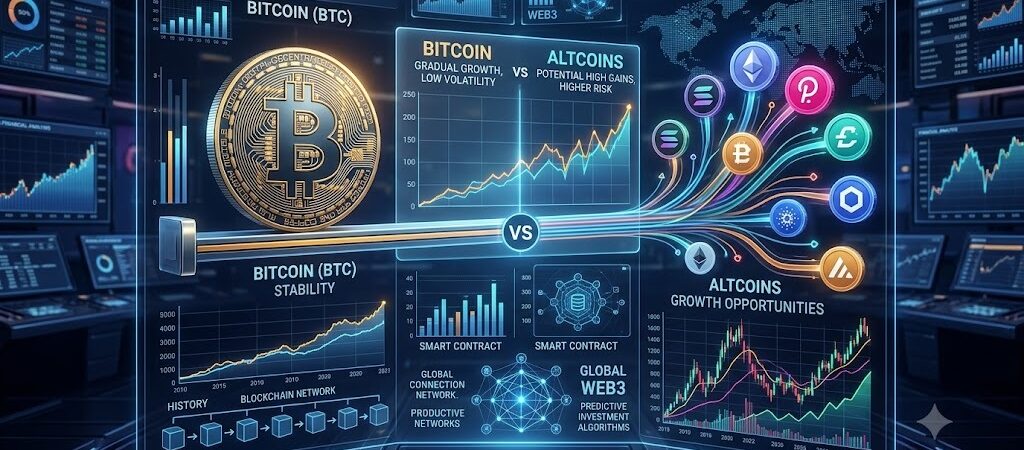
When comparing Altcoins vs Bitcoin, understanding the balance between risk and potential reward is one of the most important factors for investors. Both Bitcoin and altcoins offer opportunities, but they have very different risk profiles and growth expectations.
Bitcoin is generally considered the more established cryptocurrency investment. Its long history, large market capitalization, strong security, and widespread recognition make it a preferred choice for investors looking for a more stable digital asset. However, because Bitcoin is already a mature cryptocurrency, its future growth percentage may be lower compared to smaller emerging projects.
Altcoins, on the other hand, often provide greater growth opportunities because many projects are still expanding their technology and adoption. Successful altcoins can experience significant increases when they introduce valuable solutions and gain market attention. However, this higher potential reward comes with increased risk, as many altcoin projects may struggle with competition, limited adoption, or technical challenges.
A balanced investor may consider combining both strategies. Bitcoin can provide a foundation due to its market strength, while selected altcoins can offer exposure to emerging technologies and higher growth opportunities. The right balance depends on an investor’s goals, risk tolerance, and understanding of the cryptocurrency market.
Market cycles also play an important role. During strong crypto bull markets, altcoins may outperform Bitcoin due to increased demand for newer projects. During uncertain or bearish periods, investors often move toward more established assets like Bitcoin for relative stability.
Ultimately, there is no single strategy that works for every investor. The choice between Bitcoin and altcoins depends on individual objectives, research, and risk management. Understanding the differences between these two categories is essential for making informed cryptocurrency investment decisions. https://cryptopulsemagazine.com/best-crypto-exchanges-for-beginners-in-2026/
Bitcoin vs Altcoins: Quick Comparison
| Feature | Bitcoin | Altcoins |
|---|---|---|
| Risk Level | Lower compared to most crypto assets | Higher risk |
| Growth Potential | Steady long-term potential | Higher potential but uncertain |
| Market History | Longest track record | Many newer projects |
| Adoption | Global recognition | Varies by project |
| Volatility | High | Usually higher |
Key Points to Remember:
- Bitcoin offers stronger stability and market confidence
- Altcoins provide exposure to innovation and emerging technologies
- Higher returns usually come with higher risks
- Research and diversification are important for crypto investing
4. Long-Term Investment Strategy: Bitcoin vs Altcoins 📈
A long-term investment strategy is one of the most important factors when deciding between Altcoins vs Bitcoin. Instead of focusing only on short-term price movements, long-term investors often evaluate technology, adoption, market position, and future growth potential.
Bitcoin is commonly viewed as a long-term store of value because of its limited supply, strong network security, and global recognition. Many investors choose Bitcoin as the foundation of their cryptocurrency portfolio because it has survived multiple market cycles and continues to attract institutional interest.
Altcoins can also play an important role in a long-term strategy by providing exposure to innovative blockchain developments. Projects focused on smart contracts, artificial intelligence, decentralized finance, gaming, and real-world asset tokenization may benefit from future industry growth. However, investors must carefully research each altcoin because not every project will succeed over time.
A balanced approach may involve holding a larger portion of established cryptocurrencies while allocating a smaller percentage to carefully selected altcoins with strong fundamentals. This strategy allows investors to benefit from potential innovation while managing overall risk.
Long-term crypto investing also requires patience and discipline. Market cycles can create periods of extreme optimism and fear, causing large price fluctuations. Investors who focus on fundamentals rather than short-term emotions may be better prepared for market changes.
Ultimately, the best strategy depends on individual goals, risk tolerance, and investment knowledge. Bitcoin may appeal to investors seeking a more established asset, while altcoins may attract those willing to accept higher risk for potentially greater returns.
Long-Term Strategy Considerations:
- Bitcoin can provide portfolio stability and market exposure
- Quality altcoins can offer growth opportunities
- Diversification may help manage cryptocurrency risks
- Research and patience are essential for success
- Avoid investing based only on short-term price hype
5. Factors to Consider Before Choosing Bitcoin or Altcoins 🔍
Before deciding between Altcoins vs Bitcoin, investors should carefully evaluate several important factors. Every cryptocurrency has different strengths, risks, and growth opportunities, so understanding these differences can help create a more informed investment strategy.
1. Investment Goals
The first factor to consider is your investment objective. Investors looking for a more established cryptocurrency with a longer history may prefer Bitcoin. Those seeking exposure to newer technologies and potentially higher growth opportunities may explore selected altcoins.
2. Risk Tolerance
Risk tolerance plays a major role in cryptocurrency investing. Bitcoin is generally considered less risky compared to many altcoins because of its market size, adoption, and proven track record. Altcoins can provide higher returns but often experience larger price movements and greater uncertainty.
3. Technology and Use Cases
Understanding the technology behind a cryptocurrency is essential. Bitcoin focuses mainly on decentralized digital money and store-of-value characteristics. Many altcoins provide additional features such as smart contracts, DeFi applications, artificial intelligence solutions, gaming ecosystems, and blockchain infrastructure.
4. Market Adoption
Adoption is another important factor. Cryptocurrencies with active users, strong developer communities, partnerships, and real-world applications may have better long-term potential. Investors should research whether a project is solving real problems and gaining meaningful usage.
5. Portfolio Diversification
Instead of choosing only one category, some investors prefer diversification. Combining Bitcoin with carefully selected altcoins may provide exposure to both market stability and emerging opportunities. However, diversification does not eliminate investment risks.
6. Market Conditions
Crypto markets move through different cycles. During periods of strong growth, some altcoins may outperform Bitcoin, while during uncertain markets, investors may prefer more established assets. Understanding market trends can help investors make better decisions.
Key Questions Before Investing:
- What is my investment goal?
- How much risk am I comfortable taking?
- Does the cryptocurrency have real-world utility?
- Is the project supported by a strong community and development team?
- Am I investing based on research or market hype?
When comparing Altcoins vs Bitcoin, there is no universal winner. The better choice depends on an investor’s personal strategy, risk level, and long-term expectations.
6. Popular Bitcoin and Altcoin Investment Strategies 💡
When comparing Altcoins vs Bitcoin, investors often use different strategies depending on their goals, risk tolerance, and market knowledge. There is no single approach that guarantees success, but understanding common investment methods can help investors make more informed decisions.
1. Long-Term Holding (HODLing)
HODLing is one of the most popular cryptocurrency investment strategies. Investors buy digital assets and hold them for a long period, believing that their value may increase as adoption grows.
Bitcoin is often chosen for this strategy because of its strong history, limited supply, and established position in the market. Some investors also apply this approach to carefully selected altcoins with strong technology and long-term potential.
2. Dollar-Cost Averaging (DCA)
Dollar-cost averaging involves investing a fixed amount of money regularly instead of investing everything at once. This strategy helps reduce the impact of short-term market volatility by spreading purchases over time.
Many investors use DCA for Bitcoin because it allows gradual accumulation without trying to predict the perfect market entry point. The same approach can also be applied to promising altcoins.
3. Bitcoin-Focused Strategy
A Bitcoin-focused strategy prioritizes stability and simplicity. Investors who prefer lower risk within the crypto market may allocate most of their portfolio to Bitcoin due to its strong adoption, liquidity, and recognition.
This approach may suit investors who believe Bitcoin will continue playing a major role in the future of digital finance.
4. Diversified Crypto Portfolio
A diversified strategy combines Bitcoin with selected altcoins. The goal is to balance the relative stability of Bitcoin with the growth potential of innovative blockchain projects.
For example, investors may choose Bitcoin as a core holding while adding altcoins from sectors such as DeFi, AI, gaming, and blockchain infrastructure.
5. Research-Based Altcoin Investing
Successful altcoin investing requires careful research. Investors often analyze factors such as:
- Technology and innovation
- Development activity
- Real-world use cases
- Community growth
- Partnerships and adoption
- Token economics
Strong research can help investors identify quality projects while avoiding unreliable or speculative cryptocurrencies.
Important Strategy Tips:
- Avoid investing based only on hype
- Understand the risks before investing
- Focus on long-term fundamentals
- Maintain proper risk management
- Never invest more than you can afford to lose
Ultimately, the best strategy in the Altcoins vs Bitcoin debate depends on personal goals and risk tolerance. A thoughtful approach based on research and discipline is usually more effective than trying to predict short-term market movements.
7. Bitcoin vs Altcoins: Which Strategy May Be Better in 2027? 🚀
As the cryptocurrency market continues to evolve, many investors are asking whether Bitcoin or altcoins could offer better opportunities in 2027. The answer depends on individual investment goals, risk tolerance, and confidence in different areas of blockchain development.
Bitcoin may remain the preferred choice for investors seeking a more established cryptocurrency. Its strong brand recognition, limited supply, security, and growing institutional adoption could continue supporting its position as a leading digital asset. For investors who value stability within the crypto market, Bitcoin may serve as a core portfolio holding.
Altcoins, however, could provide opportunities for investors interested in emerging technologies and higher growth potential. Many altcoin projects are focused on areas such as artificial intelligence, decentralized finance (DeFi), blockchain scalability, gaming, tokenization, and Web3 applications. If these sectors continue expanding, successful altcoins may experience significant growth.
A possible strategy for 2027 could involve combining both approaches. Investors may choose Bitcoin as a foundation while adding carefully researched altcoins to gain exposure to innovation and emerging trends. This balanced approach can provide a mix of relative stability and growth opportunities.
However, investors should remember that higher potential returns often come with higher risks. Some altcoins may fail due to competition, lack of adoption, security issues, or changing market conditions. Thorough research and risk management remain essential. https://coinmarketcap.com/
Bitcoin Strategy May Suit Investors Who Prefer:
- A more established cryptocurrency
- Lower risk compared to most altcoins
- Long-term value storage potential
- Strong market recognition and liquidity
Altcoin Strategy May Suit Investors Who Prefer:
- Higher growth opportunities
- Exposure to new blockchain technologies
- Innovation-focused projects
- Greater risk and reward potential
A Balanced Approach for 2027:
Many investors may consider a diversified strategy that includes both Bitcoin and selected altcoins. The exact allocation depends on personal financial goals, knowledge, and risk tolerance.
Ultimately, there is no guaranteed winner in the Altcoins vs Bitcoin debate. Bitcoin may provide strength and stability, while carefully chosen altcoins may offer opportunities for future innovation and growth.
8. Common Mistakes to Avoid When Investing in Bitcoin and Altcoins ⚠️
When comparing Altcoins vs Bitcoin, investors should understand that avoiding common mistakes can be just as important as choosing the right cryptocurrency. Many beginners enter the crypto market based on emotions, hype, or short-term expectations, which can lead to unnecessary losses.
1. Investing Without Research
One of the biggest mistakes is buying a cryptocurrency without understanding its technology, purpose, team, and long-term potential. Before investing, it is important to study the project’s fundamentals, adoption, community, and real-world use cases.
2. Following Market Hype
Cryptocurrency markets often experience strong excitement around certain coins. Altcoins vs Bitcoin Social media trends and online influencers can create unrealistic expectations. Making investment decisions only because a coin is popular can increase risk.
3. Ignoring Risk Management
Both Bitcoin and altcoins can experience significant price changes. Investors should avoid putting all their funds into a single cryptocurrency and should consider diversification and responsible portfolio management.
4. Expecting Quick Profits
Many new investors enter the crypto market expecting immediate returns. While some cryptocurrencies have experienced rapid growth, short-term gains are unpredictable. A long-term approach based on research is often more sustainable.
5. Choosing Weak Altcoin Projects
The altcoin market includes thousands of projects, but not all have strong fundamentals. Altcoins vs Bitcoin Investors should be careful with cryptocurrencies that lack clear utility, active development, transparency, or real-world adoption.
6. Ignoring Security Practices
Protecting digital assets is essential. Using strong passwords, secure wallets, two-factor authentication, and trusted platforms can help reduce the risk of losing funds.
7. Emotional Decision-Making
Fear and greed are common challenges in crypto investing. Buying during extreme market excitement or selling during panic can negatively affect long-term results. Discipline and patience are important qualities for investors.
Key Lessons for Crypto Investors:
- Always research before investing
- Avoid decisions based only on hype
- Understand the risks of Bitcoin and altcoins
- Protect your digital assets
- Focus on long-term goals rather than short-term emotions
By avoiding these mistakes, investors can make more informed decisions when choosing between Altcoins vs Bitcoin and build a stronger cryptocurrency investment strategy.
9. Future Outlook: Bitcoin and Altcoins Beyond 2027 🔮
The future of cryptocurrency beyond 2027 will likely be shaped by continued innovation, wider adoption, and the growing connection between blockchain technology and traditional finance. The debate of Altcoins vs Bitcoin may continue, but both categories could play important roles in the next stage of digital asset development.
Bitcoin is expected to remain a major part of the cryptocurrency ecosystem due to its strong network, limited supply, security, and recognition among investors and institutions. As more companies and financial organizations explore digital assets, Bitcoin may continue to be viewed as a leading store of value and a key cryptocurrency benchmark.
Altcoins may also have significant opportunities as blockchain technology expands into new industries. Altcoins vs Bitcoin Projects focused on artificial intelligence, decentralized finance, real-world asset tokenization, gaming, payments, and Web3 infrastructure could benefit from increasing adoption. However, only projects with strong technology, real-world utility, and active development are likely to achieve long-term success. https://www.binance.com/en
The future crypto market may also become more connected with traditional financial systems. Improved regulations, better security solutions, and easier user experiences could encourage more individuals and businesses to adopt digital assets.
At the same time, competition between blockchain networks will continue. Altcoins vs Bitcoin Some cryptocurrencies may grow and become industry leaders, while others may lose relevance due to changing technology, weak adoption, or market challenges.
Future Trends to Watch:
- Increased institutional cryptocurrency adoption
- Growth of blockchain-based financial services
- Expansion of AI and Web3 applications
- Greater use of tokenized real-world assets
- Improved blockchain scalability and security
Ultimately, the future of Altcoins vs Bitcoin is not necessarily about one replacing the other. Bitcoin may continue providing strength and stability, while successful altcoins may drive innovation and new use cases across the blockchain industry.
Conclusion: Altcoins vs Bitcoin – Which Investment Strategy Is Better? ✅
The debate of Altcoins vs Bitcoin does not have a single answer because the better investment strategy depends on each investor’s goals, risk tolerance, and understanding of the cryptocurrency market.
Bitcoin remains the most established cryptocurrency with the strongest brand recognition, limited supply, high liquidity, and a proven history. For investors seeking a more mature digital asset with long-term adoption potential, Bitcoin may continue to serve as a strong foundation for a crypto portfolio.
Altcoins, on the other hand, provide opportunities to invest in innovative blockchain technologies and emerging sectors such as decentralized finance (DeFi), artificial intelligence, gaming, tokenization, and Web3. Altcoins vs Bitcoin While some altcoins may deliver significant growth, they also carry higher risks due to competition, volatility, and uncertainty.
A balanced investment approach may be the preferred strategy for many investors. Combining Bitcoin with carefully selected altcoins can provide exposure to both stability and innovation. However, every investor should conduct their own research, understand the risks, and avoid making decisions based only on market hype.
The cryptocurrency industry is still developing, and future winners will likely be projects that provide real-world value, strong technology, security, and long-term adoption. Altcoins vs Bitcoin Whether choosing Bitcoin, altcoins, or a combination of both, patience and responsible risk management remain essential.
In the end, the best strategy is not about choosing one over the other blindly. It is about understanding the differences between Altcoins vs Bitcoin and creating an investment plan that matches your personal financial goals.