Introduction to Decentralized Identity Infrastructure
1. Introduction
Digital identity has become an essential part of modern life. People use digital credentials to access financial services, communicate with businesses, manage healthcare information, and participate in online communities. However, many existing identity systems depend on centralized organizations that store and control users’ personal information.
This traditional approach creates several challenges, including privacy concerns, security vulnerabilities, limited interoperability, and difficulties accessing services across different platforms.
Decentralized identity infrastructure offers an alternative approach by allowing individuals to manage their digital identities and credentials through systems that reduce dependence on centralized identity providers.
Blockchain technology can support this approach by providing a shared, tamper-resistant record of certain identity-related information. When combined with cryptographic verification and privacy-preserving technologies, decentralized identity systems can help users prove specific facts about themselves without unnecessarily exposing their personal information.
For example, a person could demonstrate that they meet an age requirement without revealing their complete date of birth. Similarly, a professional could present a digitally verifiable qualification without requiring an employer to contact the issuing institution directly.
These capabilities could transform how individuals access digital services, interact with organizations, and maintain control over their personal information.
However, decentralized identity infrastructure is not simply about placing personal information on a blockchain. Effective systems must carefully manage privacy, security, credential verification, and user control.
Understanding how these systems work is essential for evaluating their potential to reshape digital access.
2. What Is Decentralized Identity Infrastructure?
Decentralized identity infrastructure refers to the technologies, standards, and systems that allow individuals and organizations to create, manage, and verify digital identities without relying entirely on a single centralized identity provider.
Traditional identity systems often require users to register separately with different platforms. Each organization may maintain its own database containing personal information, authentication credentials, and account records.
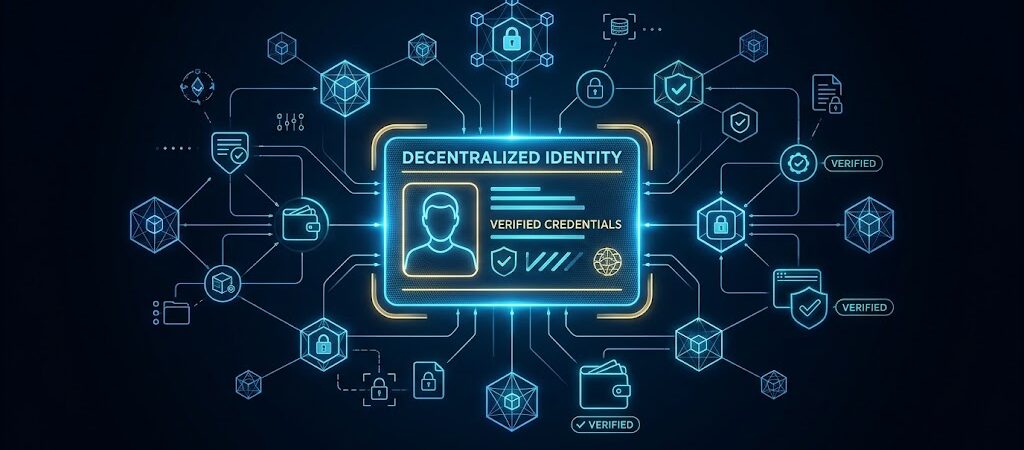
Decentralized identity systems introduce a different model in which users can manage identity-related information through digital wallets and present verifiable credentials to organizations that need to confirm specific details.
These credentials may represent information such as:
- A person’s educational qualifications.
- Professional licenses and certifications.
- Membership in an organization.
- Eligibility for particular services.
- Proof of age or residency.
- Authentication information associated with a digital account.
Blockchain technology may support the infrastructure by providing decentralized registries, credential verification mechanisms, and records of trusted issuers.
However, the identity information itself does not necessarily need to be stored on a blockchain.
In many decentralized identity systems, personal information and credentials remain under the user’s control, while blockchain networks are used to verify public keys, issuer information, or other necessary records.
This distinction is important because storing sensitive personal information directly on a public blockchain could create serious privacy risks.
The objective is to create a digital identity system that allows users to prove relevant information while minimizing unnecessary disclosure.
3. Why Traditional Digital Identity Systems Face Limitations
Traditional digital identity systems have played an important role in expanding online services. They allow businesses to authenticate customers, protect accounts, and comply with regulatory requirements.
However, their centralized structure creates several limitations.
Centralized Data Storage
Many identity providers maintain large databases containing personal information, authentication records, and account details.
If these databases are compromised, attackers may gain access to sensitive information belonging to millions of users.
Limited User Control
Individuals often have limited control over how organizations collect, store, and share their identity information.
Users may need to provide the same personal details repeatedly when registering with different services.
Fragmented Identity Systems
Digital identities are frequently tied to individual platforms.
A credential issued by one organization may not be easily recognized by another, creating additional verification requirements and administrative costs.
Dependence on Centralized Providers
When an identity provider experiences an outage, account suspension, or security incident, users may lose access to important services.
These limitations have encouraged the development of identity systems that emphasize interoperability, user control, and privacy.
Decentralized identity infrastructure could help address these challenges by allowing users to present reusable credentials across compatible services while maintaining greater control over their personal information.
4. How Blockchain Supports Decentralized Identity
Blockchain networks can provide several useful capabilities for decentralized identity infrastructure.
First, they can maintain decentralized registries containing information about trusted credential issuers, public keys, and identity-related records.
Second, blockchain-based systems can support transparent verification mechanisms that allow organizations to check whether a credential issuer is recognized and whether relevant verification information has changed.
Third, decentralized networks can reduce dependence on a single organization for maintaining certain identity-related infrastructure.
For example, a university could issue a digitally signed qualification to a graduate. The graduate could store that credential in a digital wallet and later present it to an employer.
The employer could verify the credential’s authenticity using the issuer’s cryptographic signature and relevant public information.
In this process, the blockchain may help establish trust in the issuer’s public key or provide information about whether the issuer remains authorized.
The graduate does not necessarily need to publish their educational records on the blockchain.
Instead, the system can use cryptographic verification to establish whether the credential is authentic and whether the information presented has been altered.
This approach can make digital credentials more portable and easier to verify across different organizations.
Nevertheless, blockchain does not automatically guarantee that the information contained in a credential is accurate.
The reliability of a decentralized identity system still depends on the organizations issuing credentials, the security of the verification process, and the safeguards protecting users’ private information.
The Core Components of Decentralized Identity Infrastructure
5. Decentralized Identifiers (DIDs)
Decentralized identifiers (DIDs), commonly known as DIDs, are a fundamental component of decentralized identity infrastructure.
A DID is a unique identifier that allows an individual, organization, or digital entity to establish an identity without depending entirely on a centralized registration authority.
Traditional identifiers, such as usernames and account numbers, are usually created and managed by specific organizations. A DID, in contrast, can be controlled through cryptographic mechanisms that allow its owner to demonstrate control over the associated identity.
A DID typically resolves to a DID document containing information needed to interact with that identity.
This information may include:
- Public cryptographic keys used to verify digital signatures.
- Authentication methods supported by the identity.
- Services associated with the identifier.
- Information about how the identity can be updated or managed.
DIDs can be used by individuals, businesses, institutions, and software systems.
For example, a professional could use a decentralized identifier to receive a digital qualification from a university and present it to multiple employers.
The identifier would help establish the relationship between the professional and the cryptographic keys used to manage their identity.
However, a DID does not automatically prove that a person is who they claim to be.
The reliability of a decentralized identity depends on how the identity was established, which credentials are associated with it, and how those credentials are verified.
6. Verifiable Credentials
Verifiable credentials are digitally signed statements that communicate information about a person, organization, or other entity.
They are one of the most important building blocks of decentralized identity infrastructure because they allow information to be verified without requiring the original issuer to participate in every verification process.
A credential typically includes information about its issuer, the subject it describes, the claims being made, and the cryptographic evidence used to verify its authenticity.
For example, a university could issue a verifiable credential confirming that a student has completed a particular degree.
The student could store this credential in a digital wallet and present it to an employer when applying for a position.
The employer could then verify the credential’s digital signature and determine whether it was issued by a trusted institution.
This approach can reduce administrative delays and make the verification of professional qualifications more efficient.
Verifiable credentials can also support other use cases, including:
- Digital identity verification.
- Professional licenses.
- Educational certificates.
- Membership credentials.
- Financial eligibility.
- Access permissions.
Importantly, verifiable credentials are not necessarily stored on a blockchain.
They can be held in a user’s digital wallet, while blockchain-based infrastructure may support issuer verification or other trust-related functions.
This separation helps protect personal information while allowing organizations to verify the authenticity of digital credentials.
7. Digital Identity Wallets
Digital identity wallets provide individuals with a way to store, manage, and present their identity information.
They serve as an interface between users and decentralized identity infrastructure.
A digital identity wallet may contain decentralized identifiers, verifiable credentials, cryptographic keys, and other identity-related information.
Instead of creating separate accounts and repeatedly submitting documents to different organizations, users can present relevant credentials from their wallets when accessing compatible services.
For example, an individual applying for a financial service could use a digital identity wallet to provide verified information about their identity.
The service provider could then validate the credentials without requiring the user to upload the same documents repeatedly.
Depending on the system’s design, users may also be able to select which information they share.
This can improve privacy by reducing unnecessary disclosure of personal details.
However, digital identity wallets introduce important security considerations.
If a wallet is compromised, an attacker could potentially access sensitive credentials or misuse identity-related information.
Therefore, secure key management, recovery mechanisms, device protection, and user education are essential for building reliable identity wallets.
8. Blockchain-Based Identity Registries
Identity registries provide information that helps organizations verify decentralized identities and their associated credentials.
A blockchain-based identity registry can maintain records related to public keys, credential issuers, and other information required to establish trust.
For example, a university could publish information about its authorized credential-issuing keys.
An employer verifying a graduate’s digital certificate could use this information to determine whether the credential was issued by an authorized institution.
Blockchain infrastructure can make certain registry records publicly verifiable and resistant to unauthorized modification.
However, identity registries must be carefully designed to avoid exposing sensitive personal information.
A public blockchain should not automatically become a permanent database of people’s identities, activities, or personal records.
Instead, decentralized identity systems generally aim to keep sensitive information off-chain while using blockchain infrastructure for limited verification and coordination purposes.
This separation can help balance transparency, privacy, and security.
9. Cryptographic Verification and Digital Signatures
Cryptography is essential to the security of decentralized identity infrastructure.
Digital signatures allow credential issuers to demonstrate that a credential was created by an authorized party and has not been modified.
When an organization issues a verifiable credential, it can digitally sign the credential using a private cryptographic key.
A verifier can then use the corresponding public key to check the signature.
If the signature is valid, the verifier gains evidence that the credential originated from the expected issuer and that its signed contents have not been altered.
This process can reduce the need for manual document verification and direct communication with credential-issuing organizations.
Cryptographic verification can also support privacy-preserving identity systems.
For example, certain cryptographic techniques allow users to prove that they meet a requirement without revealing every detail of the underlying information.
These capabilities are particularly valuable for financial services, online platforms, and digital systems that require reliable identity verification.
Nevertheless, cryptographic verification alone cannot guarantee that a credential contains truthful information.
A valid signature proves that a credential was signed by the relevant issuer and has not been modified. It does not independently establish that the issuer’s original claim was accurate.
Reliable decentralized identity systems therefore require both strong cryptographic protections and trustworthy credential-issuing processes.
How Decentralized Identity Infrastructure Works in Practice
10. Creating a Decentralized Digital Identity
The first step in using decentralized identity infrastructure is establishing a digital identity that an individual can manage.
Unlike traditional systems, which often require users to register with a centralized identity provider, decentralized identity systems can allow individuals to create their own identifiers and manage the associated cryptographic keys.
A typical process involves several steps.
Step 1: Generate a Decentralized Identifier
The user creates a decentralized identifier using a compatible identity wallet or application.
The identifier provides a way to establish a digital identity without depending entirely on a centralized account provider.
Step 2: Establish Control Through Cryptographic Keys
The identity system generates cryptographic keys that allow the user to demonstrate control over the identifier.
The private key must remain secure because it may be used to authorize identity-related actions.
Step 3: Obtain Verified Credentials
The user receives credentials from trusted organizations.
These credentials may confirm educational qualifications, professional licenses, or other identity-related information.
Step 4: Store Credentials in a Digital Wallet
The credentials can be stored in a compatible digital identity wallet.
The user can then manage and present the credentials when required by a service provider.
This approach creates a digital identity that can be used across compatible systems without requiring every organization to maintain a separate identity record.
11. How Organizations Issue Verifiable Credentials
Organizations play an important role in decentralized identity infrastructure because they provide the information that users need to establish trust.
A credential issuer may be a university, government agency, employer, financial institution, or another organization authorized to verify specific information.
The issuance process generally follows several stages.
First, the organization verifies the relevant information about the individual.
For example, a university confirms that a student has completed the requirements for a degree.
Next, the organization creates a digital credential containing the verified information.
The credential is then digitally signed using the issuer’s cryptographic key.
Finally, the credential is delivered to the individual’s digital identity wallet.
The recipient can retain the credential and present it to other organizations when needed.
Because the credential contains cryptographic evidence of its origin, a verifier can check its authenticity without necessarily contacting the issuer directly.
This can make credential issuance and verification more efficient.
However, organizations must establish reliable procedures for verifying information before issuing credentials.
A digitally signed credential is only as trustworthy as the process used to create it.
12. How Verifiable Credentials Are Presented and Verified
When a user accesses a service that requires identity verification, the service provider can request specific information from the user’s digital identity wallet.
The user can then present an appropriate credential or proof.
The verification process typically involves several steps.
Step 1: Request Relevant Information
The service provider identifies the information required to complete the verification process.
For example, an online platform may need confirmation that a user meets a minimum age requirement.
Step 2: Select an Appropriate Credential
The user selects a credential from their digital identity wallet that can satisfy the request.
Depending on the system, the user may be able to provide only the information necessary for verification.
Step 3: Verify the Credential
The service provider checks the credential’s cryptographic signature and confirms that the issuer is trusted.
The provider may also check whether the credential has expired or been revoked.
Step 4: Grant Access
If the credential satisfies the required conditions, the service provider can approve the user’s request.
This process allows organizations to verify information while reducing the need to collect and store unnecessary personal data.
13. Selective Disclosure and Privacy-Preserving Verification
One of the most important advantages of decentralized identity infrastructure is the possibility of selective disclosure.
Selective disclosure allows users to share specific information from a credential without necessarily revealing every detail it contains.
For example, an individual may need to prove that they are above a particular age threshold when accessing an online service.
A traditional identity verification process might require the individual to provide a complete identity document containing their name, date of birth, address, and other personal information.
A privacy-preserving decentralized identity system could allow the individual to prove that they meet the age requirement without disclosing their complete date of birth.
This reduces the amount of personal information shared with the service provider.
Some systems can also use zero-knowledge proofs to demonstrate that a statement is true without revealing the underlying information.
These techniques may help reduce unnecessary data collection and improve privacy.
However, selective disclosure is not automatically supported by every credential format or identity wallet.
The level of privacy depends on the technologies used, the information requested, and the way the verification system is implemented.
14. Credential Revocation and Expiration
Decentralized identity systems must also address the possibility that a credential becomes invalid.
For example, a professional license may expire, a security credential may be compromised, or an organization may need to revoke a previously issued certificate.
Credential revocation allows an issuer to indicate that a credential should no longer be considered valid.
Expiration provides another mechanism for limiting the period during which a credential can be used.
A verifier may check the credential’s status before accepting it.
This is particularly important for credentials used in financial services, professional licensing, and other situations where outdated information could create significant risks.
However, revocation systems must balance security with privacy.
If every credential verification creates a publicly visible record, users could become vulnerable to tracking or surveillance.
Therefore, decentralized identity infrastructure needs carefully designed verification mechanisms that allow credentials to be checked without unnecessarily exposing users’ activities.
The Benefits of Decentralized Identity Infrastructure
15. Greater Control Over Personal Information
One of the most significant benefits of decentralized identity infrastructure is the opportunity for individuals to gain greater control over their personal information.
Traditional identity systems often require users to submit sensitive information to multiple organizations. Each organization may store its own copy of the information, creating additional privacy and security risks.
Decentralized identity systems can reduce this dependence by allowing individuals to manage their credentials through digital identity wallets.
Users can choose which credentials to present and, in systems that support selective disclosure, share only the information necessary for a particular interaction.
For example, an individual applying for an online service may need to demonstrate that they meet a specific eligibility requirement.
Instead of submitting an entire identity document, the individual could provide a verifiable credential containing the relevant information.
This approach can reduce unnecessary data collection and help individuals maintain greater control over their digital identities.
However, users must still trust the organizations that issue credentials and the applications that process them.
16. Improved Security and Reduced Identity Fraud
Identity fraud remains a major challenge for digital services.
Attackers may attempt to steal personal information, create fraudulent accounts, or use forged documents to gain unauthorized access to financial and commercial platforms.
Decentralized identity infrastructure can help address these risks through cryptographic verification and tamper-resistant credentials.
Because verifiable credentials are digitally signed, unauthorized modifications can be detected during verification.
This makes it more difficult for attackers to alter legitimate credentials without invalidating their cryptographic signatures.
Decentralized identity systems can also reduce the need for organizations to maintain large centralized databases containing sensitive identity information.
Reducing the amount of personal information stored in centralized systems may limit the potential impact of certain data breaches.
Nevertheless, decentralized identity does not eliminate identity fraud.
Compromised private keys, fraudulent credential issuers, phishing attacks, and insecure identity wallets can still create serious risks.
Strong authentication, secure key management, and reliable credential verification remain essential.
17. Faster and More Efficient Digital Verification
Traditional identity verification processes can involve significant administrative work.
Organizations may need to contact credential issuers, review submitted documents, and manually verify information before approving a user.
These processes can delay access to services and increase operational costs.
Decentralized identity infrastructure can make verification more efficient by allowing organizations to validate digital credentials using cryptographic methods.
For example, an employer reviewing a candidate’s professional qualifications could verify a digitally signed credential without contacting the issuing institution directly.
Similarly, a financial service provider could use verified credentials to support customer onboarding.
Automated verification can reduce repetitive administrative tasks and make digital services more accessible.
However, organizations must still comply with applicable legal requirements and ensure that their verification processes meet the necessary standards.
18. Greater Interoperability Across Digital Services
Interoperability is another important benefit of decentralized identity infrastructure.
Traditional identity systems often operate independently, requiring users to create separate accounts and submit similar information across different platforms.
Decentralized identity systems can support the use of compatible credentials across multiple organizations.
For example, a professional qualification issued by one institution could potentially be verified by employers, licensing authorities, and other organizations that recognize the credential’s format and issuer.
This can reduce duplication and simplify interactions between users and service providers.
However, interoperability requires compatible technical standards, trusted credential issuers, and agreement on verification requirements.
Without these elements, decentralized identity systems may remain fragmented despite their underlying technology.
19. Reduced Dependence on Centralized Identity Providers
Many digital services rely on centralized identity providers to authenticate users and manage access.
Although these systems can be convenient, they may create dependencies on particular companies or platforms.
If a centralized provider experiences an outage or restricts an account, users may temporarily lose access to services connected to that identity.
Decentralized identity infrastructure can reduce some of these dependencies by allowing users to manage identifiers and credentials independently of a single provider.
This can improve resilience and provide users with greater flexibility when accessing compatible services.
However, decentralized identity systems still rely on infrastructure such as digital wallets, credential issuers, verification services, and sometimes blockchain networks.
The goal is not to eliminate every intermediary but to reduce unnecessary dependence on individual organizations.
20. Improved Accessibility and Digital Inclusion
Decentralized identity infrastructure could also support greater access to digital services for individuals who face difficulties using traditional identity systems.
In some regions, people may lack access to government-issued identity documents or face administrative barriers when attempting to establish their identities.
Verifiable credentials could help individuals demonstrate specific qualifications, relationships, or eligibility requirements through alternative trusted sources.
For example, a person who has completed a professional training program could receive a digital credential that helps them demonstrate their qualifications when applying for employment.
However, decentralized identity should not become another barrier to accessing essential services.
People without smartphones, reliable internet access, or technical knowledge may face difficulties using digital identity wallets.
Inclusive identity systems therefore need accessible interfaces, recovery mechanisms, and alternative verification methods.
Real-World Applications of Decentralized Identity Infrastructure
21. Decentralized Identity in Financial Services
Financial services represent one of the most promising areas for decentralized identity infrastructure.
Banks, payment providers, cryptocurrency exchanges, and other financial institutions must verify customer identities before providing certain services.
Traditional customer verification processes often require individuals to submit identity documents, proof of residence, and other personal information.
These procedures can be time-consuming and create additional data security responsibilities for financial institutions.
Decentralized identity infrastructure could improve these processes through reusable verifiable credentials.
For example, a trusted identity provider could issue a credential confirming that an individual has completed a particular identity verification process.
The individual could store this credential in a digital wallet and present it to compatible financial institutions.
The receiving institution could verify the credential’s authenticity and determine whether it satisfies the relevant requirements.
This could reduce repetitive verification procedures and improve customer onboarding.
In cryptocurrency markets, decentralized identity could also support identity verification for exchanges, decentralized financial applications, and other blockchain-based services.
However, reusable credentials do not automatically satisfy every Know Your Customer (KYC) or Anti-Money Laundering (AML) obligation. Financial institutions must still follow applicable regulatory requirements.
22. Decentralized Identity in Healthcare
Healthcare systems manage highly sensitive personal information, including medical histories, prescriptions, treatment records, and insurance details.
Traditional healthcare databases are often maintained by separate hospitals, clinics, laboratories, and insurance providers.
This fragmentation can make it difficult for patients to access and share relevant information across different healthcare organizations.
Decentralized identity infrastructure could help improve how patients establish their identities and present verified healthcare-related credentials.
For example, a patient could use a digital identity wallet to present an appropriate credential when accessing a healthcare service.
Authorized healthcare providers could verify relevant information without requiring the patient to repeatedly complete identical identity procedures.
Decentralized identity could also support patient-controlled access permissions, allowing individuals to manage how certain credentials are shared.
However, healthcare information requires particularly strong privacy protections.
Sensitive medical records should not be published directly on public blockchains.
Instead, decentralized identity systems should use secure storage, appropriate access controls, and privacy-preserving verification mechanisms.
23. Decentralized Identity in Education
Educational institutions issue important credentials that individuals use throughout their professional lives.
Degrees, diplomas, academic transcripts, and professional certificates are traditionally verified through documents or direct communication with issuing institutions.
These processes can be expensive and time-consuming, particularly when qualifications need to be verified across international borders.
Verifiable credentials could make educational verification more efficient.
For example, a university could issue a digitally signed certificate to a graduate.
The graduate could store the credential in a digital wallet and present it to employers, other universities, or professional organizations.
The receiving institution could verify the credential’s authenticity using cryptographic verification.
This approach could help reduce document forgery and simplify international qualification verification.
It could also make educational achievements more portable by allowing individuals to maintain access to their credentials even after leaving their original institutions.
24. Decentralized Identity in Government Services
Government services frequently require individuals to establish their identities before accessing public resources.
These services may include tax administration, public benefits, licensing, digital voting registration, and official document applications.
Traditional government identity systems can create administrative challenges when information is distributed across multiple departments.
Decentralized identity infrastructure could support more efficient verification by allowing individuals to present reusable digital credentials.
For example, a government agency could issue a digitally verifiable credential confirming that an individual is eligible for a particular public service.
The individual could then present the credential when accessing another compatible government platform.
This could reduce repetitive documentation requirements and improve administrative efficiency.
However, government identity systems must maintain strong accountability, accessibility, and legal protections.
Decentralization should not weaken the ability of individuals to correct inaccurate information or challenge decisions that affect their rights.
25. Decentralized Identity in Web3 and Decentralized Finance
Web3 ecosystems introduce new opportunities for decentralized identity infrastructure.
Blockchain applications, decentralized autonomous organizations (DAOs), cryptocurrency platforms, and decentralized finance protocols often interact with users through blockchain addresses.
However, a blockchain address does not automatically establish a verified real-world identity.
A wallet address can demonstrate control over a particular cryptographic key, but it does not independently prove the identity, qualifications, or eligibility of the person controlling it.
Decentralized identity systems could connect verified credentials with blockchain-based applications while allowing users to disclose only the information required.
For example, a DAO could use verifiable credentials to confirm that a participant meets membership requirements.
A decentralized finance application could potentially use appropriate credentials to support eligibility checks or compliance procedures.
Professional communities could also issue credentials recognizing specific skills, contributions, or qualifications.
These applications could help Web3 platforms introduce more sophisticated identity and access mechanisms without requiring every user to disclose their complete personal information.
Nevertheless, privacy, regulatory compliance, and credential security remain important considerations.
26. Decentralized Identity in Digital Commerce
Online businesses depend on reliable identity verification to manage customer accounts, prevent fraud, and provide personalized services.
Traditional e-commerce platforms frequently require customers to create separate accounts and submit personal information.
This can create unnecessary friction, especially for customers who regularly interact with multiple digital marketplaces.
Decentralized identity infrastructure could support reusable credentials that allow customers to establish relevant information across compatible platforms.
For example, a customer could present a verified credential confirming eligibility for a particular service or membership benefit.
A digital marketplace could verify the credential without requiring the customer to repeat the entire registration process.
Businesses could also use verified organizational credentials to establish trust between suppliers, distributors, and commercial partners.
These capabilities could improve digital commerce by reducing repetitive verification and simplifying interactions between organizations.
However, businesses must ensure that identity verification remains proportionate and that customers retain appropriate privacy protections.
The Role of Blockchain Standards, Web3, and Emerging Identity Technologies
27. The Importance of Decentralized Identity Standards
Decentralized identity infrastructure requires common technical standards to ensure that different identity systems can communicate and verify credentials consistently.
Without compatible standards, a credential issued by one organization may not be recognized by another platform.
This could recreate the fragmentation that decentralized identity systems are intended to address.
Organizations such as the World Wide Web Consortium (W3C) have developed technical specifications that support interoperable digital identity systems.
Two particularly important standards are Decentralized Identifiers (DIDs) and Verifiable Credentials.
DID specifications provide a framework for creating and managing decentralized identifiers.
Verifiable Credentials specifications establish common structures for issuing, presenting, and verifying digitally signed credentials.
These standards can help developers build identity wallets, credential issuers, and verification applications that work across compatible environments.
Interoperability is especially important for international identity verification, where individuals may need to present credentials issued by institutions operating under different technical systems.
However, adopting common standards does not automatically guarantee universal compatibility.
Organizations must also agree on credential formats, trust frameworks, security requirements, and verification procedures.
28. The Role of Web3 in Decentralized Identity
Web3 introduces a digital environment in which users can interact with blockchain applications through cryptographic wallets and decentralized infrastructure.
Many Web3 platforms already use wallet addresses as a basic form of digital identification.
However, wallet addresses provide limited information about the real-world identities behind them.
Decentralized identity infrastructure could expand these capabilities by connecting blockchain accounts with verifiable credentials.
For example, a blockchain wallet could be associated with credentials confirming professional qualifications, membership status, or eligibility for specific services.
A decentralized application could request a particular credential before allowing a user to access a restricted feature.
This could create more flexible identity systems across decentralized finance, gaming, decentralized autonomous organizations, and digital marketplaces.
Importantly, users would not necessarily need to disclose their complete real-world identities to participate.
Instead, they could present selected credentials that satisfy the application’s requirements.
This could help Web3 applications balance user privacy with the need for reliable verification.
29. Zero-Knowledge Proofs and Privacy-Preserving Identity
Zero-knowledge proofs are an important emerging technology for decentralized identity infrastructure.
They allow one party to demonstrate that a statement is true without revealing the underlying information used to establish that statement.
This capability could significantly improve privacy in digital identity verification.
For example, an individual may need to demonstrate that they are older than a specific age to access an online service.
Instead of revealing their full date of birth, a privacy-preserving identity system could allow them to generate a cryptographic proof confirming that they satisfy the age requirement.
The service provider could verify the proof without receiving unnecessary personal information.
Zero-knowledge proofs could also support other applications, including:
- Confirming professional eligibility.
- Demonstrating financial qualifications.
- Verifying membership requirements.
- Establishing compliance with specific conditions.
- Supporting privacy-preserving access control.
These capabilities could reduce the amount of sensitive information exchanged between individuals and organizations.
However, zero-knowledge proof systems can introduce computational complexity and implementation challenges.
Developers must ensure that the underlying credentials, proof-generation mechanisms, and verification procedures remain secure and reliable.
30. Soulbound Tokens and Digital Reputation
Soulbound tokens represent another concept that has attracted attention in discussions about blockchain-based identity.
Unlike conventional transferable tokens, soulbound tokens are designed to be associated with a particular blockchain account and are generally intended to be non-transferable.
They could potentially represent achievements, memberships, educational qualifications, or contributions within digital communities.
For example, an educational institution could issue a blockchain-based achievement token to recognize the completion of a course.
A professional community could also issue a token acknowledging a member’s participation or contribution.
These records could help establish certain aspects of a user’s digital reputation.
However, soulbound tokens are not automatically equivalent to verified identity credentials.
A token may demonstrate that a particular blockchain account received an achievement, but additional verification is necessary to establish the legitimacy of the issuer and the accuracy of the underlying claim.
There are also privacy concerns associated with permanent public records.
If personal achievements and affiliations are permanently linked to a blockchain address, users may lose control over how their historical information is interpreted.
Consequently, soulbound tokens should be considered a possible complementary technology rather than a complete replacement for established decentralized identity standards.
31. Artificial Intelligence and Decentralized Identity
Artificial intelligence is creating new opportunities for digital services, automated verification, and personalized online experiences.
However, the increasing use of AI-generated content and automated interactions also introduces challenges related to authenticity and trust.
Decentralized identity infrastructure could help establish verifiable information about individuals, organizations, and digital agents.
For example, an AI agent operating on behalf of a business could use a cryptographically verifiable credential to demonstrate that it has been authorized to perform particular tasks.
A receiving platform could verify the agent’s credentials and determine whether its permissions are valid.
Similarly, decentralized identity systems could help organizations establish the authenticity of certain digitally issued credentials associated with AI-assisted services.
This could become increasingly important as autonomous AI agents begin interacting with financial platforms, business applications, and blockchain networks.
However, identity credentials cannot independently prove that an AI-generated statement is accurate or that an automated system behaves safely.
Additional safeguards, authorization controls, and accountability mechanisms will remain necessary.
32. Cross-Chain Identity and Blockchain Interoperability
The blockchain ecosystem consists of numerous networks with different architectures, consensus mechanisms, and application environments.
A decentralized identity system that operates on only one blockchain may face difficulties when users interact with applications on other networks.
Cross-chain identity infrastructure aims to improve this situation by supporting identity verification across different blockchain environments.
For example, an individual could maintain a decentralized identity and associated credentials while interacting with applications operating on multiple compatible networks.
A verification system could check the relevant credentials without requiring the individual to create an entirely separate identity for every blockchain.
Cross-chain identity systems could be particularly useful for decentralized finance, blockchain gaming, digital marketplaces, and Web3 communities.
However, cross-chain verification introduces additional security considerations.
Bridges, interoperability protocols, smart contracts, and external verification services may create new attack surfaces.
Developers must therefore ensure that identity verification remains secure when credentials and applications operate across different blockchain environments.
Security Risks, Privacy Challenges, and Limitations of Decentralized Identity Infrastructure
33. Private Key Management and Identity Theft
Private key management is one of the most important security challenges facing decentralized identity infrastructure.
In decentralized identity systems, cryptographic keys may be used to control identifiers, authorize identity-related actions, and manage access to digital credentials.
Unlike traditional identity platforms, where centralized providers may offer account recovery services, some decentralized systems place greater responsibility on individuals to protect their cryptographic keys.
If a private key is stolen, an attacker may gain the ability to impersonate the legitimate identity holder or misuse credentials associated with that identity.
Losing access to a private key can also create serious problems if the identity system does not provide reliable recovery mechanisms.
Several security measures can help reduce these risks:
- Hardware-based key protection.
- Multi-factor authentication.
- Secure digital identity wallets.
- Multi-signature authorization.
- Encrypted backup mechanisms.
- Reliable identity recovery procedures.
Developers must create systems that protect cryptographic keys without making identity management unnecessarily complicated for ordinary users.
34. Privacy Risks and Permanent Blockchain Records
Blockchain technology can provide transparent and tamper-resistant records, but these characteristics may create privacy challenges when used for identity-related applications.
Public blockchain transactions can remain visible for extended periods.
If identity information or sensitive identifiers become permanently associated with blockchain addresses, users may face unwanted exposure.
Even when personal information is not directly published, transaction patterns and interactions between addresses may reveal information about individuals.
For example, repeated interactions with specific services could potentially expose behavioral patterns or relationships.
Decentralized identity systems must therefore avoid unnecessary publication of personal information.
Sensitive credentials should generally remain outside public blockchain storage.
Privacy-preserving verification, encrypted storage, selective disclosure, and carefully designed identifier management can help reduce these risks.
The objective should be to use blockchain technology for verification and coordination without creating permanent public records of individuals’ private activities.
35. Phishing Attacks and Fraudulent Credential Requests
Decentralized identity wallets introduce new opportunities for phishing and social engineering attacks.
Attackers may create fraudulent websites or applications that imitate legitimate identity verification services.
They could trick users into sharing credentials, approving unauthorized requests, or exposing private cryptographic keys.
For example, a malicious website might claim that a user must reconnect their digital identity wallet to maintain access to a particular service.
If the user approves an unsafe request, sensitive information or control over identity-related assets could be compromised.
Fraudulent credential issuers can also create misleading digital certificates that appear legitimate but contain inaccurate information.
To reduce these risks, users and organizations should:
- Verify the authenticity of credential issuers.
- Check the identity of applications requesting credentials.
- Avoid sharing private keys or recovery phrases.
- Review permission requests before approving them.
- Use trusted digital identity wallet applications.
- Maintain secure authentication procedures.
Security awareness is essential because decentralized identity systems cannot eliminate the human vulnerabilities commonly exploited by attackers.
36. Credential Issuer Trust and Verification Problems
Decentralized identity infrastructure depends on organizations that issue credentials.
Although cryptographic signatures can prove that a credential was signed by a particular issuer, they cannot independently guarantee that the information contained in the credential is accurate.
For example, a fraudulent organization could issue a digitally signed certificate claiming that someone has completed a professional qualification.
The signature might be technically valid, but the underlying claim could still be false.
This creates an important distinction between cryptographic authenticity and real-world trustworthiness.
Organizations using decentralized identity must establish clear rules for recognizing legitimate credential issuers.
Trust frameworks can help identify authorized institutions, define credential requirements, and establish procedures for handling invalid or fraudulent credentials.
Without reliable issuer verification, decentralized identity systems could become vulnerable to misleading or untrustworthy credentials.
37. Regulatory Compliance and Legal Uncertainty
Decentralized identity infrastructure operates within a complex regulatory environment.
Different countries have different requirements concerning personal data protection, digital identification, electronic signatures, financial verification, and identity management.
Organizations using decentralized credentials must ensure that their systems comply with applicable legal requirements.
For example, financial institutions may need to satisfy customer identification and anti-money laundering obligations.
Healthcare organizations must also protect sensitive patient information under relevant privacy regulations.
Another challenge involves determining responsibility when identity-related problems occur.
In a decentralized environment, several parties may participate in issuing, storing, presenting, and verifying credentials.
Determining which organization is responsible for a security incident or inaccurate credential can become complicated.
Clear governance arrangements, legal accountability, and appropriate technical safeguards are therefore essential.
38. Interoperability and Technical Fragmentation
Although decentralized identity standards aim to improve interoperability, technical fragmentation remains a significant challenge.
Different identity providers may implement different credential formats, authentication methods, wallet architectures, and verification procedures.
As a result, a credential that works with one platform may not necessarily be accepted by another.
This can reduce the practical usefulness of decentralized identity systems.
For example, an individual may hold a professionally verified credential in one digital wallet but discover that another organization does not support the credential’s format.
Developers must work toward compatible standards and reliable interoperability frameworks.
Organizations also need common approaches for issuer recognition, credential verification, and identity recovery.
Without sufficient compatibility, decentralized identity infrastructure could develop into separate ecosystems that provide limited benefits outside their own networks.
39. Scalability, Usability, and Infrastructure Costs
Decentralized identity systems must support large numbers of users, credential issuers, and verification requests.
As adoption increases, the underlying infrastructure must remain reliable and efficient.
Blockchain-based components can introduce additional costs and performance limitations, particularly when identity-related operations require frequent network interactions.
However, not every identity operation needs to be recorded directly on a blockchain.
Using off-chain credential storage, efficient verification mechanisms, and appropriate blockchain registries can help reduce unnecessary network activity.
Usability is another major concern.
Many individuals are unfamiliar with cryptographic keys, decentralized identifiers, and digital credential management.
If identity wallets are difficult to understand or require complicated recovery procedures, mainstream adoption could remain limited.
Developers must therefore prioritize accessible interfaces, straightforward credential presentation, secure recovery options, and clear user guidance.
A decentralized identity system must be both secure and practical for everyday use.
The Future of Decentralized Identity Infrastructure and Its Impact on Digital Access
40. The Growing Adoption of Digital Identity Wallets
Digital identity wallets are likely to become increasingly important as individuals and organizations look for more convenient ways to manage digital credentials.
Traditional identity systems often require people to maintain separate accounts and repeatedly submit personal documents when accessing different services.
Digital identity wallets could simplify these processes by allowing individuals to store and present reusable credentials through a single interface.
For example, a person could maintain educational certificates, professional qualifications, membership credentials, and other verified information within one digital wallet.
When accessing a compatible service, the individual could present the required credential without repeating the entire verification process.
As wallet technologies improve, developers may introduce stronger authentication, more effective recovery mechanisms, and better compatibility across different platforms.
However, widespread adoption will depend on whether digital identity wallets become sufficiently secure, accessible, and easy to use.
41. Decentralized Identity and International Digital Access
International digital services frequently face challenges when verifying identities across different countries.
Documents issued by one government or institution may require additional verification before another organization recognizes them.
Decentralized identity infrastructure could help simplify these processes through standardized digital credentials.
For example, an educational institution could issue a verifiable qualification that an international employer can authenticate through compatible verification systems.
Similarly, professional organizations could issue digital licenses that individuals present when applying for opportunities in other countries.
This could improve the portability of digital credentials and reduce administrative barriers.
International interoperability will remain important because identity systems must recognize different legal requirements, credential standards, and institutional trust frameworks.
Decentralized identity could contribute to a more connected digital environment, but achieving this goal will require cooperation between governments, businesses, and technology providers.
42. The Role of Governments and Institutional Partnerships
Government participation could significantly influence the development of decentralized identity infrastructure.
Public institutions often have the authority to issue important identity documents, educational records, licenses, and other official credentials.
By supporting compatible digital credential standards, governments could help create more reliable identity verification systems.
Private organizations could also contribute by developing identity wallets, credential management applications, and verification services.
Universities, financial institutions, healthcare providers, and technology companies could participate in credential ecosystems that recognize trusted issuers.
These partnerships could help establish common technical standards and improve interoperability.
However, institutional participation must be balanced with individual privacy and user control.
Decentralized identity should not simply replace one centralized surveillance system with another.
Its long-term value will depend on whether individuals receive meaningful control over how their credentials and personal information are used.
43. Decentralized Identity and the Expansion of Web3 Applications
As Web3 ecosystems develop, identity verification may become increasingly important.
Blockchain applications currently rely heavily on wallet addresses to identify users and authorize transactions.
However, wallet addresses alone cannot establish whether an individual possesses a particular qualification, belongs to an organization, or satisfies a specific eligibility requirement.
Decentralized identity infrastructure could provide an additional layer of verification.
For example, decentralized finance applications could use verifiable credentials to support eligibility checks.
DAOs could use identity credentials to confirm membership requirements and participation rights.
Blockchain gaming platforms could also recognize achievements or qualifications through portable digital credentials.
These applications could expand the usefulness of blockchain technology beyond financial transactions.
However, developers must ensure that identity verification does not introduce unnecessary barriers or expose sensitive user information.
44. AI Agents and Machine-Readable Digital Credentials
Artificial intelligence agents are increasingly capable of interacting with websites, software applications, financial services, and blockchain networks.
As these systems become more autonomous, establishing their identity and authorization will become increasingly important.
Decentralized identity infrastructure could provide machine-readable credentials that help verify the identity and permissions of automated agents.
For example, an AI agent working for a business could present a digitally verifiable credential demonstrating that it has authorization to access a particular application.
A receiving system could check the credential before allowing the agent to perform a specific action.
Such mechanisms could help organizations distinguish authorized automated services from unauthorized software.
Future identity systems may also support credentials describing an AI agent’s permitted activities, organizational affiliation, and authorization status.
Nevertheless, credentials alone cannot guarantee that an AI agent behaves correctly.
Additional safeguards, monitoring systems, permission controls, and accountability mechanisms will remain essential.
45. Self-Sovereign Identity and Greater Individual Ownership
Self-sovereign identity (SSI) is an important concept associated with decentralized identity infrastructure.
It describes an approach in which individuals have greater control over their digital identities and identity-related information.
Instead of depending entirely on centralized platforms, users can manage identifiers and credentials through systems designed to support individual control.
This model could change the relationship between individuals and organizations that request identity information.
For example, users could maintain educational qualifications, professional certificates, and other credentials in their digital wallets.
When accessing a service, they could present the information required for verification without necessarily transferring complete ownership of their identity records to the receiving organization.
However, self-sovereign identity does not mean that individuals can independently create trustworthy official qualifications or bypass legitimate identity verification requirements.
Trusted issuers, reliable verification mechanisms, and appropriate governance remain necessary.
The long-term objective is to create a digital identity environment in which individuals have greater control while organizations can still establish trust.
46. Building a More Connected and Privacy-Focused Digital Identity Ecosystem
The future of decentralized identity infrastructure will depend on the development of systems that combine security, interoperability, privacy, and usability.
Blockchain technology can provide decentralized verification infrastructure, while verifiable credentials can support trusted digital claims.
Digital identity wallets can give individuals practical tools for managing credentials, and privacy-preserving cryptographic techniques can reduce unnecessary information disclosure.
Together, these technologies could create more flexible digital access systems.
However, successful adoption will require collaboration between technology developers, credential issuers, governments, businesses, and users.
Standards must become more compatible, security mechanisms must improve, and identity wallets must become accessible to people with different levels of technical experience.
If these challenges are addressed, decentralized identity could become an important part of the infrastructure supporting future digital services.
Practical Strategies for Implementing Decentralized Identity Infrastructure
47. Establishing a Clear Identity Management Strategy
Organizations planning to adopt decentralized identity infrastructure should begin by establishing a clear identity management strategy.
Implementing blockchain-based identity technology without understanding the organization’s actual requirements can introduce unnecessary complexity and security risks.
Businesses should first identify which identity-related processes need improvement.
These may include customer onboarding, employee verification, professional credential management, membership authentication, or access control.
Once these requirements are identified, organizations can determine whether decentralized identifiers, verifiable credentials, and digital identity wallets provide practical solutions.
A successful implementation should consider several important factors:
- The type of information requiring verification.
- The organizations authorized to issue credentials.
- The privacy requirements of users.
- The technical standards supported by the system.
- The security requirements for identity management.
- The legal and regulatory environment.
A well-defined strategy can help organizations avoid unnecessary infrastructure costs and build identity systems that address real operational challenges.
48. Selecting Reliable Credential Issuers
Credential issuers are central to the reliability of decentralized identity infrastructure.
Organizations must establish procedures for recognizing legitimate institutions and determining whether their credentials can be trusted.
For example, a financial institution may accept identity credentials issued by approved verification providers.
A university may issue educational qualifications that employers can independently authenticate.
However, organizations should not automatically trust every credential simply because it contains a valid digital signature.
They must verify the issuer’s identity, authorization, and reputation.
Establishing trusted issuer registries and clear credential policies can improve the reliability of the entire identity ecosystem.
Organizations should also establish procedures for handling expired credentials, revoked qualifications, and compromised issuer keys.
These measures help ensure that decentralized identity systems remain trustworthy as their user communities expand.
49. Prioritizing Privacy by Design
Privacy should be considered during the earliest stages of decentralized identity development.
Organizations should avoid collecting or storing personal information that is not necessary for their services.
They should also carefully determine which identity-related information belongs on a blockchain and which information should remain in secure off-chain environments.
For example, a system may use a blockchain registry to verify an issuer’s public key while keeping individual credentials inside users’ digital wallets.
Selective disclosure can further reduce unnecessary information sharing.
Where appropriate, zero-knowledge proofs may allow users to demonstrate eligibility without revealing the underlying personal information.
Organizations should also evaluate data retention, consent management, access permissions, and applicable privacy regulations.
A privacy-focused architecture can reduce exposure risks and increase user confidence in decentralized identity applications.
50. Implementing Strong Security and Recovery Mechanisms
Decentralized identity infrastructure requires security measures that protect users, credential issuers, and verification platforms.
Organizations should prioritize secure cryptographic key management because compromised keys can allow unauthorized control over identity-related operations.
Digital identity wallets should provide appropriate protection through encryption, secure authentication, and supported recovery mechanisms.
Multi-signature authorization may also help protect important organizational identity operations.
For example, an institution could require multiple authorized administrators to approve changes to its credential-issuing keys.
This can reduce the risk of unauthorized modifications caused by a compromised account.
Organizations should additionally conduct security assessments, monitor suspicious activities, and establish incident response procedures.
Recovery mechanisms are particularly important because users may lose access to devices or cryptographic keys.
A reliable system should provide secure recovery options without creating additional opportunities for identity theft.
51. Supporting Interoperability Through Open Standards
Interoperability should be a major consideration when selecting decentralized identity technologies.
Organizations should prioritize established technical standards that allow credentials to be issued, presented, and verified across compatible platforms.
The use of common standards can reduce dependence on proprietary identity systems and make it easier for users to transfer credentials between applications.
For example, an individual should ideally be able to receive a professional credential from one institution and present it to another compatible organization without requiring an entirely new identity registration process.
Developers should evaluate DID methods, verifiable credential formats, wallet compatibility, and verification protocols before selecting an implementation.
Organizations should also test interoperability with external systems before launching services.
This can help identify compatibility problems early and reduce the risk of fragmented identity ecosystems.
52. Educating Users About Digital Identity Security
Technology alone cannot guarantee the success of decentralized identity infrastructure.
Users must understand how digital credentials work and how to protect their identity information.
Many people are unfamiliar with decentralized identifiers, private keys, digital signatures, and credential verification.
Without proper education, users may become vulnerable to phishing attacks, fraudulent applications, and unauthorized credential requests.
Organizations should provide straightforward instructions explaining how to:
- Create and secure a digital identity wallet.
- Protect private keys and recovery information.
- Identify legitimate credential issuers.
- Review credential-sharing requests.
- Recognize suspicious verification applications.
- Recover access through approved security procedures.
User education should be supported by simple interfaces and clear explanations.
Decentralized identity systems are more likely to achieve widespread adoption when individuals can use them confidently without needing advanced technical knowledge.
53. Starting With Pilot Projects Before Large-Scale Deployment
Organizations should consider introducing decentralized identity infrastructure through controlled pilot projects.
A pilot project allows developers and administrators to evaluate the technology before deploying it across an entire organization.
For example, a university could begin by issuing digital certificates to a limited group of graduates.
The institution could then evaluate credential issuance, wallet compatibility, verification accuracy, and user experience.
Similarly, a financial institution could test verifiable credentials within a specific customer onboarding process.
Pilot projects can reveal technical limitations, security weaknesses, and operational challenges that may not become apparent during initial development.
Organizations can use these findings to improve their systems before expanding adoption.
A gradual implementation strategy can reduce operational risks and make long-term infrastructure development more manageable.
54. Measuring the Success of Decentralized Identity Systems
Successful implementation requires measurable objectives.
Organizations should evaluate whether decentralized identity infrastructure actually improves their identity management processes.
Important performance indicators may include:
- Average time required to verify credentials.
- Reduction in repetitive identity checks.
- Credential verification accuracy.
- Number of successful credential presentations.
- Security incidents and unauthorized access attempts.
- User satisfaction and adoption rates.
- Infrastructure and operational costs.
These measurements can help organizations determine whether the technology delivers meaningful benefits.
They can also identify areas requiring additional investment or technical improvements.
Ultimately, decentralized identity should be evaluated according to its ability to improve trust, privacy, security, and digital accessibility rather than simply the number of blockchain features implemented.
Conclusion — How Decentralized Identity Infrastructure Could Transform Digital Access
55. The Future of Digital Identity and Individual Control
Decentralized identity infrastructure represents an important development in how individuals and organizations establish trust in digital environments.
Traditional identity systems have enabled billions of people to access online services, but their dependence on centralized databases and individual identity providers creates challenges involving privacy, security, interoperability, and user control.
Blockchain-based identity infrastructure introduces an alternative approach that combines decentralized identifiers, verifiable credentials, cryptographic verification, and digital identity wallets.
These technologies could allow individuals to manage reusable digital credentials and present verified information across compatible services without repeatedly sharing unnecessary personal details.
The potential applications extend across financial services, healthcare, education, government platforms, digital commerce, and Web3 ecosystems.
Privacy-preserving technologies, including selective disclosure and zero-knowledge proofs, could further improve how individuals demonstrate eligibility and authenticate information.
However, decentralized identity is not a complete solution to every digital identity challenge.
Security vulnerabilities, private key management, credential issuer trust, regulatory requirements, and technical fragmentation remain important obstacles.
The success of these systems will depend on developing reliable standards, accessible applications, and governance frameworks that protect individual rights.
56. Can Blockchain Credentials Transform Digital Access?
Blockchain credentials could significantly change how people interact with digital services by making identity verification more portable, efficient, and privacy-conscious.
Instead of depending entirely on separate identity databases maintained by different organizations, individuals could use compatible digital wallets to present trusted credentials when accessing online platforms.
Businesses could benefit from more efficient verification procedures, while educational institutions and government agencies could issue credentials that remain accessible to individuals beyond a single digital platform.
Web3 applications could also introduce more sophisticated identity verification without requiring users to reveal their complete real-world identities.
Nevertheless, blockchain credentials should not be viewed as automatically trustworthy simply because they are digitally signed or associated with decentralized networks.
Reliable credential issuance, secure verification, privacy protection, and appropriate institutional accountability will remain essential.
The most successful decentralized identity systems will be those that combine technological innovation with practical usability and meaningful user control.
Ultimately, decentralized identity infrastructure could become an important foundation for a more connected digital economy, where individuals have greater ownership of their identity-related information and organizations can establish trust through secure, verifiable credentials.
The transition will take time, but continued progress in blockchain standards, cryptography, and digital identity technologies could make decentralized credentials an increasingly important part of everyday digital access.