
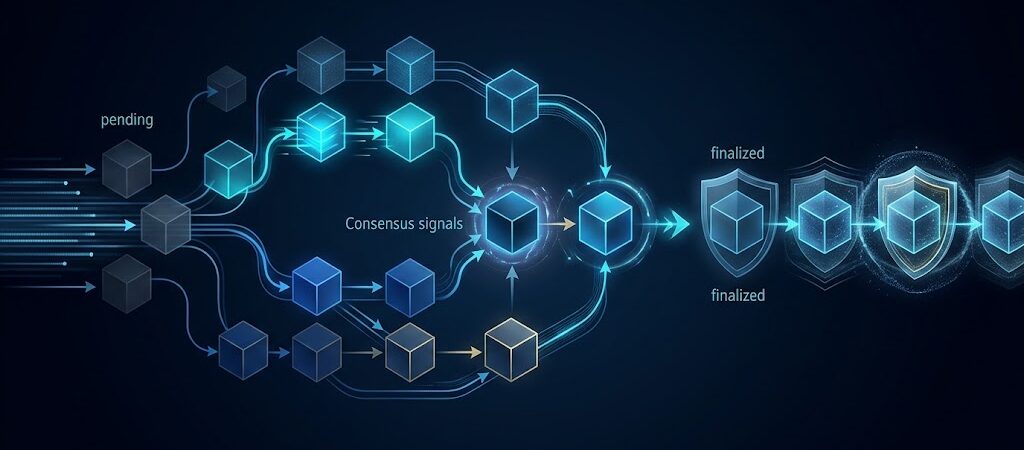
Understanding Blockchain Finality Models and Transaction Security
1. What Are Blockchain Finality Models?
Blockchain finality models describe how a blockchain network determines when a transaction or a group of transactions can be considered confirmed and sufficiently secure against reversal. Finality is a fundamental component of blockchain architecture because it influences transaction reliability, settlement confidence, network security, and the way applications interact with digital assets.
When a user sends cryptocurrency, the transaction typically passes through several stages. It is broadcast to the network, checked against protocol rules, included in a block, and accepted according to the network’s consensus mechanism. However, inclusion in a block does not necessarily mean the transaction is permanently irreversible. The level of certainty depends on the blockchain’s design and the conditions under which its consensus protocol operates.
Different networks establish finality in different ways. Bitcoin, for example, relies on proof-of-work and accumulating block confirmations to make transaction reversals increasingly difficult. Ethereum uses proof-of-stake consensus with explicit finality checkpoints, while other blockchain networks employ Byzantine fault-tolerant consensus protocols to finalize blocks under defined assumptions about participating validators.
These differences matter because transaction confirmation and transaction finality are not always the same thing. A transaction can appear in a block and be accepted by an application before reaching the network’s strongest finality threshold.
Understanding these distinctions helps users, developers, investors, exchanges, and financial institutions evaluate the reliability of blockchain transactions. It also provides a foundation for understanding why some networks prioritize rapid finality, while others emphasize decentralization, economic security, or resistance to attacks.
2. How Transaction Finality Works in a Blockchain Network
Transaction finality emerges from the interaction between transaction validation, block production, and consensus. Although the exact process varies across networks, most blockchain systems follow a sequence that allows participants to agree on which transactions belong to the accepted history of the ledger.
Transaction Submission and Validation
The process begins when a user signs a transaction and broadcasts it to the network. Nodes check whether the transaction satisfies the protocol’s requirements, including signature validity, available balances, spending conditions, and other relevant rules.
A valid transaction may enter a node’s transaction pool while waiting to be included in a block. Depending on the network, validators or miners then select eligible transactions and propose a new block.
At this stage, the transaction has been submitted and may be considered valid, but it has not necessarily been included in the blockchain. Applications should distinguish between a transaction that has merely been broadcast and one that has received meaningful network confirmation.
Block Inclusion and Initial Confirmation
Once a block containing the transaction is proposed and accepted by the network, the transaction receives its first block confirmation. This represents an important step because the transaction is now part of a candidate or accepted version of the blockchain’s history.
However, the strength of this confirmation depends on the consensus mechanism.
In a proof-of-work blockchain, additional blocks can be built on top of the block containing the transaction. As the chain accumulates more work, reversing the transaction generally becomes more difficult and expensive.
In a proof-of-stake blockchain with deterministic finality, a transaction may initially appear in a proposed block and subsequently become finalized when the required consensus conditions are satisfied.
Therefore, a block’s appearance on a blockchain explorer does not, by itself, establish that the transaction has reached the strongest available level of finality.
Consensus Agreement and Finalization
Consensus allows the network’s participating nodes to agree on the ledger’s accepted state. The process may rely on computational work, validator voting, stake-based security, or a combination of protocol mechanisms.
Some systems treat finality as a gradual increase in confidence. Others provide an explicit protocol-defined finalization event once the required conditions are met.
For applications handling valuable transactions, this distinction can influence when deposits are credited, withdrawals are released, or cross-chain transfers are completed.
A payment processor might accept a low-value transaction after a limited number of confirmations, while an exchange handling a large deposit may require additional confirmations or wait for a stronger finality condition.
The key principle is that transaction finality depends on the network’s consensus rules, security assumptions, and current operating conditions—not simply on the number of seconds that have passed since a transaction was submitted.
3. Why Blockchain Finality Matters for Network Security
Finality is more than a technical property of blockchain consensus. It directly affects how users trust transactions, how applications manage risk, and how blockchain systems support financial and commercial activity.
Preventing Transaction Reversals
One of the primary purposes of finality is to establish confidence that an accepted transaction will remain part of the ledger’s history.
Without adequate finality, a transaction might be affected by a chain reorganization, a conflicting block history, or a consensus failure. Depending on the network, these events could change the status of transactions that users previously considered confirmed.
For example, imagine a merchant accepting a cryptocurrency payment and immediately delivering a product. If the transaction is later removed from the accepted chain and replaced by a conflicting transaction, the merchant could lose the payment while still having delivered the product.
A suitable confirmation policy reduces this risk. However, the protection offered by a particular policy depends on the blockchain’s consensus design and the resources or influence an attacker might control.
Supporting Exchanges and Financial Applications
Cryptocurrency exchanges depend on reliable deposit and withdrawal procedures. When an exchange receives a deposit, it must determine when the transaction is sufficiently secure to credit the customer’s account.
If the exchange credits deposits too early, it may become vulnerable to transaction reversals or chain reorganizations. Waiting longer can reduce exposure to certain risks, but it can also increase withdrawal delays and worsen the user experience.
Blockchain finality models help exchanges establish appropriate operational policies. A network offering rapid, explicit finality may allow an exchange to recognize settled transactions sooner under normal operating conditions. A probabilistic system may require a confirmation threshold based on transaction value, network conditions, and the exchange’s risk tolerance.
The same considerations apply to payment processors, custodians, lending platforms, and decentralized finance applications.
Improving Smart Contract and Cross-Chain Reliability
Smart contracts frequently depend on the status of transactions and blockchain state. For instance, a decentralized application may release collateral, execute a trade, or initiate another operation after observing an earlier transaction.
If the application treats a transaction as irreversible before the relevant finality conditions are met, a subsequent reorganization or consensus failure can create inconsistencies.
Cross-chain systems face an additional challenge because they must interpret events on one blockchain and use that information to trigger actions on another. A bridge may observe a deposit on a source chain and release corresponding assets on a destination chain.
If the source-chain transaction is reversed after the destination-chain assets have been released, the bridge can face an unbacked transfer or financial loss.
Consequently, secure applications must account for the source network’s finality guarantees, the destination network’s settlement rules, and any additional verification or challenge periods imposed by the cross-chain protocol.
Finality-aware application design helps developers reduce these risks and establish clearer settlement policies.
4. The Difference Between Transaction Confirmation and Finality
The terms confirmation and finality are sometimes used interchangeably, but they describe different aspects of transaction settlement.
Confirmation generally indicates that a transaction has been included in a block or recognized by the network according to its rules. Depending on the context, a confirmation count may increase as additional blocks are added after the transaction’s block.
Finality describes the point or condition at which the protocol provides a stronger guarantee that the transaction will not be reversed under its stated assumptions. The nature of this guarantee varies among consensus systems.
Consider two simplified examples.
In a proof-of-work blockchain, a transaction included in a block may become increasingly difficult to reverse as additional valid blocks accumulate on the chain. Its security generally increases over time, but the protocol does not necessarily provide the same kind of explicit finalization certificate used by some proof-of-stake networks.
In a blockchain with explicit deterministic finality, a transaction may be included in a block before that block becomes finalized. Once the protocol’s finality conditions are satisfied, reverting the finalized history may require a serious consensus violation or other exceptional circumstances, depending on the system.
Even deterministic finality should not be interpreted as an unconditional guarantee against every possible failure. Protocol bugs, compromised validator assumptions, governance interventions, or extraordinary recovery procedures can complicate the practical meaning of permanence.
For this reason, blockchain documentation and application interfaces should explain whether a displayed status means submitted, included, confirmed, justified, finalized, or settled.
Clear terminology helps users avoid confusing a successful transaction broadcast with a transaction that has reached the network’s intended settlement guarantee.
5. The Main Factors That Influence Blockchain Finality
Although blockchain networks use different consensus mechanisms, several recurring factors determine how quickly and reliably they can establish finality.
Consensus Mechanism
The consensus mechanism is one of the most important influences on finality.
Proof-of-work systems use computational work to determine which chain history is accepted according to their consensus rules. A transaction’s resistance to reversal generally grows as additional work accumulates on the accepted chain.
Proof-of-stake systems rely on validators that commit economic resources and participate in protocol-defined consensus procedures. Some use explicit finality rules based on validator votes and stake-weighted thresholds, while others rely on different mechanisms.
Byzantine fault-tolerant systems can finalize decisions through coordinated voting, provided the protocol’s assumptions about participating nodes and network conditions hold.
The consensus mechanism therefore determines not only how blocks are produced but also what the network can guarantee about their acceptance and finalization.
Validator Participation and Network Distribution
In validator-based networks, participation levels and the distribution of voting power can influence security and reliability.
A system may depend on a minimum threshold of active validator stake to finalize blocks. If too much stake becomes unavailable, finalization may pause even while some block production or transaction processing continues.
Concentrated voting power can also introduce risks if a small number of participants gain excessive influence over consensus.
In proof-of-work networks, the distribution of mining power affects the resources an attacker might need to reorganize the chain. Greater decentralization can make coordination more difficult, although decentralization alone does not guarantee security.
Networks must balance performance, participation requirements, and fault tolerance to provide reliable settlement.
Network Latency and Communication
Consensus participants need to exchange blocks, votes, and other protocol messages. Network latency and communication failures can affect how quickly they coordinate.
When messages arrive slowly or participants temporarily lose connectivity, a consensus protocol may delay finalization, produce competing candidate blocks, or reduce transaction throughput.
Some systems are designed to continue processing transactions under specified network conditions but may delay finality until sufficient communication is restored. Others prioritize stronger agreement before accepting new blocks.
These trade-offs are particularly important for applications requiring predictable settlement times, including trading systems, payment services, and cross-chain protocols.
Economic Incentives and Attack Costs
Economic security is another important component of finality.
In proof-of-work systems, an attacker attempting to reorganize a chain may need substantial computational resources and ongoing operating costs. The practical cost depends on mining-power distribution, available hardware, energy prices, and the attack’s duration.
In proof-of-stake systems, attacks against consensus may expose an attacker to penalties, including slashing where the protocol supports it. The relevant economic consequences depend on the network’s rules, the amount of stake involved, and the nature of the violation.
Economic incentives can discourage attacks, but they do not eliminate every possible vulnerability. Software defects, governance disputes, compromised infrastructure, and weaknesses in protocol assumptions can still threaten transaction reliability.
A sound evaluation of blockchain finality must therefore consider both the consensus algorithm and the real-world conditions under which it operates.
The Major Types of Blockchain Finality Models
6. Probabilistic Finality: Why More Confirmations Increase Security
Probabilistic finality is a model in which confidence in a transaction’s permanence increases as the blockchain accumulates additional blocks. Instead of declaring every accepted transaction permanently finalized after a single event, the network makes transaction reversals progressively more difficult under its consensus assumptions.
This approach is closely associated with proof-of-work blockchains, including Bitcoin. In these systems, miners compete to produce valid blocks by performing computational work. Nodes follow the applicable consensus rules to determine which valid chain history to accept, typically favoring the chain with the greatest accumulated proof-of-work.
When a transaction enters a block, it receives an initial confirmation. As additional blocks are built on top of that block, an attacker seeking to replace the transaction’s history generally needs to produce a competing chain with sufficient accumulated work to overtake the accepted chain.
The longer the accepted chain grows, the more difficult a successful reversal generally becomes, assuming the attacker does not control overwhelming mining power or exploit other weaknesses.
How Probabilistic Finality Works
Consider a user sending Bitcoin to a cryptocurrency exchange. The transaction is broadcast to the network and eventually included in a valid block.
At first, the exchange may treat the transaction as having one confirmation. If additional blocks are subsequently added, the transaction’s confirmation count increases.
Each new confirmation adds more proof-of-work on top of the block containing the transaction. An attacker attempting to remove the transaction would need to construct an alternative valid history that satisfies the network’s consensus rules and overtakes the accepted chain.
The exchange can establish a confirmation threshold based on its risk tolerance, the transaction’s value, and its assessment of network conditions.
A small transaction might be accepted under a lower confirmation threshold, while a large deposit may require more confirmations before the exchange makes the funds available for withdrawal or trading.
Importantly, additional confirmations reduce reversal risk; they do not establish an absolute mathematical guarantee that a transaction can never be reversed.
Advantages of Probabilistic Finality
One major advantage of probabilistic finality is that it allows a blockchain to operate without requiring every transaction to pass through an explicit validator-voting finalization process.
Security develops through accumulated work, and applications can choose confirmation thresholds appropriate to their circumstances.
This model also supports decentralized participation because independent nodes can verify blocks and apply the network’s consensus rules without relying on a central settlement authority.
Another benefit is flexibility. Exchanges, merchants, and payment processors can adopt different confirmation policies depending on the financial consequences of a potential reversal.
Limitations and Security Considerations
The main limitation is that transaction security is not expressed as a simple, universal point at which every reversal becomes impossible.
A chain reorganization can replace previously accepted blocks with a different valid history. The likelihood and consequences of such an event depend on mining-power distribution, network conditions, the number of confirmations, and the attacker’s capabilities.
Probabilistic finality can also create settlement delays. Waiting for additional confirmations improves confidence but may make payments less convenient.
For applications requiring rapid, predictable settlement, these delays can create challenges. Developers must therefore balance confirmation depth against transaction value, user experience, and the cost of a possible reversal.
7. Deterministic Finality: Establishing an Explicit Finalization Point
Deterministic finality describes a consensus model in which the protocol can identify a transaction or block as finalized once specified conditions have been satisfied.
Unlike probabilistic finality, which generally provides increasing confidence as additional blocks accumulate, deterministic finality establishes a protocol-defined finalization condition. Reverting finalized history would ordinarily require violating the protocol’s assumptions, compromising its security, or invoking exceptional recovery procedures.
Deterministic finality is commonly associated with Byzantine fault-tolerant consensus protocols and with proof-of-stake systems that include explicit finality mechanisms.
However, deterministic finality does not mean that a blockchain can never experience a software bug, validator compromise, or governance-related intervention. Its guarantees must always be understood within the context of the protocol and its security assumptions.
How Deterministic Finality Works
In a typical Byzantine fault-tolerant system, participating validators exchange messages and vote on proposed blocks or state transitions.
The protocol defines the conditions under which a proposal receives sufficient support to become finalized. Depending on the design, validators may need to exchange several rounds of messages before reaching agreement.
Once the required threshold is satisfied, the block or decision becomes finalized under the protocol’s rules. Honest participants following those rules should not accept a conflicting finalized history, provided the system’s safety assumptions remain intact.
This provides a clearer settlement event for applications that need to determine when a transaction can be treated as finalized.
Why Deterministic Finality Matters
Explicit finalization can simplify the design of financial applications and infrastructure.
An exchange may be able to recognize deposits after the relevant block reaches the network’s finalized state instead of relying exclusively on a manually selected number of confirmations.
A decentralized application can also use finality information when deciding whether to execute a dependent operation.
Nevertheless, developers must account for the specific network implementation. A transaction included in a block may not be finalized immediately, and the protocol may temporarily stop finalizing blocks if its safety or participation requirements are not met.
Advantages and Limitations
Deterministic finality offers a clear protocol-defined settlement condition, which can make transaction processing more predictable.
It can also reduce uncertainty for systems that depend on confirmed state transitions, particularly when multiple applications interact with the same blockchain.
However, explicit finality does not automatically guarantee high performance. Consensus may require communication among many validators, and finalization can slow down when validators become unavailable or network connectivity deteriorates.
Some protocols preserve safety by halting finalization rather than allowing conflicting decisions. This is an important distinction: a blockchain can remain secure while temporarily becoming less responsive.
Applications should therefore evaluate both the strength of the finality guarantee and the network’s ability to maintain progress under adverse conditions.
8. Economic Finality: When Reversals Carry Financial Consequences
Economic finality refers to the economic security that makes reversing a transaction or violating consensus rules prohibitively expensive or financially unattractive under the system’s assumptions.
The term can describe different mechanisms across blockchain architectures. It is particularly relevant to proof-of-stake networks, where validators commit stake and may face penalties for certain forms of misconduct.
Economic finality should not be confused with a guarantee that a transaction has already reached a protocol-defined finalized state. A network can have strong economic deterrents without providing immediate or absolute finality for every transaction.
Economic Security in Proof-of-Work Networks
In proof-of-work systems, miners expend computational resources and incur operating costs to produce valid blocks.
An attacker attempting to reorganize the blockchain may need to acquire substantial mining capacity, pay for energy, and sustain the attack long enough to challenge the accepted chain’s accumulated work.
These requirements can make attacks costly, particularly when mining power is widely distributed and the network has substantial security resources.
However, the attack cost is not fixed. It depends on the attacker’s existing resources, access to hardware, mining-pool concentration, market conditions, and the duration and objectives of the attack.
Probabilistic finality and economic security therefore work together: accumulated confirmations increase the amount of competing work an attacker must overcome, while economic conditions influence how feasible the attack would be.
Economic Security in Proof-of-Stake Networks
Proof-of-stake networks use validator stake as part of their consensus and security design.
Validators may be required to lock or delegate assets to participate in consensus. Certain protocol violations can result in slashing, which removes some of the validator’s stake according to the network’s rules.
This creates a financial deterrent against specific forms of misconduct.
Some proof-of-stake protocols also establish explicit finality through validator votes. In such systems, economic security can reinforce deterministic finality by attaching penalties to behavior that violates consensus requirements.
For example, a validator that signs conflicting messages in circumstances prohibited by the protocol may face financial penalties. The exact consequences depend on the blockchain’s implementation and the evidence required to establish the violation.
The Limits of Economic Finality
Economic deterrence does not eliminate every possible attack.
A wealthy adversary may consider an attack worthwhile if the expected benefit is sufficiently large. A compromised validator may act against its owner’s interests, while a protocol defect could allow unexpected behavior that penalties were not designed to address.
Slashing mechanisms also depend on enforceable protocol rules, reliable evidence, and assumptions about the behavior of other validators.
Furthermore, the market value of a blockchain’s native asset can fluctuate. A decline in token value may change the economic cost of acquiring stake or conducting certain attacks.
For these reasons, economic security should be evaluated alongside consensus safety, validator distribution, implementation quality, and the network’s recovery procedures.
9. Byzantine Fault-Tolerant Finality: Agreement Despite Faulty Participants
Byzantine fault-tolerant finality is based on consensus protocols designed to help a distributed network reach agreement even when some participants behave incorrectly, become compromised, or send conflicting messages.
The concept takes its name from the Byzantine Generals Problem, which illustrates the difficulty of coordinating decisions when some participants may be unreliable or malicious.
In blockchain systems, Byzantine fault tolerance helps establish rules for deciding which blocks or state transitions can be accepted despite a defined level of faulty participation.
Different protocols implement these ideas differently. Some use multiple rounds of voting, while others incorporate specialized message patterns, validator committees, or stake-weighted consensus rules.
How Byzantine Fault Tolerance Works
A Byzantine fault-tolerant protocol defines how nodes propose decisions, exchange messages, and establish agreement.
In a simplified classical design with a fixed set of validators, a common requirement is that the system tolerate up to f Byzantine faulty participants among 3f + 1 total validators, subject to the protocol’s assumptions.
For example, a system with four validators may be designed to tolerate one Byzantine faulty validator. More generally, the classical threshold requires enough correctly behaving participants to prevent faulty nodes from forcing conflicting decisions.
This is a simplified illustration rather than a universal rule for every blockchain. Real systems may use weighted voting, changing validator sets, different quorum structures, or additional assumptions about network timing.
Once the required consensus conditions are satisfied, the protocol can finalize a decision while preventing honest participants from finalizing a conflicting decision under its safety assumptions.
Safety and Liveness
Two important properties of Byzantine fault-tolerant consensus are safety and liveness.
Safety means that the protocol prevents conflicting decisions from both becoming finalized, assuming its required conditions hold.
Liveness means that the system can continue making progress and finalizing decisions when the protocol’s progress assumptions are satisfied.
These properties are related but distinct.
A protocol may preserve safety during a network disruption by refusing to finalize new blocks until sufficient communication is restored. In this situation, transactions may remain unfinalized even though the network is still operating in some capacity.
This trade-off can be appropriate for systems that prioritize avoiding conflicting finalized histories over maintaining uninterrupted progress.
Advantages and Challenges
Byzantine fault-tolerant finality can provide a clear settlement guarantee and rapid finalization when validators communicate effectively and the required quorum is available.
It can be useful for payment networks, enterprise blockchains, and public blockchains that need predictable confirmation behavior.
However, consensus performance depends on validator count, message complexity, network latency, and the protocol’s design.
Large validator sets can introduce communication overhead, while concentrated validator control can create governance and decentralization concerns.
A strong Byzantine fault-tolerant design must therefore consider fault tolerance, validator independence, network performance, and the consequences of losing quorum.
10. Comparing the Four Major Finality Models
Probabilistic, deterministic, economic, and Byzantine fault-tolerant finality describe related but different aspects of blockchain settlement. They should not always be treated as mutually exclusive categories.
Probabilistic finality describes how confidence in a transaction’s permanence increases as a blockchain accumulates confirmations. Deterministic finality describes a protocol-defined condition for finalization. Economic finality focuses on financial incentives and the cost of violating security assumptions. Byzantine fault tolerance describes a family of consensus techniques that can support agreement despite a defined level of faulty participation.
A blockchain may combine several of these characteristics. For example, a proof-of-stake network can use Byzantine fault-tolerant consensus to finalize blocks, impose economic penalties for certain validator violations, and provide a protocol-defined finalization threshold.
When evaluating a blockchain, it is therefore more useful to examine the exact guarantees it provides than to assume that each network belongs to only one finality category.
The most important questions include how the protocol recognizes finalization, what assumptions prevent conflicting histories, what happens if validators become unavailable, and how the network responds when those assumptions fail.
Understanding these distinctions makes it easier to compare blockchain settlement systems and determine whether their guarantees are appropriate for payments, exchanges, decentralized finance, and cross-chain applications.
How Bitcoin, Ethereum, and Other Networks Establish Finality
11. Bitcoin Finality: How Proof-of-Work Confirmations Protect Transactions
Bitcoin uses a proof-of-work consensus mechanism that allows independent nodes to agree on an accepted transaction history without depending on a central settlement authority. Its approach to finality differs from systems that explicitly finalize blocks through validator voting.
Rather than providing an absolute point at which every transaction becomes permanently irreversible, Bitcoin offers increasing confidence as additional blocks accumulate on top of the block containing a transaction.
This model is commonly described as probabilistic finality.
How Bitcoin Confirms Transactions
When a user sends Bitcoin, the transaction is broadcast to the network and checked by participating nodes. If the transaction satisfies the applicable consensus rules, a miner may include it in a candidate block.
Once that block is accepted as part of the network’s valid chain, the transaction receives its first confirmation.
As miners produce additional blocks, the transaction’s confirmation count increases. Each subsequent block adds more proof-of-work to the accepted history, making it increasingly difficult for an attacker to replace that history with a competing chain.
For example, suppose a user sends Bitcoin to an exchange. The exchange might initially detect the transaction before it has been included in any block. Once the transaction is included, it receives one confirmation. After five additional blocks are built on top of its block, it has six confirmations.
The exchange can use this information when deciding whether to credit the deposit or permit withdrawals.
The appropriate confirmation threshold depends on the exchange’s policies, transaction value, network conditions, and assessment of reversal risk. Six confirmations are a familiar reference point in Bitcoin discussions, but they are not a universal requirement for every transaction or service.
Why Bitcoin Does Not Have Conventional Deterministic Finality
Bitcoin’s proof-of-work consensus rules select an accepted chain based on accumulated work among valid competing histories.
A sufficiently powerful attacker may attempt to create an alternative chain that replaces previously accepted blocks. The likelihood of success depends on factors including the attacker’s share of mining power, the amount of accumulated work, and the time available.
As more blocks are added, a successful reversal generally becomes more difficult. However, the protocol does not ordinarily produce a validator certificate declaring each transaction irreversibly finalized after a fixed number of confirmations.
This is why Bitcoin’s settlement model is described as probabilistic rather than conventionally deterministic.
The distinction is important for applications that need to decide when to treat a payment as sufficiently secure. Bitcoin can offer strong practical settlement assurance without claiming that every confirmed transaction is absolutely impossible to reverse.
Factors That Influence Bitcoin Finality
Bitcoin’s practical finality depends on several factors.
Mining-power distribution: A concentrated or compromised share of mining power can increase the risk of competing-chain attacks.
Confirmation depth: Additional confirmations generally increase the work an attacker must overcome.
Transaction value: High-value transfers may justify a more conservative confirmation policy.
Network conditions: Connectivity problems or competing blocks can temporarily affect which valid chain nodes accept.
Economic incentives: The cost and potential consequences of attempting a reversal influence the practical security of a transaction.
Bitcoin’s model prioritizes decentralized verification and security through accumulated proof-of-work. Its trade-off is that applications must assess confirmation risk rather than rely on a universal deterministic finalization event.
12. Ethereum Finality: How Proof-of-Stake Validators Finalize Blocks
Ethereum uses proof-of-stake consensus and has an explicit finality mechanism that differs from Bitcoin’s accumulated-work approach.
Validators participate in proposing blocks and attesting to the chain they consider valid. Ethereum’s consensus protocol organizes participation into slots and epochs, with an epoch consisting of 32 slots.
Under normal conditions, slots are scheduled at approximately 12-second intervals, making an epoch approximately 6.4 minutes long. Actual block production and finalization depend on network conditions and validator participation.
Ethereum distinguishes between blocks that have been proposed and accepted into the chain and blocks that have reached finalized status under its consensus rules. Understanding Ethereum’s finality mechanism also helps explain how blockchain preconfirmations can provide earlier assurances about transaction inclusion.
How Ethereum’s Finality Mechanism Works
Ethereum’s proof-of-stake consensus uses validator attestations to support the chain’s progress and finalization.
Validators are assigned duties that include proposing blocks and attesting to the state of the chain. These attestations contribute to the consensus process that establishes justified checkpoints and, when the required conditions are satisfied, finalized checkpoints.
A checkpoint is a block associated with an epoch boundary. Ethereum’s consensus protocol uses these checkpoints when determining the finalized history.
Under normal operating conditions, finalization commonly takes approximately two epochs, or around 12.8 minutes. This is a typical expectation rather than a guaranteed deadline. Finalization can be delayed if insufficient validator stake participates or other consensus conditions are not met.
Once a checkpoint becomes finalized, reverting it through the normal consensus process would require a serious violation of the protocol’s safety assumptions or extraordinary circumstances.
The Role of Validator Stake
Ethereum’s finality mechanism depends on validator participation and stake-weighted voting.
Validators attest to the chain according to the consensus rules, and the protocol evaluates these attestations when establishing justified and finalized checkpoints.
Finality normally requires support representing at least two-thirds of the relevant active stake under the protocol’s rules.
If sufficient participation is unavailable, Ethereum may continue producing blocks while finalization is delayed or temporarily stops. This demonstrates that block production and finalization are related but separate processes.
The distinction matters because a transaction included in a recently proposed block may not yet be part of finalized history.
Economic Penalties and Finality
Ethereum’s proof-of-stake design also incorporates economic penalties for certain validator behaviors.
Validators that violate specified consensus rules may face slashing, while other forms of inactivity can lead to penalties under the protocol’s rules.
These mechanisms help discourage conduct that threatens consensus security. They also connect Ethereum’s explicit finality mechanism with economic security.
However, penalties do not eliminate every possible risk. Software defects, compromised validators, implementation problems, and extraordinary social or governance responses can affect how a network handles exceptional situations.
Ethereum’s finality guarantees should therefore be understood within its protocol assumptions rather than as an unconditional promise against every conceivable failure.
13. Proof-of-Work vs. Proof-of-Stake Finality
Proof-of-work and proof-of-stake provide different ways to secure a blockchain’s accepted history.
Proof-of-work relies on computational resources and accumulated work. Proof-of-stake relies on validator participation, stake-weighted consensus, and protocol-specific incentives and penalties.
Neither mechanism should be judged by a single metric. Their security properties depend on implementation, decentralization, economic conditions, and the assumptions required for consensus to function correctly.
Proof-of-Work Finality
In a proof-of-work system such as Bitcoin, miners compete to produce valid blocks. Nodes independently verify blocks and follow the network’s consensus rules to determine which valid chain has the greatest accumulated work.
A transaction becomes more difficult to reverse as its block gains additional confirmations.
This approach provides a continuously increasing level of confidence rather than a conventional, explicit finalization certificate.
Its practical security depends on the cost and availability of mining resources, the distribution of mining power, and the attacker’s capabilities.
Proof-of-Stake Finality
Proof-of-stake networks use validators that participate in consensus by committing or controlling stake according to the network’s design.
Some proof-of-stake blockchains, including Ethereum, provide explicit finality through validator voting and checkpoint rules.
Other proof-of-stake networks use different consensus designs, including protocols in which the probability of reversal decreases as the chain develops. Therefore, proof-of-stake should not automatically be treated as synonymous with deterministic finality.
The exact finality guarantees must be evaluated at the protocol level.
Comparing Their Trade-Offs
Proof-of-work systems can provide strong security through accumulated computational work, but applications may need to wait for additional confirmations to increase confidence.
Proof-of-stake systems with explicit finality can provide a clear settlement condition, but finalization depends on validator participation and the availability of the required consensus quorum.
Proof-of-work attacks may require substantial mining resources, while proof-of-stake attacks may involve control over stake, conflicting validator behavior, or weaknesses in consensus assumptions.
Both approaches can experience operational difficulties, and neither eliminates the possibility of implementation bugs or exceptional network failures.
For users and developers, the most useful comparison is not simply which mechanism is faster. It is how each network defines confirmation, establishes finality, handles failures, and protects accepted transactions from reversal.
14. Solana and Other High-Performance Blockchain Finality Models
High-performance blockchains seek to process transactions rapidly while maintaining agreement among distributed participants.
Different networks use different combinations of block production, validator voting, leader selection, and consensus rules. Their finality mechanisms can therefore differ significantly, even when their transaction-processing performance appears similar.
Solana provides an example of a blockchain that combines a time-ordering mechanism with proof-of-stake and Tower Byzantine Fault Tolerance, a consensus mechanism based on validator voting and lockouts.
Understanding Solana’s Confirmation Levels
Solana distinguishes between several transaction commitment levels, including processed, confirmed, and finalized.
A processed transaction has been handled by a node or included in a block produced by the current leader, but that block may still be vulnerable to being dropped or replaced.
A confirmed transaction has received a stronger level of support from the network’s validator stake under the relevant commitment rules.
A finalized transaction has reached the network’s stronger commitment threshold, based on the consensus process and the required supermajority of stake.
These distinctions are important for developers building exchanges, wallets, payment services, and decentralized applications.
An application that uses a weaker commitment level may respond more quickly but accept greater risk that the transaction’s status will change. Waiting for finalized status generally provides stronger settlement assurance, though the exact timing depends on network conditions.
Balancing Speed and Settlement Confidence
High-performance networks often optimize transaction processing and block production to support applications requiring low latency.
However, rapid block production does not automatically mean that every transaction is immediately finalized.
Applications must distinguish between transaction execution, block inclusion, confirmation, and the network’s strongest finality state.
A trading application might prioritize speed for displaying preliminary transaction status while waiting for a stronger commitment level before completing an irreversible financial operation.
A wallet may show a transaction as processed while separately indicating whether it has reached a confirmed or finalized state.
This approach allows user interfaces to remain responsive without incorrectly presenting preliminary confirmation as absolute permanence.
What Developers Should Consider
When integrating a high-performance blockchain, developers should examine the network’s official commitment definitions and select the level appropriate to their use case.
They should also consider how their applications behave during network congestion, validator disruptions, and temporary disagreements about the accepted chain.
For financial operations, stronger commitment requirements may be appropriate even if they increase waiting time.
The goal is to balance responsiveness with the consequences of acting on a transaction before the network has established the intended level of finality.
15. Why Blockchain Finality Times Are Not Always Predictable
Blockchain finality is often discussed in terms of average or expected settlement times. However, a typical finalization time is not the same as a guaranteed maximum delay.
Different networks depend on different combinations of block schedules, validator participation, network communication, and consensus conditions.
A blockchain may normally finalize transactions within a predictable interval but experience delays during periods of degraded connectivity or reduced validator participation.
Validator Participation and Quorum Availability
Networks that use validator voting may require a specified proportion of active stake or participating validators to finalize blocks.
If participation falls below the required threshold, the network may be unable to finalize new blocks even if transactions continue to be submitted or blocks continue to be produced.
This behavior can protect consensus safety by preventing the system from finalizing decisions without sufficient support.
Congestion and Network Communication
High transaction volume can increase the time needed for transactions to enter blocks, while communication delays can affect how quickly consensus participants exchange information.
These issues can influence the time between transaction submission, block inclusion, and finalization.
The effect varies by network. Transaction congestion does not necessarily prevent finality for blocks that have already been produced, but it may delay when a transaction enters the chain in the first place.
Protocol-Specific Recovery Behavior
Different networks respond differently when consensus assumptions are threatened.
Some systems may continue accepting blocks while delaying finalization. Others may temporarily halt progress until participants regain the ability to coordinate.
Recovery procedures can also vary, especially when a network experiences a major software defect or an unusual consensus failure.
Applications that depend on predictable settlement should therefore avoid assuming that a blockchain will always finalize transactions within its normal operating interval.
Instead, they should define appropriate timeout policies, monitor the transaction’s actual status, and provide clear guidance when finality is delayed.
Layer-2 Finality, Cross-Chain Settlement, and Security Risks
16. Understanding Blockchain Finality in Layer-2 Networks
Layer-2 networks are designed to improve blockchain scalability by processing transactions outside a base blockchain while using that underlying network for some combination of settlement, data availability, and security.
These networks can reduce transaction costs and increase throughput, but they introduce additional distinctions between transaction execution, sequencing, proof verification, and final settlement.
A transaction that appears successful on a Layer-2 network may not yet have reached the strongest settlement guarantee provided by its underlying blockchain.
Understanding this difference is essential for users, exchanges, developers, and decentralized applications that depend on Layer-2 transactions.
How Layer-2 Transaction Finality Works
A typical Layer-2 system processes transactions through a network-specific execution environment. Transactions may be ordered by a sequencer, executed according to the system’s rules, and then represented through data, commitments, or proofs submitted to the underlying Layer-1 blockchain.
The process can involve several stages:
- A user submits a transaction to the Layer-2 network.
- The network orders and executes the transaction.
- The Layer-2 system communicates the resulting state or transaction data through its settlement mechanism.
- The underlying blockchain processes the relevant submission.
- Additional protocol conditions determine when the Layer-2 result can be considered final for a particular purpose.
Not every Layer-2 architecture follows precisely this sequence. Some systems use different sequencing arrangements, data availability mechanisms, or settlement designs.
The important point is that Layer-2 execution confirmation and Layer-1 settlement finality are distinct concepts.
An application may display a transaction as successful immediately after Layer-2 execution, even though the corresponding data or proof has not yet reached its final settlement state.
Why Layer-2 Finality Matters
Layer-2 networks often prioritize fast transaction execution and low fees. These characteristics improve usability, particularly for trading, gaming, payments, and other applications that require frequent interactions.
However, users need to understand what a transaction’s displayed status actually guarantees.
For example, a decentralized exchange may show a completed trade after the Layer-2 execution environment processes it. A withdrawal to the underlying blockchain, however, may require additional steps before the user can access the funds on Layer-1.
The distinction becomes especially important when a Layer-2 system depends on a sequencer, validity proofs, fraud proofs, or external data availability arrangements.
A reliable assessment must consider the entire transaction lifecycle rather than relying solely on the speed of the initial confirmation.
17. Optimistic Rollups: Challenge Periods and Withdrawal Finality
Optimistic rollups process transactions outside the underlying blockchain and submit transaction data or state commitments to the base layer.
They generally operate under the assumption that submitted state transitions are valid unless an invalid transition is successfully challenged through the protocol’s fraud-proof mechanism within the applicable challenge period.
This approach allows the system to avoid generating a validity proof for every state transition, although the precise design varies between implementations.
How Optimistic Rollup Finality Works
When an optimistic rollup processes transactions, its sequencer or other transaction-ordering mechanism establishes an execution order and produces the resulting Layer-2 state.
The system then submits the relevant data or commitments to the underlying blockchain.
Depending on the rollup, a state commitment may remain subject to a challenge period during which an invalid transition can be disputed.
If a valid challenge succeeds, the protocol may reject the disputed state transition or apply the appropriate corrective procedure.
If the challenge period expires without a successful challenge, the state commitment may become eligible for further settlement steps, subject to the rollup’s complete protocol rules.
For withdrawals, this process can introduce a delay between initiating the withdrawal and receiving the corresponding assets on the underlying blockchain.
Why Challenge Periods Matter
Challenge periods provide time for participants to identify and dispute invalid state transitions.
They are an important part of the security assumptions used by many optimistic rollups, although the exact mechanisms and guarantees differ among systems.
If a system depends on fraud proofs, its security can be affected by whether those proofs are available, functional, and usable within the relevant time limits.
Other factors can include transaction-data availability, permission restrictions, upgrade mechanisms, and the ability of independent participants to monitor the system.
A challenge period should therefore not be treated as the only measure of an optimistic rollup’s security.
Trade-Offs Between Speed and Security
Optimistic rollups can provide rapid transaction execution while relying on a longer process for certain withdrawals or settlement operations.
This creates a distinction between a transaction being usable within the Layer-2 environment and a withdrawal being finalized on Layer-1.
Some services offer faster withdrawals through liquidity providers that advance funds before the native withdrawal process finishes. These services can improve convenience, but they introduce separate liquidity, counterparty, pricing, and operational risks.
Users should understand whether they are relying on the rollup’s native settlement mechanism or an external service.
For developers, the appropriate confirmation threshold depends on the operation being performed and the consequences of acting before the relevant state is finalized.
18. Zero-Knowledge Rollups: Validity Proofs and Settlement
Zero-knowledge rollups, often called ZK-rollups, use cryptographic validity proofs to demonstrate that a batch of transactions or a state transition satisfies specified computational rules.
In many implementations, a proof is submitted to a smart contract on the underlying blockchain, where a verifier checks its validity.
A successfully verified proof can provide strong evidence that the corresponding state transition follows the rules encoded in the verification system.
However, a validity proof does not by itself guarantee that every aspect of the rollup is secure or that every withdrawal is immediately available.
How Validity-Proof Finality Works
A ZK-rollup processes transactions and generates a proof representing the correctness of the resulting state transition.
The proof and associated state commitment are submitted to the settlement contract on the underlying blockchain.
The contract verifies the proof according to its programmed rules. If verification succeeds and the required conditions are met, the contract can accept the state transition.
The transaction that submits the proof must itself be processed by the underlying blockchain. Consequently, the practical settlement guarantee also depends on the Layer-1 network’s confirmation and finality rules.
The complete process therefore involves both the rollup’s proof-verification mechanism and the underlying blockchain’s settlement model.
Advantages of Validity Proofs
Validity proofs can reduce the need to wait for a lengthy fraud-proof challenge period before accepting a valid state transition.
They can also allow many Layer-2 transactions to be represented through a compact proof, helping improve scalability.
These properties can be useful for applications requiring efficient execution and strong verification of state transitions.
However, generating proofs can require substantial computational resources, depending on the system’s design and workload.
The security of a ZK-rollup also depends on correct proof-system implementation, verifier contracts, data availability, upgrade controls, and other architectural components.
What Validity Proofs Do Not Guarantee
A proof establishes only the properties that the system is designed to prove.
It does not automatically establish that transaction data is available to every user, that the sequencer is always operational, or that the system’s administrative controls cannot introduce additional risks.
For example, a rollup may use a valid proof to demonstrate that a state transition follows its programmed rules while still relying on a centralized sequencer to order transactions.
Similarly, a user may need to wait for the relevant Layer-1 transaction to reach the appropriate finality condition before treating a settlement operation as complete.
A comprehensive evaluation must therefore examine proof verification, data availability, transaction ordering, upgrade authority, and Layer-1 settlement together.
19. Cross-Chain Finality: Why Different Blockchains Create Additional Risks
Cross-chain systems allow assets, messages, and state information to move between separate blockchain networks.
These systems are important for decentralized finance, token transfers, interoperability protocols, and applications that operate across multiple execution environments.
However, different blockchains do not necessarily share the same consensus mechanism, confirmation rules, or finality guarantees.
A cross-chain application must therefore establish how it will determine whether an event on one network is sufficiently reliable to trigger an action on another.
How Cross-Chain Finality Works
Consider a user transferring a digital asset from one blockchain to another through a bridge.
The source network first processes the user’s transaction. The bridge or its verification system then observes the transaction and determines whether the event satisfies the required confirmation or finality conditions.
Once the source event is accepted, the destination network may execute a corresponding action, such as releasing an asset held in reserve or minting a representation of the transferred asset.
The security of the destination action depends partly on the reliability of the source-chain event and the bridge’s verification mechanism.
If the bridge acts before the source transaction has reached an adequate level of finality, a later source-chain reorganization could create a mismatch between the two networks.
For this reason, cross-chain systems need to define how they verify source-chain transactions, what evidence they accept, and when destination-chain execution is permitted.
The Problem of Inconsistent Finality
Suppose a bridge observes a transaction on a chain that relies on probabilistic finality.
The bridge releases corresponding assets on another network after a limited number of confirmations. Later, an unusual chain reorganization removes the original transaction from the accepted source-chain history.
The destination-chain action may already have been completed, creating a discrepancy between the source and destination networks.
This example illustrates why confirmation policies must reflect the source chain’s actual security characteristics.
A bridge that interacts with several blockchains may need different confirmation thresholds for each network. Applying the same fixed delay everywhere can be inappropriate because the underlying consensus assumptions may differ.
Approaches to Improving Cross-Chain Security
Cross-chain protocols can reduce finality-related risks through several complementary measures.
Stronger source-chain verification: The protocol can wait for the appropriate source-chain finality condition before accepting an event.
Light-client verification: A destination system can verify relevant source-chain consensus evidence where the architecture supports this approach.
Fraud-proof or challenge mechanisms: Some designs allow disputed cross-chain messages to be challenged before they trigger irreversible actions.
Conservative execution policies: Applications can delay high-value operations until the required evidence is available.
Risk limits and monitoring: Protocols can restrict exposure and monitor unusual transaction patterns or changes in network security.
None of these measures automatically eliminates every bridge risk. The appropriate combination depends on the verification design, trust assumptions, supported networks, and economic consequences of failure.
20. The Difference Between Blockchain Finality and Data Availability
Finality and data availability are related but separate properties of blockchain systems.
Finality concerns the protocol’s guarantee that a transaction or state transition will remain part of the accepted history under specified assumptions.
Data availability concerns whether the information needed to verify, reconstruct, or interact with that history is accessible to the relevant participants.
A blockchain may establish a strong finality guarantee for a block while applications still face difficulties obtaining the information they need, depending on its data-handling architecture.
Similarly, making transaction data available does not automatically mean the associated transaction has reached finality.
Why Data Availability Matters for Rollups
Rollups depend on information about transactions or state transitions to support their security and usability.
Depending on the architecture, users or independent participants may need access to transaction data to reconstruct the Layer-2 state, verify activity, or exercise particular recovery or dispute procedures.
If required information is unavailable, users may face difficulties interacting with the system even when other components continue functioning.
Different rollups use different data availability arrangements, and the implications vary according to whether data is published directly to the underlying blockchain or handled through another mechanism.
Evaluating Both Properties Together
When assessing a blockchain or Layer-2 system, developers should ask two separate questions.
First, what conditions make the transaction or state transition final?
Second, what guarantees ensure that the data needed to verify or use that state remains available?
A system’s overall security depends on the interaction between these properties and the additional assumptions built into its architecture.
Treating finality and data availability as interchangeable can lead to incorrect conclusions about the safety of rollups, bridges, and other blockchain applications.
21. Common Finality Risks and How Networks Address Them
Even well-designed blockchain systems can encounter conditions that weaken transaction guarantees or delay settlement.
Understanding these risks helps developers choose appropriate confirmation policies and build applications that respond safely to unexpected events.
Chain Reorganizations
A chain reorganization occurs when a network changes which valid chain history it accepts.
In proof-of-work systems, competing blocks can temporarily create alternative candidate histories. A node may later adopt a different valid chain with greater accumulated work, changing the status of transactions included in the displaced blocks.
Applications can reduce exposure by waiting for additional confirmations before performing high-value or irreversible operations.
Validator Collusion or Compromise
Validator-based systems depend on participants following the protocol and maintaining the required consensus assumptions.
If sufficient voting power becomes compromised or behaves maliciously, the network’s safety or liveness guarantees may be threatened.
Protocols may use slashing, validator accountability, distributed participation, and recovery mechanisms to address particular risks.
However, the effectiveness of these measures depends on their implementation and the type of failure involved.
Network Partitions
A network partition can prevent groups of participants from communicating effectively.
Depending on the consensus mechanism, this may cause delayed finality, competing candidate histories, or temporary interruptions in block production.
Some protocols prioritize safety by preventing new blocks from reaching finality when sufficient agreement cannot be established.
Applications should therefore distinguish between temporary processing delays and evidence that a transaction has reached the intended settlement condition.
Software Bugs and Consensus Failures
A software defect can undermine assumptions that would otherwise protect finalized transactions.
For example, different implementations might interpret a consensus rule inconsistently, or an error in a smart contract might affect how state transitions are accepted.
Networks may respond through software upgrades, coordinated recovery procedures, or other exceptional measures. Such responses can involve technical and governance decisions that fall outside ordinary consensus operation.
This is why finality should be understood as a guarantee under specified assumptions rather than an absolute promise against every possible failure.
Weak Confirmation Policies
An application can introduce unnecessary risk by accepting transactions too early.
A payment service that releases goods immediately after observing an unconfirmed transaction may be exposed to conflicting transactions or other network-specific attacks.
Similarly, a bridge that triggers destination-chain execution before the source event reaches the required finality threshold may create financial exposure.
Developers should establish confirmation policies that reflect transaction value, the consensus mechanism, the consequences of reversal, and the reliability of the verification infrastructure.
22. How to Evaluate a Blockchain’s Finality Model
Choosing a blockchain for a financial application or infrastructure project requires more than comparing transaction speeds and advertised settlement times.
Developers, businesses, and users should examine the guarantees provided by the consensus protocol and the conditions under which those guarantees remain valid.
Identify the Finality Mechanism
Determine whether the network relies on probabilistic confirmations, explicit deterministic finality, economic security, Byzantine fault-tolerant voting, or a combination of these mechanisms.
Examine how the protocol distinguishes between transaction submission, block inclusion, confirmation, and finalization.
This helps prevent preliminary transaction status from being mistaken for a stronger settlement guarantee.
Understand the Security Assumptions
Investigate the network’s dependence on mining-power distribution, validator stake, consensus quorums, network communication, and economic incentives.
For Layer-2 systems, also examine sequencer arrangements, proof verification, data availability, upgrade controls, and withdrawal procedures.
The goal is to understand which failures the protocol is designed to tolerate and which conditions could undermine its guarantees.
Examine Finality Under Adverse Conditions
Normal operating performance does not fully describe a blockchain’s reliability.
Review how the system behaves when validators become unavailable, network communication deteriorates, or consensus participation falls below the required threshold.
Determine whether the network preserves safety by delaying finalization, whether transactions can continue to be processed, and how normal operation is restored.
These questions are particularly important for financial applications that must remain reliable during periods of disruption.
Match Confirmation Policies to Financial Risk
Different operations require different levels of assurance.
A low-value payment may justify a faster acceptance policy, depending on the network and merchant’s risk tolerance. A large exchange deposit, bridge transfer, or irreversible financial settlement may require stronger confirmation or explicit finality.
Applications should define these policies clearly and communicate the transaction’s status accurately.
They should also consider the cost of a false acceptance, not simply the inconvenience of waiting.
Monitor Finality and Operational Health
Applications can monitor transaction status, validator participation, confirmation depth, proof submissions, and other network-specific indicators.
For systems that depend on external services, monitoring should also cover the reliability of RPC providers, sequencers, bridge relayers, and verification infrastructure.
A well-designed application should handle delays gracefully rather than assuming every transaction will reach finality within a fixed time.
By evaluating these factors together, developers can select blockchain infrastructure that fits their security requirements and operational constraints.
The Future of Blockchain Finality and Its Role in Digital Finance
23. The Future of Blockchain Finality Models
Blockchain finality continues to evolve as networks seek to improve transaction speed, settlement reliability, decentralization, and security. As blockchain technology expands into financial services, tokenized assets, decentralized applications, and cross-chain infrastructure, finality mechanisms are becoming increasingly important to the reliability of digital transactions.
Future developments will likely focus on reducing settlement delays, improving consensus efficiency, strengthening economic security, and making finality information easier for applications to interpret.
However, there is no single finality model that is ideal for every blockchain. Different applications have different requirements, and improvements in one area can introduce trade-offs elsewhere.
Faster Consensus and More Efficient Finalization
One important development is the continued improvement of consensus protocols designed to establish agreement more efficiently.
Some blockchain architectures use optimized validator communication, improved block propagation, or more efficient voting procedures to reduce the time needed to finalize transactions.
These improvements can benefit applications such as payment systems, decentralized exchanges, and blockchain-based financial infrastructure, where long settlement delays can create operational difficulties.
However, faster consensus does not automatically mean stronger security. A network must still maintain appropriate protections against conflicting decisions, malicious participants, and communication failures.
Developers should evaluate both the time required to reach finality and the conditions under which the network provides its settlement guarantee.
Improved Finality Monitoring
Another important development is the growing need for applications to monitor blockchain finality directly rather than relying only on transaction confirmation counts.
Modern blockchain applications may need to distinguish between transactions that have been submitted, included in a block, confirmed by validators, and finalized under the protocol’s rules.
More sophisticated monitoring systems can help exchanges, custodians, payment processors, and decentralized applications make decisions based on the transaction’s actual status.
For example, an exchange could use different acceptance thresholds for deposits on different blockchain networks. A system could wait for explicit finality on one network while requiring an appropriate number of confirmations on another.
This approach makes transaction processing more adaptable to the security characteristics of each network.
Stronger Cross-Chain Verification
Cross-chain interoperability is creating a growing need for reliable verification of events across independent blockchains.
Future systems may combine stronger light-client verification, more efficient cryptographic proofs, improved message verification, and risk-sensitive settlement policies.
These approaches can help destination networks establish greater confidence that a source-chain event has occurred and reached the required finality condition.
Nevertheless, cross-chain security will continue to depend on the specific verification architecture, the trust assumptions of participating networks, and the handling of exceptional conditions.
A bridge cannot safely assume that every blockchain provides identical finality guarantees. It must account for the source network’s consensus rules and the consequences of accepting an event too early.
Better Settlement for Tokenized Assets
Tokenization allows assets such as securities, commodities, and other financial instruments to be represented through blockchain-based systems.
For these applications, transaction finality can influence ownership records, collateral management, delivery-versus-payment arrangements, and settlement reconciliation.
Financial institutions may require clearly defined settlement conditions before treating a transfer as complete.
Blockchain systems that provide transparent finality information can help applications coordinate these processes more effectively.
However, technical finality on a blockchain does not automatically resolve every legal or operational question. Ownership rights, regulatory requirements, custody arrangements, and the relationship between on-chain records and off-chain assets remain important.
The future of tokenized finance will therefore depend on both reliable blockchain settlement and the legal and institutional frameworks surrounding the assets.
24. How Blockchain Finality Supports Decentralized Finance
Decentralized finance, commonly known as DeFi, depends on smart contracts that execute financial operations according to programmed rules.
These operations can include exchanging tokens, supplying liquidity, borrowing assets, managing collateral, and liquidating undercollateralized positions.
Because many DeFi operations depend on the state of a blockchain, finality can influence how safely applications process financial transactions.
Protecting Trades and Liquidity Operations
A decentralized exchange may execute a trade after receiving a valid transaction from a user.
The application can display the execution result before the underlying network’s strongest finality condition has necessarily been reached.
If the transaction is later affected by a chain reorganization, the resulting state may differ from what the application initially displayed.
For applications operating on probabilistic-finality networks, appropriate confirmation policies can help reduce the risk of acting on transactions that may be reversed.
On networks with explicit finality, applications can use the protocol’s finalized status where appropriate, while still accounting for the network’s broader security assumptions.
Supporting Lending and Collateral Management
DeFi lending protocols often depend on collateral values, account balances, and transaction ordering.
A protocol may accept collateral before allowing a user to borrow another asset. If an application treats an unsettled transaction as permanent, a reversal or inconsistent state can complicate accounting and risk management.
Finality-aware application design can help ensure that dependent operations use sufficiently reliable blockchain state.
The exact requirements depend on the protocol. Some applications may need stronger settlement guarantees for withdrawals or collateral releases than for preliminary user-interface updates.
Managing Liquidation and Settlement Risk
Liquidation mechanisms in DeFi can depend on rapidly changing prices, account balances, and collateral ratios.
A transaction may be executed promptly, but applications still need to understand when the resulting state becomes sufficiently reliable for dependent operations.
Developers should consider the interaction between finality, transaction ordering, network congestion, and the possibility of reorganizations.
These factors do not eliminate the need for other safeguards, such as reliable price feeds, prudent collateral requirements, and protection against smart contract vulnerabilities.
Instead, finality is one component of a broader financial risk-management framework.
25. Blockchain Finality in Payments and International Transfers
Blockchain-based payments can provide a way to transfer digital assets without relying exclusively on traditional payment intermediaries.
However, the speed at which a payment appears on a blockchain is not necessarily the same as the time required to obtain the desired settlement assurance.
Payment providers must determine when a transaction is sufficiently secure to deliver goods, release funds, or mark a transfer as complete.
Merchant Payment Acceptance
A merchant accepting cryptocurrency faces the risk that a transaction may not yet be sufficiently secure against reversal.
For low-value purchases, the merchant may choose to accept a transaction relatively quickly, depending on the network and the merchant’s risk tolerance.
For larger payments, a more conservative confirmation policy may be appropriate.
The decision should account for the consensus mechanism, the potential cost of a reversal, and the time required to obtain stronger settlement confidence.
International Transfers and Remittances
Blockchain networks may support transfers across borders without using exactly the same settlement infrastructure as traditional banking systems.
However, a reliable transfer requires more than broadcasting a transaction.
The sending and receiving services must account for transaction validation, network fees, finality conditions, custody arrangements, and applicable financial regulations.
Where transfers involve multiple blockchains or conversion services, each additional component can introduce separate operational and settlement risks.
A finality-aware payment system can improve transparency by clearly communicating whether a transfer has been submitted, confirmed, or finalized according to the relevant network’s rules.
Balancing Speed, Cost, and Reliability
Payment providers must balance three important objectives: rapid processing, reasonable costs, and appropriate security.
Waiting for stronger finality can reduce certain reversal risks, but it may increase settlement time.
Accepting transactions earlier can improve convenience, but it may expose the service to additional risk.
The most suitable approach depends on the transaction’s value, the network’s finality model, and the consequences of an unsuccessful settlement.
There is no universally correct confirmation threshold for every payment.
26. Common Misconceptions About Blockchain Finality
Blockchain finality is frequently misunderstood because transaction explorers and wallet interfaces often display simplified status indicators.
Understanding several common misconceptions can help users and developers make better decisions.
Misconception 1: Every Confirmed Transaction Is Permanently Irreversible
A transaction’s inclusion in a block does not always mean it has reached the network’s strongest finality condition.
On probabilistic-finality networks, additional confirmations generally increase confidence that the transaction will remain in the accepted history.
On networks with explicit finality, a transaction may be included in a block before the relevant block or checkpoint becomes finalized.
Users should therefore understand what a confirmation indicator represents for the specific blockchain.
Misconception 2: Faster Finality Always Means Better Security
Fast finality can improve user experience, but speed alone does not establish the quality of a blockchain’s security.
A network must still protect against conflicting decisions, compromised participants, implementation failures, and other threats.
The security of a finality model depends on its consensus assumptions, validator or mining distribution, economic incentives, and the correctness of its implementation.
A slower system may offer useful security properties, while a faster system may be appropriate for applications that require rapid settlement and have evaluated its assumptions.
Misconception 3: Proof-of-Stake Always Provides Deterministic Finality
Proof-of-stake describes a way of participating in blockchain consensus, not one universal finality mechanism.
Some proof-of-stake networks use explicit finality rules based on validator voting. Others use different consensus designs and provide different degrees of settlement assurance.
The relevant question is how the particular network defines finality and what conditions are required to achieve it.
Misconception 4: Layer-2 Confirmation Means Layer-1 Settlement Is Complete
A Layer-2 transaction can execute successfully before the corresponding settlement process on the underlying blockchain is complete.
Optimistic rollups may rely on challenge periods for certain state transitions, while validity-proof rollups use cryptographic proofs that must be verified according to the system’s design.
The underlying blockchain’s own finality rules also affect the ultimate settlement guarantee.
Users should distinguish between fast Layer-2 execution and the complete settlement process.
Misconception 5: Blockchain Finality Eliminates Every Form of Risk
Finality addresses a particular question: how the network establishes confidence in its accepted transaction history.
It does not automatically prevent phishing, stolen private keys, fraudulent transactions, smart contract exploits, or mistakes made by users.
Nor does it guarantee that off-chain assets represented on a blockchain will always be available or legally enforceable.
Strong security requires finality to work alongside sound application design, custody practices, smart contract security, and operational risk management.
27. Practical Recommendations for Developers and Blockchain Users
A clear understanding of finality can improve the design of blockchain applications and help users interpret transaction statuses correctly.
The following recommendations provide a practical starting point.
For Blockchain Developers
Developers should study the finality rules of every blockchain their applications support.
They should distinguish between transaction submission, execution, block inclusion, confirmation, and finalization.
Applications should avoid assuming that all networks use the same confirmation thresholds or provide identical settlement guarantees.
For operations involving substantial value, developers should consider waiting for the appropriate finality condition before triggering irreversible actions.
They should also design for delayed finality, unavailable network services, and unexpected consensus disruptions.
For Cryptocurrency Exchanges
Exchanges should establish deposit and withdrawal policies based on each supported network’s consensus characteristics.
A single confirmation policy may not be appropriate across Bitcoin, Ethereum, high-performance proof-of-stake networks, and Layer-2 systems.
Deposit thresholds should reflect transaction value, potential reversal risks, and the exchange’s operational requirements.
Exchanges should also monitor network status and communicate delays clearly when finality takes longer than expected.
For Cross-Chain Application Operators
Bridge and interoperability operators should verify source-chain events using mechanisms appropriate to the relevant network.
They should understand whether the source blockchain provides probabilistic or explicit finality and account for the risks associated with its consensus design.
Operators should also evaluate relayer security, verification contracts, data availability, upgrade authority, and exposure limits.
Where appropriate, conservative settlement policies can reduce the consequences of accepting an event before sufficient evidence is available.
For Everyday Cryptocurrency Users
Users should check transaction status through reliable wallet interfaces or blockchain explorers.
They should understand the difference between a transaction being broadcast, included in a block, confirmed, and finalized.
For large transfers, it is sensible to verify the destination address, the network being used, and the receiving service’s deposit requirements before sending funds.
Users should also remember that finality cannot reverse an incorrect transfer or restore funds lost through a compromised wallet.
Understanding finality is therefore an important part of responsible cryptocurrency use.
28. Conclusion: Why Blockchain Finality Models Matter
Blockchain finality models determine how networks establish confidence in transactions and protect their accepted history against reversal. They influence settlement speed, application security, financial risk, and the reliability of blockchain-based services.
Probabilistic finality, commonly associated with Bitcoin’s proof-of-work confirmation model, provides increasing confidence as additional work accumulates on the accepted chain. Deterministic finality establishes a protocol-defined finalization condition, as seen in Ethereum’s proof-of-stake consensus. Economic security helps discourage attacks through resource costs and financial penalties, while Byzantine fault-tolerant protocols allow distributed participants to reach agreement despite a defined level of faulty behavior.
Layer-2 networks introduce further distinctions between execution, proof verification, data availability, and underlying blockchain settlement. Cross-chain applications must also account for differences between the finality guarantees of independent networks.
No single model eliminates every risk. Each relies on particular assumptions about consensus, network participation, implementation correctness, and operational security.
For developers, the priority should be to understand what each network guarantees and to design transaction-handling procedures that reflect those guarantees. Exchanges and payment providers must select appropriate confirmation thresholds, while users should learn to distinguish preliminary transaction status from stronger settlement assurance.
As blockchain adoption expands into decentralized finance, digital payments, tokenized assets, and cross-chain infrastructure, finality will remain a central part of blockchain security.
Ultimately, reliable blockchain settlement depends not only on how quickly transactions are processed, but also on how convincingly a network establishes that its accepted history can be trusted.